 Italy for me From Italy with love


The Arch of Constantine (Arco di Costantino) is the most famous of the three surviving imperial triumphal arches in Rome.
Let me know if you’d like me to reformat any past output too!
Page Contents
Interesting Facts
The Arch of Constantine stands out for three particularly fascinating reasons:
- It was the last triumphal arch of Ancient Rome to be built and still standing today.
- The arch was erected to commemorate victory in a civil war rather than over a foreign enemy, which broke with long-standing Roman tradition.
- Its construction incorporated numerous decorative elements repurposed from earlier architectural monuments. This unique aspect turned the Arch of Constantine into an open-air museum of ancient Roman sculpture.
Who Was It Named After?
This monumental landmark of Ancient Rome bears the name of one of the greatest rulers of the empire — Constantine (Flavius Valerius Aurelius Constantinus), known as Constantine I or Constantine the Great.
He ruled from 306 to 337 AD and is especially remembered for his groundbreaking actions in support of Christianity. In 313 AD, Constantine proclaimed freedom of religion, marking the beginning of a profound new era in the spiritual life of the Romans and all of Europe. In 330 AD, he established a “New Rome” by making the Greek city of Byzantium the empire’s new capital, renaming it Constantinople (Constantinopolis) in his honor.
Although Constantine officially converted to Christianity only on his deathbed, the Christian Church venerates him as a saint and Equal-to-the-Apostles.
What Event Was It Dedicated To?
The Arch that glorifies Constantine is not associated with the Christianization of the empire. It was erected in 315 AD, shortly after his victory in a civil war against a domestic enemy — Maxentius (Marcus Aurelius Valerius Maxentius), remembered in history as a usurper and ruthless tyrant.
A decisive turning point in this power struggle was the Battle of the Milvian Bridge (Ponte Milvio) on the Tiber River (Tevere), which took place on October 28, 312 AD. With strong support from the Roman people, Constantine triumphed over Maxentius, whose severed head was displayed after he drowned in the river while fleeing defeat.
In honor of Constantine’s defining victory, and in continuation of Roman tradition, the Senate of Rome decreed the construction of a grand triumphal arch.
Where Was It Built?
The Arch of Constantine was constructed along the ancient triumphal route between the Palatine Hill (Palatino) and the Caelian Hill (Celio). You can read more in the article on the Seven Hills of Rome.
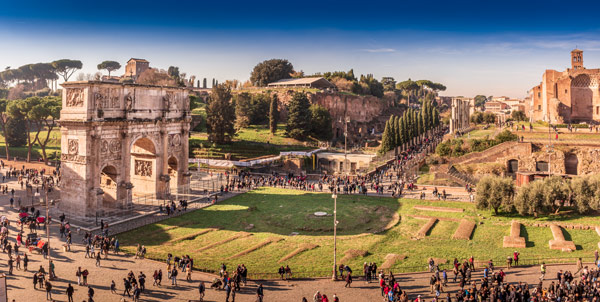
It’s known that victory parades would begin at the Field of Mars (Campus Martius) and move toward the sacred boundaries of the city. The procession would pass through the Triumphal Gate, continue past the Flavian Amphitheater (Anfiteatro Flavio) and the Circus Maximus (Circo Massimo), then proceed to the Arch of Titus (Arco di Tito) along the Sacred Way (Via Sacra), through the Roman Forum (Forum Romanum), and finally ascend the Capitoline Hill (Monte Capitolino) to the Temple of Jupiter, where sacrifices were made in thanks for victory.
Constantine I aimed to have his triumphal arch completed in time for the tenth anniversary of his reign. Construction began in 312 AD and was finished in 315. Recent studies suggest that a structure already existed on this site during the reign of Emperor Hadrian (Publius Aelius Traianus Hadrianus, 76–138 AD). The rapid construction of Constantine’s Arch may have been possible due to the reuse of the earlier foundation.
Architecture
The massive size and three-arch layout of the Arch of Constantine give it a monumental presence, while its proportions — aligned with the golden ratio — offer a harmonious balance.
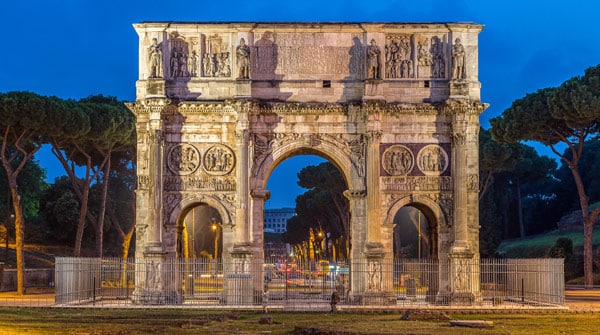
Its design mirrors the Arch of Septimius Severus (Arco di Settimio Severo) in the Roman Forum — featuring a nearly square shape, triple archways, columns on tall pedestals, and depictions of winged Victories on the central vault’s ceiling.
The arch’s dimensions are impressive: 21 m (69 ft) high, 25.9 m (85 ft) wide, and 7.4 m (24 ft) deep. Each side is adorned with four Corinthian columns made from yellow Numidian marble (sourced from North Africa). The facades are clad in white marble, much of it repurposed from older monuments.
It is believed that the two side arches were added onto an existing central structure.
Inscriptions
On the attic of the Arch of Constantine, both the southern and northern sides bear identical dedicatory inscriptions, originally formed with bronze letters:
“To the Emperor Caesar Flavius Constantine the Great, pious and fortunate Augustus: the Senate and People of Rome dedicated this exceptional arch, inspired by the divine, and by the greatness of his mind, he used his army to save the state with righteous force of arms from the tyrant and his followers.”
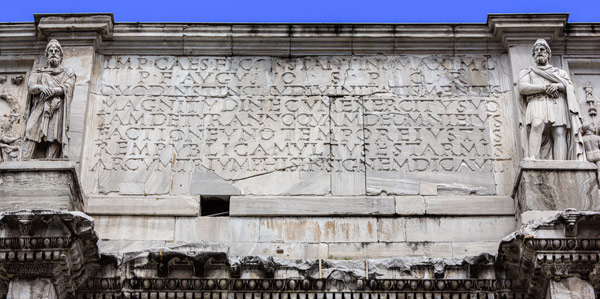
The inscription on the eastern side of the arch commemorates the tenth anniversary of Constantine’s reign, while the western inscription honors Pope Clement XII (Clemens PP. XII), who initiated restoration work on the ancient monument in 1731.
Artistic Decoration
The decoration of the Arch of Constantine is a unique blend of decorative elements from various periods of Late Antiquity, primarily from the reigns of the great emperors Trajan (Marcus Ulpius Nerva Traianus), Hadrian, and Marcus Aurelius (Marcus Aurelius Antoninus). Sculptures and reliefs that survived the great fires of Rome in 283 and 307 AD found new life adorning the facades of Constantine’s Arch.
Check out more about the emperors of Ancient Rome.
Sculptures
One of the more curious elements of the arch’s decor is the inclusion of 8 statues depicting captured barbarian Dacians.
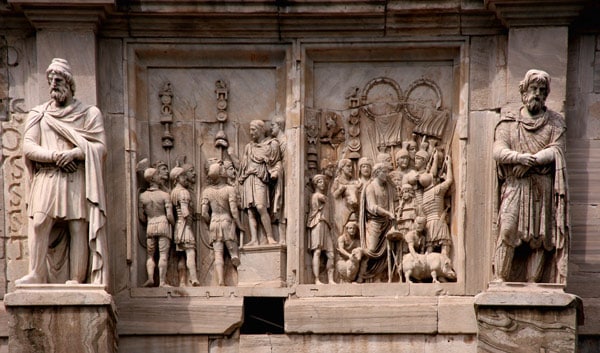
These figures are placed atop the pedestals crowning each column on the arch’s façade and appear surprisingly dignified for representations of captives. It’s possible the sculptor chose to depict Dacian leaders rather than mere prisoners of war.
Originally, these statues decorated Trajan’s Forum and commemorated the emperor’s victories over the Dacians during the wars of 101–102 and 105–106 AD.
The figures are carved from the rare pavonazzetto marble, notable for its colored veining and purplish streaks. Named after the Italian word for “peacock” (pavone), this marble was quarried in Docimium (modern-day Turkey) and widely used in the columns, floors, and sculptures of Trajan’s Forum.
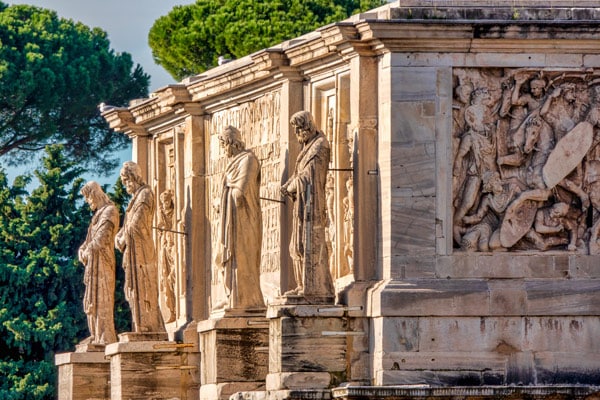
In 1534, the statues were decapitated when their heads were knocked off and stolen. During the 1731 restoration commissioned by Pope Clement XII, the sculptures were finally repaired.
The missing heads and arms, along with one entire figure in white marble, were fully reconstructed in 1742 by the renowned sculptor Pietro Bracci.
Attic Reliefs
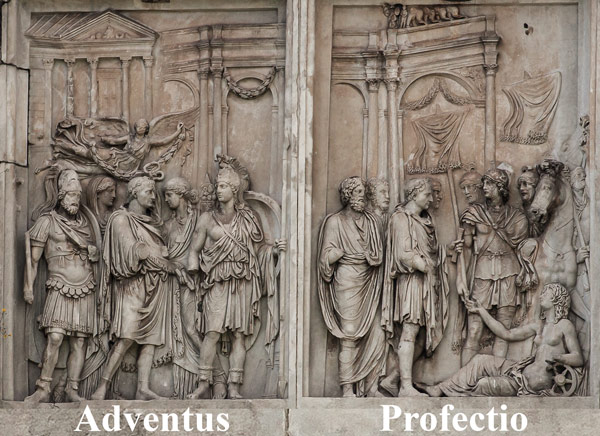
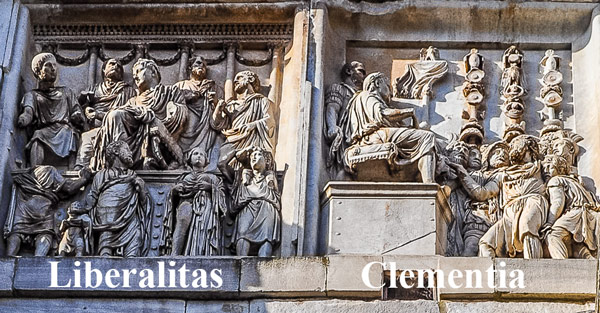
The attic of the Arch of Constantine is adorned with eight reliefs depicting scenes from the triumphs of Marcus Aurelius over the Germanic and Sarmatian tribes between 169 and 175 AD.
Northern Side
From left to right, the following scenes are presented:
- Adventus – the ceremonial entry of the victor into the city. The emperor is shown surrounded by allegorical figures symbolizing victory—soaring Victory, the goddess Roma, and Mars. In the background, the outlines of the Temple of Fortuna on the Via Lata in the Campus Martius can be seen. Today, the ruins of this temple can be visited at Largo di Torre Argentina, near the famous cat sanctuary.

- Profectio – the ceremonial departure of Marcus Aurelius for war. The reclining figure at the emperor’s feet symbolizes the Via Flaminia, giving him a blessing for the journey. The bearded figure behind him represents a genius (genius), a guardian spirit in Roman mythology. If you look closely at the background, you can spot the Arch of Domitian and a quadriga drawn by elephants atop it.
- Liberalitas – an act of generosity. Upon returning from war in 176 AD and wishing to gain the people’s favor, the emperor distributes money and goods, demonstrating his virtue. The dots surrounding the female figure—symbolizing Generosity—represent ancient Roman coins and typical gifts such as oil, bread, meat, wine, and salt.

- Clementia – a display of mercy. Marcus Aurelius, seated on a campaign chair, shows clemency (granting life) to defeated enemies, likely a Germanic chieftain and his son. In the upper right square, three standards—signa (signum)—are depicted. These military insignias were used to distinguish Roman army units. The disks strung along the pole represent phalerae, honor badges that were the predecessors of modern medals, orders, and military awards.
Southern Side
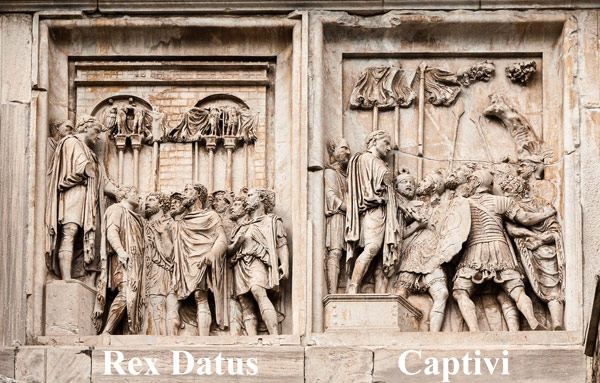
The reliefs on the southern side of the arch are equally fascinating:
- Rex Datus – the presentation of a barbarian king. Marcus Aurelius is shown granting authority in a province to a Germanic chieftain—once an enemy, now an ally. Behind the emperor stands his ally and son-in-law, Tiberius Claudius Pompeianus. In the background, a Roman military camp is depicted.

- Captivi – captives before the emperor. Roman legionaries bring a bound barbarian leader to Marcus Aurelius and Pompeianus, his hands tied behind his back.
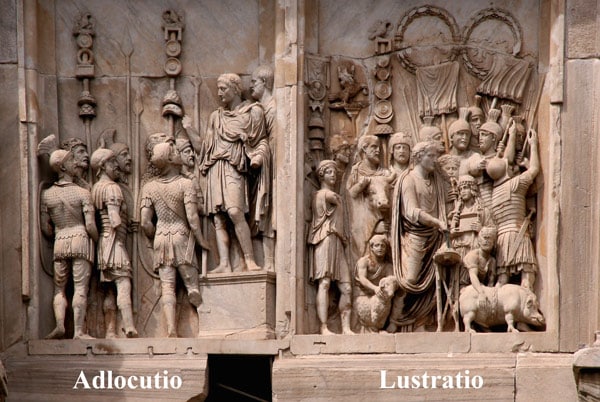
- Adlocutio – the emperor inspires his troops with a speech before heading into battle. The relief is rich in details of the legionaries’ attire, including scale armor and segmented cuirasses.

- Lustratio – purification through sacrifice. This complex composition shows the ancient ritual of the suovetaurilia, a triple offering to the god Mars involving the sacrifice of a bull, a pig, and a ram. The solemn ritual was believed to cleanse and protect the fields, the city, and the people in times of looming calamity.
Reliefs on the Lateral Walls and Inside the Central Arch
The reliefs on the side walls and inside the central arch originally formed part of a frieze that once decorated a large monument on Trajan’s Forum.
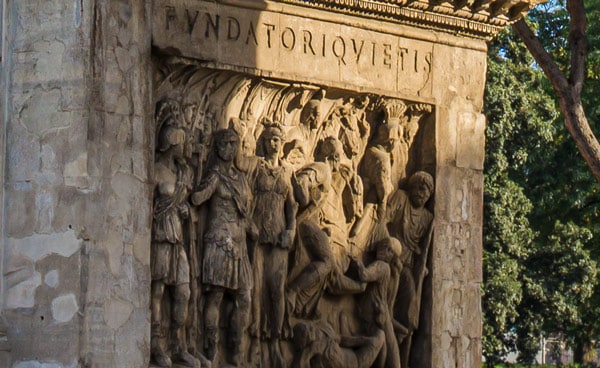
These stone panels were carved from Pentelic marble, quarried in Greece, the same material used for the construction of the Acropolis in Athens.
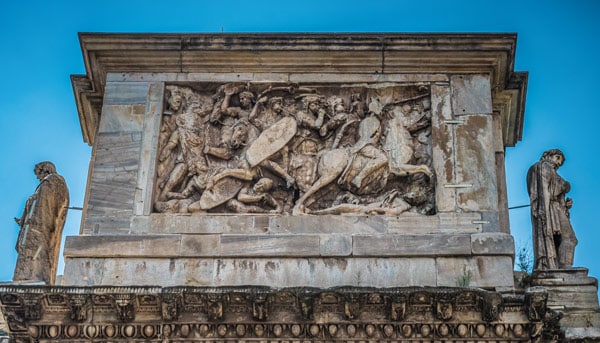
The scenes on the eastern and western sides depict moments from the Dacian Wars, with Trajan shown galloping on horseback—symbolizing the liberator of the city—surrounded by the goddess Roma and Victory, representing the bringer of peace.
Tondi
Images framed within a circular shape are known as tondi (tondo), from the Latin word tondere, meaning “to round off.”
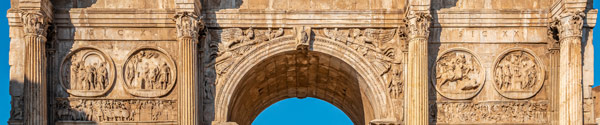
The Arch of Constantine is decorated with several such elements, which create a continuous visual rhythm around the structure, adding a sense of softness and even a musical flow to the composition.
The tondi above the lateral archways, each with a diameter of 2.4 m (7.9 ft), date back to the time of Emperor Hadrian. They depict hunting scenes—of lions and bears—as well as sacrificial rituals dedicated to the gods Apollo, Hercules, Silvanus, and Diana.
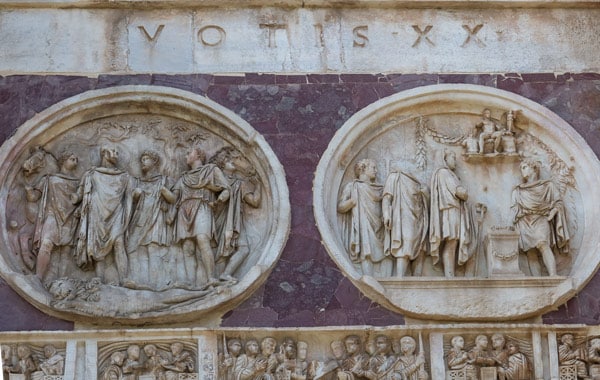
It is clear that the original heads of Hadrian were replaced during the construction of the arch with portraits of Constantine, Constantius Chlorus (Flavius Valerius Constantius), and Licinius (Flavius Galerius Valerius Licinianus Licinius).
The tondi on the side surfaces of the arch belong to Constantine’s era and symbolize his triumph within a cosmic framework.
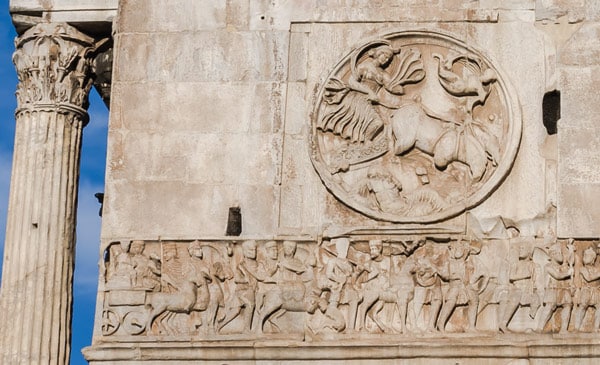
On the eastern side, the Sun is depicted as Apollo rising from the sea in a chariot, while the western side features the Moon personified as Diana, descending into the waves.
Frieze
The lower part of the Arch of Constantine is framed by a frieze dating back to the time of its construction. From an artistic point of view, the reliefs in this decorative section are significantly inferior to the earlier classical fragments and may even appear primitive.
The main value of this stone panel lies in its numerous details reflecting the era of Constantine, as well as its artistic style that bridges ancient and medieval art.
The relief presents a panoramic sequence of events that begins on the western side of the arch.
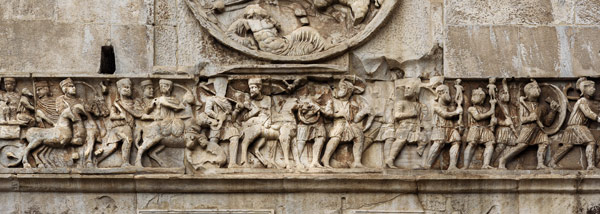
The central theme is the deeds and victories of Constantine.
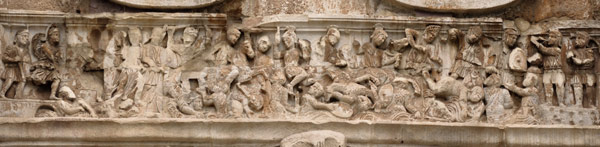
The scenes show the emperor departing from Milan in a chariot, the siege of Verona, the Battle of the Milvian Bridge, his triumphant entry into Rome after defeating Maxentius, and acts of virtue and generosity.
The relief on the eastern side is badly damaged—and the identity of the culprit is actually known.
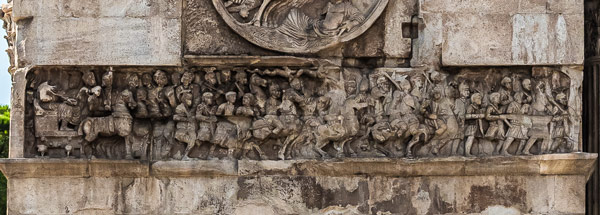
Italian writer Lorenzino de’ Medici, famously known as Lorenzaccio and celebrated for his opposition to tyranny, as a defiant act against his uncle Pope Clement VII (Clemens PP. VII), destroyed the heads of Constantine on the arch. For this offense, the noble-born rebel was expelled from Rome in 1530. He wandered through Europe for years before being assassinated in Venice by hired killers.
Other Reliefs
The reliefs at the base of the columns belong to the time of Constantine. Their main figures include the goddess of victory Victoria, Roman soldiers, and prisoners of war.
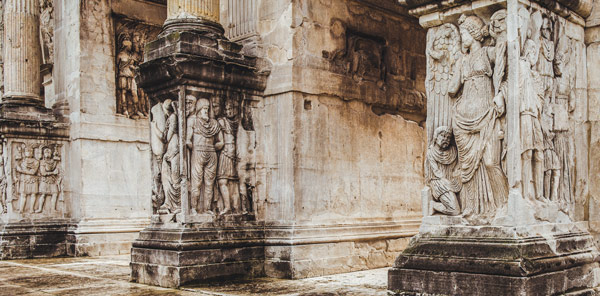
From the same period come the reliefs in the spandrels of the main arch, where you’ll find winged Victories holding trophies and putti representing the seasons. The spandrels of the side arches are decorated with river gods.
The Arch of Constantine remains one of the most vivid symbols of the Roman Empire’s grandeur. This ancient monument even became part of modern Olympic history in 1960.
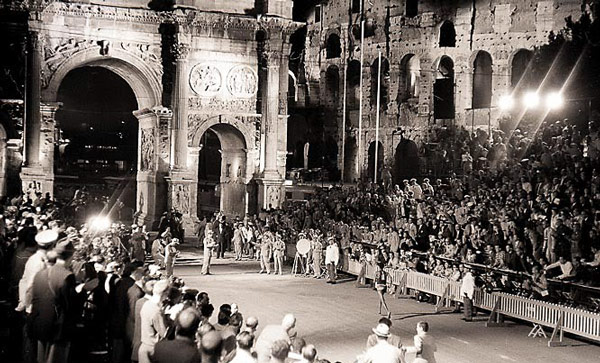
It was the finish line for the historic marathon victory of Ethiopian runner Abebe Bikila, who famously completed the race barefoot. Running enthusiasts may enjoy reading about the traditional Rome Marathon.
How to Get There
The Arch of Constantine is located right next to the Colosseum and the Roman Forum. The nearest metro station is Colosseo on Line B. Tram line N3 also stops nearby and runs directly from Roma Trastevere station.
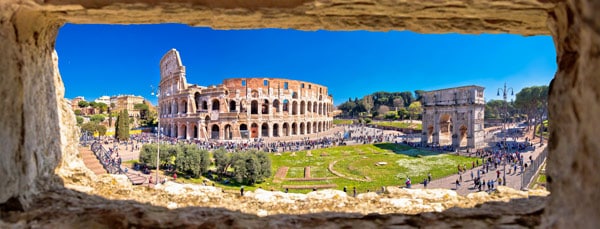
You can also reach the arch on foot. It’s a 20-minute walk from the Altar of the Fatherland (Il Vittoriano) along Via dei Fori Imperiali, and only 10 minutes from the Circus Maximus.