 Italy for me From Italy with love


The Tiber (Latin: Tiberis; Italian: Tevere) has been a symbol of Rome since the days of the Great Empire.
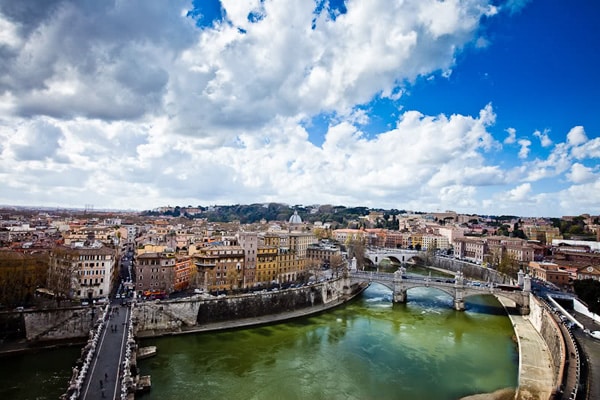
The winding river wraps around the famed hills of the Italian capital, gently outlining the silhouette of the Trastevere district. The shimmering waters are surrounded by remnants of ancient and medieval architecture. Dozens of bridges connect the Tiber’s left and right banks, imbuing Rome’s landscapes with undeniable romance.
Page Contents
Geography
The Tiber originates in the Apennine slopes of the Emilia-Romagna region. This full-flowing mountain river winds its way through Umbria and Lazio before reaching Rome. It is fed by tributaries such as the Nera and Aniene rivers. As it nears Rome, the Tiber is flanked by concrete embankments, and throughout the city it flows in a canal known as the Fossa Traiani. The river ultimately empties into the Tyrrhenian Sea (Mar Tirreno).
With a total length of 252 miles (406 km), the Tiber ranks as Italy’s third-longest river. Its drainage basin covers 6,708 square miles (17,375 km2). For Rome, the Tiber has long been a vital source of water. Italians often refer to the river by its Latin nickname, “flavus,” meaning “blond” or “white.” This name derives from the river’s yellowish-white hue.
Name
There are several theories about the origin of the name “Tiber.” One suggests that “Tiber” predates Latin, stemming from the personal name “Tibur,” the ancient name of the town of Tivoli, located 18.6 miles (30 km) from Rome. References to the river also appear in Etruscan writings as “Tiferios,” which may have evolved into “Tiber” in the Italian language.
The river’s history wouldn’t be complete without legend. King Tiberinus, who lived in the 9th century B.C., was said to have drowned in the Albula River, which was later renamed Tiberis in his honor. According to myth, Jupiter transformed the deceased king into the river god Volturnus. Thanks to this ancient tale, rivers, seas, and oceans in sculpture have been traditionally portrayed as powerful, bearded men.
History
The Tiber is the very river where, according to legend, the infant twins Romulus and Remus, founders of Rome, were cast adrift to drown.

Historians believe that Rome was founded around 753 B.C. on the banks of the Tiber, about 15.5 miles (25 km) from the coast near Ostia (Latin: Ostia Antica). In ancient times, the river served as a natural boundary between the Etruscans to the west, the Sabines to the east, and the Latins to the south.
The river played a major role in the lives of the Romans, who built their economy around trade along its waters. Merchants brought food supplies, construction materials, and other goods into the capital by boat. During the Punic Wars in the 3rd century B.C., the port at Ostia was of critical importance to naval battles. As a result, Rome gained strategic military dominance as well.
Later, a large wharf was built along the riverbank near the Field of Mars (Latin: Campus Martius). And during the construction of Rome’s central sewage system, the Cloaca Maxima, the Tiber became a key component. Through underground tunnels and pipes, clean water was distributed to the city center.
Over time, the river shallowed, and Rome’s port and maritime trade shifted to nearby Fiumicino. In the 17th and 18th centuries, the papacy undertook significant efforts to clean the river within the city limits. These actions improved the river’s environmental health, though little changed in terms of transportation, as river freight had lost much of its former importance.
Interesting Facts
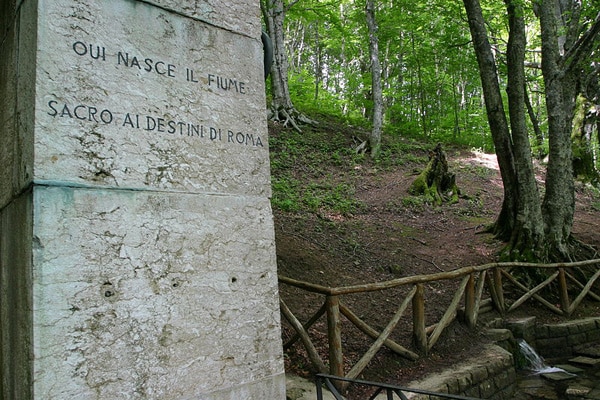
- The Tiber originates from two mountain springs located at an altitude of 4,160 feet (1,268 meters) above sea level. In 1930, Benito Mussolini placed an ancient marble column at the river’s source. The obelisk bears a Latin inscription meaning: “Here is born the river / sacred to the fate of Rome.”
- One of the river’s defining features is its frequent flooding. The Campus Martius area, for example, was often submerged by up to 6.5 feet (2 meters) of water. Since 1876, Romans have lived in relative safety thanks to the construction of high stone embankments along both sides of the Tiber.
- Another curious fact relates to the river’s name: the phrase “to cross the Tiber” means to convert to Catholicism. Similarly, “to cross the Thames” implies adopting English customs. During periods of religious conflict, such idioms carried significant weight.
- In the days of Ancient Rome, public executions were carried out by drowning in the Tiber. Under Emperor Tiberius, the condemned were led to the Gemonian Stairs (Scale Gemonie) and then thrown into the deep river. Not only common criminals met this grim fate—early Christian pontiffs did as well.
- Romans love a brisk dip in cold water. Every January 1, brave—if not reckless—locals leap from the Cavour Bridge (Ponte Cavour) into the Tiber, cheered on by a boisterous crowd!
- The riverfront is ideal for morning and evening jogs or cycling adventures.
Bridges
In Rome, the Tiber River’s left and right banks are connected by 26 bridges. Alongside the newer ones, several ancient structures have also stood the test of time.
- The Milvian Bridge (Ponte Molle) was built in the 1st century B.C. to extend the Via Flaminia and connect Rome to Ariminum (modern-day Rimini). In the 4th century A.D., a major battle took place at the Milvian Bridge between Emperors Maxentius (Latin: Maxentius) and Constantine the Great (Latin: Constantinus). It was not just a struggle for power, but also for religious supremacy. The defeated Maxentius drowned in the Tiber, while Constantine (read more about his Triumphal Arch) moved closer to becoming the sole emperor of Rome. Thus began the era of Christianity. Today, the Olympic Stadium (Stadio Olimpico), home to Roma and Lazio football clubs, is located near the Milvian Bridge.
- Ponte Sisto is a pedestrian bridge connecting the right bank of the Tiber to the Trastevere district. This medieval stone bridge, named after Pope Sixtus IV, offers a picturesque backdrop against the old riverside promenade. On the left bank, just past the bridge, lies Piazza Trilussa — a popular gathering spot for locals and visitors to Trastevere. From July to August, the Tiber promenade by Ponte Sisto comes alive with food stalls, cocktails, and live music. Everyone is welcome to join the lively evening scene or browse the vendors.
- South of the Vatican (Vaticano), a small island appears in the river — Tiber Island (Isola Tiberina). From above, it resembles a fishing boat. Around the year 1000, the Basilica of Saint Bartholomew (Basilica di San Bartolomeo all’Isola) was built on the island, where the tomb of Saint Bartholomew resides. If you cross the Tiber via the island, you’ll arrive on the right bank at one of Rome’s curious landmarks — the Mouth of Truth (Bocca della Verità).
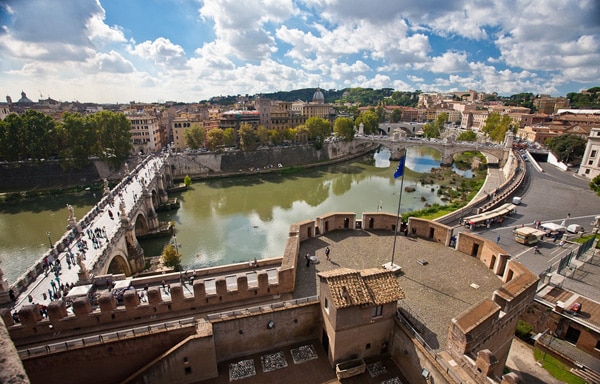
- The Bridge of Angels (Ponte Sant’Angelo) dates back to the 2nd century A.D. and is used exclusively for pedestrian traffic. In ancient times, the bridge was named after Emperor Hadrian, as it was constructed by his order. The bridge leads to Hadrian’s Mausoleum, which in the Middle Ages became known as the Castle of the Holy Angel. This massive stone cylinder houses the remains of Christian pontiffs and countless ancient relics. In the 15th–16th centuries, the marble bridge was adorned with statues of Saints Peter and Paul. In the 17th century, Gian Lorenzo Bernini (Giovanni Lorenzo Bernini) added 10 angel statues to complete the decoration.