 Italy for me From Italy with love


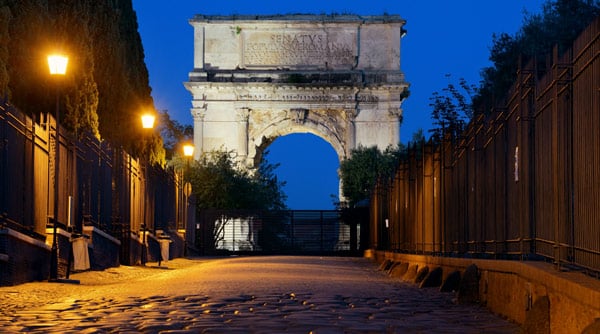
Arco di Tito (Arch of Titus) is a monumental structure of Ancient Rome, erected in 81 AD to commemorate Emperor Titus’s (Titus Flavius Caesar Vespasianus Augustus) victory in the Jewish War of 66–71 AD, also known as the Jewish Revolt against Roman rule.
This architectural monument immortalizes the triumph of an emperor who reigned for just two years, yet secured a lasting place in history thanks to his lineage from the distinguished Flavian dynasty and his military campaign that ended with the destruction of Jerusalem.
This landmark stands at the highest point of the ancient Via Sacra (Sacred Road), offering panoramic views of the Colosseum (Colosseo), the Roman Forum (Foro Romano), and the Arch of Constantine the Great (Arco di Costantino).
Page Contents
The Tradition of Erecting Arches
The tradition of building monumental arches and associating them with the triumphs of victors and significant events originated in Ancient Rome. It was first established by Emperor Augustus (Octavianus Augustus), who in 29 and 19 BC constructed two triumphal arches in the Roman Forum (though neither survives today).
Before the era of the Roman emperors, the custom of building arched structures already existed in Etruria and the states of the Near East, where it was connected to religion or mythology.
According to prevailing beliefs, an army could not enter a peaceful city until it had been cleansed of the blood of war. Gates were often erected at city entrances or at important crossroads to symbolically leave behind the “dead field” of battle and mark the boundary between life and death.
The Romans redefined the function of these sacred constructions and began erecting grand stone arches in honor of military victories by generals and rulers. The arch’s curve was seen as a celestial rainbow, and walking beneath it symbolized the rising of a divine light or deity—an association applied to the emperors themselves.
You might enjoy reading about Ancient Roman Gods and Goddesses.
What Event Was It Dedicated To?
The single-arch monument, dedicated to the triumph of Titus, was erected after the emperor’s death by order of Domitian (Titus Flavius Domitianus), the last member of the Flavian dynasty. The Roman victory in the First Jewish War was a significant moment in Ancient Roman history, and the moral echoes of that event still resonate today.
The Jewish revolt against Roman rule broke out in Judea (in the lands of present-day Israel) in 65 AD. In 67 AD, a massive Roman army led by Vespasian (Titus Flavius Vespasianus) was sent to suppress the uprising, with his eldest son Titus fighting by his side. When Vespasian returned to Rome in 69 AD to become emperor, Titus remained in Judea to conquer Jerusalem and bring the war to an end.
The war brought humiliation and enormous loss of life to one side, and glory and riches to the other. Titus returned to Rome in triumph, publicly displaying around 700 prisoners and the lavish treasures looted from Herod’s Temple.
Not all sons of Israel were executed; many Jewish slaves were used in the construction of the Colosseum, and some went on to form the first Jewish diaspora.
To Whom Was It Dedicated?
Titus became emperor in 79 AD, immediately following the death of his father, Vespasian. This marked the first time in Roman history that power passed directly from father to son. His reign, however, was brief — he died of a fever in 81 AD. During his short time on the throne, he witnessed two major disasters that struck the empire: the Great Fire of Rome (80 AD) and the eruption of Mount Vesuvius (79 AD). Still, Titus earned fame as an ideal ruler, remembered for his generosity, kindness, and liberal policies.
No death sentences were issued during his reign, earning him the title “amor et deliciae generis humani” — “the love and delight of the human race.” He strengthened the empire and died at the height of his popularity. Naturally, one could speculate that had he ruled longer, some less flattering aspects of his character might have surfaced.
Titus’s personality, even before he assumed imperial power, was controversial. Critics compared him to Nero, accusing him of greed, cruelty, and scandalous relationships with the Egyptian queen Berenice, boys, and eunuchs.
Description
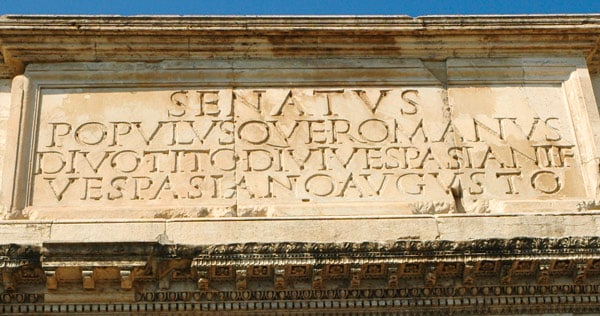
The triumphal arch stands as the most vivid reminder of Emperor Titus and a powerful expression of Roman reverence. This is confirmed by the dedicatory inscription carved above the cornice on the eastern side: *”The Senate and People of Rome to the deified Titus Vespasian Augustus, son of the deified Vespasian.”*
Architecture
The exact architect of the Arch of Titus remains unknown, but based on stylistic elements and comparison with other structures, *some experts attribute it to the Roman architect Rabirius*, who is also believed to have designed the Colosseum.
Rabirius lived in the 1st and 2nd centuries AD and executed several projects commissioned by Domitian, including the Domus Flavia (Palace of the Flavians) on the Palatine Hill (Palatino), and the Alban Villa (Albanum Domitiani) in modern-day Castel Gandolfo.
Ironically, the construction of the monument dedicated to Titus’s triumph was carried out by Jewish captives brought to Rome from Judea.
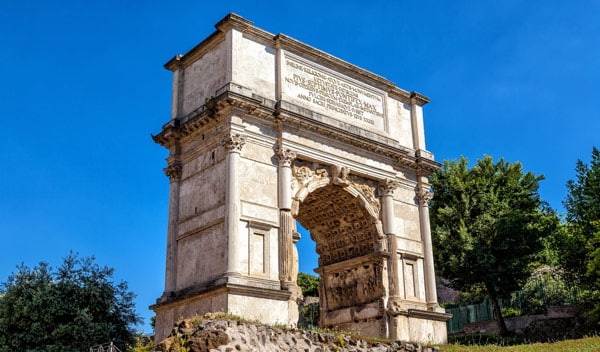
The Arch of Titus differs noticeably from the architectural style of arches built during Augustus’s reign. It is more compact and massive: the total height is 15.4 meters (50.5 feet), width is 13.5 meters (44.3 feet), the single arch spans 8.3 meters (27.2 feet) in height, 4.75 meters (15.6 feet) in length, and 5.33 meters (17.5 feet) in width.
The entablature with its frieze is supported by four engaged half-columns—one of the earliest known examples of the use of the Composite order (ordine composito) in Roman architecture. The arch opening is framed by fluted columns with Corinthian capitals, recessed into the wall.
For the foundation, the ancient architect used travertine, while the rest of the structure was built with Pentelic marble, quarried in Attica and renowned for its brilliant whiteness. The inner core of the arch was made from Roman concrete (opus caementicium), celebrated for its exceptional strength.
Artistic Decoration
The Arch of Titus is remarkable not only for its architecture but also for its artistic and historical value.
It is believed that the arch was once topped with a gilded quadriga—a four-horse chariot—one of the most iconic symbols of imperial triumph.
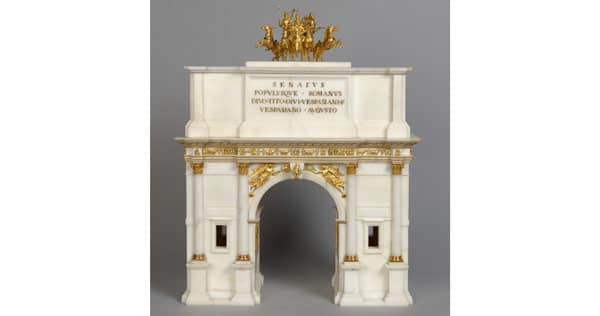
At the top of the arch, in the triangular spandrels, are depicted winged goddesses of Victory. The keystone is adorned with a female figure on the eastern side and a male figure on the western side.
The frieze beneath the dedicatory inscription shows a sacrificial scene—a procession with bulls and a reclining statue representing the river god Jordan.
As you pass through the arch, the coffered ceiling immediately catches the eye. Its centerpiece is the apotheosis of Titus—an image of the emperor ascending into the heavens on the back of an eagle, symbolizing his divine elevation.
The most valuable artistic features are found on the inner walls, where the reliefs depict scenes from the triumphal procession that took place in Rome more than two thousand years ago.
Relief – The Triumphal Procession
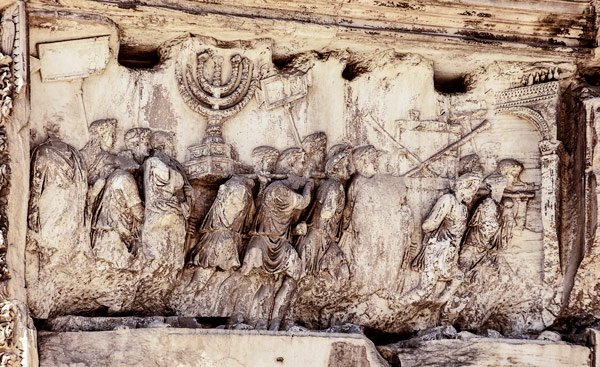
The scene of the triumphal procession on one side of the Arch of Titus’s passage captures the events of 71 AD, when the Romans celebrated their victory in the Jewish War. This detailed relief shows a line of Roman legionaries carrying precious spoils of war. The realism of the figures, their garments, and especially the rare depictions of sacred artifacts from Herod’s Temple is striking.
Trophies
The focal point is the golden seven-branched candelabrum, or Menorah, which later became a symbol of the Jewish diaspora and a part of the modern emblem of the State of Israel. Vespasian placed this sacred Jewish relic, along with other spoils, in the Temple of Peace, also known as the Forum of Vespasian (Forum Vespasiani). Interestingly, Jewish and Christian pilgrims—both of whom regarded the Menorah as a sacred object—were able to approach and even touch it within the temple. The significance of this priceless trophy is reflected in the medieval nickname of the Arch of Titus: *Portico delle Sette Lucerne* (Portico of the Seven Lamps).
The fate of the Menorah is shrouded in mystery. One account claims it sank into the waters of the Tiber River (Tevere) beneath the Ponte Fabricio during a clash between legionaries over the treasure (which included more than 30 kg—or 66 lbs—of pure gold). Another version says the Menorah was stolen and taken from Rome by barbarian invaders in 455 AD, but eventually found its way back to Jerusalem.
Other sacred objects of Judaism depicted on the relief include Silver Trumpets, ritual vessels, and the Table of the Showbread. In the background, Roman soldiers raise placards inscribed with the names of captured treasures and conquered cities.
Relief – Titus in a Quadriga
Of particular interest is the relief on the opposite side of the arch’s interior, where Titus is depicted riding in a chariot.
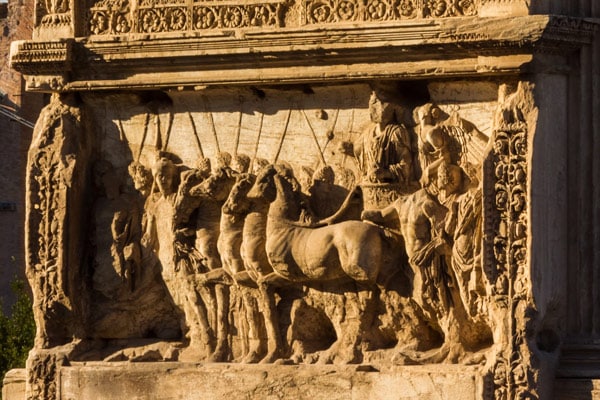
The horses are guided by Roma, the personification of the city itself, while Victoria crowns the victor with a laurel wreath. The procession is accompanied by genii (guardian spirits) and public officials—lictors—carrying fasces, the traditional symbol of authority.
What makes this stone relief unique is its rendering of layered depth, which creates a three-dimensional and almost animated effect. The various planes, life-sized figures, and repeated outlines of horses all combine to convey motion and immerse the viewer in the vivid energy of the historical scene.
What Did the Arch Look Like Before Restoration, During the Middle Ages?
During the Middle Ages, many monuments of Ancient Rome were damaged or outright destroyed. The glorious period of the great empire was replaced by centuries of darkness that cloaked Rome for nearly a thousand years. The Arch of Titus ceased to be a symbol of triumph for the ruler of the largest metropolis of the ancient world and turned into a shapeless ruin.
In the 11th century, the powerful Roman Frangipani family incorporated the arch into their fortress walls, damaging its columns and artistic reliefs in the process.
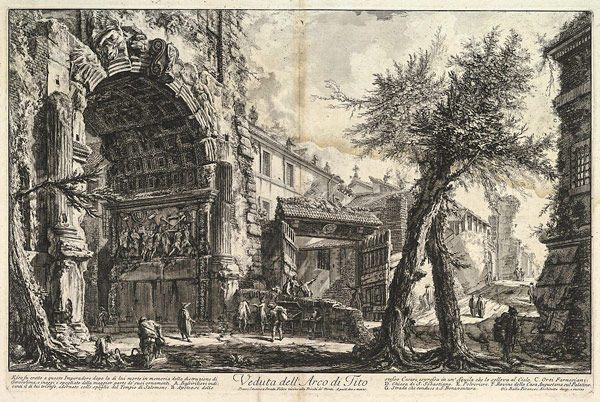
Piranesi’s engraving, along with paintings by Canaletto and Pannini, captured the urban landscape of the 1740s, with the Arch of Titus as a central figure.
In the 16th century, during the papacies of Paul II and Sixtus IV, the ancient monument was incorporated into the structure of the Church of Santa Francesca Romana (formerly known as Santa Maria Nova). The church preserved the arch because it symbolized the destruction of Jerusalem and the suppression of the Jewish people—events that were welcomed by many Christians at the time.
Restoration
The first major restoration of the Arch of Titus took place between 1812 and 1824. By the time work began, much of the structure had already deteriorated—its foundation, columns, and precious reliefs were significantly damaged.
Giuseppe Valadier’s Contribution
The most significant contribution to the arch’s restoration was made by Italian archaeologist and restorer Giuseppe Valadier, who was invited by Pope Pius VII. After removing the medieval masonry, Valadier carefully and faithfully reconstructed the monument’s original appearance. Some differences from the original, however, remain: marble panels were replaced with travertine, and the elaborate column capitals were simplified.
A commemorative inscription on the western side of the arch reads:
*”This monument, remarkable for both religion and art, had weakened with time. Pope Pius VII, supreme pontiff, ordered it restored and preserved with new work in the likeness of the ancient model.”*
The Second Arch
In 2015, archaeologists discovered the remains of a second Arch of Titus at a depth of 3 meters (approximately 10 feet). It had been built in 81 AD in the center of the semicircle of the Circus Maximus (Circo Massimo) and was also dedicated to the Roman victory over the Jews in Jerusalem. Made of Carrara marble, this monument featured three arches and was designed to impress with its grandeur and rich decorations. With the fall of the Roman Empire, the arch slowly crumbled and was forgotten. Its marble blocks were later reused in aqueducts and medieval buildings.
Excavations revealed over 300 column fragments and base slabs. Further research on this second arch will require time and funding, so for now, the remains have been reburied to protect them from further degradation.
The Arch of Titus no longer serves as a reminder of the subjugation of Judea. Today, it stands as a magnificent architectural monument that brings Ancient Roman history to life and makes the present more vivid and engaging.
The Arch of Titus served as a model for many triumphal structures in later eras, inspiring the construction of the Arc de Triomphe in Paris, the Narva Triumphal Arch in Saint Petersburg, Wellington Arch in London, and even the Gateway of India in New Delhi.