 Italy for me From Italy with love

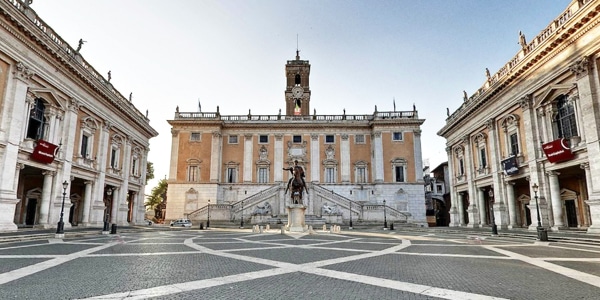
In Italian, Capitoline Hill is called Monte Capitolino—the Capitoline Hill. It is the gentlest of the seven hills on which Rome was built. The hill stands 151 feet (46 meters) tall.
At its summit lies Piazza del Campidoglio, in the center of which stands a bronze statue of Marcus Aurelius. Around the square, you’ll find the Palazzo Senatorio (Senatorial Palace), Palazzo dei Conservatori (Palace of the Conservators), Palazzo Nuovo (New Palace), and the Basilica of Santa Maria in Aracoeli.
Page Contents
History
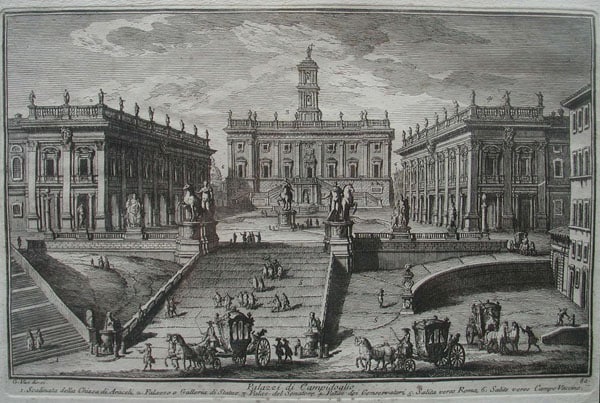
In Ancient Rome, the Senate gathered on Capitoline Hill, and the state archive building, the Tabularium, was located here.
In the 5th century BC, the Capitoline Temple was built in honor of the three main gods of Ancient Rome: Jupiter, Juno Moneta, and Minerva. Some of these structures were burned and looted, while others were rebuilt or repurposed. Over time, the square fell into decay, and by the 5th century AD, goats had grazed around it.
Capitoline Hill was revitalized in 1536 thanks to the arrival of King Charles V of Spain in Rome. Pope Paul III, as the host of the city, was simply ashamed of the sorry state of the Capitoline. The project was entrusted to Michelangelo Buonarroti, the most famous artist and architect of the time. Unfortunately, he only managed to realize a small portion of his plans. After Michelangelo’s death, his students took over the restoration, and the square attained its final form, which we still see today, in 1654.
Architecture
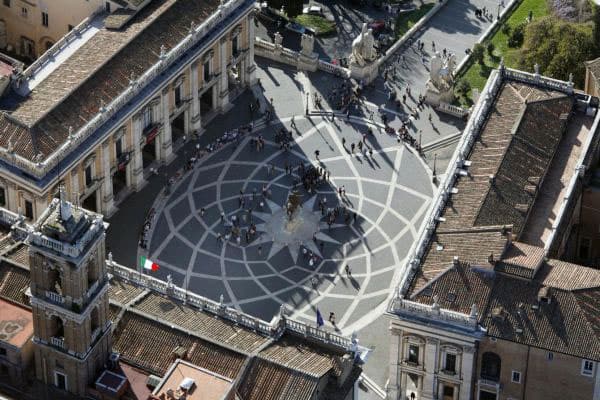
From a bird’s eye view, the square has a trapezoidal shape, which Michelangelo designed to make it visually open to the city and its visitors.
At the head of the square is the Palazzo Senatorio, with the Palazzo dei Conservatori and the Capitoline Museum (Musei Capitolini) flanking the sides. Marble representations of the Tiber and Nile Rivers are located on either side of the square. The entire ensemble is filled with hidden allusions to various events and figures. Art historians who study Michelangelo’s work continue to decipher his concealed messages. Perhaps you might unravel one when you visit Rome.
Palazzo Senatorio
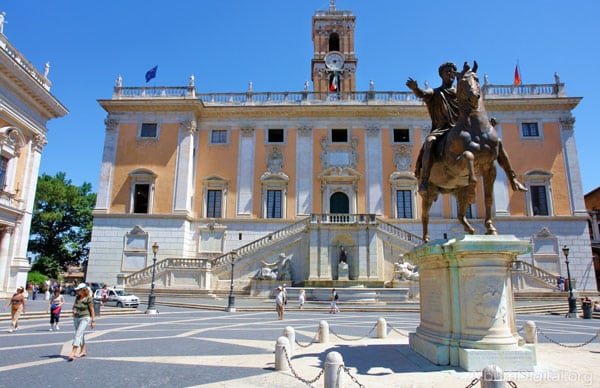
Built in the 1st century BC, Palazzo Senatorio originally served as an archive but stood abandoned for much of the Middle Ages, gradually falling into ruin. It was given new life during the reconstruction of the entire square. Today, it houses the city hall, so most of the building is not open to the public. Visitors can, however, access the Lapidarium, a museum dedicated to inscriptions on stone tablets that tell stories of life and politics in Ancient Rome, as well as the ancient underground corridors of the Tabularium.
Palazzo dei Conservatori
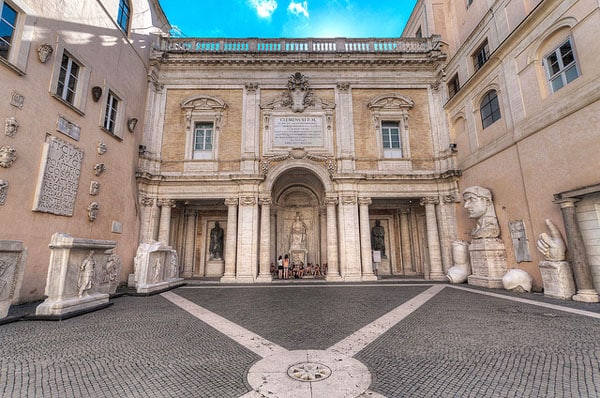
Built in the 15th century, Palazzo dei Conservatori served as a meeting hall for senators and judges called “conservatori,” which is how it got its name. It now houses a museum of marble busts from Ancient Rome, frescoes, and a Pinacoteca featuring works by Rubens, Velázquez, and Caravaggio.
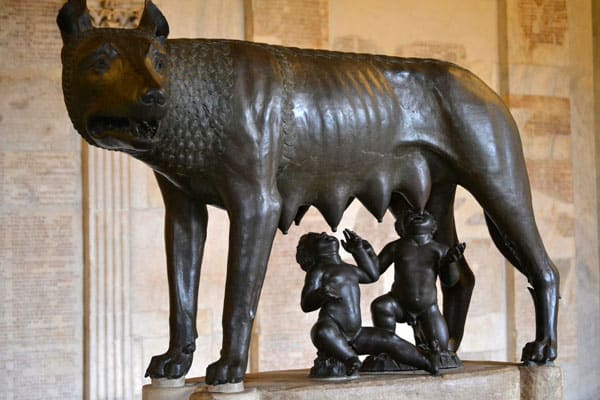
A separate room is dedicated to the famous Capitoline Wolf, the symbol of Rome.
In the Castellani Hall, you can see Etruscan and Greek artifacts, while the Capitoline Coin Museum displays collections of coins and jewelry.
Palazzo Nuovo
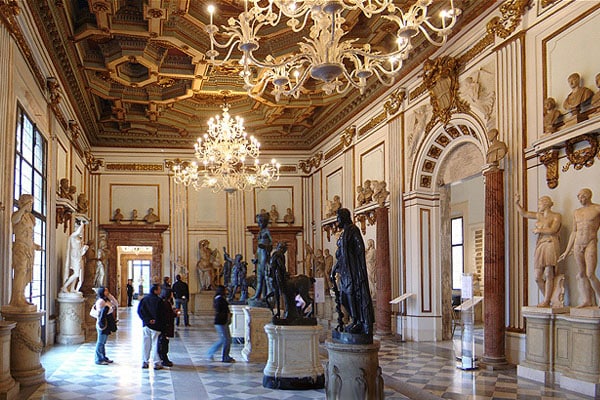
As its name suggests, Palazzo Nuovo is the newest building in the entire architectural ensemble. Built-in the 17th century, it was designed as a replica of the Palazzo dei Conservatori and was initially intended to be a museum. In its long galleries and atrium, you can admire ancient Greek and Roman sculptures.
The three palaces mentioned above are part of the Capitoline Museum. The exhibitions share the same operating hours and can be visited with a single ticket.
- Hours: Tuesday to Sunday, 9:00 AM to 8:00 PM.
- Ticket price: Full ticket — €18, reduced — €13.
Basilica of Santa Maria in Aracoeli
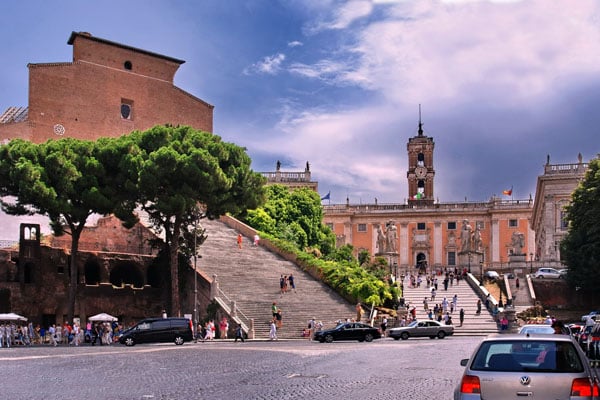
The Basilica of Santa Maria in Aracoeli was built on the site of a pagan temple dedicated to Juno Moneta. Initially, it was a Greek monastery, but it later came under various monastic orders, including the Benedictines and Franciscans, who completed and consecrated it in 1921. Highlights include the carved wooden ceiling, the 13th-century icon of the Madonna on the altar, and a sculpture of the Christ Child, which is believed to have miraculous powers.
- Hours: Daily, 9:00 AM to 5:30 PM.
- Entrance: Free.
Interesting Facts
- The statue of Marcus Aurelius was saved during the Christian purge of pagan artifacts, mainly because his face resembled that of Constantine. The statue’s pedestal was made from a column of the Temple of Castor and Pollux. The Capitoline Venus in the Palazzo Nuovo nearly faced a similar fate, but Roman citizens hid it from destruction. The statue wasn’t rediscovered until the 17th century.
- Coins were once minted on the grounds of Juno Moneta’s temple. The goddess was depicted on the newly struck coins, and from her name, the word “Moneta” (money) spread across the world.
- According to legend, the statue of the Capitoline Wolf was cast by the Etruscans in the 5th century BC, but during its restoration in 2010, experts concluded that it couldn’t have been produced in that period but only in the Middle Ages.
How to Get There
- Address: Piazza del Campidoglio
- Capitoline Hill is a 20-minute walk from the Colosseum, near the Roman Forum and Piazza Venezia.
- By Metro: Line B, Colosseo station.
- By bus: No. 30, 51, 81, 83, 85, 87, 118, 160, 170, 628, 810 to Ara Coeli-Piazza Venezia stop.
- By tram: No. 8 to the Venezia stop (end of the line).
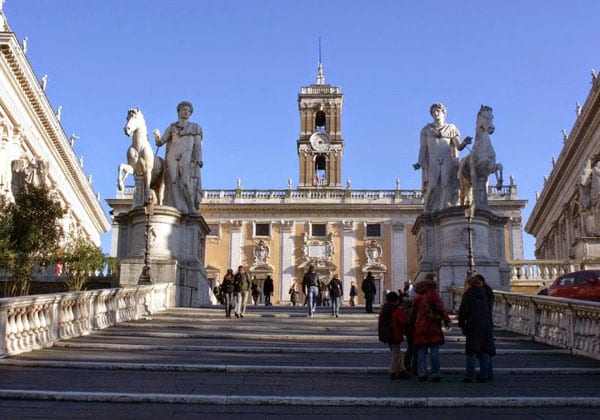
- For pedestrians: You can climb up the stairs by Lorenzo di Simone Andreozzi, but be prepared for a steep ascent. The main staircase of the Cordonata complex is much more convenient and is designed as a stepped ramp. To avoid crowds of tourists, head slightly to the right and find a modest, gentle staircase with a pergola that locals use for a more comfortable, shaded climb.
- Official website: https://www.comune.roma.it