 Italy for me From Italy with love


The majestic Palazzo Farnese is considered one of the most beautiful buildings in Rome, long revered as a model of Renaissance palace architecture.
This luxurious architectural monument from the Renaissance era impresses with its monumental presence and elegant simplicity of form. Although for over a century the palazzo has served as the administrative building of the French Embassy and is not fully open as a tourist site, visitors can still access it through guided tours, which are available by advance reservation.
Curious travelers visiting the “Eternal City” should not miss the chance to tour the palace and witness a true masterpiece created by Italy’s finest artisans.
Page Contents
History of Construction
Construction of the palazzo began around 1513–1514, commissioned by Alessandro Farnese. Though not yet ordained, he received the title of cardinal and was appointed bishop of three dioceses, a rise believed by contemporaries to be aided by his sister, Giulia Farnese, who was romantically linked to Pope Alexander VI (Rodrigo Borgia).
In 1527, construction was halted due to the sack of Rome by Emperor Charles V’s forces. Over time, Cardinal Farnese’s ecclesiastical career peaked, and in 1534 he ascended to the papacy as Pope Paul III. This prompted a major redesign of the palazzo to expand its size and reconfigure its layout. The palace’s grandeur and luxurious interiors were intended to symbolize the power, wealth, and prestige of the Farnese family.
Construction resumed in 1541, and after the death of Antonio da Sangallo the Younger five years later, the work was taken over by the renowned artist Michelangelo Buonarroti.
Michelangelo added a projecting cornice to the central facade, which was finished in golden brick with white travertine accents. He also introduced other design changes, such as decorating the windows with marble columns and installing a grand doorway crowned by the Farnese family crest above the central balcony. Michelangelo’s vision also expanded the building to three stories on the inner courtyard side.
The next phase was overseen by Giacomo da Vignola, who also designed the Villa Farnese in Caprarola. His contributions included the design of the rear facade facing Via Giulia.
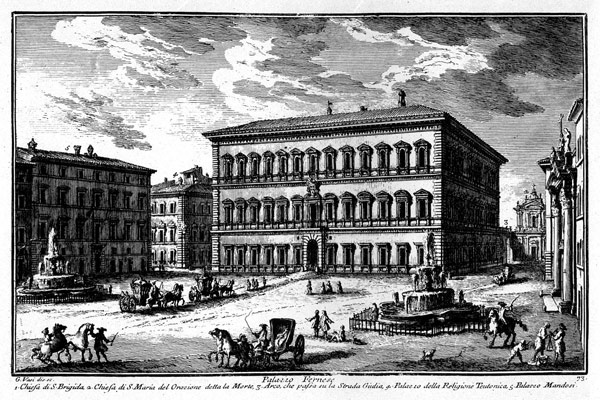
In the early 1590s, nearly 75 years after construction began, the palace finally reached completion thanks to the efforts of Giacomo della Porta. A celebrated architect and sculptor, and a leading figure of the Mannerist movement, della Porta was invited by Cardinal Alessandro Farnese, a renowned patron of the arts and the grandson of Pope Paul III.
Interior Decoration
The Farnese family were great patrons of the arts and sciences. Their private collection included ancient sculptures, artworks crafted from precious metals and gemstones, as well as paintings by Renaissance masters. A significant portion of this collection, originally assembled by Pope Paul III, is now housed in the National Archaeological Museum of Naples (Museo Archeologico Nazionale di Napoli).
Cardinal Odoardo Farnese played a major role in the history of the palazzo. In 1597, he invited the Bolognese painter Annibale Carracci to Rome and commissioned him to decorate the palace’s interiors with elaborate frescoes.
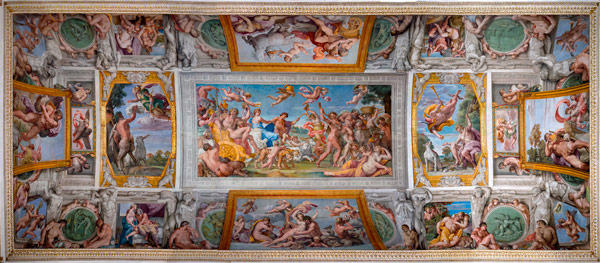
The series of mythological wall frescoes, titled “The Loves of the Gods,” was intended to celebrate the dynastic marriage between the fourth Duke of Parma, Ranuccio I Farnese—a great-great-grandson of Pope Paul III—and Margherita Aldobrandini, a grandniece of Pope Clement VIII. This union, which followed lengthy negotiations, had immense political significance, as it aimed to strengthen ties between the Holy See and the Duchy of Parma (Ducato di Parma).
The artistic decoration of Palazzo Farnese took more than seven years to complete. Annibale worked alongside his elder brother Agostino Carracci and their pupils Giovanni Lanfranco and Domenichino.
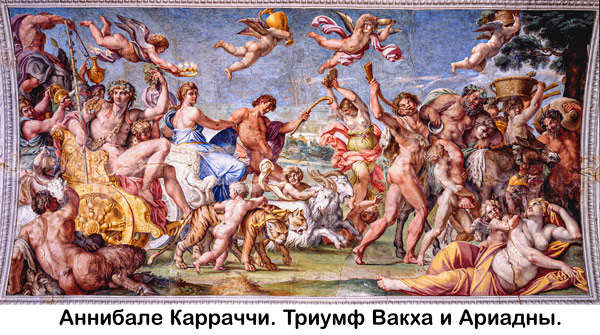
The unique ceiling and wall frescoes were complemented by elaborate gilded stucco, sculptural groups, and bas-reliefs. Masterpieces such as “The Triumph of Bacchus and Ariadne,” “Mercury and Paris,” “Pan and Diana,” and “Jupiter and Juno” are celebrated for their sophisticated compositions, vibrant color palettes, richness of tone, and profound allegorical meaning, and are regarded by art historians as some of the finest achievements of these painters.
The interior decoration of the palazzo was completed in 1604, after which the Carracci brothers gained extraordinary acclaim, with their fame spreading far beyond Rome. In the 17th and 18th centuries, the decoration of the Farnese Gallery (measuring 66 by 23 feet, or 20 by 7 meters) became a benchmark for palace and ceremonial interior design.
We also recommend reading about the most beautiful palaces and villas in Rome.
Interesting Facts
Like many historic architectural monuments, Palazzo Farnese has experienced periods of both prosperity and decline over its long history. Its fate has been closely tied to the lives of the descendants of the powerful Farnese family and the royal houses of Europe.
After the death of Cardinal Odoardo Farnese in 1626, the palace remained vacant for a long time.
During the 1630s–1680s, the palazzo served as a residence for important figures close to imperial and royal courts. Among its frequent visitors was Cardinal Alphonse-Louis du Plessis de Richelieu, a high-ranking dignitary of the French monarchy.
Wedding of Louis XIV
In 1660, the palace hosted the grand wedding ceremony of Maria Theresa of Austria (Spain) and Louis XIV of France, famously known as the “Sun King.” The bride and groom were first cousins. This political marriage ended a long-standing Franco-Spanish war but lasted only about a year.
Queen Christina of Sweden
In 1655, with the permission of Pope Alexander VII, Queen Christina of Sweden took up residence in the vacant Palazzo Farnese after arriving in the “Eternal City.” Remarkably, a few years earlier, she had abdicated the Swedish throne and converted to Catholicism. Eccentric, controversial, and exceptionally gifted, Christina turned the palace into an intellectual and cultural hub, attracting Italy’s finest poets, musicians, composers, scholars, and artists.
However, some historians claim that after a year of her residence, many valuable items and artworks were found missing from the palace.
Ownership by the Spanish
In 1731, the eighth Duke of Parma, Antonio Farnese, the last male heir of the powerful Farnese dynasty, passed away. After his death, the family’s properties, including the palazzo, were transferred to the Spanish crown. As Antonio had no children, Palazzo Farnese was inherited by Elizabeth of Parma (Isabella Farnese), who was married to King Philip V of Spain, and later by their eldest son.
In the 1730s, the future King Charles III of Spain moved most of the artworks stored in the palazzo to Naples (Napoli) and Caserta, where his residences were located.
The Palazzo Today
In the second half of the 19th century, French authorities signed a lease agreement with the right to purchase, eventually acquiring ownership of the palace in 1911. During the dictatorship of Benito Mussolini, the Italian government sought to reclaim the building.
Thus, in 1936, a sales contract was signed, stipulating that Palazzo Farnese would remain the premises of the French Embassy for 99 years, with a symbolic monthly rent of just 1 euro.
How to Visit
Access to Palazzo Farnese is only possible by advance reservation through the official website of the French Embassy in Rome: it.ambafrance.org. 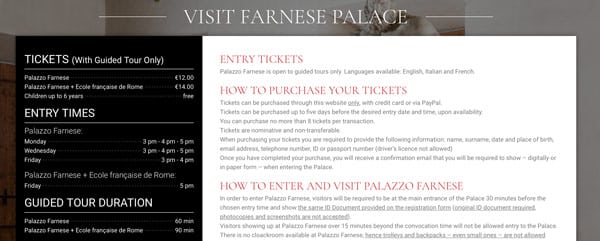
Tours last one hour and are available on Mondays, Wednesdays, and Fridays at 3:00 PM, 4:00 PM, or 5:00 PM. Spots for tours in Italian, French, or English must be reserved at least one month in advance on this page.

As of 2026, the ticket price is €12. Children under 6 years old accompanied by adults can enter for free. Since this visit grants access to embassy grounds, be prepared to provide your passport information.
Fountains
The center of Piazza Farnese is adorned with two large twin fountains, constructed in the 1620s based on the design by architect Girolamo Rainaldi. The massive basins are crowned with sculptural lily buds—the heraldic symbol of the powerful Farnese family.
To protect the fountains from the unruly public, they were originally enclosed by low metal railings. Until 1920, the fountains remained the property of Pope Paul III’s descendants, after which they came under the jurisdiction of the state.
The basins at the center of each fountain are particularly noteworthy. Each is crafted from Egyptian granite from the ancient Roman period and is a genuine artifact discovered among the ruins of the Baths of Caracalla (Terme di Caracalla)—one of the great wonders of Rome in the 5th century AD.
Interestingly, one of these ancient basins was installed in the square as early as the mid-16th century, long before the fountains themselves were built, and originally served as a viewing platform for privileged spectators during public festivities.
Church
To the right of the palazzo stands a small church dedicated to the Catholic saint Bridget of Sweden (Chiesa di Santa Brigida).
Declared one of Europe’s patron saints in 1999, Saint Bridget arrived in Rome in the mid-14th century, earning widespread respect for her charity and piety. The church’s lavish facade is designed in the Baroque style, and its interior is adorned with stunning paintings and frescoes by the Italian artist Biagio Puccini.
Villa Farnesina
On the opposite, western bank of the Tiber River stands Villa Farnesina, once owned by the influential merchant and banker Agostino Chigi. 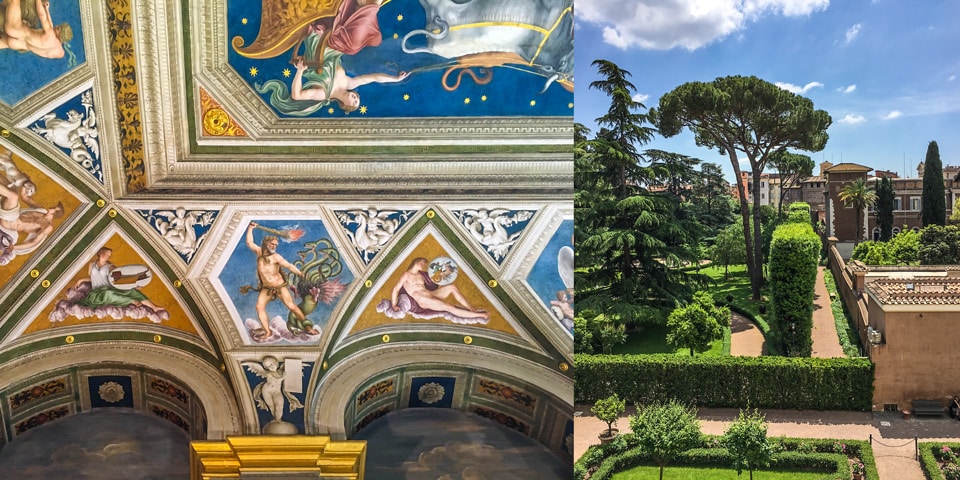
In 1577, the villa was purchased by Cardinal Alessandro Farnese, the grandson of Pope Paul III. Built in the early 16th century to the design of Baldassare Peruzzi, the villa is a significant monument of High Renaissance architecture and fine arts.
The interior decoration, particularly the frescoes on the walls and ceilings of the upper floor, was the work of Raphael (Raffaello Santi) and his pupils.
Plans were repeatedly proposed to build a bridge across the Tiber River linking the inner courtyard of Palazzo Farnese to the family’s villa on the opposite bank, but these plans never came to fruition. Today, the villa houses a museum showcasing paintings, drawings, and engravings by European masters from the 15th to the 19th centuries.