 Italy for me From Italy with love


Fontana dell’Acqua Felice (also known as the Fountain of Moses, or Fontana del Mosè) was erected in the 16th century on Piazza San Bernardo, perched atop the Quirinal Hill in Rome. This monumental fountain marked the end point of the restored ancient aqueduct Aqua Alexandrina, renamed Acqua Felice in honor of Pope Sixtus V from the Felice family.
A striking creation of the Renaissance era, the fountain has long sparked debate: while some hail it as a Baroque masterpiece, others critique its proportions and mock the imposing statue of Moses, finding its figure clumsy and even comical.
Page Contents
Restoring the Aqueduct
The Acqua Felice was the first monumental fountain built in Rome since antiquity. As the Eternal City emerged from medieval decline, Pope Sixtus V—born Felice Peretti di Montalto—played a key role in its revival. He understood that restoring access to clean drinking water was essential, especially in hilltop neighborhoods like Viminal and Quirinal, where residents had to walk long distances to the only remaining spring near what is now the Trevi Fountain.
It’s widely believed that Sixtus V also had personal motives: he wanted to direct water to his grand Villa Montalto Peretti, a lavish estate spanning the hills of Viminal, Quirinal, and Esquiline—covering a perimeter of nearly 4 miles.
In May 1585, shortly after becoming pope, Sixtus V purchased land from Roman nobleman Marzio Colonna, which included the water source that once fed the Aqua Alexandrina—Rome’s last great aqueduct of the ancient era. The task of restoring the aqueduct was entrusted to architect Giovanni Fontana, brother of the famed Domenico Fontana. Giovanni conducted an extensive survey, sampling more than 50 underground springs before identifying the optimal source.
The New Fountain
Following the restoration of the ancient Roman aqueduct and the construction of new branches of the city’s water system reaching the summit of the Quirinal Hill, the project’s creators sought to commemorate this achievement—and honor Pope Sixtus V—by erecting a series of elegantly designed fountains.
One such fountain was to be built at the terminus of the Aqua Felice aqueduct, near the former site of the Baths of Diocletian (Thermae Diocletianae), the largest bathing complex of ancient Rome.
The fountain’s design was entrusted to Domenico Fontana, who was given very little time to complete the project by Sixtus V.
To meet the pope’s tight deadline, Domenico Fontana adopted a common practice of the era—reusing available and cost-free materials taken from ancient monuments and other architectural structures.
Travertine was sourced from the ruins of the Baths of Diocletian, while the balustrade surrounding the fountain, dating back to the time of Pope Pius IV (1559–1565), was relocated from the Cortile del Belvedere in the Vatican.
On June 15, 1587, the architectural complex was officially inaugurated. Though still incomplete, it already stunned visitors with its grandeur, reminiscent of the majestic structures of Imperial Rome. Like the aqueduct itself, the fountain was named Aqua Felice.
Description
The Aqua Felice Fountain was designed in the style of an ancient Roman triumphal arch. The nearly square, rectangular structure features three arched niches (originally empty), framed by four Ionic columns supporting an entablature crowned with a tall attic.
The symbols of Pope Sixtus V adorn the pediment: within the aedicule is his family coat of arms, upheld by two angels, and above it, a stylized depiction of the three hills of Rome with a cross made of gilded copper.
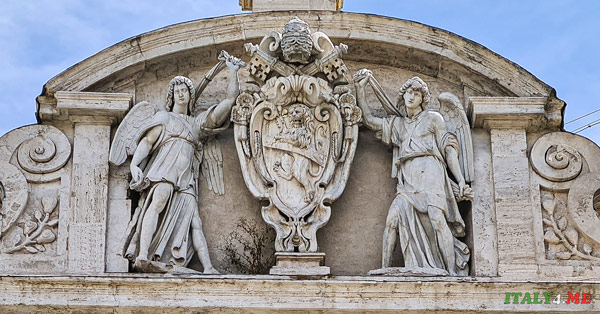
The sculptures were created by Flaminio Vacca and Pietro Paolo Olivieri. The obelisks flanking the pediment were added later and did little to enhance the fountain’s aesthetic.
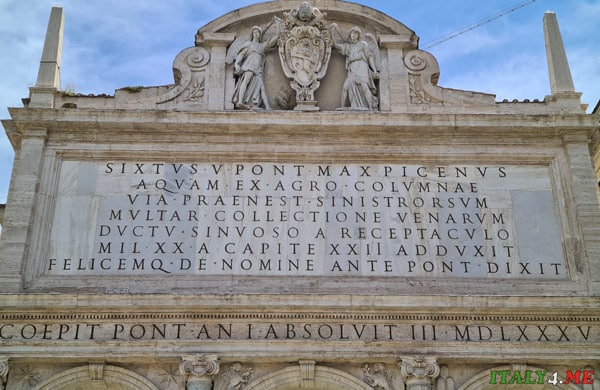
An inscription on the attic immortalizes Pope Sixtus V:
“Sixtus V, supreme pontiff from Piceno, gathered water from many springs between the twentieth and twenty-first mile to the left of the Via Prenestina on the land of Colonna, brought it through a winding channel, and named it Felice after the name he bore before becoming pontiff.”
A distinctive feature of the fountain is the presence of four marble lion sculptures—Egyptian works dating back to the reign of Pharaoh Nectanebo I (4th century BCE). Water flows from the mouths of the lions into three basins, protected by a travertine balustrade.
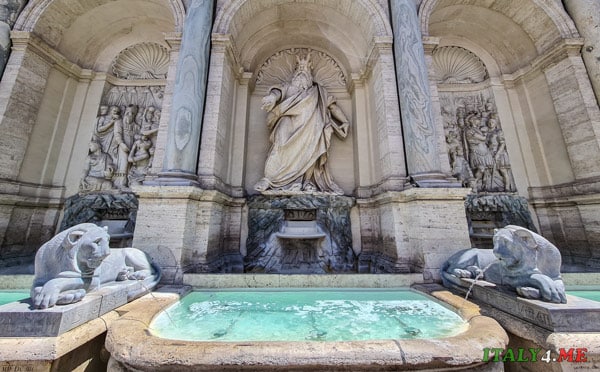
The lions were discovered during excavations at the Pantheon during the pontificate of Pope Eugene IV (1383–1447). They originally formed part of a monumental fountain dedicated to Marcus Agrippa. In the 19th century, the ancient sculptures were replaced with replicas, while the originals were preserved in the Vatican Museums (Musei Vaticani).
Sculptures and Reliefs
The sculptures and reliefs in the niches of the Aqua Felice Fountain were added in 1588, a year after its official unveiling. The statue of Moses became the focal point of the entire architectural ensemble, drawing attention and sparking debate over its artistic merit.
The Statue of Moses
The choice of the Hebrew prophet Moses for this monumental fountain was no coincidence. According to the Bible, one of the miracles performed by the savior of the Israelites was striking a rock at the foot of Mount Sinai with his staff, causing pure spring water to gush forth. Pope Sixtus V likely wished to equate his efforts to provide Rome with water with those of the prophet, and the fountain served as a powerful visual reminder of this connection.
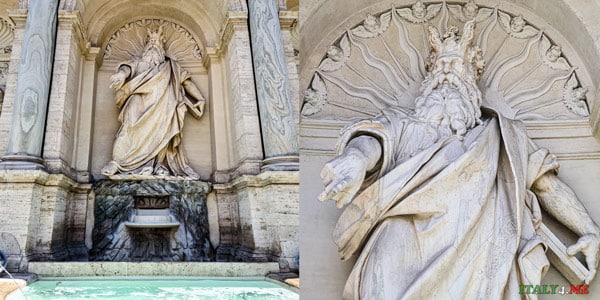
Moses is depicted emerging from the rock, gesturing toward the miraculously gushing water intended to quench the thirst of the Israelites. In his hands, he holds the tablets of the Ten Commandments, received from God atop Mount Sinai.
The four-meter-tall (about 13 feet) statue was created by Leonardo Sormani in collaboration with Prospero Antichi, also known as Bresciano. Sormani served as the principal sculptor of the piece.
The artists were clearly inspired by Michelangelo’s famed Moses in the Basilica of San Pietro in Vincoli. However, something went awry in the execution of this version—the massive, squat figure soon became the target of ridicule and satire, earning the nickname “Ridiculous Moses” from Romans. Even the statue’s furrowed brows have been humorously interpreted by locals as an expression of Moses’ own dissatisfaction with his appearance.
Observers often note the prophet’s unusual hairstyle, with peculiar bumps or horns emerging from his forehead. This is not a satanic symbol, which would be entirely inappropriate for a biblical figure. In Christian iconography, these “horns” are more accurately interpreted as rays of light, representing the divine radiance that shone from Moses’ face after his encounter with God on Mount Sinai.
Other Fountain Imagery
The two side reliefs in the niches of the Aqua Felice Fountain continue the biblical theme of water.
On the left, sculptor Giovanni Battista della Porta depicted a scene where Aaron, the elder brother of Moses, leads the Israelites to water flowing from the desert.
The right relief, created by Flaminio Vacca and Pietro Paolo Olivieri, portrays Joshua, leader of the Israelites, guiding his army to the Red Sea.
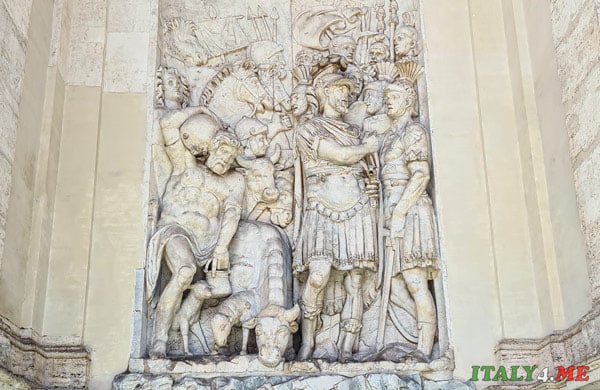
Although the Aqua Felice Fountain is often criticized for its imperfections in form, its merits are undeniable. The availability of clean drinking water helped revitalize the Quirinal district, transforming it into one of Rome’s most prosperous neighborhoods.
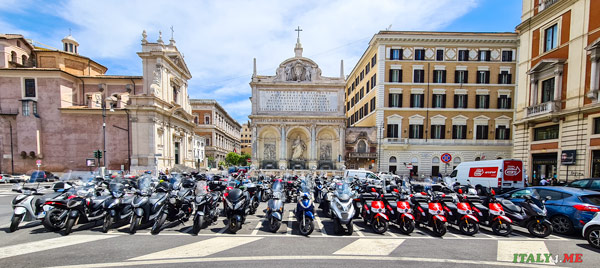
For over four centuries, the fountain has continued to offer cool, clean water, drawing attention not only for its monumental scale but also for its charming flaws. The Moses Fountain served as a model for future masterpieces, including the Trevi Fountain and the Aqua Paola Fountain (Fontana dell’Acqua Paola).
How to Get There
The Aqua Felice Fountain is located just 650 feet (200 meters) from Piazza della Repubblica.
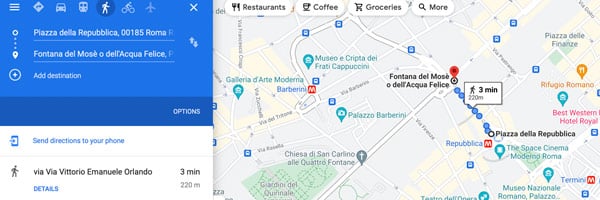
It’s about a 10-minute walk from either Roma Termini Station or Piazza Barberini.