 Italy for me From Italy with love


The towers of the Sforza Castle (Castello Sforzesco), seamlessly connected by fortress walls into a majestic structure, are an unavoidable sight for visitors to Milan.
For seven centuries, the Sforza Castle has stood under the azure Italian sky. During this time, it has witnessed the rise and fall of ruling dynasties, revolutions, and popular uprisings, and it has felt the touch of talented architects, sculptors, and painters. Austere and captivating, the architectural ensemble bears a striking resemblance to the Kremlin in Moscow, a similarity explained by the Italian roots of the Russian fortress’s design.
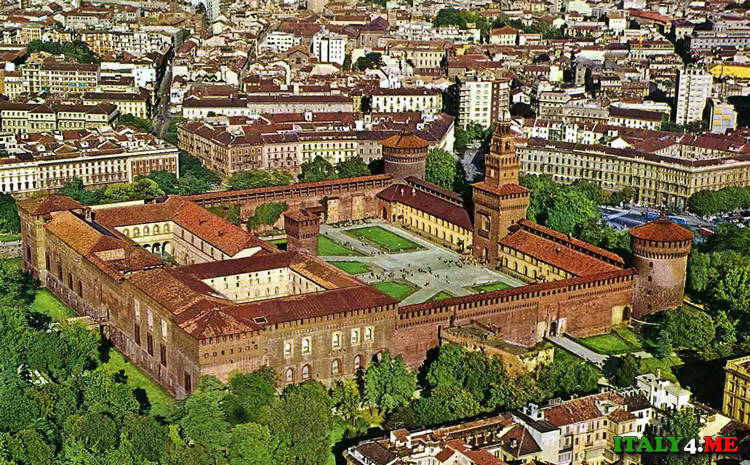
The history of this remarkable architectural monument dates back to the Middle Ages. In the 14th century, the aristocratic Visconti family decided to establish a family residence near Milan. At the time, the chosen site was located in the suburbs, necessitating the construction of significant defensive structures and sturdy walls. However, the greatest threat to the castle and its inhabitants came from an unexpected direction. In the mid-14th century, the Visconti family lost its influence, and the Ambrosian Republic was proclaimed in Milan. Its supporters caused extensive damage to the castle, which symbolized the deposed regime.
Page Contents
Construction of the Castle
The new republic lasted only briefly, from 1447 to 1450. The leaders from the people failed to withstand pressure from other cities and sought the help of military commander Francesco Sforza.  He had married Bianca, the daughter of the last ruler from the Visconti family. With the support of his aristocratic wife and a formidable military force, Francesco Sforza restored order in the city and declared himself the new Duke of Milan.
In the 15th century, thanks to Sforza’s efforts, the semi-ruined Visconti castle was given a new lease on life. The Duke had two objectives: to revive the symbol of the ruling dynasty and to fortify the city’s approaches. Building upon the foundation of the fortress walls, high and sturdy defenses were erected. A geometrically precise stone square with 200-meter sides encircled the castle with reliable protection. However, the new owner cared not only about functionality but also about aesthetics. The renowned architect A. Averlino, also known as Filarete, was specially invited to embellish the exterior facades.
In time, towers with rounded walls appeared at the corners of the fortress. They have been well preserved to this day and give the Sforza Castle a magnificent appearance, especially when viewed from Via Dante.
Francesco and Bianca Sforza spent their lives in central Milan, using a palace on the Cathedral Square as their residence.  Their son, Galeazzo, aspired to restore the out-of-town fortress to its former glory as the family castle. New construction projects expanded the building and renovated its interior spaces. Architect Benedetto Ferrini designed the castle’s interior to include two cozy courtyards—the Ducal Courtyard and the Rocchetta Courtyard. Additionally, the castle gained spacious stables capable of housing 90 horses.
Galeazzo Maria Sforza also transformed the living quarters, sparing no expense on luxurious furniture, art, and elaborate decoration. A ballroom was added specifically for hosting receptions and sports activities. Much of the interior splendor has been preserved and remains accessible to visitors of Castello Sforzesco.
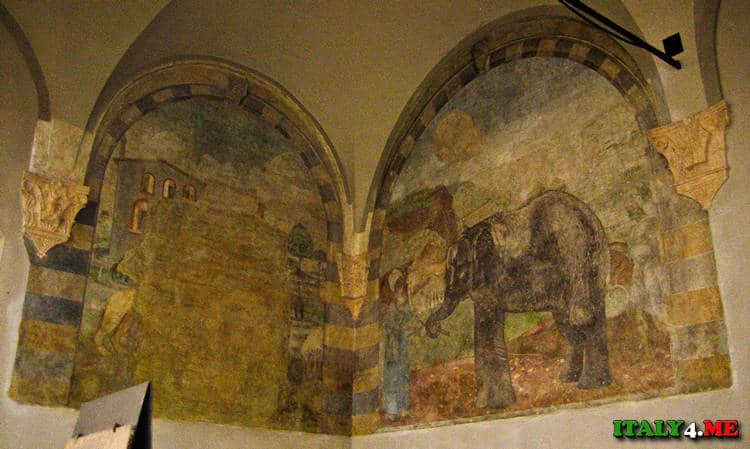
After Galeazzo’s death, his titles and responsibilities passed to his brother Ludovico Moro. This distinguished member of the noble family managed to enlist none other than Leonardo da Vinci as the castle’s artist.
The legendary Italian decorated the Sala delle Asse, adorning it with magnificent frescoes. Several fragments of Leonardo’s work have been preserved in good condition. Incidentally, da Vinci was deeply attached to Milan, which is why the city hosts the Museum of Science and Technology dedicated to Leonardo. Located on the grounds of the San Vittore monastery, the museum’s main exhibits include the inventor’s designs, drawings, sketches, and both artistic and technical creations.
Transformation into a Military Stronghold
At the end of the 15th century, a turbulent era began, marked by the struggle among Italy, Spain, France, and the Holy Roman Empire for world dominance. During this period, Milan and its surroundings frequently changed rulers, which had an adverse effect on the condition of the Sforza Castle. 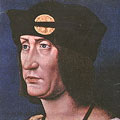 French King Louis XII held the title of Duke of Milan for a significant period. Among his many reforms was the transformation of the Sforza Castle from a hub of secular life into a military fortress. The splendor of the interior halls quickly faded under the harsh realities of military occupation. In 1521, one of the castle’s towers was destroyed by a massive explosion of gunpowder stored within its walls.
Following the French occupation, Spanish rule came to Italy. The Spanish authorities maintained the same approach as their predecessors regarding Castello Sforzesco. As a result, the fortress walls were surrounded by an additional ring of ramparts and fortifications. The new defensive line was designed according to the latest military engineering principles, shaped like a 12-pointed star.
From then on, the castle housed about two thousand soldiers. Facilities such as a hospital, dining halls, and two chapels for the troops’ spiritual needs were established. Needless to say, the halls once adorned with frescoes by Leonardo da Vinci and other artists were repurposed as storage areas.
At the dawn of the 18th century, Spanish rule was replaced by Austrian control. Little changed for the Sforza Castle—it remained a vast barracks fortified by powerful bastion walls. It wasn’t until 1796 that French Emperor Napoleon succeeded in driving out the Austrians and completely occupying Milan.  Bonaparte planned to increase the barracks’ capacity to house 4,000 troops, but the local population was staunchly opposed. For centuries, the Sforza Castle had symbolized the power of foreign occupiers, and Milan’s citizens demanded its complete demolition.
However, the French emperor soon found himself preoccupied with other matters. In 1799, the united forces of Russia, Britain, and Austria, led by the Russian commander Alexander Vasilyevich Suvorov, approached the walls of the Milanese fortress. Suvorov, a brilliant strategist, succeeded in driving Napoleon out from behind the fortress’s strong defenses. Russian troops later withdrew across the Alps, leaving the city under the control of the Austrian emperor—though not for long. Napoleon Bonaparte would reclaim victory at the Battle of Marengo near the city. On the recaptured territory, the Cisalpine Republic was proclaimed, with Milan as its capital.
Napoleon Bonaparte’s Role
Napoleon had a dual impact on the Sforza estate. On one hand, the castle continued to be relentlessly used as a military barracks. Frescoes and other interior decorations were buried beneath layers of plaster and whitewash. However, the emperor did respond to the wishes of the Italians by removing the fortifications that had surrounded the castle since the era of Spanish domination.
To address the destruction left around Castello Sforzesco following the demolition of the defensive walls and ramparts, two Italian architects were commissioned. Giovanni Antolini and Luigi Canonica proposed an ambitious plan that included creating a large park with avenues as well as constructing several culturally significant buildings. However, only the landscaping for a garden square was realized.
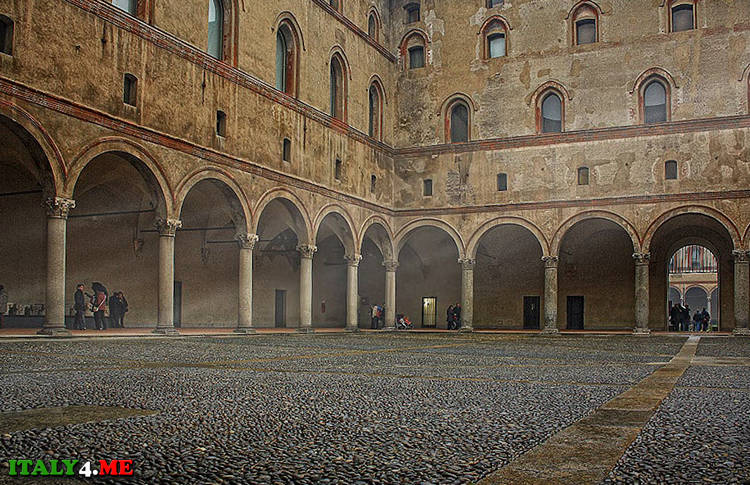
The final collapse of Napoleon and his empire in 1815 allowed the Austrians to regain control, which they quickly acted upon. Lombardy and Venice were once again seized, and the long-suffering Milanese castle returned to military use. For the next 50 years, Italians struggled to resist foreign domination. At one point, they even succeeded—during a five-day uprising in March 1848, the people of Milan briefly reclaimed control of their city.
The most dramatic events in the history of the Sforza Castle unfolded in 1859 after Austrian forces were forced to abandon Italian territories. The impassioned citizens of Milan showed no mercy to the Austrian military fortifications, sweeping through the inner perimeter of the fortress with fire and fury. The castle was looted and suffered significant damage.
The Unification of Italian Lands
The process of Italian unification (Risorgimento) began in 1861. At that time, attention finally turned to the famous fortress. The structure’s considerable age, along with its significance in the city’s history, prompted Milan’s new leaders to designate the Sforza Castle as an architectural monument and a symbol of the city. As a result, the castle’s restoration and the revival of its former splendor became a high priority.
Luca Beltrami was appointed as the supervisor for the restoration of Castello Sforzesco. The architect approached the task with great dedication. Before drafting the renovation plans, he thoroughly studied a vast array of historical literature and documents relating to the fortress’s architecture and design. The squat towers located at the corners of the fortress walls were the first to be addressed.
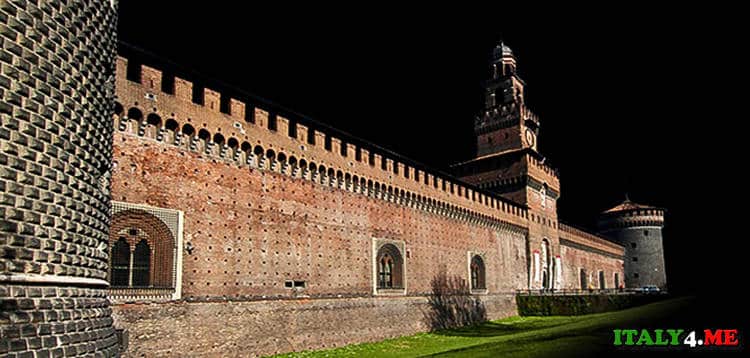
Work began with the restoration of partially damaged walls and ceilings, and the authentic finishes of the structures were reinstated. Additionally, the towers were given a new functional purpose—they were transformed into water reservoirs. The castle’s restoration continued until 1905, although it was partially open to visitors from the early 20th century. Since then, and to this day, the Sforza Castle has remained the property of the city of Milan and its residents.
World War II and Restoration
The last wave of destruction struck the Sforza Castle in 1943 during the battles of World War II. Aerial bombings damaged the fortress walls and the Rocchetta courtyard. After the war, restoration work continued until 1956. During those years, meticulous efforts were made to restore the damaged buildings, refresh the frescoes, and renew the interior decorations.
Today
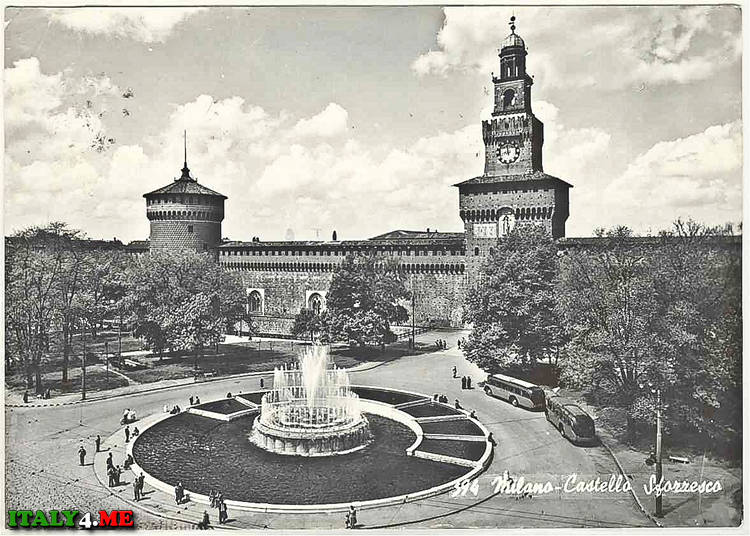
Visitors to Milan eager to see the famous Sforza Castle today will find it located in the historic heart of the city. The grounds that once lay at the city’s edge are now surrounded by newer districts. The space within the castle walls has been paved with a special surface featuring a geometric design. The Piazza delle Armi stretches around the castle. For several centuries, this square served as a parade ground for soldiers of various armies.
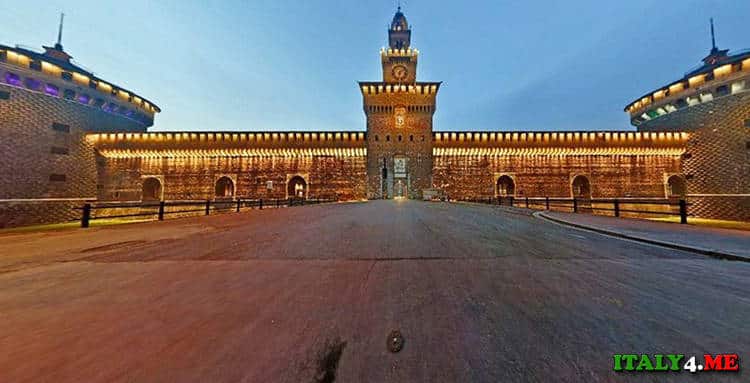
You can enter the castle’s inner courtyard through the main gate located in the Filarete Tower. The tower itself is a majestic, multi-tiered structure with a square design, rising to a height of 70 meters. The castle’s main tower is adorned with a bas-relief of the Italian monarch Umberto I. The first tier’s summit features heraldic frescoes and an image of Saint Ambrose, the patron saint of Milan.
The second tier of the Filarete Tower is crowned with decorative battlements shaped like swallowtails. This design indicates that the castle’s owners were in opposition to the views of the Pope. On this tier, you can also see an old clock called the “Sun of Justice,” which remains as a tribute to the Visconti family, who laid the first stones of the castle.
Today, the castle’s walls house a library and several museums dedicated to the history of Milan and the Sforza Castle itself. Particularly popular with tourists are the elegant art gallery, a museum filled with medieval art exhibits, the Archaeological Museum, and the Museum of the Risorgimento. Notably, the Sforza Castle is home to Michelangelo’s final, unfinished sculpture—the Rondanini Pietà. In the inner courtyard, near the Filarete Tower, you’ll also find a monument dedicated to Saint John of Nepomuk, the Czech saint.
Attractions Near Sforza Castle
Outside the fortress walls, the Sforza Castle is surrounded by Sempione Park, established in 1893. Milan’s main city park is crisscrossed with cozy paths and relaxing spots, making it a favorite not only for tourists but also for locals.
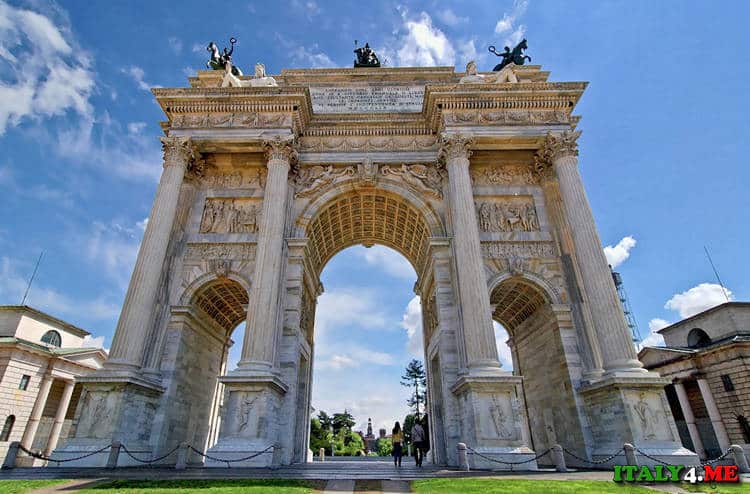
The highlight of the park is the Arco della Pace (Arch of Peace), built by order of Napoleon in the 19th century. The memorial was conceived as a counterpart to the Arc de Triomphe in Paris.
The French emperor sought to commemorate his victory in the Apennines. According to Bonaparte’s plans, the ceremonial entrance to the city was to pass through new, fourteenth-century-style gates. A long-standing legend claims that the Arco della Pace and the Arc de Triomphe are aligned along the same axis, adding symbolic meaning to the monument in Sempione Park.
Opening Hours and Ticket Prices
Castello Sforzesco is open daily from 7:00 AM to 7:00 PM in summer and from 7:00 AM to 6:00 PM in winter. Entry to the castle grounds is completely free. However, visiting the museums has specific regulations.
The museums inside the Sforza Castle are open from Tuesday to Sunday, from 9:00 AM to 5:30 PM. They are closed on major religious holidays and Mondays. A single-entry museum ticket costs €15 (audio guide included). To avoid lines, it’s recommended to book your date and time in advance through www.tiqets.com.
Address and How to Get There
Sforza Castle is located in Milan’s Porta Umberto district. You can reach the castle using public transportation:
- Metro, Line MM1 Cairoli (Cadorna – Cairoli), Line MM2 Cadorna-Lanza (Cadorna – Lanza);
- Buses: 18, 37, 50, 58, 61, 94;
- Trams: 1, 2, 4, 12, 14, 19.