 Italy for me From Italy with love


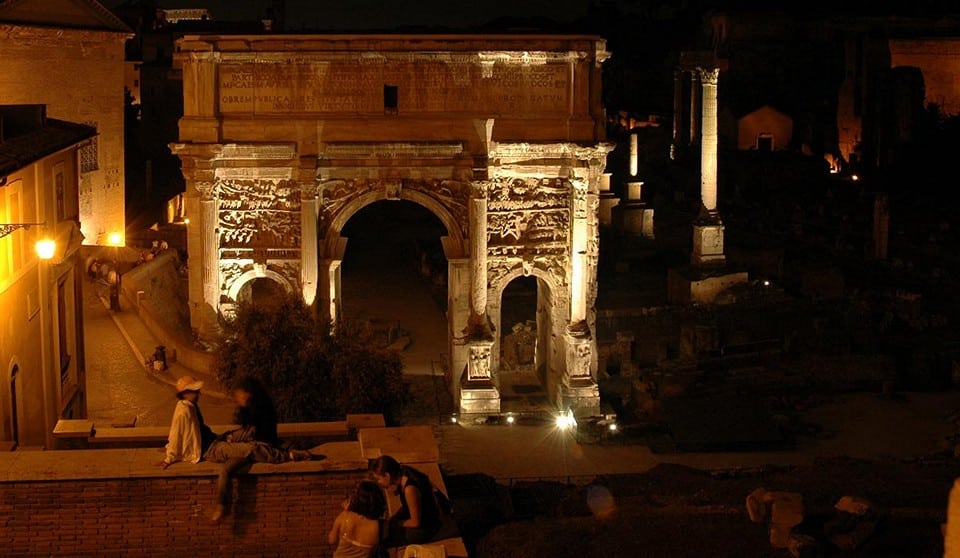
The Arch of Septimius Severus (Arco di Settimio Severo) in Rome is a unique artistic creation built by unknown masters nearly two thousand years ago. It embodies the greatness of man as a warrior and as a creator of grand, immortal art.
Page Contents
Construction History
A trip to Rome introduces us to three famous triumphal arches:
- Arch of Titus (Arco di Tito, the oldest, built in AD 81);
- Arch of Constantine (Arco di Costantino, constructed in AD 315);
- Arch of Septimius Severus (a late Roman structure dated to AD 205).
The Arch of Septimius Severus was built as part of the Forum (Forum Romanum) complex to commemorate two events: the 10th anniversary of Emperor Severus’ reign and the victories of his sons Geta and Caracalla over the Parthians in a series of battles from 195 to 203 AD.
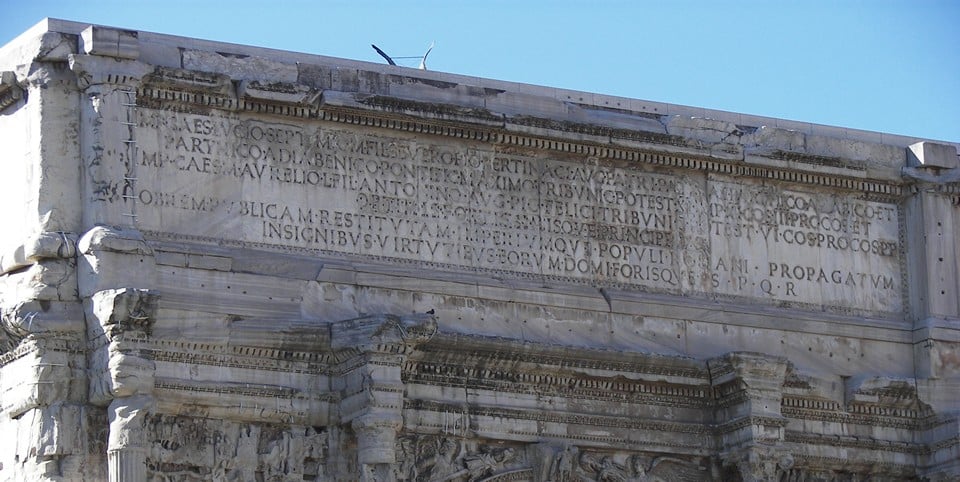
Thus, the arch on both its sides at the top (on the attic) features an inscription carved in stone telling the story of the glorious deeds and achievements of Emperor Severus and his son Caracalla (originally the inscription also praised Geta, but the power-hungry Caracalla later had his brother killed and ordered Geta’s name erased from the triumphal arch).
Septimius Severus personally chose the site for the construction, considered the most prestigious in Ancient Rome.
The location of the triumphal arch in the northern section of the Forum is symbolic: nearby lies the circular marker of the center of Ancient Rome, and the arch itself stands directly on the Sacred Road (Via Sacra), connecting two hills—the Palatine (Palatium) and Capitoline (Monte Capitolino). To the left are the ruins of the speaker’s platforms once used by celebrated orators and the Senate chambers. Besides commemorating the emperor’s achievements, the arch served practical purposes: the central passage allowed horse-drawn carriages to ascend the Capitoline Hill, while the side passages were used by pedestrians.
We also recommend reading about the Baths of Caracalla.
Achievements of Septimius Severus for Rome
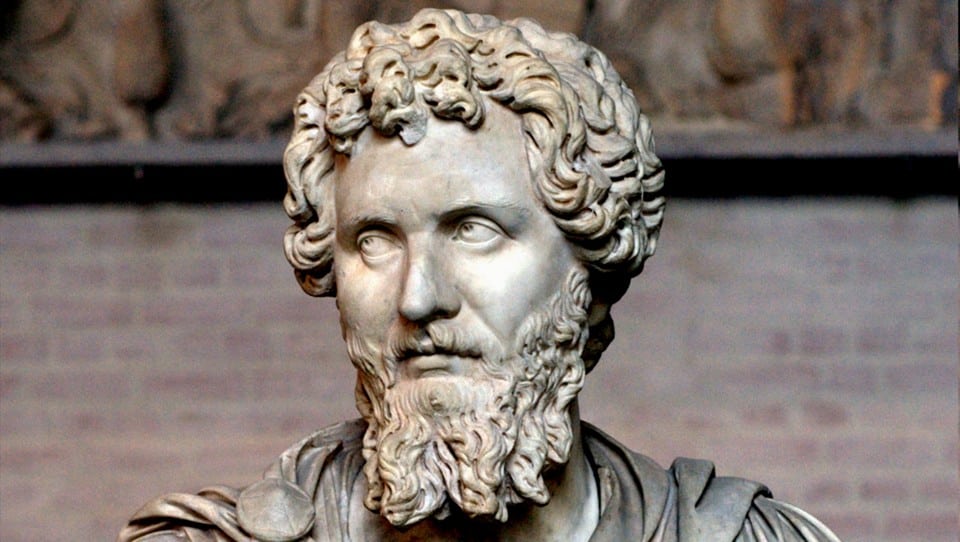
The biography of Septimius Severus is well documented. He was born in North Africa and received his early education at home before continuing his studies in Rome. The path of Septimius Severus is a clear example of rapid career growth: from legionary soldier to senator, then consul, later commander-in-chief, and ultimately the emperor who brought glory to Rome.
Severus had a keen interest in astronomy and the study of celestial bodies, through which he met the daughter of a priest devoted to the powerful god Baal—Julia Domna—who would become his wife. According to legend, his wife foretold Severus’ rise to imperial power in Rome. His destiny indeed proved fortunate: he was a farsighted and wise ruler who strengthened the army and cared for the needs of the country and its people. Another important contribution Severus made to Rome was the expansion of its borders, achieved through skilled foreign policy.
Severus earned renown through his brave campaigns into uncharted lands. During his final campaign, aimed at conquering Britain and marked by brilliant victories over the Pictish tribes, Emperor Septimius Severus died from an old illness. His sons brought his body back home, where he was buried with full military honors.
Architectural Features
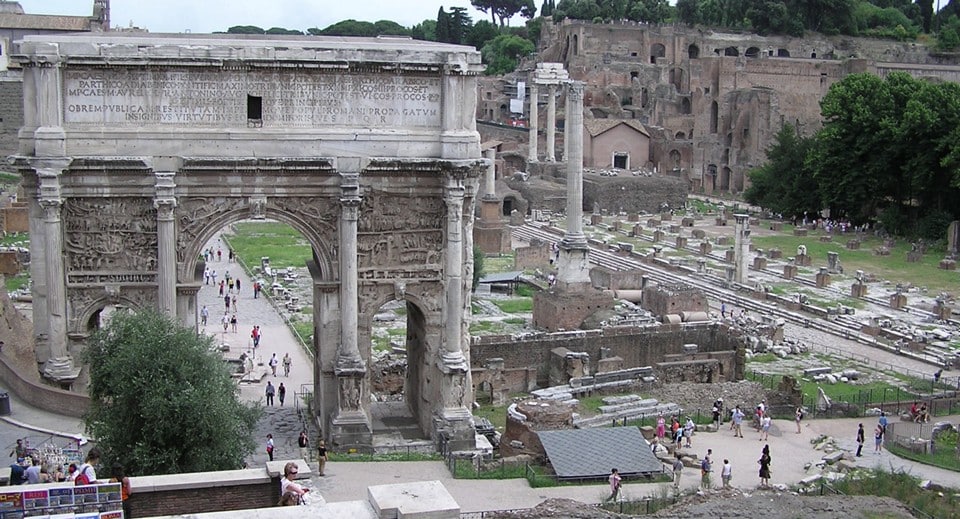
The Arch of Septimius Severus is truly monumental: it rises over 20 meters (66 feet) high, measures just over 23 meters (75 feet) in width, and a little more than 11 meters (36 feet) in depth.
The arch was intended as a permanent structure, so it was built not from wood, but from brick, blocks, and panels of travertine (limestone tuff). The arch is clad in marble, with all decorative elements and columns made of the same material. Its architectural complexity and refinement immediately catch the eye.
The arch features three barrel-vaulted passageways. The central passage is taller than the side ones, which gives the massive structure balance and visual elegance, emphasizing its upward movement. Hidden within the arch’s supports are passageways that form inner chambers, creating an illusion of lightness and openness.
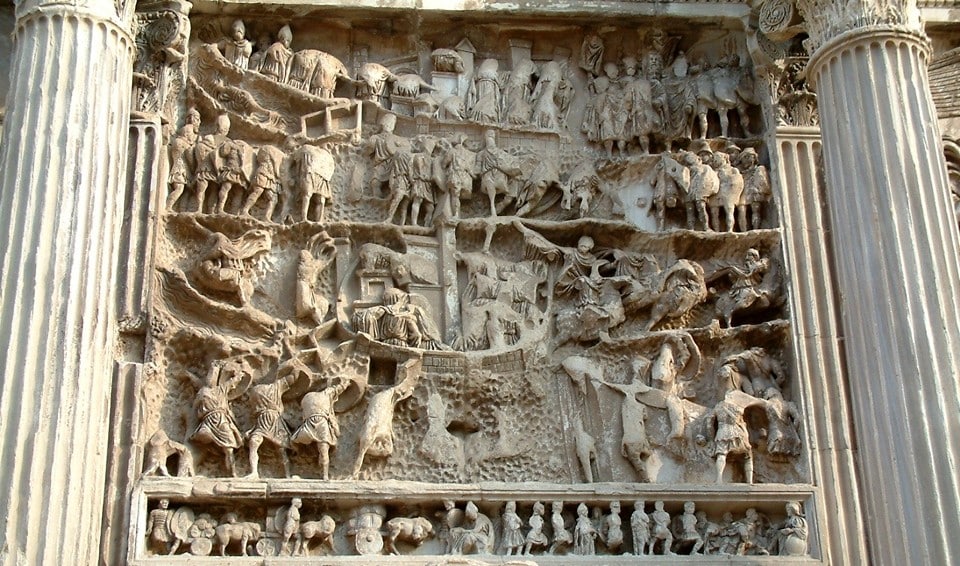
Stairs from the Forum side lead up to the arch, with additional steps inside that allow access to the rooms within the upper level (attic). The marble panels between the arches are adorned with masterful relief scenes depicting Rome’s war with the Parthian Empire:
- Moments of preparation for battle and major military engagements;
- Multiple images of the emperor rallying the legions to victory and then leading his legendary army;
- Romans storming the fortress of Ctesiphon on the banks of the Tigris River;
- The siege of the city of Seleucia by Roman forces and the triumphant march
- Of Septimius Severus’ legions through its streets;
- Scenes of the Parthian king’s surrender and the retreat of the enemy army.
The arch tells the story and geography of Septimius Severus’ victories: the smaller arches are adorned with personifications of rivers near which great battles took place under the emperor’s command in Syria, Arabia, Mesopotamia, Gaul, and Britain.
A recurring motif in the reliefs is the image of the winged goddess of Victory—Victoria—as well as depictions of Mars and other classical gods and heroes.
The arch’s grandeur and monumentality are enhanced by its columns with capitals that blend various classical orders. At the base of the columns are reliefs showing Roman legionaries and captured enemies.
Thanks to its depiction on ancient Roman coins, we know that the arch was originally topped with a bronze quadriga—a four-horse chariot—featuring statues of the emperor and his heroic sons.
The emperor sought to leave a lasting legacy through a colossal structure symbolizing wealth, power, and imperial authority.
How to Get There
The arch is located 950 meters (about an 11-minute walk) from the Colosseo metro station (line B). Tram No. 3 also stops nearby at Parco Celio, just across from the Colosseum. The Altar of the Fatherland is also located nearby on piazza Venezia.
Using a map of Rome or this guide, you can take a scenic walk to the Triumphal Arch from the Vatican (Stato della Città del Vaticano), passing by many of the city’s most iconic landmarks.
You can enjoy all three arches in comfort during our signature sunrise tour of Rome—away from the crowds.
Tickets & Opening Hours
The Arch of Septimius Severus is part of the Roman Forum complex. A standard admission ticket (Colosseum Tickets & Roman Forum – including entry to the Colosseum and Palatine Hill) costs €12. Entry is free for visitors under 18.
A step-by-step guide to buying your ticket without queues or intermediaries is available here.
Entrance to the Forum area is open from 8:30 AM to 5:00 PM (6:00 PM).