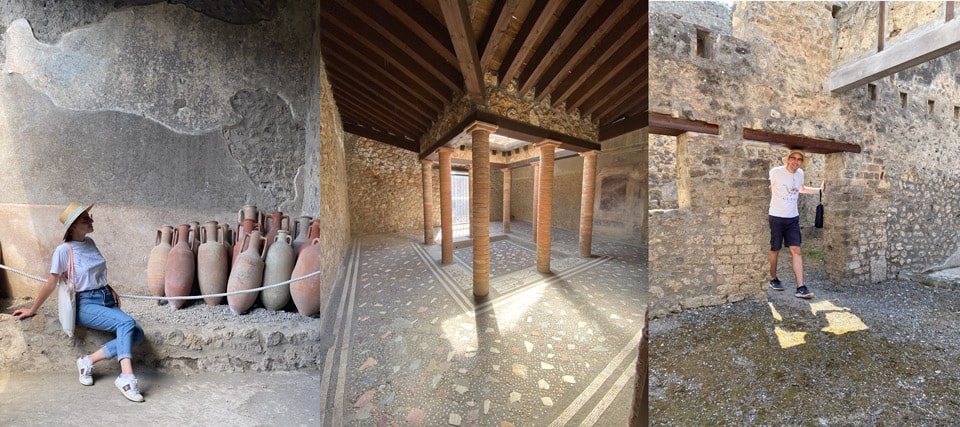
 Italy for me From Italy with love


Pompeii is an ancient Roman city in southern Italy near Naples. As is well known, Pompeii was buried under meters of ash during the eruption of Vesuvius in 79 AD. Today, the city is an enormous open-air museum, added to the UNESCO World Heritage List in 1997.
Page Contents
Things to Know Before Visiting Pompeii
What happened to Pompeii?
Where are the bodies in Pompeii?
When was Pompeii built?
When will Pompeii erupt again?
How many Pompeii survivors were there?
How far is Pompeii from Rome?
Where can you buy Pompeii tickets?
How far is Pompeii from the Amalfi Coast?
How long does it take to walk around Pompeii?
History
The city was founded by the Oscans in the 6th century BC. The name “Pompeii” comes from the Oscan word *pumpe*, meaning “five,” as the city was formed by the merging of five smaller settlements. During Roman times, the city was divided into five electoral districts. Another possible origin of the name is Greek, from the word *pompe* meaning “triumphal procession.”
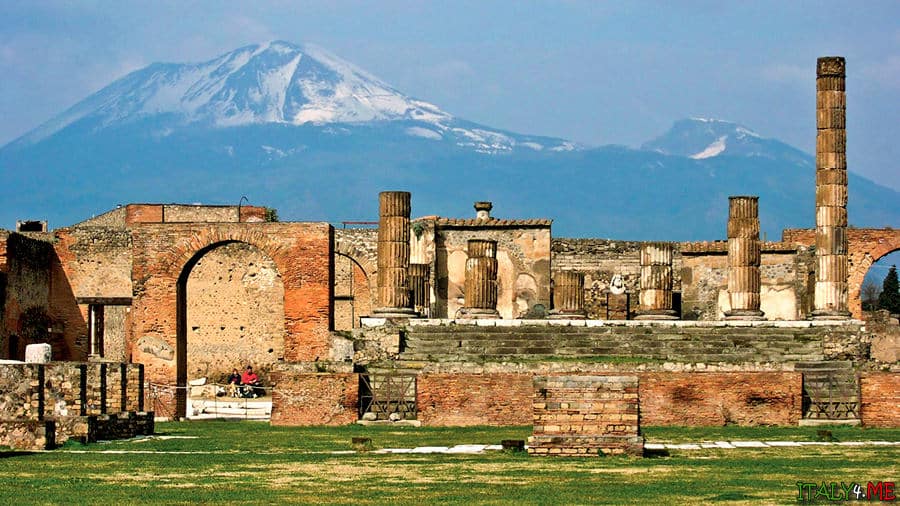
According to this legend, the city was founded by Hercules after his victory over Geryon, as he triumphantly marched through these lands. Over time, the city was controlled by the Greeks, Etruscans, and Samnites.
In 310 BC, Pompeii became an ally of the Roman Republic, gaining the status of an autonomous, self-governing city.
Between 90 and 88 BC, the city participated in a revolt against Rome.
In 89 BC, consul Sulla took control of the city, limited its autonomy, and turned it into a Roman colony. Pompeii was strategically important on the trade route between Ancient Rome and southern Italy. Many wealthy Romans had villas in Pompeii. A notorious event occurred in AD 59 when a violent brawl between the citizens of Pompeii and Nuceria broke out during gladiator games. What began as an ordinary fight between fans escalated into a bloody massacre. As a result, gladiator games were banned in Pompeii for three years.
In AD 62, a major earthquake caused significant damage to the city. On August 24, AD 79, Mount Vesuvius erupted, spewing thousands of tons of ash and lava. Pompeii, Stabiae, and Herculaneum were destroyed, with approximately 16,000 people killed.
Excavations
Excavations in Pompeii began in 1748. At that time, the focus was mainly on finding objects of artistic value. Discovered items were sorted, with valuable artifacts sent to the Royal Museum in Naples, while others were destroyed.
Initially, it was thought that the site being excavated was Stabiae. In 1763, an inscription on a pedestal was discovered, identifying the city as Pompeii. In 1870, it was found that where the bodies of victims lay, voids had formed. These voids were filled with plaster, recreating the final poses of the catastrophe’s victims. Since 1960, only restoration work has been carried out in the excavated areas.
Recommended: Excursion to Vesuvius and Pompeii
The Painting “The Last Day of Pompeii” by Karl Bryullov
In 1828, Russian painter Karl Bryullov visited Pompeii. During his visit, he made numerous sketches for his future painting, *The Last Day of Pompeii*, which he completed in 1833.
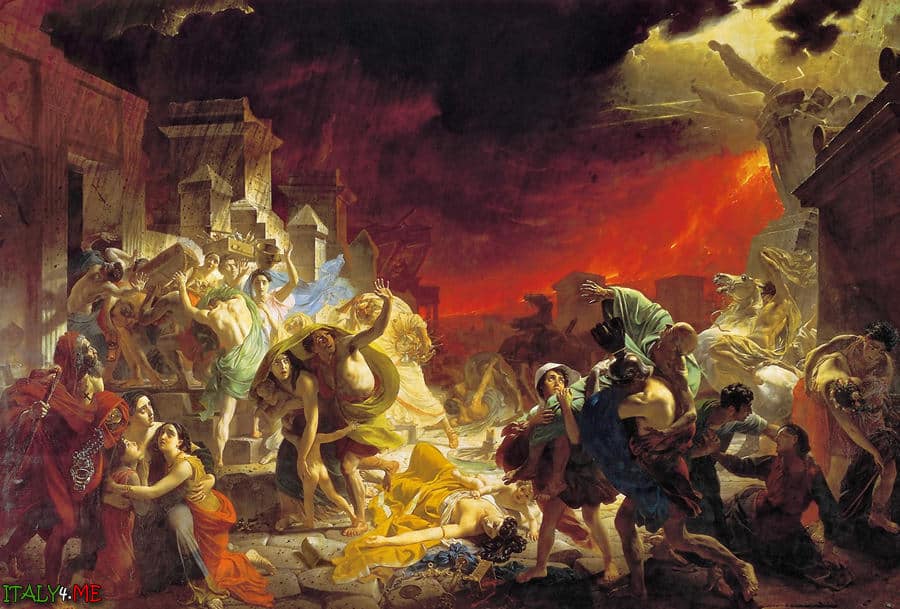
The painting was exhibited in Rome and received enthusiastic reviews from international critics. It was then sent to the Louvre in Paris.
In 1834, the painting returned to Russia, where poets such as Alexander Pushkin and Yevgeny Baratynsky composed poems dedicated to Bryullov’s masterpiece.
In 1895, the painting was moved to the Russian Museum in St. Petersburg, where it remains accessible to visitors at the Russian State Museum. Today, Pompeii is a world-famous tourist destination.
Who Were the Residents of Pompeii?
In recent decades, Italian archaeologists have meticulously scanned and reconstructed the remains of 86 people who perished during the eruption of Vesuvius (Vesuvio) in AD 79. Using advanced tomography, they have been able to visualize the layers of volcanic ash that preserved the bodies of the townspeople, frozen in time.
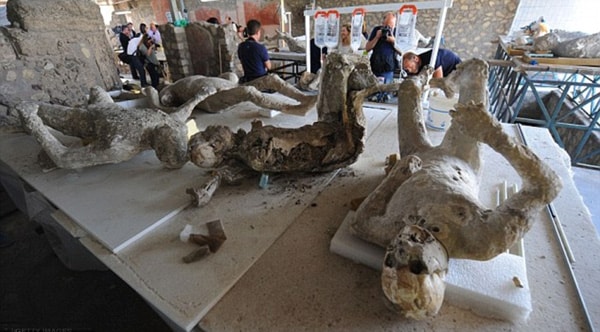
Scientists were able to precisely locate the bodies and carefully extract them from the volcanic mass.
Detailed studies of the remains revealed an interesting fact: during Ancient Rome, people had good teeth.
It is believed that ancient diets were rich in fiber, low in sugar, and generally consisted of healthier, higher-quality food.
Researchers managed to create complete 3D models of several victims, providing both external and internal views. Another discovery was that many residents suffered severe head injuries, likely caused by falling debris from collapsing buildings. The archaeologists plan to display these findings in an exhibition called *Pompeii and Europe*.
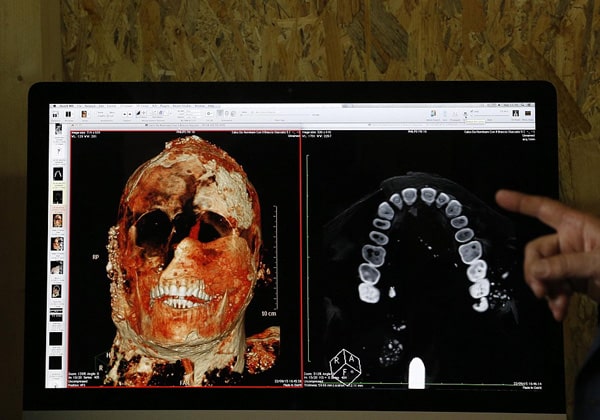
The extensive use of CT scans, a method borrowed from medicine, allows researchers to create 2D and 3D models or cross-sections at any depth. This helps study bodies that are too fragile to fully extract from the lava. Scientists say their research is not just archaeology but an archaeological study of humanity.
One of the key subjects of this research was a 4-year-old boy found near his family: his father, mother, and the child in his arms. Detailed examinations helped sketch the child’s clothing. The scans revealed everything down to the skeleton. The expressions of shock remain unchanged on the faces of the people who were buried by ash and lava on August 24, AD 79.
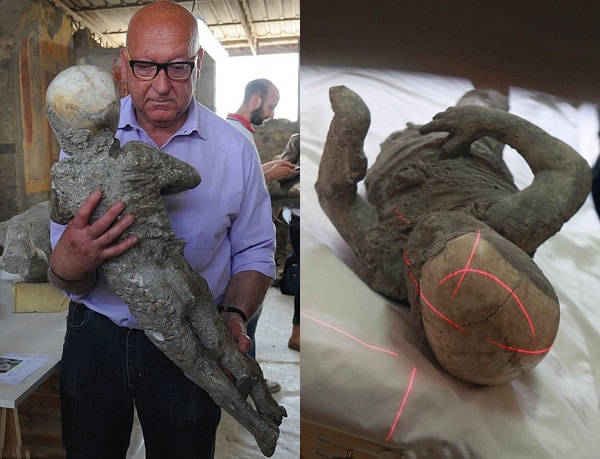
Preliminary information suggests that around 2,000 human remains have been uncovered throughout the archaeological excavations in and around Pompeii.
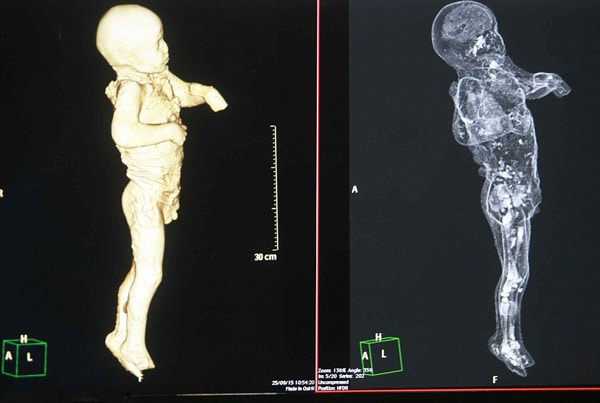
It is estimated that between 10,000 and 25,000 people perished during the eruption of Vesuvius, and the city and its surroundings remained abandoned until 1748.
Tours of Pompeii
If you want the ruins to come alive for you, we recommend booking an Small Group Tour with an Archaeologist.
The cost of a Pompeii private tour for 2-3 people is from €400, which includes the service of a licensed English-speaking archaeologist guide. A more extended option, including a visit to Vesuvius, costs from €675.
Tickets to the Pompeii Archaeological Complex
Admission to the Pompeii archaeological site starts at €19, plus an online reservation fee. It is free for visitors under 18, but they must show proof of age.
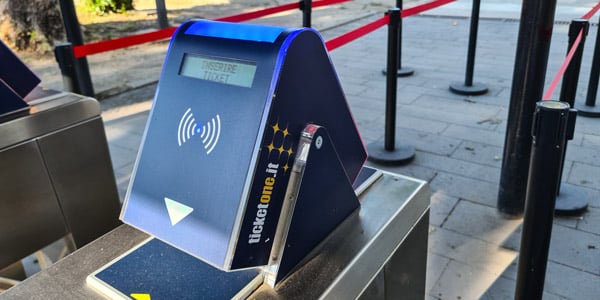
It is highly recommended to purchase tickets online in advance, only from official ticket offices like Ticketone.it or Tiqets.com
Official website: www.pompeiisites.org
At the entrance, you will need to scan the barcode on your ticket.
How to Get to Pompeii from Naples Independently
You can get to Pompeii from Naples on your own by train, bus, or rented car. While we recommend public transportation, be aware that in southern Italy, public transport runs irregularly and often unpredictably. It is suitable only for experienced travelers with time to spare who are looking to save money.
Let’s review the various options:
By Rental Car
If you’re traveling through Italy’s small towns independently, driving to Pompeii is the most convenient self-directed option. Parking near the archaeological site costs €1.50 per hour. Read about car rental tips and find great deals on our site auto.italy4.me.
Useful resources:
- How to get from Rome to Pompeii
- How to get from Naples airport to the city center
By Train
Circumvesuviana Train
Direct Circumvesuviana trains (“Around Vesuvius”) run from Napoli Porta Nolana and Napoli P. Garibaldi stations in Naples—this is the only public transport option we can confidently recommend. Here’s the timetable. Get off at Pompei Scavi Villa dei Misteri, located near the ticket office. The journey takes about 30 minutes.
You can buy tickets online through ots.eavsrl.it/web/public/ots/ticket/index.
Select the Napoli-Sorrento line and a ticket to Pompei Scavi Villa Misteri, specify the date and number of passengers, and click “Avanti.” Note that the website is also available in English (look for the British flag).
Morning trains depart at 9:06 AM and 11:36 AM.
To fully experience Pompeii, plan at least 2 hours for your visit. This train line also stops at Herculaneum. The return train to Naples departs at 5:18 PM, and a round-trip ticket costs €11 (no discounts for children).
Trenitalia Regional Trains
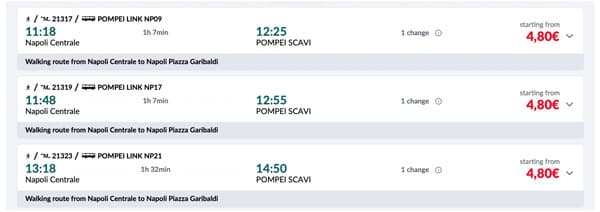
Regional trains from Naples Central Station (Napoli Centrale) to Pompeii Scavi station depart about every 30 minutes. A one-way ticket costs €4.80. The journey takes approximately 1 hour and 8 minutes if the train is on schedule and without interruptions. Be prepared for frequent stops and the presence of gypsies and beggars. Please note that you will need to transfer to the Pompeii Link bus in Pompeii.
By Bus
According to Google, buses N5000 and N5020 from Naples to Pompeii’s archaeological site are operated by SITAsud, but we do not recommend this option due to a lack of reliable schedules or pricing information on the company’s website. Nonetheless, for the sake of completeness, let’s mention it.
The bus stop, Via Ferraris Galileo in Naples, is about 1 km from Napoli Centrale station.
Bus tickets should cost around €10 and can be purchased at the following locations:
- BAR ETTORE, PIAZZA GARIBALDI 95
- Inside Napoli Centrale station, look for EDICOLA NUMBER ONE HUDSON NEWS
- ARPANET, Corso Arnaldo Lucci, 163
- BIGLIETTERIA NAPOLI CAPOLINEA, PIAZZALE IMMACOLATELLA VECCHIA 1
- BAR DEL PORTO, VIA C OLIVARES ANG. VIA CAMPO D’ISOLA 26
- BAR TIRAMISU’, Napoli – Corso Lucci
What to See – Main Attractions in Pompeii
Here are the key sites in Pompeii worth visiting, either independently or with a guide:
- The Temple of Apollo – one of the city’s oldest temples dedicated to the Greek god Apollo. The first mention dates back to the 8th century BC, as confirmed by archaeological findings. Initially, the site likely hosted an altar, and the main building was constructed later. Today, only two columns of the once-grand colonnade, which originally had 28, remain. Frescoes inside the temple depict scenes from the Trojan War.
- The Garden of the Fugitives
- The Large Palaestra
- The Temple of Jupiter
- The Amphitheater
- Via dell’Abbondanza (Street of Abundance)
- The Baths
- The House of Venus in the Shell
- Thermopolia (ancient snack bars)
- The Large and Small Theaters
- The Gladiators’ Barracks
- The Triangular Forum
- The Lupanar (brothel)
- The Forum
- The Building of Eumachia
- The Temple of Vespasian
- The Market
- The House of the Faun
- The House of the Small Fountain
Personal Experience and Tips
We visited Pompeii during our road trip along the Amalfi Coast. We were lucky to get tickets at the last minute. The scale of the site is impressive, and as ancient history enthusiasts, we found every stone fascinating.
I recommend watching a few videos on YouTube about Pompeii beforehand, but ideally, take a guided tour on your first visit. Exploring the ruins with a knowledgeable guide will allow you to immerse yourself in the ancient world and uncover its secrets.
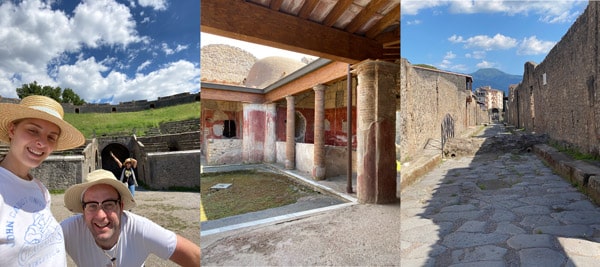
It’s essential to consider the weather, especially if you visit Pompeii between April and October. The sun can be pretty intense during these months.
What to Bring
- Drinking water. There are a few fountains on-site, but you’ll likely get thirsty long before reaching them.
- Comfortable shoes. This may seem like obvious advice, but your feet will quickly tire from walking on cobblestones.
- Headwear. Most of the site’s attractions are located in open-air areas.
- Sunscreen. Even on cloudy days, you can get sunburned in southern Italy within an hour.
- Knowledge or a knowledgeable friend. Without preparation, a visit to Pompeii might feel superficial.