 Italy for me From Italy with love


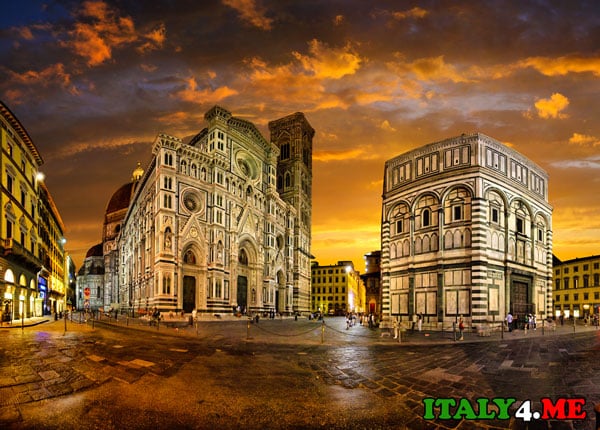
The Baptistery of St. John the Baptist is one of the three main components of the architectural ensemble of the Cathedral of Santa Maria del Fiore, the famous symbol of Florence.
A traveler entering Cathedral Square (Piazza del Duomo) from the main entrance to the Duomo will certainly notice the squat building in the foreground. This unusual structure is the baptistery, named after Florence’s patron saint, St. John. In Italian, the baptistery is called Battistero di San Giovanni.
Page Contents
Things to Know Before Visit
How much would it cost to build a Baptistery like the one in Florence?
Who designed the Baptistery in Florence?
Who did the baptistery doors in Florence?
Who is buried in the Florence Baptistery?
Why is the Florence Baptistery important?
How tall is the Florence Baptistery?
History of Construction
The site where the baptistery stands has long been considered sacred by the inhabitants of this part of Italy. There are records of a temple dedicated to a resident of Olympus, possibly the warlike Mars, being built in this part of Cathedral Square in the 1st century AD. In the 7th century AD, the building underwent significant changes, transforming into a Romanesque basilica by the 9th century.
In 897, the building was associated with the name of St. John. In the 11th century, the religious structure received its remarkable octagonal shape, blessed by Pope Nicholas II.
The 12th century was significant for this landmark. In 1128, it was granted the status of a baptistery. Throughout the century, builders added to the roof and topped it with a small lantern. They also actively worked on cladding the building’s walls with white and green-gray polychrome marble. At the beginning of the 13th century, the baptistery received an addition in the form of a rectangular apse (scarsella).
From the 9th to the 12th century, the baptistery combined the functions of a cathedral and a baptistery. To allow parishioners to freely attend sermons and participate in baptism ceremonies, the baptistery has three pairs of doors. Each of them has a special significance.
The Doors
The first to decorate the portals was the talented medieval master Andrea Pisano. He was entrusted with the bronze doors, also known as the Southern Doors of the baptistery. His work on the Southern Doors took six long years, starting in 1330. On the golden bronze surface of the panels, Pisano engraved scenes from the life of John the Baptist, accompanied by allegorical depictions of the Virtues. The 28 scenes, crafted with the help of jewelers, evoke admiration and awe among visitors to Florence.
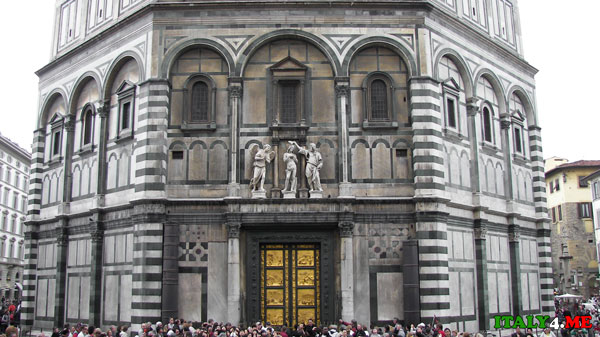
The Northern entrance to the Baptistery of St. John was assigned to Lorenzo Ghiberti after a long and intense competition.
One of the losing competitors was Brunelleschi, the creator of the unrivaled dome of the Cathedral of the Duomo. Ghiberti worked on the Northern Doors from 1401 to 1424, covering them with scenes from the New Testament and the Gospels.
Near the Northern Doors stands a column dedicated to St. Zenobius, the first bishop of Florence. His relics were placed in the Duomo, where they remain to this day. According to local legend, the tomb containing the saint’s remains caused an old elm to bloom in the middle of a harsh winter. A marble monument was later erected in place of the miraculous elm.
The Northern Doors impressed the guild of merchants so much that Lorenzo Ghiberti almost immediately began working on the baptistery’s third portal, the Eastern Doors. The master’s creative vision was so extensive that he needed his own workshop to work with bronze. The entire period of work on the Eastern Doors lasted 27 years. With funding from the guild of merchants, Ghiberti created the true Gates of Paradise.
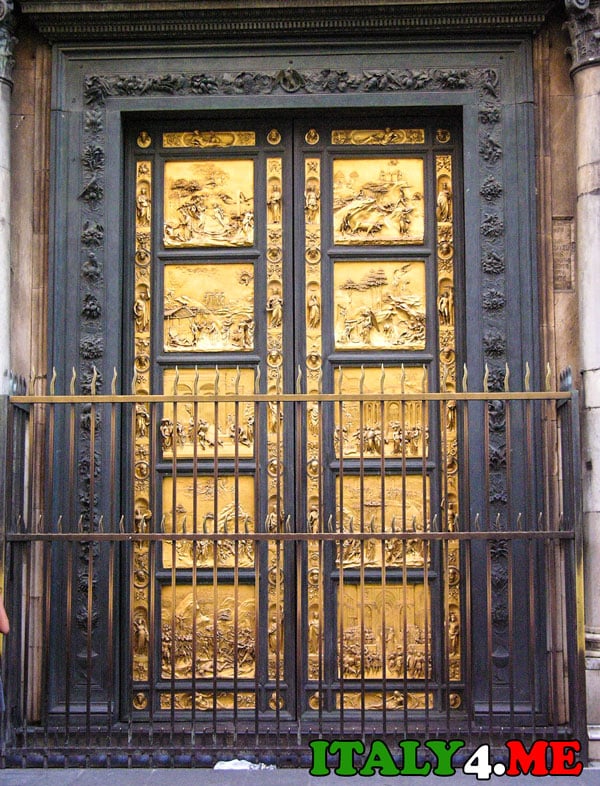
The Eastern Gates are divided into 10 separate bronze panels, each measuring 16.4 by 6.6 feet (5 by 2 meters). Each panel illustrates stories from the Old Testament, framed by the faces of saints. Legend has it that the name “Gates of Paradise” was given to the Eastern entrance of the baptistery by Michelangelo, struck by the precision of the details and the beauty of the drawings. The fresh shine of the newly polished bronze only added to the incredible impression of the gate panels.
Interior Decoration
The exterior of the three-tiered baptistery harmonizes well with the soaring Giotto’s Bell Tower and the building of the Cathedral of Santa Maria del Fiore. However, the interior decor of the baptistery is impressive in its detail and immense value.

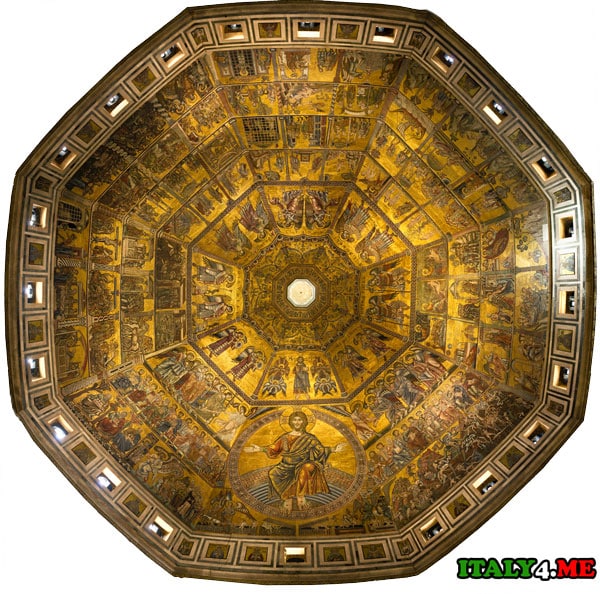
The white marble dome of the baptistery is a fantastic sight from the inside. The eight facets of the ceiling converge at a tiny spot of natural light high under the lantern. The rays of daylight fill the space, illuminating the most beautiful frescoes in all of Florence and Tuscany. Various Italian masters worked on ceiling paintings from the 13th to the 14th centuries.
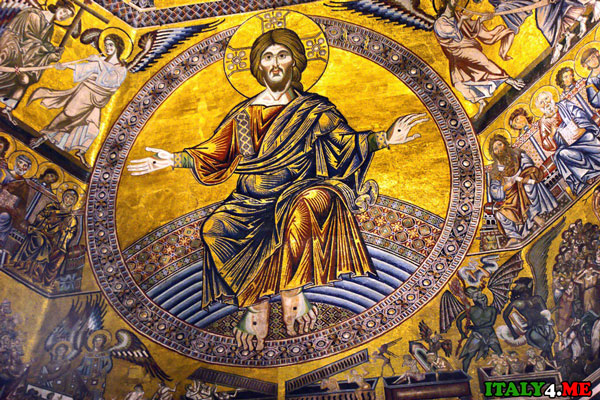
The image of Jesus, surrounded by heavenly angels, worldly deeds, and mortal sins, stands out especially. The scene of the Last Judgment occupies three adjacent facets of the dome. The remaining surfaces are painted with scenes from the scriptures. Here, you can admire the creation of life on Earth, as well as the Heavenly Hierarchy, and find figures such as John the Baptist and the Virgin Mary. A unique contribution to the frescoes was made by the artist Coppo di Marcovaldo.
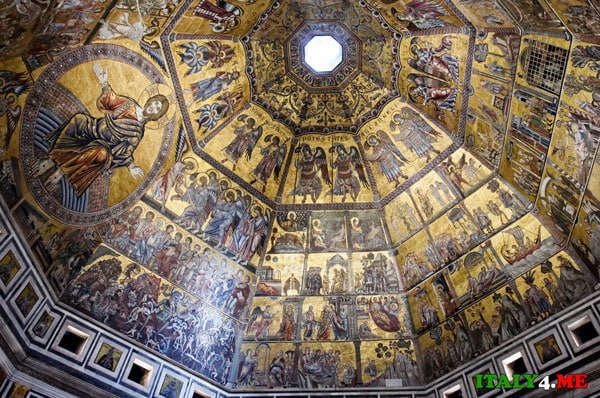
The dome is separated from the wall section by a narrow horizontal tier adorned with windows and saints’ faces. The walls, or the lower order of the building, have a classic Romanesque finish. This means vertical space division by columns. Paired windows with rounded arches are adorned with intricate stucco, serving more of a decorative purpose than a functional one.
Looking further down, you can enjoy the combination of columns and large geometric patterns. This ensemble organically links the richly painted ceiling with the modest floor decor.
Visitors will also be captivated by the baptistery’s pulpit, decorated with frescoes from the late 13th century. Additionally, the Baptistery of St. John houses the sarcophagus of Bishop Ranieri and a memorial to John XXIII. The tomb of the self-proclaimed pope was created by two talented Italians, Michelozzo and Donatello.
The baptismal font is modestly located against the baptistery’s wall. Many generations of Florentines owe their initiation into the Catholic faith to this font. From the 9th century until the end of the 19th century, the sacrament of baptism was performed twice a year at this font. Dante Alighieri was so impressed by the baptistery’s grandeur that he mentioned the font in his most significant work, the Divine Comedy.
As a special reminder of the city’s great past, the baptistery houses the tomb of a member of the Medici family. Another pleasant detail is the wooden statue of Magdalene created by Donatello in the mid-15th century.
How to Get There and Visiting Hours
The baptistery is located in the center of Florence on Piazza del Duomo, right in front of the Cathedral of Santa Maria del Fiore. The following bus numbers can reach Piazza del Duomo: 6, 17, 14, 22, 23, 36, 37, and 71.
The baptistery is open to visitors every day from 11:15 AM to 7:00 PM, except Sundays, when it is open from 8:30 AM to 2:00 PM. On major religious holidays, it is open from 8:30 AM to 7:00 PM.
To enjoy the beauty and grandeur of the buildings on Cathedral Square, visitors are offered a comprehensive ticket costing 10 euros. With this ticket, a traveler can visit:
- The Cathedral and climb its dome;
- The Baptistery of San Giovanni;
- Giotto’s Bell Tower;
- The Crypt of Santa Reparata;
- The Duomo Museum.
The ticket is valid for 24 hours from the first visit to one of these attractions.
I sincerely hope you find the time and inspiration to visit such a grand Florentine landmark as the Baptistery of St. John. The stunning blend of grandeur, beauty, and an enduring sense of history is incredible. Cathedral Square, with all its buildings, is a real treasure trove of strong impressions. Then, after the excitement and wonder, peace and tranquility will settle into your soul. I wish you only pleasant emotions!