 Italy for me From Italy with love


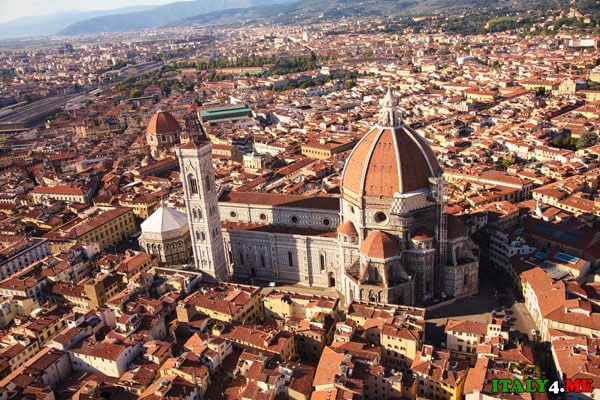
The most beautiful and popular attraction in Florence is the Cathedral of Santa Maria del Fiore (Duomo di Firenze), the symbol of Tuscany’s capital.
Modern travelers strolling through the streets near Cathedral Square can spot Santa Maria del Fiore from afar.
The cathedral’s soaring tower rises 295 feet (90 meters) above the ground. This enormous building, masterfully adorned with stucco, is crowned with a bright red dome. This dome, like a guiding beacon, draws the eye and beckons travelers toward it. By the way, no camera, not even the widest-angle one, can capture the entire cathedral building!
Page Contents
Things to Know Before Visit
How much would it cost today to build a cathedral like the Duomo in Florence?
Why is the cathedral of Santa Maria del Fiore important?
Who designed the Duomo in Florence, Italy?
Is the Duomo in Florence free?
Do you need tickets to visit the Duomo in Florence?
How long does it take to climb the Duomo in Florence?
Who painted the Florence Duomo’s ceiling?
What is the Florence duomo made of?
Style and History of the Cathedral
The Cathedral of Santa Maria del Fiore (Italian: La Cattedrale di Santa Maria del Fiore) makes an indelible impression. This extensive structure does not overwhelm visitors with its monumentality. The intertwining of Early Renaissance and Gothic styles resulted in an inexpressibly beautiful Quattrocento architectural style. It imbues the cathedral’s marble walls with a divine lightness, prompting visitors to reflect on the most profound thoughts. Let us turn to history to understand the life journey of this building.
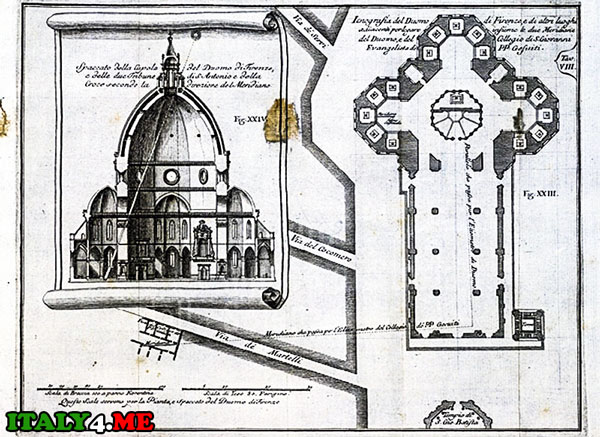
The Catholic Church took the initiative to construct a new cathedral in the late 13th century. At that time, Florence was rapidly developing into a major city. The number of parishioners at the local Santa Reparata church exceeded its capacity. City authorities were also interested in ensuring that Florence could compete with other major Tuscan cities like Pisa and Siena. Thus, the outdated Santa Reparata cathedral was replaced to make way for its successor.
Construction of the Duomo (cathedral) began in the 13th century, and the final work on the facade was completed by the late 19th century.
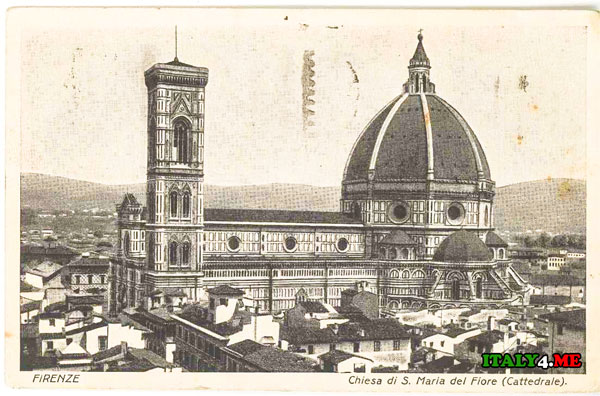
The construction of the Cathedral of Santa Maria del Fiore, renowned for its unparalleled dome and mesmerizing exterior, took six centuries. As a result, the citizens received a uniquely large church with a capacity of 30,000 parishioners. Essentially, it represents an entire square covered by the cathedral’s dome.
Construction Work
The architect chosen to design the cathedral was Arnolfo di Cambio. Drawing on ideas from early Italian Renaissance and Gothic elements, the architect envisioned a grand structure. The Duomo of Santa Maria del Fiore was designed as a three-nave church in the shape of a cross. The size of the new cathedral significantly exceeded that of its predecessor. The entire area previously occupied by Santa Reparata fit within the central nave of Santa Maria del Fiore. 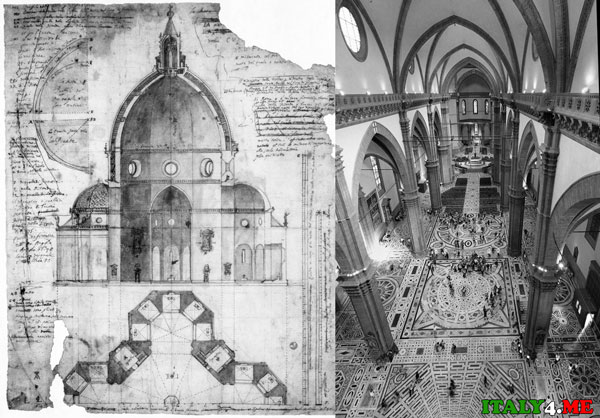
The symbolic first stone of the cathedral’s foundation was laid in September 1296 by a papal envoy from Pope Boniface VIII. Thanks to Arnolfo di Cambio’s efforts, most of the work on the cathedral walls was completed. However, after the architect’s death, construction paused for 30 years. The next overseer of the cathedral’s construction was the famous Italian painter and architect Giotto di Bondone  . The work of this artist later inspired geniuses like Raphael, Michelangelo, and Leonardo da Vinci.
At that time, Giotto was the chief architect of Florence. In his official capacity, he closely worked on the Duomo’s bell tower, named Campanile (Italian: Campanile). Giotto developed the construction plan for the bell tower and created detailed sketches for the first tier’s external decoration.
The architect’s death in 1337 temporarily halted construction. An epidemic of plague 11 years later further delayed work.
Workers resumed their duties in 1349 under the direction of architect Francesco Talenti. Ten years later, he was succeeded by Giovanni di Lapo Ghini. These overseers are credited with completing the bell tower’s construction and finalizing the cathedral walls’ architectural design. By the early 15th century, Santa Maria del Fiore was ready for the dome’s construction. This task posed the most significant challenge, as the dome’s large area required innovative engineering solutions.
The ingenious Italian precisely calculated the parameters of the octagonal tower and the extended spire. He also invented and implemented several mechanisms to lift entire sections of the dome to great heights. To stabilize the structure, Brunelleschi ordered the installation of 24 vertical ribs and 6 horizontal rings. This framework still holds the Duomo’s dome, which weighs about 37,000 tons.It is believed that the Florentine authorities held a competition to find a solution for this task. On one hand, they needed the perfect design for the dome, and on the other, they had to solve the problem of constructing it at great heights. Ultimately, the answers emerged from the mind of architect Filippo Brunelleschi.
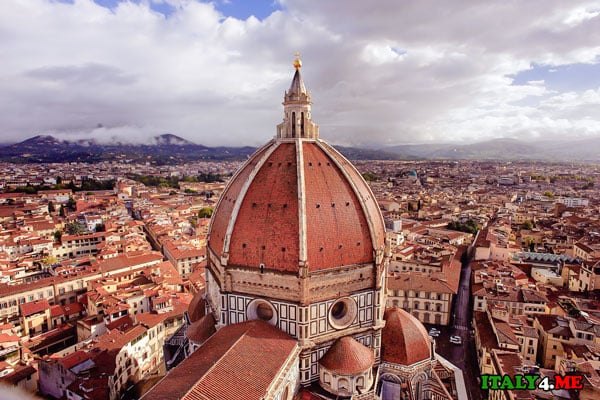
Work on the dome continued from 1410 to 1461. As the final architectural touch, Filippo Brunelleschi envisioned a lantern tower crowning the dome of Santa Maria del Fiore. It helps distribute the dome’s weight evenly across the structure and serves both aesthetic and functional purposes. The completed structure was consecrated by Pope Eugene IV, giving it additional significance within the Catholic Church.
In the 16th century, a scandal erupted around the cathedral. Many of the tasks related to the Duomo’s external decoration were subject to competition. However, various nobles and officials sought to profit from the participants. As a result, construction activities were postponed until the mid-19th century.
Ultimately, the cathedral’s design from 1876 to 1887 was overseen by Italian architect Emilio De Fabris. His patterns still adorn the facades of Santa Maria del Fiore. De Fabris’s particular innovation was the polychrome cladding marble. This material makes the cathedral “play” with colors: white blending into gray, green, and pink tones. This palette is intended to mimic the tricolor Italian flag.
The pointed arches of the facade are decorated with frescoes dedicated to the life of the Virgin Mary. Above the central entrance to the cathedral is an infant Christ seated on a throne with the Virgin Mary, surrounded by statues of twelve preachers. Higher up, the facade is adorned with a large lace window. The space around the window contains stucco medallions depicting famous Florentines. The three bronze doors guarding the entrance to the cathedral are particularly notable.
Interior Decoration of the Cathedral
The richness of Santa Maria del Fiore’s exterior decoration and its size make an incredible impression on travelers. Once inside, visitors may be taken aback. The lacework of the exterior decor gives way to the austere interior of the Catholic church. During the reign of Lorenzo de’ Medici, Dominican friar Girolamo Savonarola preached in the Duomo. He was known for his strict views and ensured that the Duomo became a model of morality and virtue.
The cathedral’s vaults are adorned with 15th-century frescoes depicting Florentines who significantly contributed to the city’s, country’s, and church’s life. These include compositions dedicated to Dante Alighieri, Giovanni Acuto, and Niccolò da Tolentino. Additionally, busts by Arnolfo di Cambio, Giotto di Bondone, Brunelleschi, and Emilio De Fabris are preserved.
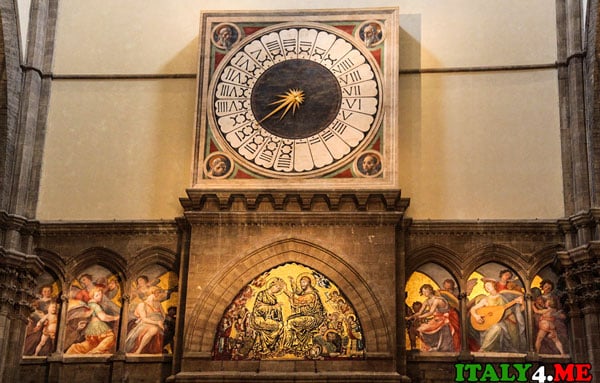
The most important relic of Santa Maria del Fiore is the urn with the relics of Saint Zenobius of Florence, discovered in the ruins of Santa Reparata in the 14th century. An unusual decoration of the cathedral is the clock created by Paolo Uccello in 1443. The unique feature of this chronometer is that its hands move in the opposite direction.
The incredible stained glass windows of the Duomo cannot be overlooked. Forty-four glass paintings adorn the arches of the nave and transepts. Each of them is dedicated to the deeds of saints and martyrs from the Old and New Testaments. The round stained glass windows in the dome’s drum depict scenes from the lives of Christ and the Virgin Mary.
After experiencing the energy emanating from the frescoes, stained glass, and sculptures within the cathedral’s walls, visitors need only look up to feel a new surge of awe. The extensive Duomo dome was masterfully painted in the second half of the 16th century by artists Giorgio Vasari and Federico Zuccari.
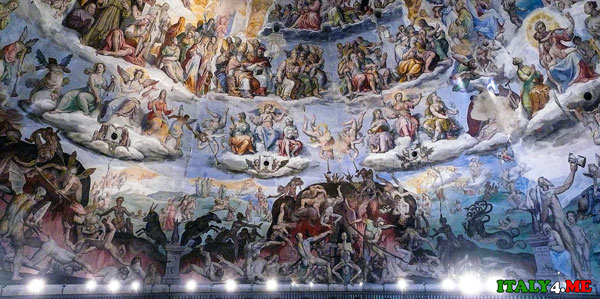
The painting has a multi-tiered structure and is dedicated to the Last Judgment. The lowest ring is devoted to mortal sins and the inhabitants of Hell, led by the Antichrist. The subsequent rings, rising towards the lantern, depict saints, elders of the apocalypse, heavenly angels, the Virgin Mary, and good deeds. The image of Satan contrasts with the bright figure of Christ.
Museum of the Works of Santa Maria del Fiore
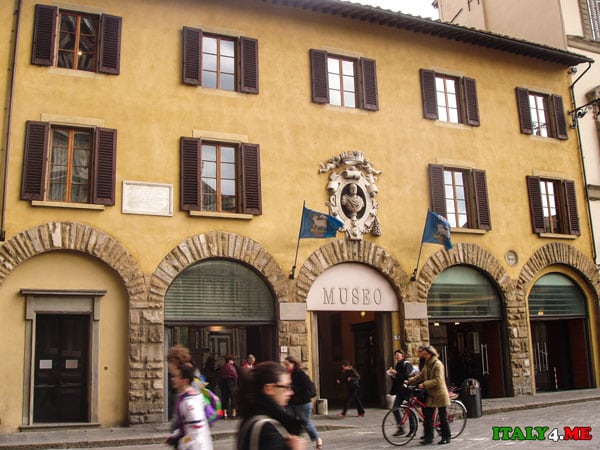
Most of the items that once adorned the cathedral’s interior have been gradually moved to the Duomo Museum (Museo dell’Opera di Santa Maria del Fiore), located on Cathedral Square. The workshop used by architect Brunelleschi opened as a museum in 1891. Visitors can admire the dome’s design drawings and models created by Brunelleschi himself. The choirs, which served the cathedral singers in the 15th century, also found their place in the museum.
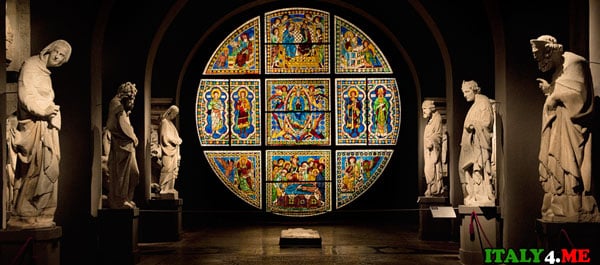
The extensive collection of sculptures exhibited in the Duomo Museum deserves special mention. It includes:
- An excellent selection of Florentine sculptures from the 16th century.
- The statue “Penitent Mary Magdalene” (15th century), previously adorning the cathedral’s Baptistery.
- “Prophet Habakkuk” (15th century) by Donatello, moved from the bell tower;
- A statue of Pope Boniface VIII by Arnolfo di Cambio, removed from the cathedral’s facade.
- And an unfinished work by the great Michelangelo Buonarroti – “Pieta“.
The Baptistery of San Giovanni
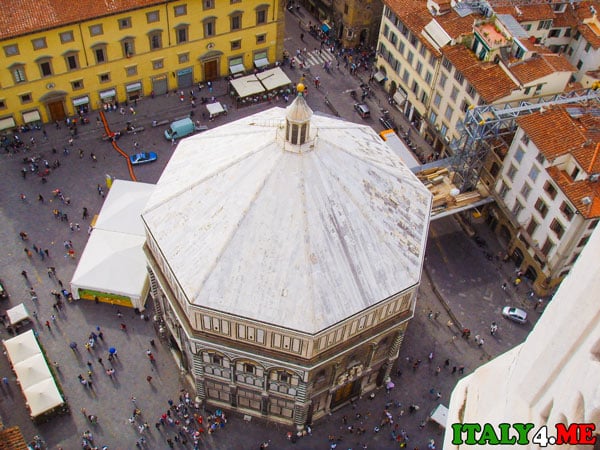
The Santa Maria del Fiore cathedral complex includes the Baptistery (Battistero di San Giovanni), a separate building near the Duomo on Cathedral Square. The Baptistery is named after John the Baptist (Italian: San Giovanni Battista) and is the oldest building on the square, with its construction dating back to the 5th century.
The low hexagonal building is Romanesque in style and received its current appearance in the 12th century. Inside the Baptistery, visitors can admire the golden dome painted with images of Christ, saints, and biblical scenes.
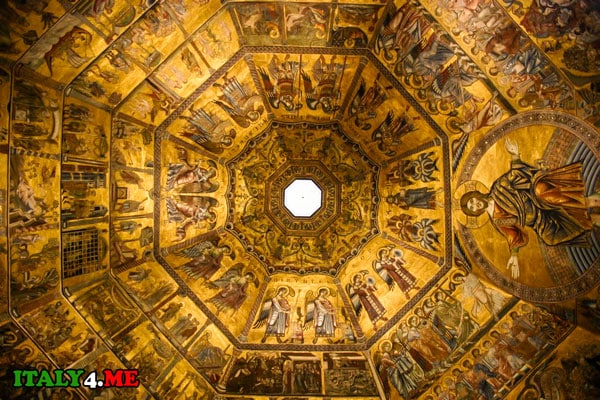
The bas-reliefs decorating the baptistery gates from the 13th to 15th centuries are particularly interesting. They depict John the Baptist and the main virtues. The newest gates, the eastern ones, were uniquely designed by Lorenzo Ghiberti in the mid-15th century. The Golden Gate was divided into ten equal panels, each carefully reproducing biblical stories. This masterpiece is also known as the Gates of Paradise.
Santa Maria del Fiore Cathedral in Numbers
Viewed from above, the Duomo resembles a Latin cross, with a vertical axis of 502 feet (153 meters) and a transept (width of the crossbar) of 295 feet (90 meters). The height of the internal arches reaches 75 feet (23 meters). The cathedral’s highest point, a bronze ball at the tip of the dome, is 295 feet (90 meters). The capacity is 30,000 people. A dozen architects worked on the building, with the construction spanning six centuries.
The Duomo’s remarkable dome’s parameters include:
- Its diameter is 138 feet (42 meters);
- Weight – 37,000 tons;
- Number of bricks – about 4 million.
Considering all this, it is safe to say that the Duomo of Santa Maria del Fiore is one of the largest and most impressive churches in Europe!
Practical Information
Ticket Prices
Enjoy the beauty of Santa Maria del Fiore’s interior by purchasing a unified ticket for €18, which is also valid for the dome climb (requires advance booking), Duomo Museum, and Baptistery visit.
Check the current ticket prices and schedule on the official website Duomo.firenze.it, available in Italian and English. Last-minute tickets can be purchased on the website www.getyourguide.com.
For children aged 3 to 11, the ticket costs €3. Tickets are valid for 72 hours, allowing one visit to each attraction.
The cathedral can also be accessed for free, with an approximate two-hour wait in line.
Cathedral Hours
- Monday, Tuesday, Wednesday, Friday – open from 10:00 AM to 5:00 PM;
- Saturday – from 10:00 AM to 4:45 PM;
- Sunday – from 1:30 PM to 4:45 PM.
You can visit the cathedral dome:
- All days except Saturday – from 8:30 AM to 7:00 PM;
- Saturday – from 8:30 AM to 4:40 PM.
Museum Hours
- All days except Sunday – from 9:00 AM to 7:00 PM;
- Sunday – from 9:00 AM to 1:45 PM.
How to Get There
The Cathedral of Santa Maria del Fiore is located in Florence, Italy, at Cathedral Square (Piazza del Duomo), building No. 17.
Find a hotel near the Duomo
Getting to the cathedral is easy since it is in the city center and is Florence’s most famous attraction. Any bus heading to Cathedral Square will take you there.
Guided Tours
You can access the dome without waiting in line by joining an English-language group tour, which lasts for one hour and costs €20 per person, with start times at 10:00 AM or 2:00 PM. This option is also suitable for those who could not reserve a dome visit in advance.
Take the time to dedicate a whole day to exploring Cathedral Square and visiting the Santa Maria del Fiore cathedral. TheDuomo’s external beauty and immense historical value create an incomparable atmosphere of being part of something eternal.