 Italy for me From Italy with love


The Arch of Janus (Arco di Giano) is a monument of Ancient Rome dating back to the 4th century AD, a period marked by the reign of the first Christian emperor, Constantine the Great. This landmark stands in Rome’s historic center on Via del Velabro, near the northwestern slope of the Palatine Hill (Palatino).
Unlike other Roman arches, this ancient structure has a unique form known as a Greek tetrapylon or Latin quadrifrons, meaning “four doors.” These are square-shaped architectural structures with an arched entrance on each side.
Arco di Giano is the only well-preserved tetrapylon in Rome, apart from the Arch of Malborghetto (Arco di Malborghetto) on Via Flaminia, which has been fully walled up since the Middle Ages.
Page Contents
Location
The Arch of Janus was built during the late antiquity period on the eastern edge of the Forum Boarium (Foro Boario), in the Velabrum (Velabro) district. In Rome’s pre-imperial era, this area between the Palatine and Capitoline Hill (Monte Capitolino) was a marshy lowland frequently flooded by the waters of the Tiber River (Tevere).
By the 6th century BC, after the construction of the Cloaca Maxima (Cloaca Maxima), the Velabrum was drained and became one of the city’s busiest areas, thriving as a commercial hub. The Forum Boarium not only became a center of commerce but also a site for several religious structures, including the surviving Temple of Portunus (circa 100 BC) and the Temple of Hercules Victor (circa 80 BC).
The four-faced arch was constructed directly above the Cloaca Maxima at a prominent intersection where key roads converged, linking the city’s oldest port, the Portus Tiberinus, to the heart of Rome—the Roman Forum.
When and Why Was It Built?
The purpose and exact construction date of the Arch of Janus remain subjects of debate.
The most widely accepted theory suggests it was erected around AD 356 by order of Emperor Constantius II to honor his father, Constantine the Great. Surviving records from 4th-century Roman catalogues mention a structure at this location called Arcus Divi Constantini—the Arch of the Divine Constantine. In 2017, the discovery of the letters COS (an abbreviation for COSTANTINO) inscribed on blocks of the staircase leading to the tetrapylon’s attic further confirmed the monument’s connection to the first Christian emperor.
To date, scholars have found no evidence to suggest that the imposing structure was built to commemorate a military triumph. It was more likely intended as a monumental marker at a major crossroads linking the Forum Boarium, the Palatine, the Circus Maximus, and the southern boundary of the Campus Martius.
The Name
Like its purpose, the origin of the Arch of Janus’s name is also unclear. Its original name on ancient Roman maps is unknown. The current name, associated with the god Janus, only emerged in the 16th century. The four-sided arch was seen as an apt symbol of the many-faced deity—one of the most mysterious and paradoxical figures in the Roman pantheon. 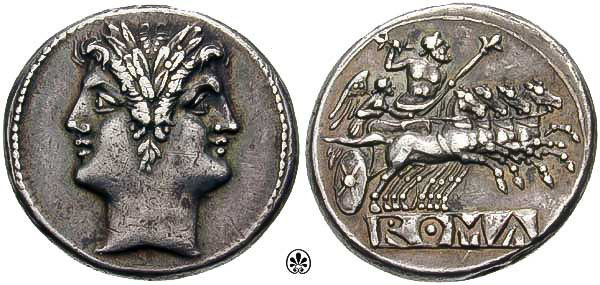
However, the explanation may be more mundane: the name “Arch of Janus” could simply derive from the Latin word *ianus*, meaning “covered passageway.”
Read more about ancient Roman gods and goddesses.
What Did the Arch of Janus Originally Look Like?
Today, we can only speculate about the Arch of Janus’s original appearance.
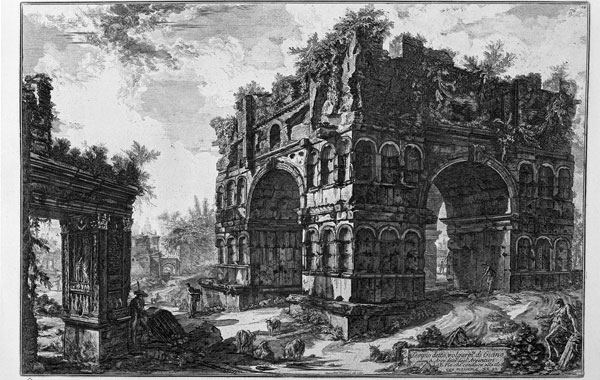
Its decorative elements and upper structure have not survived. The tall attic may once have had a pyramidal brick roof clad in marble, while the four facades were likely adorned with magnificent bronze statues of gods and mythological heroes. These statues probably did not remain long, as Emperor Theodosius I declared Christianity the empire’s sole religion in AD 392, rendering pagan deities obsolete.
It is remarkable that the monument was not completely destroyed over time. In the 12th century, the Frangipane family incorporated the Arch of Janus into a fortress, bricking up all four arches. This adaptation protected the ancient tetrapylon from the fate that befell many other pagan structures.
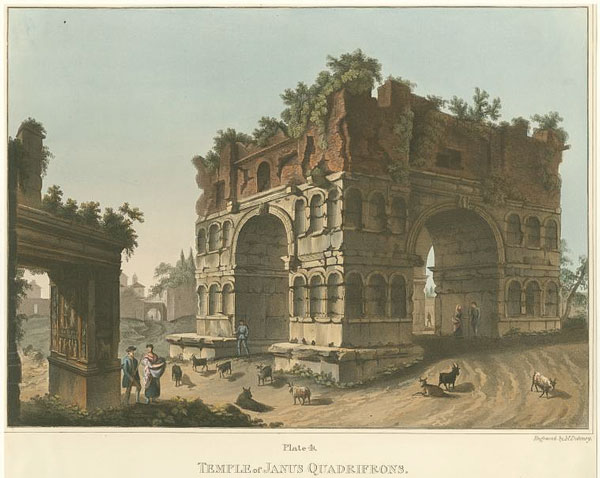
The arch stood fortified for centuries until 1830, when the medieval additions were removed. Unfortunately, the roof was also demolished at that time, mistakenly thought to be a later addition.
Description and Architectural Features
Like the Arch of Constantine (Arco di Costantino) near the Colosseum, the Arch of Janus was constructed using materials and decorative elements repurposed from older buildings. The main structure was built with brick and durable Roman concrete, while the exterior was faced with marble.
What remains today is a massive cube measuring 12 by 16 meters, supported by four piers with a shared cross-vaulted ceiling. Each archway is 10.6 meters tall and 5.7 meters wide. The entire structure is topped by a high, flat attic once covered in marble. A preserved staircase and doorway in the southeast pier suggest that the attic once housed a large upper chamber.
Numerous holes in the facade mark where iron pins once secured the marble cladding.
Recessed niches, arranged in two levels on each side and topped with shell-shaped semi-domes, were originally designed to hold 48 statues—likely life-sized. Fragments of some sculptures remain on the keystones of the four arches: the goddess Roma on the east side, Minerva on the north, and possibly Juno and Ceres on the others.
Some decorative elements and dedicatory inscriptions removed from the arch are now housed in the nearby church of San Giorgio in Velabro.
Today, the Arch of Janus is in need of further restoration. Dark stains and holes mar its surface, the result of centuries of weathering and treasure hunters searching for hidden riches. In 1993, a mafia car bomb exploded near the arch, leading to the installation of a protective fence and the closure of the monument to visitors.
The tetrapylon on Via del Velabro remains a vital part of the vast cultural and historical legacy of the Roman Empire, alongside other monumental tetrapylons such as the Arch of Septimius Severus in Leptis Magna (Libya), the Tetrapylon in Palmyra (Syria), the Heidentor in Carnuntum (Austria), and the Tetrarchic Tetrapylon in Tébessa (Algeria).
Nearby Attractions:
- Temple of Portunus (Tempio di Portuno) – circa 80 BC;
- Temple of Hercules Victor (Tempio di Ercole Vincitore) or Hercules Olivarius (Tempio di Ercole Oleario) – circa 120 BC;
- Arch of the Argentarii (Arco degli Argentari) – AD 204;
- The Mouth of Truth (Bocca della Verità);
- Theatre of Marcellus (Teatro di Marcello) – 12 BC.
Visiting Hours
In November 2021, the Arch of Janus opened to the public for the first time in 28 years.
The arch is open to visitors every Saturday from 10:00 AM to 2:00 PM, with free admission. From the last Sunday in March through the end of October, it also opens from 4:00 PM to 8:00 PM.
Address: Via del Velabro, 5, 00186 Rome