 Italy for me From Italy with love


In the Renaissance era and the periods that followed, the magnificent city of Florence (Firenze) gave the world a multitude of talented sculptors whose creations had a profound influence on the development of European culture. These fantastic marble and bronze sculptures have continued to amaze and inspire for centuries.
In form and content, these works remain the epitome of the most enlightened humanistic ideas. When visiting the Tuscan capital, it’s essential to see these 10 sculpture masterpieces in person and feel a connection to the world of art.
Page Contents
David, Michelangelo
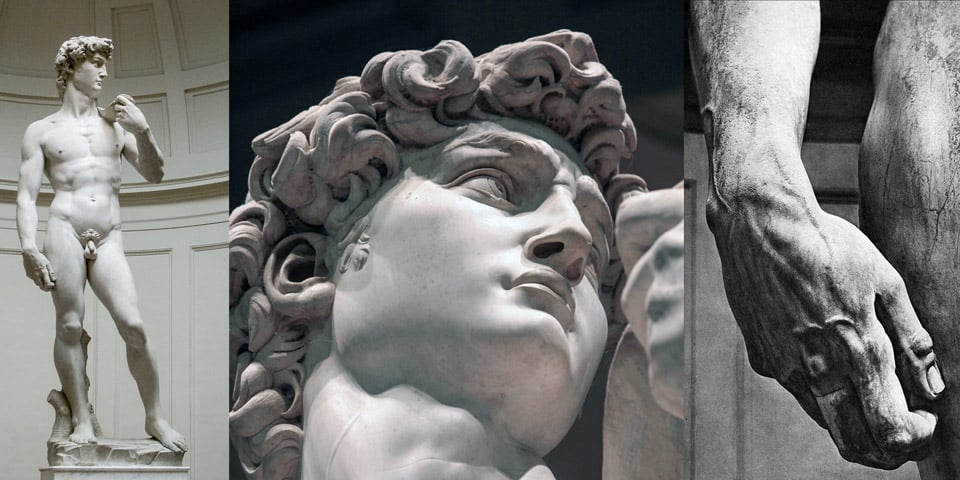
- Location: Gallery of the Academy
- Entrance Fee: from 23 euros
The 5-meter marble statue of David, created by the 26-year-old Michelangelo Buonarroti (Michelangelo di Buonarroti), is one of the world’s most replicated and interpreted sculptures. The young sculptor began his work in 1501, laboring for over two years without assistance. When the giant statue was unveiled, the Florentine public was stunned and deemed it perfect.
Michelangelo’s David was perceived as a symbol of Tuscany’s struggle for independence and became an emblem of freedom from tyrannical dynasties. The religious aspect of the statue, depicting the biblical Jewish king who defeated Goliath, gave way to contemporary patriotic ideas.
Contrary to the biblical image, Michelangelo depicted David not as a fragile shepherd boy but as a resolute, experienced warrior with a calm, confident gaze.
Interestingly, despite the apparent ideal proportions, researchers note distortions in David’s upper body proportions.
The impressive statue stood at the Palazzo Vecchio for over 300 years before being moved to Florence’s Academy of Fine Arts (Accademia di belle arti di Firenze) in 1873. Two exact full-size replicas can also be seen at Piazza della Signoria and Piazzale Michelangelo.
Slaves, Michelangelo
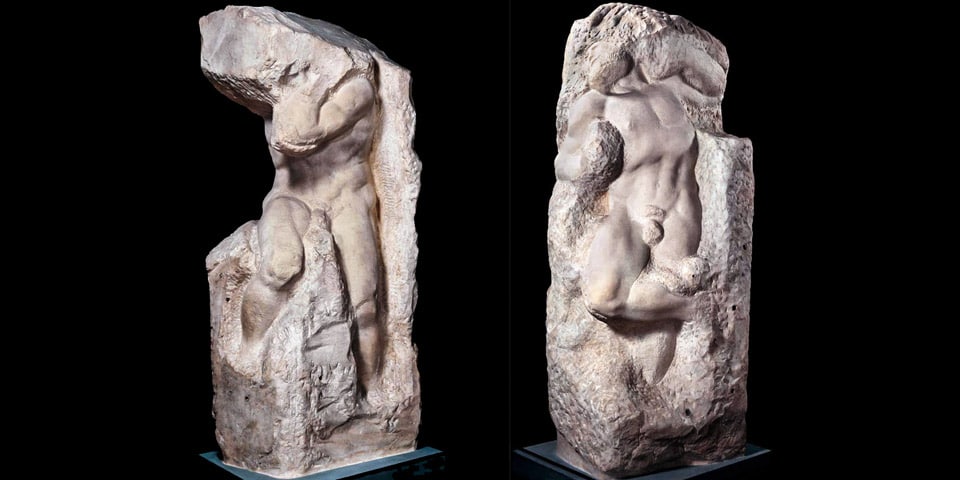
- Location: Gallery of the Academy
- Entrance Fee: from 23 euros
The cycle of six incredibly expressive sculptures, “Slaves,” was initially intended for a project decorating the tomb of Pope Julius II in Rome. Over 40 years, Michelangelo developed several versions of the tomb’s decoration, but the created figures of the captives never adorned the sarcophagus.
Two completed statues were gifted to the Florentine nobleman Roberto Strozzi (now in the Louvre), while the remaining four unfinished works stayed in the sculptor’s workshop. They later entered the collection of Duke Cosimo I, decorated one of the grottos of the Boboli Gardens, and became part of the Academy of Fine Arts collection in 1909. They can still be seen there today.
These marble sculptures are imbued with incredible expression and deep meaning. They captivate viewers, making them ponder Michelangelo’s allegory. The figures are dynamic, seemingly brought to life from the cold stone.
The Gallery of the Academy in Florence is located at Via Ricasoli, 58/60, and is open to visitors from 8:15 AM to 6:50 PM every day except Monday. Tickets can be purchased in advance on the official Florence museums website www.b-ticket.com
Perseus, Benvenuto Cellini
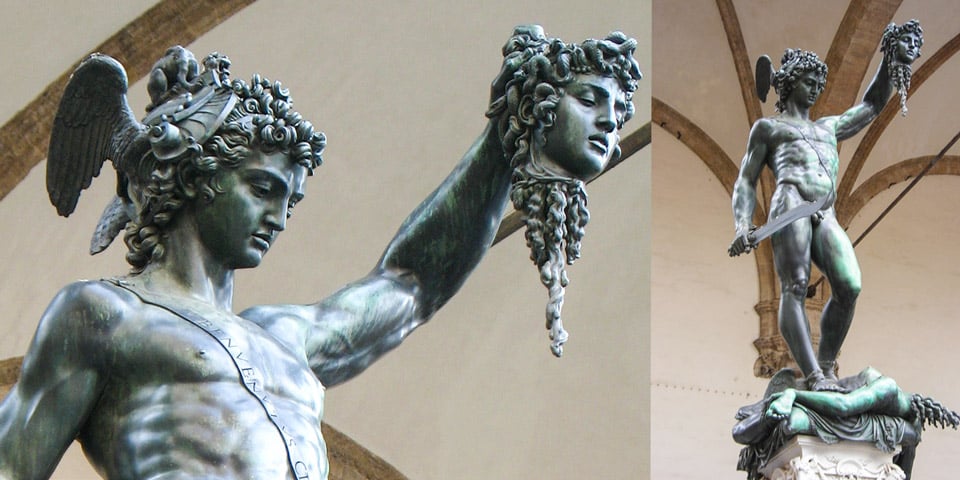
- Location: Loggia dei Lanzi, Piazza della Signoria
- Entrance Fee: Free
The mystical bronze statue “Perseus” is considered the best and most striking work by Benvenuto Cellini, a renowned student of Michelangelo, a famous Italian jeweler, and sculptor. The artist created it for his patron, Duke Cosimo I de’ Medici, over nine painstaking years.
Cellini’s hero is the ancient youth Perseus, who defeated Medusa Gorgon. He stands confidently with the severed head of the sea monster, depicted as a woman, in his raised muscular hand. His feet seem poised to dance over the lifeless body of Gorgon.
The relief of Andromeda’s liberation on the high pedestal enhances the composition’s overall concept. Cellini’s allegorical sculpture symbolized the Medici dynasty’s absolute dominance in Florence. It adorns the Loggia dei Lanzi on Piazza della Signoria and is one of the few artworks not replaced by a copy.
The Rape of the Sabine Women, Giambologna
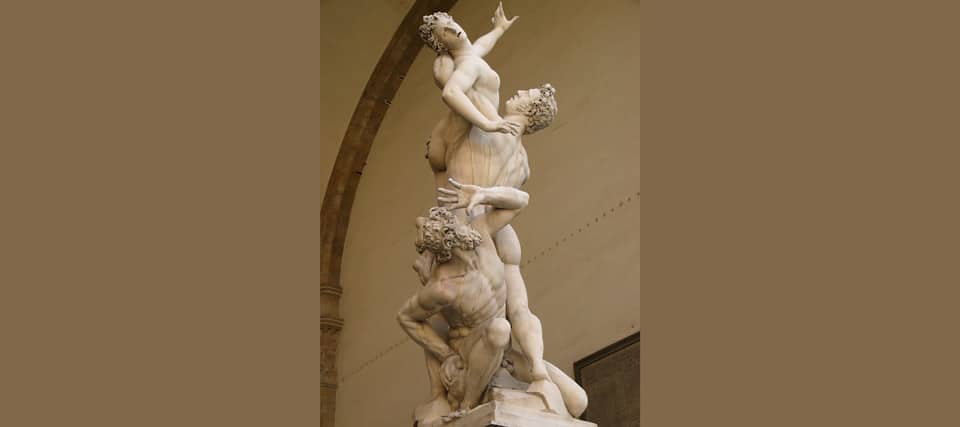
- Location: Loggia dei Lanzi, Piazza della Signoria
- Entrance Fee: Free
The 4-meter statue “The Rape of the Sabine Women,” masterfully executed by the Florentine artist Giambologna from a single piece of marble, is recognized as one of the best works in the history of sculpture. This masterpiece combines classical nude forms typical of Greek sculpture with the agitation and dynamism characteristic of Mannerism. Giambologna, a member of the prestigious Academy of Arts in Florence, began work on the statue in 1579.
The composition is based on the legend of the beginning of the Sabine War. The conflict erupted due to the chaos caused by Romulus’ soldiers during a festival in honor of the god Consus at the Circus Maximus. The Romans attacked the unarmed and unsuspecting Sabines and abducted their women, later coercing them into marriage.
This intricate composition, designed for a circular view, consists of three human figures skillfully intertwined into a single spiral. The characters are overwhelmed by a storm of conflicting emotions: passion, lust, fear, and despair. Giambologna’s incredibly sensual creation can be seen at the Loggia dei Lanzi, where it was installed in 1583 by the order of Francesco I de Medici.
David, Donatello
- Location: National Museum of Bargello
- Entrance Fee: from 15 euros
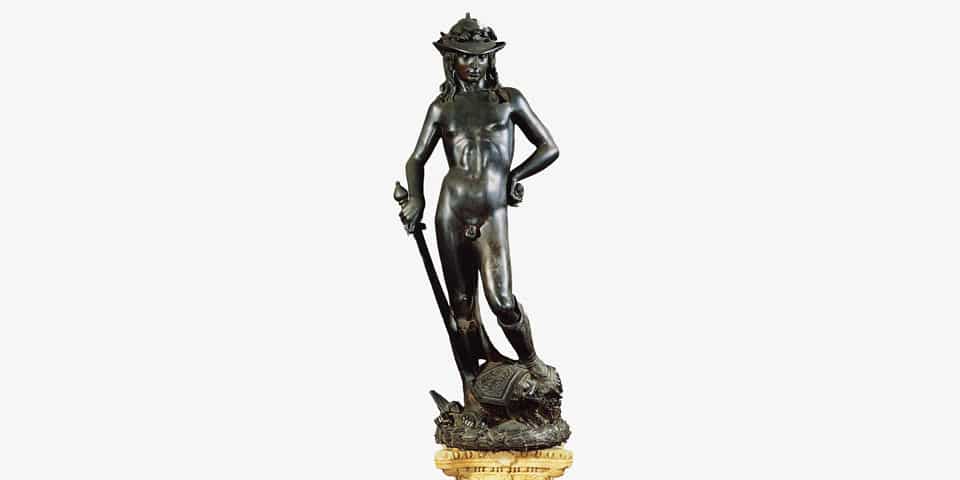
The bronze statue “David,” created by the genius Donatello, is considered one of the best interpretations of the biblical Jewish king. Donatello’s David is portrayed as a delicate, beautiful youth standing in a relaxed and self-assured pose.
At the young warrior’s feet lies the severed head of the Philistine Goliath. The statue dates back to the 1430s-1440s and is considered the first freestanding nude statue since antiquity. While the posture and body curves retain Gothic echoes, Donatello’s David heralded the beginning of a new humanistic art.
This marvelous 1.5-meter statue was commissioned by the influential Cosimo de’ Medici. In 1495, it adorned the courtyard of the Palazzo Vecchio, was later moved to the Uffizi Gallery, and now is part of the National Museum of Bargello’s collection, located at Via del Proconsolo 4. Opening hours: daily from 8:15 AM to 1:50 PM, Tuesday – Saturday, and every 1st, 3rd, and 5th Monday of the month.
Suggested reading: a biography of Donatello
Mercury, Giambologna
- Location: National Museum of Bargello (Museo Nazionale del Bargello)
- Entrance Fee: from 15 euros
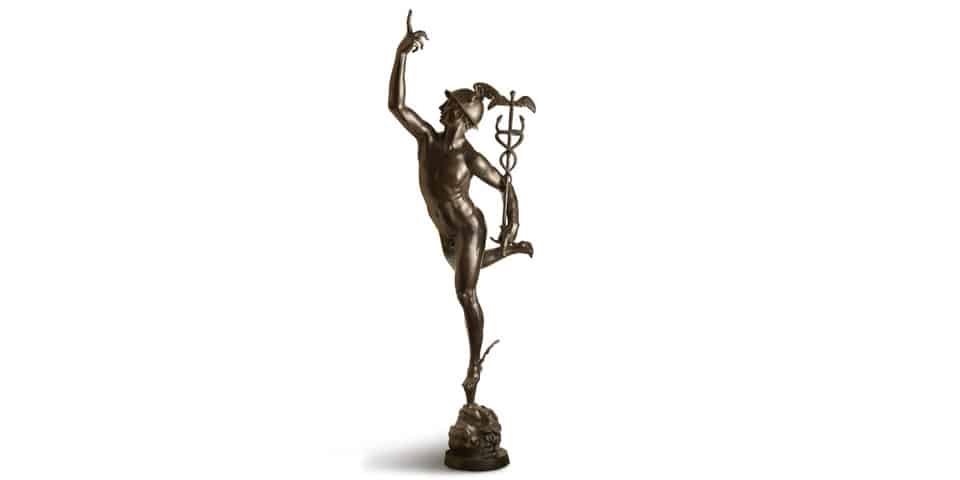
The incredibly refined, elegant, and dynamic bronze statue “Mercury” by Giambologna is considered a masterpiece of Italian Mannerism and a true marvel of plastic art.
The sculptor created a dynamic image of the god of ancient Roman mythology, the patron of merchants and travelers. The figure appears to overcome gravity, balanced along a vertical axis. The caduceus in his hand, an essential attribute of the deity, adds rhythm, grace, and playfulness.
The statue was made in the late 16th century at the request of Cardinal Ferdinando de’ Medici and resided at his villa in Rome until 1780. By the will of Princess Anna Maria Luisa de’ Medici, the last representative of the influential Tuscan family, Giambologna’s creation was moved to Florence. Today, this masterpiece is part of the invaluable collection of the National Museum of Bargello.
Lady with a Bouquet, Andrea del Verrocchio
- Location: National Museum of Bargello
- Entrance Fee: from 15 euros.
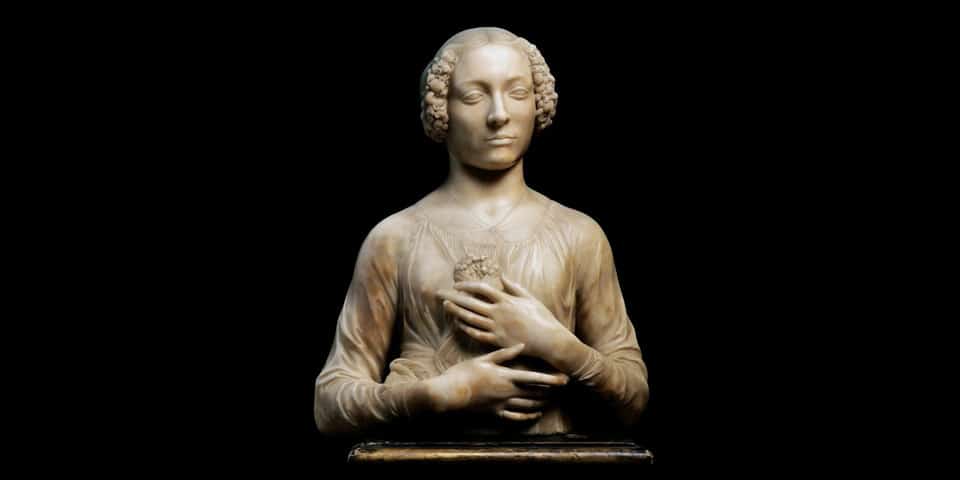
“Lady with a Bouquet” is a sculptural portrait embodying fantastic tenderness and femininity, created by the prominent representative of the Florentine School, Andrea del Verrocchio. The artist masterfully depicted the subject’s delicate facial features, intricately styled hair, and fine folds of fabric. The expressive hands of the heroine seem to have frozen in motion, tenderly clutching a small bouquet of flowers. Art historians date the sculpture to 1475.
There is no verified information about the identity of the subject. According to legend, Andrea del Verrocchio immortalized Lucrezia Donati, the only muse and secret love of the head of the Florentine Republic, Lorenzo de’ Medici, known as “the Magnificent” (Lorenzo de’ Medici il Magnifico). This exquisite sculptural portrait graces the collection of the National Museum of Bargello.
Gates of Paradise, Lorenzo Ghiberti

- Location: Museum of the Duomo
- Entrance Fee: Free
The bronze and gold-plated “Gates of Paradise,” which adorn the Baptistery of San Giovanni on Piazza del Duomo, are the famous creation of Lorenzo Ghiberti, a magnificent masterpiece of Early Renaissance sculpture that Florence rightfully prides itself on.
Creating these reliefs was the work of Ghiberti’s entire life. He spent a total of 48 years working on first the north and then the east doors of the Baptistery. The commission for the first part of the work was awarded thanks to his victory in a competition organized by the Arte di Calimala guild. The jury included members of the Florentine nobility.
The composition of the north doors is realized in relief depictions of New Testament biblical scenes, as well as evangelists and church fathers. They retain some Gothic elements while also demonstrating truthfulness, vivid narration, and an inexhaustible variety of meticulously crafted details.
The east doors of the Baptistery, which earned the name “Gates of Paradise” thanks to Michelangelo’s praise, illustrate Old Testament stories. They are distinguished by a richness of imagery and compositional complexity governed by the laws of linear perspective. An interesting detail: on the left door, between the third and fourth rows of reliefs, there are sculpted heads in medallions, functioning as door handles—portraits of Ghiberti and his young apprentice.
The original work of the great master has been replaced by a copy and, after extensive restoration, has become part of the Museo dell’Opera del Duomo exhibition. Visitors are welcome every day except Sunday. Hours: 8:30 AM – 7:00 PM (Monday – Friday); 8:30 AM – 5:49 PM (Saturday).
Night, Michelangelo Buonarroti

- Location: New Sacristy (Sagrestia Nuova), Medici Chapels
- Entrance Fee: Free
The allegorical sculpture “Night,” created by the incomparable Michelangelo, is part of a cycle of four marble statues that adorn the luxurious tombs of Lorenzo II di Piero de’ Medici and his younger brother Giuliano de’ Medici.
The sarcophagi are placed in the family memorial chapel at the Basilica of San Lorenzo. Sensual male and female figures, full of natural beauty, were celebrated in hundreds of sonnets composed by Michelangelo’s admiring contemporaries. The nude bodies of ideal proportions and forms have a deep allegorical meaning. Their massiveness seems to convey the overwhelming burden of human existence: the lazy awakening (“Morning”), anxious wakefulness (“Day”), and oppressive, restless concentration (“Evening”).
The most plastic and expressive of the entire composition seems to be the sculpture “Night,” presented in the captivating image of a woman. Looking at her creates an absolutely realistic sensation of viewing not a stone statue but a beautiful, living maiden immersed in a deep, heavy sleep. Michelangelo himself dedicated a short quatrain to his creation, translated into Russian by F. I. Tyutchev in 1855:
Hush, I beg you, do not wake me. Oh, in this criminal and shameful age Not to live, not to feel—is an enviable fate… It’s bliss to sleep, more blissful to be stone.
Gaddi Torso, Unknown Artist
- Location: Uffizi Gallery
- Entrance Fee: from 29 euros.
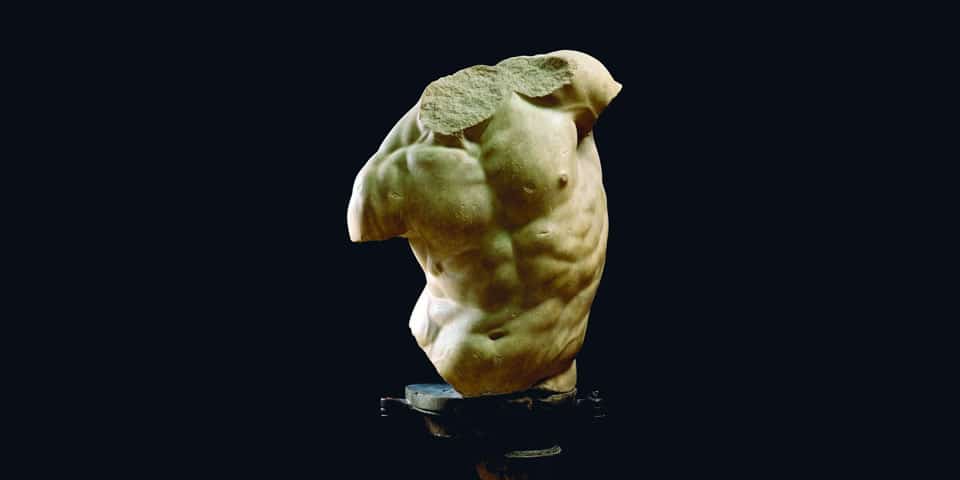
The unique collection of the Uffizi Gallery includes the world-famous fragment of an ancient marble statue depicting the upper part of a centaur’s torso.
This work is also traditionally called the “Gaddi Torso,” after the family that once owned this masterpiece of sculpture. A striking example of Hellenistic art from around the 2nd century BC, it impresses with the realism of its forms. The curve of the body and the tension of the muscles convey incredible power, strength, and energy. The works of ancient sculptors had a significant influence on the young Michelangelo, who represented his heroes as athletically built, muscular men.
I hope my article has inspired you to travel to Florence. We look forward to seeing you on our exclusive tours with the best guides in Italy.