 Italy for me From Italy with love


In Rome’s historic center, there are only 13 ancient Egyptian obelisks, and the smallest among them holds special significance. Located in Piazza della Minerva, just steps from the Pantheon, stands a unique monument featuring an Egyptian obelisk mounted on the back of an elephant, famously known as the Obelisk of Minerva (L’obelisco della Minerva).
This charming elephant greets every visitor exploring Rome’s major landmarks and truly deserves special attention.
The sculptural ensemble, erected in 1667, has a fascinating backstory and hidden symbolic messages from its brilliant creator, Giovanni Lorenzo Bernini.
Page Contents
The Obelisk
This monument, featuring a delightful elephant skillfully carrying a heavy load on its back, became part of Pope Sixtus V’s grand urban plan. His vision was to place ancient obelisks topped with a cross in Rome’s main squares to symbolize Christianity’s continuity. These monuments also served as directional markers guiding pilgrims, as they were strategically placed near religious sites across the city.
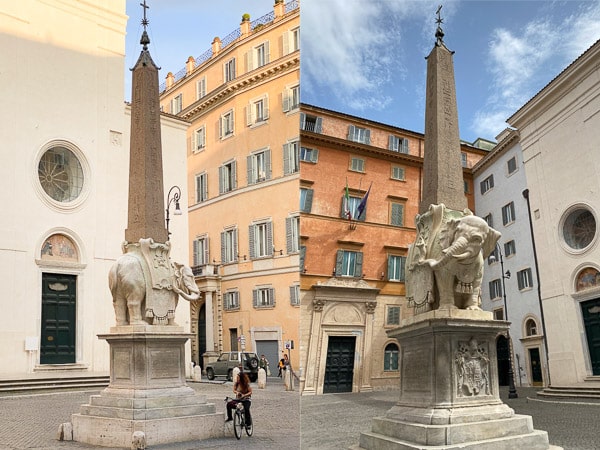
Most of the obelisks were brought from Egypt during the Roman Empire era, with the first arriving under Emperor Augustus.
The obelisk in Piazza della Minerva originated from the ancient Egyptian city of Sais. It was built around 580 BC during the reign of Pharaoh Apries of the 26th Dynasty. In the 1st century AD, Emperor Domitian brought the obelisk to Rome, where it was used to adorn the Temple of Isis in the Campo Marzio (Field of Mars).
Made from pink granite, the obelisk stands 17.9 feet (5.47 meters) tall. It was discovered in 1665 during excavations in the garden of the convent adjacent to the Basilica di Santa Maria sopra Minerva, which had been built over the ruins of a temple dedicated to Minerva. Interestingly, the cult of the Egyptian goddess Isis was later transferred by the Romans to their own goddess Minerva, and eventually to Mary, all of whom were associated with virtue and wisdom.
The highlight of L’obelisco della Minerva is undoubtedly the elephant sculpture, which not only gives the monument its distinctive charm but also imbues it with profound philosophical meaning.
The Birth of an Idea
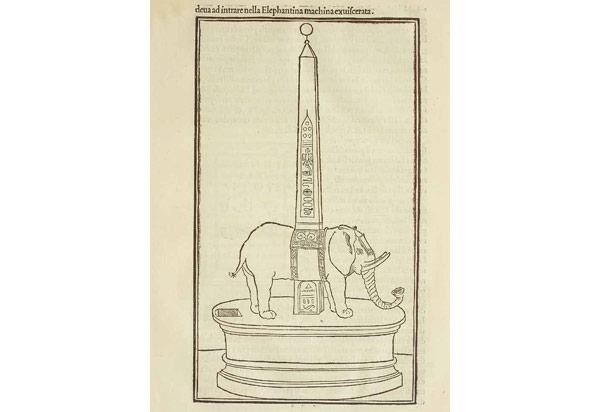
The first edition of this lyrical romance, published in 1499, includes refined woodcut engravings—among them an image of an elephant carrying an obelisk topped with a sphere.
Bernini may have drawn inspiration from this rare book, as a similar sketch was made by him in 1630 for a planned monument in front of Cardinal Francesco Barberini’s palace (the drawing is now held at Windsor Castle in the UK, www.rct.uk).
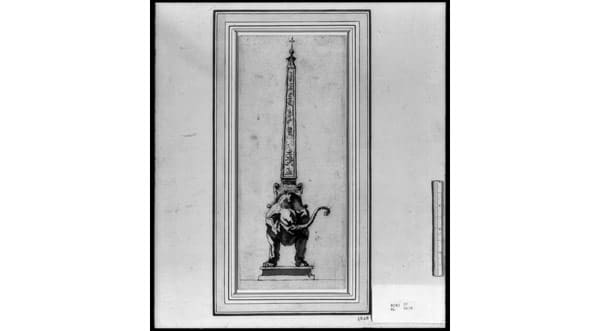
For unknown reasons, that project was never realized.
According to another theory, the choice of an exotic animal for the sculpture may have been inspired by an earlier fascinating story.
As early as 1504, a live elephant named Annone had already arrived in the Vatican. It was a gift to Pope Leo X from King Manuel I of Portugal. The appearance of such an exotic animal in Italy was seen as a marvel. Once a week, Romans were allowed into the Vatican to witness this immense creature from distant lands. Annone was featured in many drawings and engravings, and the Portuguese, whose gift so delighted the Pope, enjoyed special privileges in Rome for years.
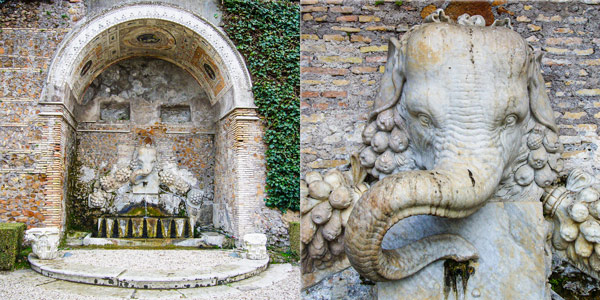
A sculptural representation of Annone survives in a fountain created by Giovanni da Udine in the garden of Villa Madama.
Project Selection
Bernini returned to his idea of an elephant monument in 1660, after a newly discovered obelisk was unearthed during excavations. Pope Alexander VII of the Chigi family was eager to continue the tradition of erecting ancient Egyptian monuments in Rome’s public squares.
To select a design, the Pope considered two candidates: Dominican friar Domenico Paglia and the already renowned architect Gian Lorenzo Bernini. A fierce rivalry ensued between them.
Father Domenico Paglia submitted a sketch featuring six mounds (a heraldic symbol of the Chigi family) and four dogs at each corner, symbolically representing the Dominicans as the “watchdogs of the Lord” (“Domini Canes”).
Bernini, meanwhile, presented ten different concepts for the Pope to consider—three of which, bearing the artist’s signature, are preserved today in the Apostolic Library of the Vatican. Among his ideas were designs where the obelisk was supported by Hercules, by figures of Time, and by other allegorical characters. The most compelling proposal was the one with the elephant.
Bernini’s new sketch differed from his earlier 1630 version—it featured a different angle, a revised pedestal, and the elephant itself appeared friendlier and even cheerful.
Pope Alexander VII ultimately rejected Paglia’s idea and selected Bernini’s elephant design. This would become the Pope’s final commission to the great sculptor, as Alexander died in 1667 before the monument’s unveiling.
Project Execution
The monument was crafted based on Bernini’s design by his talented pupil, Ercole Ferrata.
Standing 41.6 feet (12.69 meters) tall, the obelisk and elephant were installed near the center of Piazza della Minerva. The sculpture faces the façade of the Basilica di Santa Maria sopra Minerva, while its back is turned toward the Palazzo della Minerva.
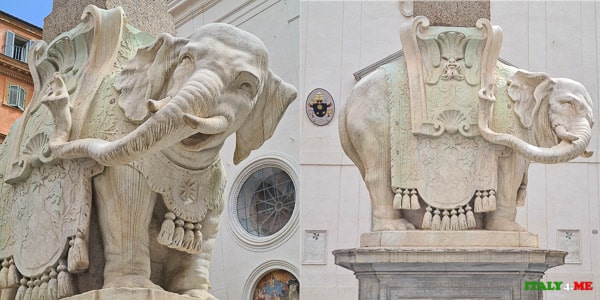
The nearly life-sized marble elephant stands atop a tall, narrow pedestal. The obelisk is crowned with the emblem of Pope Alexander VII—the Chigi hills and an eight-pointed star—topped with the Cross of Christ.
The pedestal also features the Pope’s large heraldic coat of arms and dedicatory inscriptions.
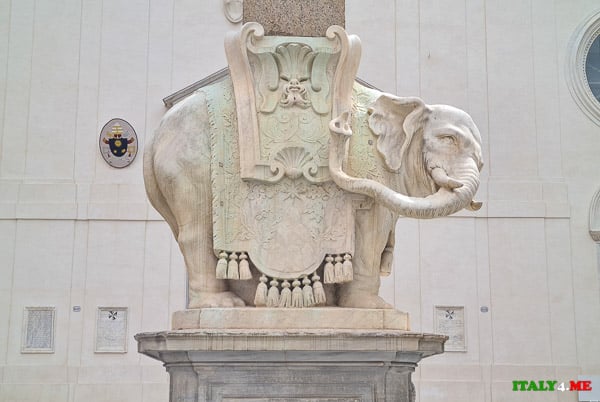
The final sculpture differs slightly from Bernini’s original sketch, which showed the entire structure supported solely by the elephant’s four legs. Influential Dominican friar Giuseppe Paglia insisted the design be made more structurally sound.
Bernini’s Joke
Soon after the obelisk monument was installed in Piazza della Minerva, humorous interpretations and playful remarks began to circulate about Bernini’s unusual elephant. The animal’s rear is pointed directly at the Dominican Order’s headquarters, where the Inquisition office was located—home to Father Giuseppe Paglia, Bernini’s envious rival.
When examining the smiling elephant, take note of the positioning of its body: the tail is lifted to the side and the tension in the back and hindquarters suggests a very specific physiological act.
Through this irreverent pose, Bernini delivered his revenge and “paid his respects” to the Dominicans.
The Obelisk of Minerva carries both humor and deep philosophical meaning. It’s known that Bernini had never seen a real elephant and created the sculpture based on others’ drawings and written descriptions. Its slightly disproportionate body and piglet-like features led Romans as early as the 18th century to affectionately nickname the monument “Porcino della Minerva” (The Piglet of Minerva), which eventually evolved into “Pulcino della Minerva” (The Chick of Minerva).
It is believed that Pope Alexander VII himself suggested Bernini inscribe a Latin motto on one side of the pedestal:
“Let anyone who sees the carved images of Egyptian wisdom carried by the elephant, the strongest of beasts, understand this: to carry solid wisdom, one must have a strong mind.”