 Italy for me From Italy with love


Ponte Sisto is an ancient bridge in the historic center of Rome that spans the Tiber River (Tevere), connecting Via dei Pettinari with Piazza Trilussa in the Trastevere district.
The bridge was built between 1473 and 1479 on the remains of a Roman-era foundation, commissioned by Pope Sixtus IV, after whom it was named. It was the first stone bridge constructed in the city since the time of the Roman Empire. Earlier bridges were known by the names of their builders—such as the Bridge of Agrippa, the Bridge of Aurelius, the Bridge of Antoninus, the Bridge of Valentinian, and the Gianicolense Bridge, named for its proximity to the Janiculum Hill (Gianicolo).
Page Contents
Predecessor Bridges
The first Roman to seek a direct connection between his estates on opposite banks of the Tiber was the politician and military commander Marcus Vipsanius Agrippa. Around 19 BCE, he built a stone bridge slightly upstream from the current Ponte Sisto. This is supported by the discovery of four massive piers at the bottom of the Tiber. It’s possible that the bridge also carried the Aqua Virgo aqueduct, which was constructed that same year to supply water to the Baths of Agrippa (Thermae Agrippae) in the Campo Marzio (Field of Mars).
Frequent flooding gradually weakened the stone structure. In 147 CE, Emperor Antoninus Pius (Titus Aurelius Fulvus Boionius Arrius Antoninus Pius) built a new bridge near the old one, known as the Bridge of Aurelius or the Bridge of Antoninus. It’s likely that he reused the piers of Agrippa’s bridge in the construction.
Major restoration work on the Aurelius crossing was carried out in 366–367 CE by Emperor Valentinian I (Flavius Valentinianus). As a result, the bridge gained a new name—Ponte Valentiniani. It featured a triumphal arch adorned with dedicatory inscriptions and bronze statues, several of which were recovered from the Tiber in 1878 and 1892 and are now housed in the National Roman Museum.
The Collapse of the Ancient Bridge
The destruction of the Bridge of Aurelius was linked to severe flooding of the Tiber River in 589–590 CE and, in part, to the capture of Rome by Desiderius, King of the Lombards, in 772. After a catastrophic flood in 792, the ancient bridge—completely submerged—collapsed. From then on, Romans began calling it the “Broken Bridge” (Pons ruptus).
Rumor has it that when he was still a cardinal living at the Convent of San Salvatore in Onda (Convento di S. Salvatore in Onda) on Via dei Pettinari, he had already begun thinking about building a new bridge, as reaching the Vatican via the Ponte Sant’Angelo was inconvenient and far.
- Also read: How to get to the Vatican today?
The Medieval Bridge and the Role of Pope Sixtus IV
During the reign of Pope Sixtus IV, only three bridges from the imperial era remained in Rome: the Ponte Fabricio and Ponte Cestio, both leading from Tiber Island (Isola Tiberina), and the well-known bridge to Castel Sant’Angelo.
For the relatively small city Rome had become (with a population of around 30,000), these crossings were sufficient. But Sixtus remembered the tragedy that occurred during the Jubilee Year of 1450—a special Holy Year when the Catholic Church granted absolution of sins. Tens of thousands of pilgrims flooded into the city on the feast day, all trying to reach St. Peter’s Basilica via a single route—the Ponte Sant’Angelo. The resulting crush on the narrow bridge led to the deaths of over 200 people. Many were trampled or drowned in the Tiber after the bridge railings gave way under the pressure of the crowd.
Construction
On April 29, 1473, the 212th Pope personally laid the foundation stone for the new bridge, and by the Jubilee Year of 1475, the bridge was ceremoniously opened, although some work continued until 1479.
Funding for the construction of Ponte Sisto came from the Church of Santa Maria sopra Minerva, which had received a bequest from Cardinal Giovanni di Torquemada, the uncle of Sixtus IV.
The design of Ponte Sisto is credited to Italian architect and master woodworker Baccio Pontelli, although no official documents confirm this. According to the renowned architect and art historian Giorgio Vasari, it was indeed Pontelli whom Pope Sixtus IV regularly consulted for his many architectural projects aimed at transforming Rome.
Restorations and Structural Changes
The structure of the new bridge built by Pope Sixtus IV turned out to be less than sturdy and was constantly at risk of damage from the Tiber’s annual floods. Between 1564 and 1567, under orders from Pope Pius IV, work was carried out to reinforce one of the piers. In 1598, at the initiative of Pope Clement VIII, repairs were organized for the sidewalk and parapets.
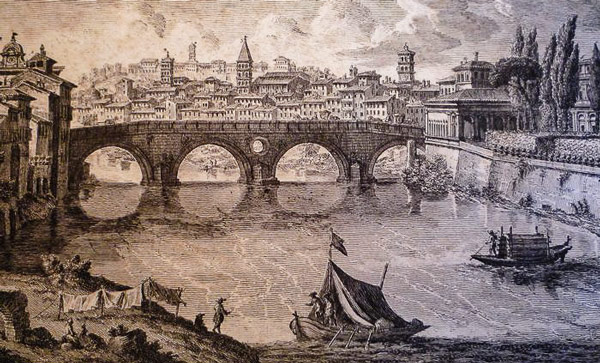
Another issue was the bridge’s width, which had narrowed to 21 feet (6.4 m), compared to the 30 feet (9 m) of the Agrippa Bridge. In 1877, the bridge underwent major reconstruction to make it wider and more accessible for traffic. A new pedestrian section was built using suspended cast-iron walkways supported by eight massive cantilevers on each side of the bridge, and parapets made of decorative grilles.
In the 1970s, a market operated on Ponte Sisto.
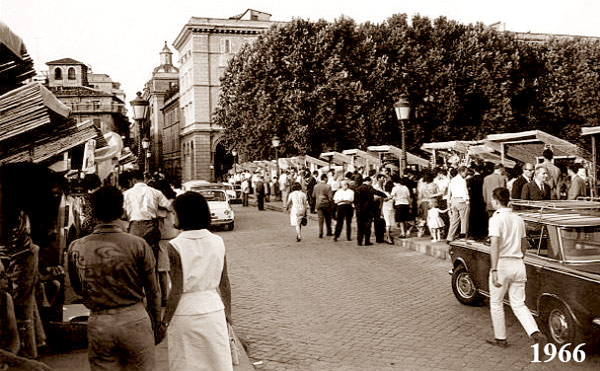
Debates over interfering with the bridge’s medieval architecture dragged on for more than 20 years. Eventually, a decision was made to dismantle the unsightly cast-iron structure and restore the original stone parapets. By 2000, after the restoration project was completed, Ponte Sisto had regained its original 15th-century silhouette.
Description
Ponte Sisto, stretching 354 feet (108 m) long and 36 feet (11 m) wide, consists of four arches clad in travertine, which may have originally been sourced from the construction of the Colosseum. 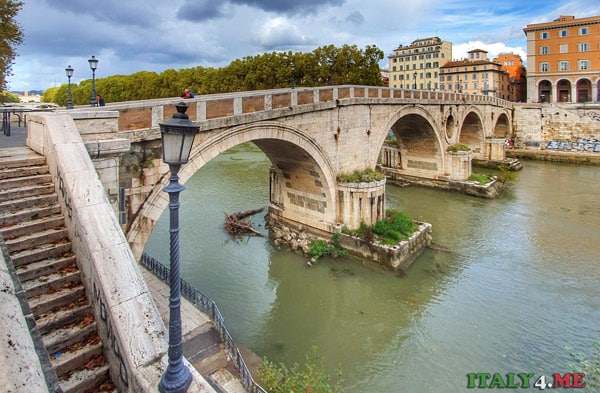
Its central pier features a round opening known to Romans as the “occhialone.” This was designed to allow water to pass through during floods, reducing pressure on the bridge. Romans used it to predict whether the bridge and the city could withstand another natural disaster. If the water reached the occhialone, it triggered a flood warning.
Since Pope Paul V (1605–1621) restored the Roman aqueduct (Acqua Paola), Ponte Sisto has carried water through eight large pipes from the Fontana dell’Acqua Paola to the Campo Marzio district.
Read more about ancient Roman aqueducts and baths.
To honor Pope Sixtus IV, inscriptions from the original memorial plaques with wishes for the pontiff’s health and long life have been restored on the parapets.
Although relatively simple in structure, Ponte Sisto has a distinctive charm thanks to its “humpbacked” arch, which adds both strength and a picturesque silhouette. Such bridges are believed to have mystical qualities and are affectionately called “humpbacked” by locals.
My Favorite Bridge in Rome
Shrouded in the mist of ancient romance, Ponte Sisto has long been one of the top landmarks of the Eternal City and a favorite spot for true lovers of history and scenic views.
Many consider the bridge leading to Castel Sant’Angelo the most beautiful in Rome, but for me, Ponte Sisto takes the top spot. Old, pedestrian-only, and authentic—without grandiose statues or excessive decoration. From the bridge, you can enjoy a stunning view of the dome of St. Peter’s Basilica, which I highly recommend seeing at sunset.
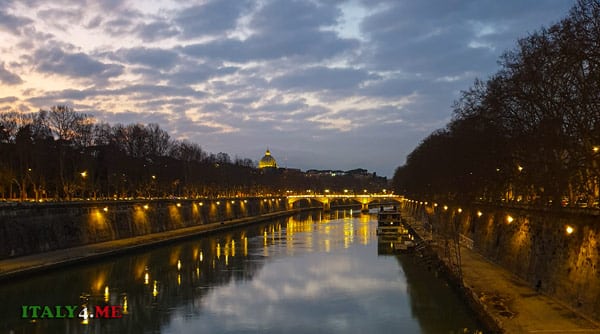
After a walk through the historic center of Rome, we always head to Trastevere via Ponte Sisto. On Piazza Trilussa, street musicians often perform, and we grab a pizza from a local pizzeria and sit on the fountain steps to eat.

During the summer months, the right bank of the Tiber, from Ponte Sisto to Tiber Island, is lined with souvenir stalls and pop-up restaurants.
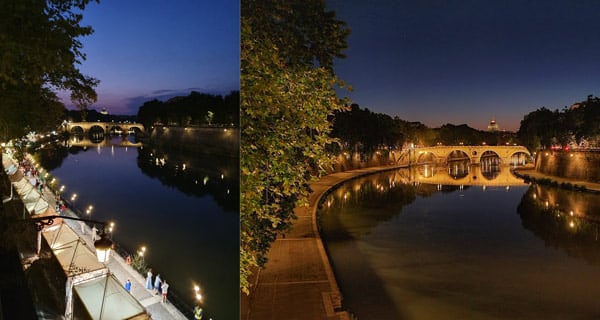
I recommend a stroll along the riverbank, then a climb up to the Garibaldi Bridge to watch the sunset over one of Rome’s most beautiful views. Once your soul is satisfied, head to one of the restaurants in the Trastevere district for a well-earned dinner.