 Italy for me From Italy with love


San Pietro in Vincoli (Basilica di San Pietro in Vincoli al Colle Oppio), meaning “Saint Peter in Chains on the Oppian Hill,” is a Roman Catholic titular church with the status of a minor basilica. It is also one of the most visited pilgrimage sites in Rome. The basilica is located on the Oppian Hill (Colle Oppio), in the Monti district (Rione Monti) on Piazza di San Pietro in Vincoli.
The name of the basilica reflects its most important relic—the chains (known in Orthodox tradition as verigi) that once bound the Apostle Peter in both the Jerusalem and Roman prisons. In addition to this sacred artifact, the basilica attracts visitors with one of its greatest artistic treasures—the seated statue of Moses, rightfully considered a masterpiece by Michelangelo Buonarroti (Michelangelo Buonarroti).
Page Contents
History
The history of the Basilica of Saint Peter in Chains, which has largely preserved its original structure, dates back to the 5th century, making it one of the oldest Christian churches in Rome.
It is also known as the Eudossian Basilica (Basilica Eudossiana), a name that refers to a story where historical facts and legends intertwine.
The Discovery of the Relic
In 442, Aelia Eudocia—the wife of Eastern Roman (Byzantine) Emperor Theodosius II—received as a gift from Patriarch Juvenal of Jerusalem the chains that, according to the Acts of the Apostles, had bound Peter in prison in the Holy City. Later, from Constantinople, she sent part of this precious gift to Rome to her daughter, Licinia Eudoxia, wife of Western Emperor Valentinian III. He, in turn, presented the chains to Pope Leo I the Great, who confirmed their authenticity.
It is known that in Rome, the Apostle Peter spent his final days before execution in the Mamertine Prison (Carcere Mamertino o Tulliano). According to legend, when Pope Leo I placed the chain from Jerusalem next to the chain from the Roman prison, they miraculously fused into one. To commemorate this event and preserve the sacred chains, it was decided to build a Christian basilica on the Oppian Hill.
Construction and Reconstructions
At the behest of Empress Licinia Eudoxia, the basilica was built in 442 on the remains of a 4th-century church known as Ecclesia Apostolorum—the Church of the Apostles. The reason for the destruction of the earlier building in 435 remains unknown, but its size was impressive, considering that the central nave had 15 columns on each side and the apse measured 34 by 10 meters (111 by 33 feet). An even earlier structure on the site was a Roman urban complex from the 3rd century BC to the 3rd century AD, known as the “Temporary House of Nero” (Neronian Domus Transitoria). Overall, the construction of the Christian basilica atop ancient ruins lasted approximately 48 years, spanning from 422 to 470.
The basilica was consecrated in 439 during the pontificate of Sixtus III. At that time, it still bore its old name, Ecclesia Apostolorum, and was dedicated to both Apostles Peter and Paul. In 501–502, it was referred to as Ecclesia a vincula sancti Petri (Church of Saint Peter in Chains), and by the 8th century, it had acquired its current name, Basilica di San Pietro in Vincoli al Colle Oppio.
San Pietro in Vincoli underwent several reconstructions and restorations over the centuries.
The most significant changes to the architecture and interior took place in the 8th century under Pope Adrian I and in the 15th–16th centuries under Popes Sixtus IV and Julius II, who continued restoration work initiated by Cardinal Nicola Cusano following the basilica’s decline during the Avignon Papacy (1309–1377).
The latest restoration efforts occurred in the 18th century under Francesco Fontana and again in 1875.
In 1493, Cardinal Giuliano della Rovere (the future Pope Julius II) entrusted San Pietro in Vincoli to the religious order of the Augustinian Canons of the Lateran Islands, who continue to administer the basilica today.
Description
San Pietro in Vincoli has retained its present appearance since the 16th century, as confirmed by an illustration in the 1588 Guide to Rome. 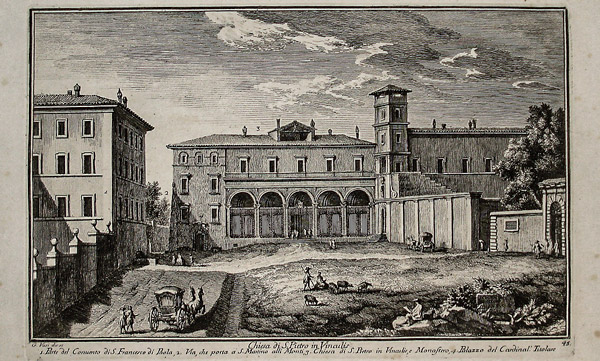
Facade
The basilica’s main facade, flanked by the monastery walls, is fairly modest for a Roman religious building, despite its impressive dimensions of 28 by 60 meters (92 by 197 feet), matching those of the earlier church.
A simple portico with five arches supported by octagonal columns was built in 1475, designed by architect Baccio Pontelli. This entrance style was not new, dating back to the 5th century and continuing the traditions of early Christian architecture. During the persecutions of the first Christians, places of worship were intentionally concealed rather than highlighted among the city’s other structures.
Between 1570 and 1578, an additional story with a flat roof and five small windows was added above the portico to obscure the old facade.
The bronze openwork grilles with delicate patterns date to the time of Pope Clement XI (1649–1721). They were installed to protect the church at night from beggars and stray livestock, which roamed Rome’s streets freely until the 19th century. The basilica’s marble portal (its only entrance, which is unusual) has survived from the 5th century, although its interior section was modified in the 16th century.
The rear facade of the basilica is far more colorful than the view from Piazza di San Pietro in Vincoli. The exterior of the apse, facing east, and the basilica’s walls are made of red brick and preserve the original 5th-century structure.
Monastery
The design of the monastery adjoining the basilica, built between 1493 and 1503, is attributed to Giuliano da Sangallo, while its elegant cloister with a graceful well is credited to Antonio da Sangallo the Younger (Antonio da Sangallo il Giovane).
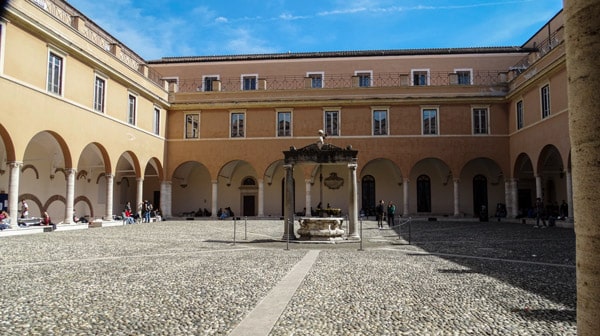
The well’s decoration, featuring the coats of arms of Popes Sixtus IV and Julius II, was crafted by Simone Mosca, a Florentine sculptor who collaborated with Michelangelo.

The bell tower and part of the monastery were demolished in the 20th century when the Faculty of Civil and Industrial Engineering of Sapienza University took over the monastery’s buildings. Interestingly, the monastery’s well became the symbol of the university’s engineering faculty.
Fun fact: At the request of Cardinal Giuliano della Rovere, the architect also built a villa next to the basilica (no longer standing), where the cardinal kept the famous statue of the Greek god known as the Apollo Belvedere. Later, after ascending to the papacy, Giuliano della Rovere moved the ancient masterpiece to the Vatican Hill in the Casino di Belvedere.
Interior
San Pietro in Vincoli follows the typical layout of a Roman basilica.
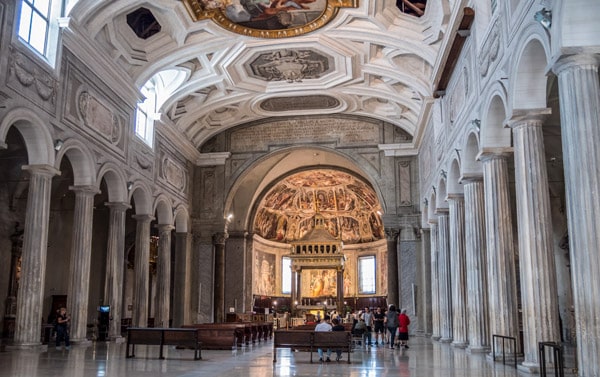
Three naves, separated by rows of 20 Doric columns, end in three apses. The largest, the central apse, houses a monumental ciborium (canopy), constructed between 1876 and 1877 based on a design by Virginio Vespignani. The canopy’s structure consists of four Corinthian columns made of pink granite and a pyramidal roof of gilded wood.
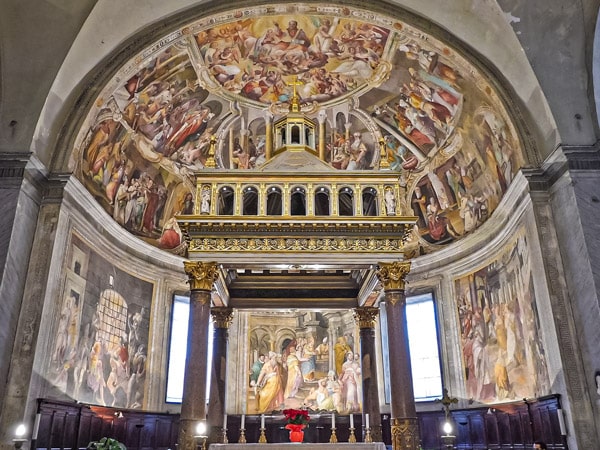
The central marble altar, rebuilt during the 1465 renovation, has remained almost unchanged.
The origin of the elegant and valuable nave columns remains a subject of debate. It is likely that in the 5th century they were repurposed from the Porticus Liviae, a portico of Ancient Rome built in 7 BC by Emperor Augustus for his wife Livia Drusilla.
The cylindrical vault of the central nave, with its coffered ceiling, dates to 1706 and was designed by the renowned Francesco Fontana. The ceiling fresco, “The Miracle of Peter’s Chains,” was painted the same year by Italian artist Giovanni Battista Parodi.
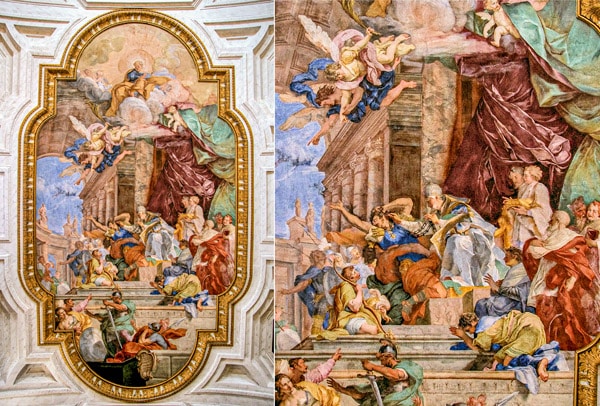
The fresco depicts the moment when Pope Alexander I touches the goiter on Saint Balbina’s neck with the sacred chains, healing her.
The basilica’s original floor has not survived, as it was removed in 1956 during archaeological excavations.
Main Attractions
San Pietro in Vincoli is best known for the sacred chains of the Apostle Peter and Michelangelo’s Moses. Visitors queue for these treasures as soon as the basilica doors open.
Chains of Saint Peter
The basilica’s principal relic is the Chains of Saint Peter.
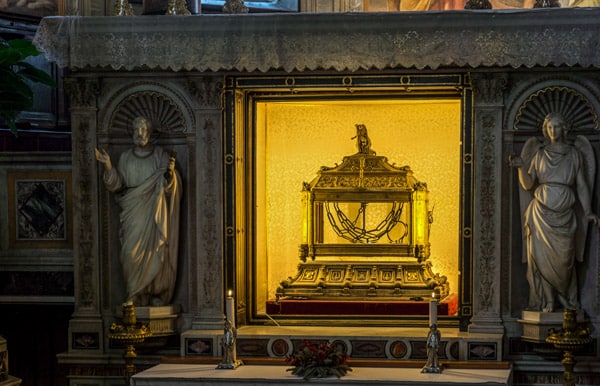
This priceless Christian treasure has drawn countless pilgrims for centuries, praying for miracles of healing. The chains are kept beneath the main altar in a reliquary secured by two gilded bronze doors crafted in 1477 by goldsmith Giovanni Matteo Foppa, known as Caradosso. Unfortunately, the design depicting scenes from the life of Saint Peter is visible on these doors only when they are closed.
The elegant shrine for the chains, created by architect Andrea Busiri Vici, was donated to the basilica in 1856 by Cardinal Niccola Parracciani Clarelli, who held the title of San Pietro in Vincoli.
The Chains of Saint Peter measure approximately 2 meters (about 6.5 feet) in length and consist of two joined parts: 23 rings with a collar from the Mamertine Prison and 11 links from the Jerusalem dungeon. In the past, many pontiffs gifted fragments of the sacred chains or filings from them to other churches, which is why this important Christian relic can also be found in other churches throughout Italy and Europe.
On either side of the reliquary stand statues of Saint Peter and the angel who freed the apostle from his chains in the Jerusalem prison.
Each year on August 1, Catholics celebrate the Feast of the Miracle of the Chains’ Fusion, during which special ceremonies are held in the basilica. Before the last restoration in 1875, the reliquary was kept in the sacristy and brought out for public viewing only on especially significant occasions.
Tomb of Julius II
For the faithful, the basilica’s greatest treasure is the Chains of Saint Peter. For art enthusiasts, it is the statue of Moses by Michelangelo. San Pietro in Vincoli is sometimes called a museum for this sculpture, emphasizing the value of the master’s genius creation.
Design
Michelangelo created the statue of the prophet Moses as part of the ensemble for the tomb of Pope Julius II.
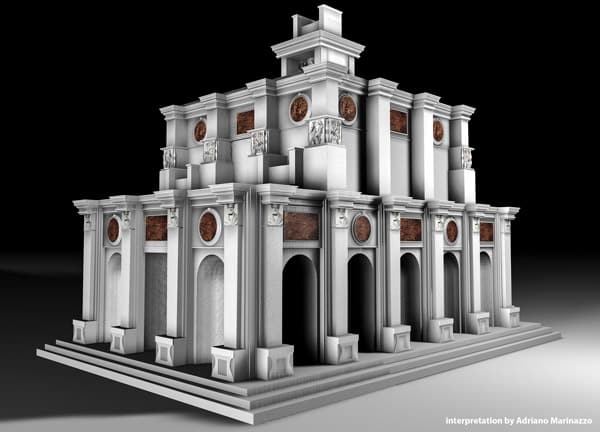
The pontiff envisioned an unprecedented mausoleum, grander than any before, comparable only to the majestic tombs of the Roman emperors. Rectangular at its base and rising skyward with a pyramidal peak, the three-tiered funerary monument of pure white marble was to be adorned with 40 life-sized statues.
The boldness of the vision lay in the proud Pope Julius II’s desire to place his tomb in the central nave of St. Peter’s Basilica (Basilica di San Pietro in Vaticano), precisely where the colossal Baldacchino di San Pietro now stands.
He entrusted the project to the then-young but already accomplished sculptor Michelangelo Buonarroti, who began work in 1505 and completed it only in 1545 as a mature and celebrated master.
Inspired, Michelangelo spent nearly eight months just searching for the perfect marble in the Carrara quarries before beginning the project. Due to financial difficulties, construction progressed slowly. Soon, Julius II lost interest and shifted his attention to other works in the Vatican.
In 1508, he commissioned Michelangelo to paint the Sistine Chapel (Cappella Sistina). Michelangelo immersed himself in the frescoes, leaving work on the tomb to his students. The death of Julius II in 1513 and Michelangelo’s personal challenges prevented the completion of the grand mausoleum. Pope Leo X, Julius II’s successor, ordered the tomb’s size to be reduced and placed it in San Pietro in Vincoli, where Julius II had once served as cardinal.
It is known that five designs for the tomb were never realized. Only the sixth, significantly simplified version, was approved in 1542 and completed in 1545.
The sculptor deeply regretted that he could not fulfill his original vision. Nevertheless, what he did create remains a testament to his genius and continues to inspire awe.
Statues
The tomb of Julius II was installed in San Pietro in Vincoli only 32 years after the pope’s death, and his body was never placed in this basilica. The pontiff was originally buried alongside the remains of his uncle, Sixtus IV. After the tomb was desecrated during the Sack of Rome in 1527 by the troops of Charles V of Habsburg, his remains were moved to the front of the monument to Pope Clement X in St. Peter’s Basilica in the Vatican.
Michelangelo was able to create only a few statues for the original sculptural ensemble. Two completed statues, the Rebellious Slave and the Dying Slave, were gifted by Michelangelo himself to Roberto Strozzi in 1546, who presented them to King Francis I of France. Since 1793, they have been part of the French national collection and are housed in the Louvre. Other unfinished figures are now displayed in the Galleria dell’Accademia di Firenze in Florence.
The tomb of Julius II features three original statues by Michelangelo: the seated Moses at the center, flanked by Rachel on the right and Leah on the left.
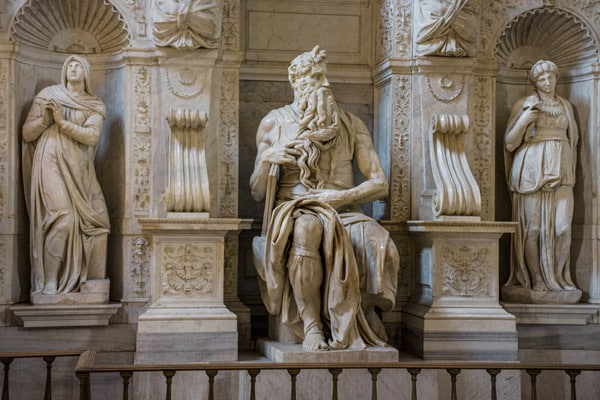
The allegorical female figures, created between 1540 and 1545, are deliberately contrasted. Leah, the first wife of Jacob, represents the active life, while the graceful and elevated Rachel, Jacob’s second wife, symbolizes the contemplative life. These two virtues, embodied in female forms, reflect the soul and character of Julius II, who held both ecclesiastical and secular power.
At the center of the tomb’s second tier is a statue of the Madonna and Child (1527) by Domenico Fancelli, with the side niches containing a Sibyl and a Prophet sculpted by Raffaello da Montelupo and Domenico Fancelli.
In recent years, art historians increasingly support the theory that the reclining figure of Julius II, depicted in eternal sleep, is also the work of Michelangelo rather than Tommaso Boscoli, as previously believed. This statue was intended to serve as the compositional centerpiece of the tomb, perfectly fulfilling its ultimate purpose—the glorification and elevation of the pontiff. However, all attention and well-deserved admiration ultimately went to the statue of Moses, into which Michelangelo poured his talent and soul. It has come to be recognized as one of the greatest achievements of human genius.
Moses by Michelangelo
The marble statue of Moses was created by Michelangelo between 1513 and 1515. It was originally intended for the second level of the tomb, and its large dimensions (2.35 meters, or about 7 feet, tall) were calculated to maintain proper perspective and proportionality when viewed from below.
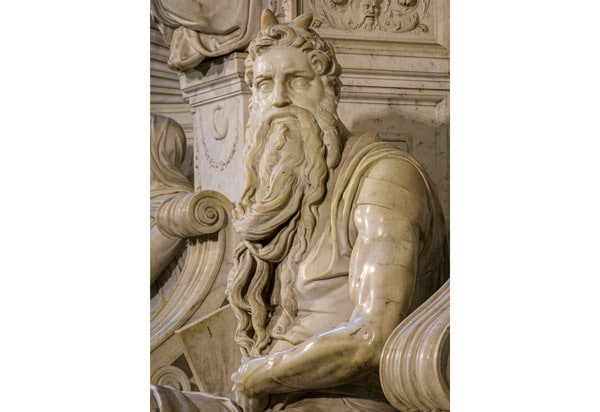
Recent studies have confirmed that 25 years after the statue’s creation, the sculptor slightly turned Moses’ head to the left, away from the apse containing the sacred chains. By doing so, he not only added greater expressiveness to the figure’s dynamic pose but also conveyed a subtle religious meaning: Moses, who scorned the Golden Calf that replaced God, would likewise have disapproved of the indulgences granted to pilgrims venerating the chains of Saint Peter.
The seated Moses, with his handsome and spiritual face, appears vivid and powerful. The Hebrew prophet is depicted at the moment he descends from Mount Sinai after conversing with God. His proud, resolute, and even slightly angry gaze is directed at the apostates worshipping a false idol. The tension in Moses’ muscles and the pulsing veins emphasize the force of will with which the prophet restrains his anger. His right hand protects the stone Tablets of the Law received from God, while his fingers touch his luxurious beard. Michelangelo’s rendering of the flowing hair in marble resembles brushstrokes on a canvas, making the beard appear soft and silky.
The resulting image of Moses closely reflected the determined and fiery character of Michelangelo himself, who considered this statue his finest work. According to legend, the crack in the marble Moses’ knee was caused when the sculptor, recognizing the statue’s perfection, struck it with a hammer in frustration, exclaiming, “Why do you not speak?”
Other Attractions
It would be unfair not to highlight the other treasures of San Pietro in Vincoli—home to remarkable frescoes, paintings, and valuable historical monuments, most of which date from the Renaissance period.
Frescoes by Jacopo Coppi
The frescoes in the central apse immediately capture attention upon entering the basilica.
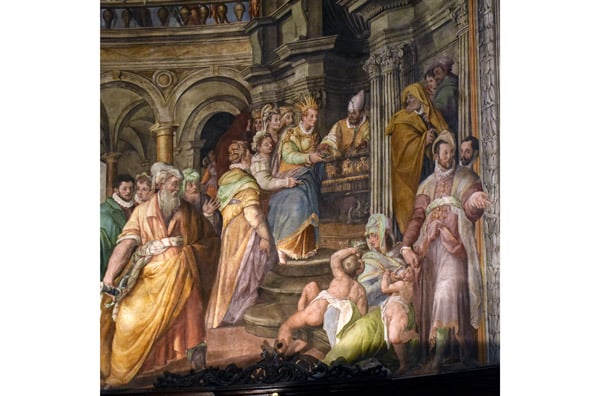
The frescoes by Jacopo Coppi, completed in 1577, depict scenes related to the basilica’s principal relic:
- On the left—an angel leads the Apostle Peter out of the Jerusalem prison;
- On the right—Licinia Eudoxia presents the chains to Pope Leo I;
- In the center—Aelia Eudocia receives the chain from Patriarch Juvenal in Jerusalem.
The dome fresco illustrates the Miracle of the Crucifix in Beirut, which occurred in the 7th century when Jews desecrated a Christian icon. By choosing this theme, the artist likely sought to draw a parallel with the Chains of Saint Peter, which, like the wounded and bleeding icon of Jesus, were believed to grant miraculous healings of incurable ailments.
Sarcophagus of the Maccabee Brothers
Beneath the basilica’s main altar lies a crypt housing a 4th-century sarcophagus containing the remains of the seven Jewish Maccabee brothers.
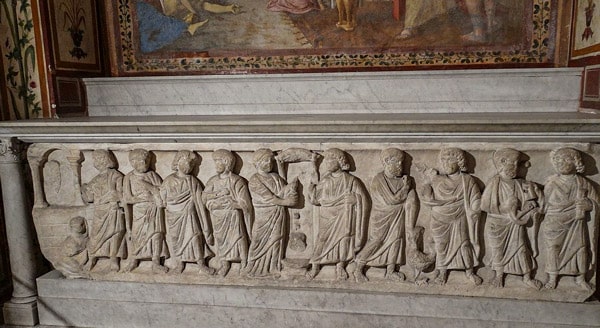
They were tortured to death along with their mother in the 2nd century BC for refusing to renounce the Law of Moses. The ancient sarcophagus, divided into seven niches and adorned with New Testament scenes, was discovered in 1876 during restoration work. At that time, a crypt was created to house the valuable find, fully decorated with frescoes featuring floral motifs. The fresco above the sarcophagus, painted in 1876 by Silverio Capparoni, depicts the martyrdom of the Maccabee brothers and their mother, who begged for mercy for at least her youngest son.
Unfortunately, the crypt is currently closed. A recent reopening of the sarcophagus revealed that it contains the bones of dogs rather than the martyred brothers.
Tomb of Nicola Cusano
At the beginning of the left aisle, a tomb slab for Cardinal Nicola Cusano, created in 1464 by Andrea Bregno—the leading sculptor in Rome before Michelangelo—adorns the wall.
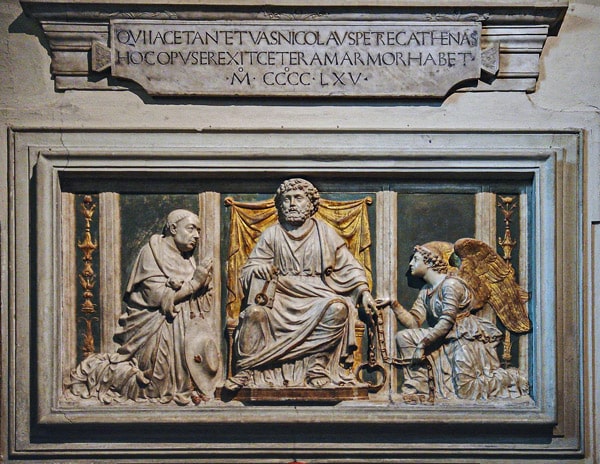
The relief depicts Saint Peter holding a chain in one hand, with the kneeling cardinal on the left and the angel who freed the apostle on the right. A lobster image at the bottom refers to Cusano’s family coat of arms.
Nicola Cusano was not only the cardinal of San Pietro in Vincoli but also a prominent 15th-century figure, known as a theologian, philosopher, humanist, jurist, and mathematician. Although German by birth, he requested that his heart be buried separately in his hometown of Bernkastel-Kues in the Rhine region, in the chapel of the Hospital of Saint Nicholas.
San Sebastiano Mosaic
The third altar of the left nave features the basilica’s only surviving 7th-century mosaic, depicting Saint Sebastian.
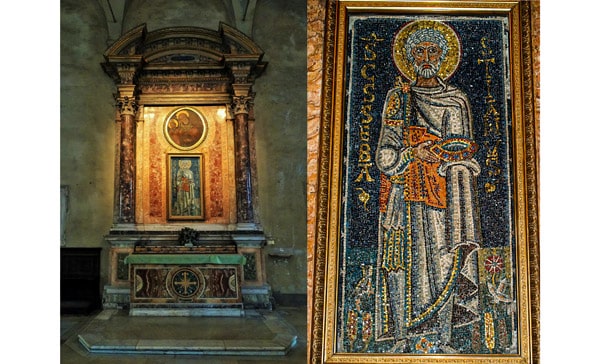
This portrayal is quite unusual compared to the traditional iconography, which depicts a handsome, semi-nude youth pierced by arrows. In this mosaic, Saint Sebastian appears as an elderly man dressed in long Byzantine robes, resembling the courtiers of Emperor Justinian.
The altar and mosaic were added to San Pietro in Vincoli in 680 as a votive offering to protect the city from the plague. Previously, the relics of Saint Sebastian in the church bearing his name in Pavia, northern Italy, had already spared that city from a devastating epidemic.
Tomb of the Pollaiuolo Brothers
To the left of the basilica’s entrance lies the tomb of the Florentine artists, sculptors, and goldsmiths Antonio del Pollaiuolo (on the left) and his younger brother Piero (on the right).
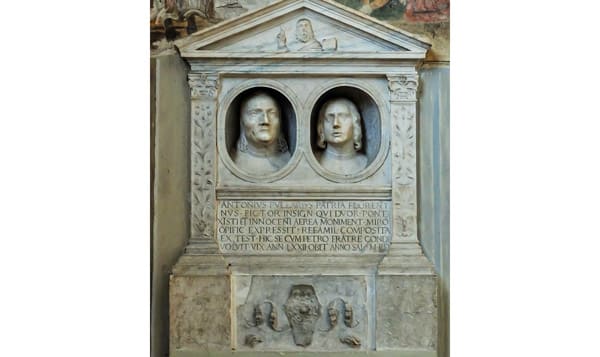
The artists’ busts are attributed to Luigi Capponi, who likely created them between 1498 and 1510. The brothers’ work was highly successful.
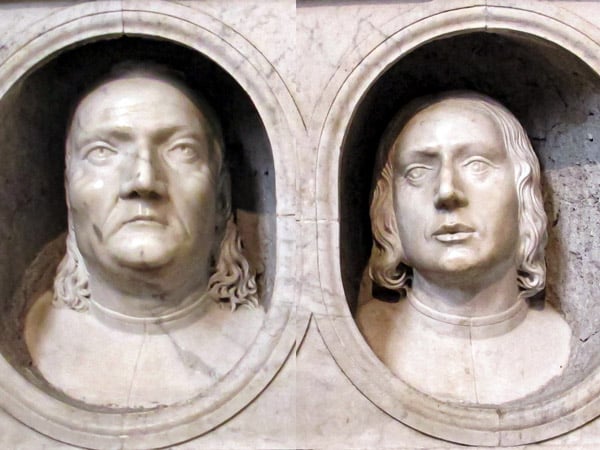
It is known that Antonio’s workshop in Florence rivaled that of the famous Andrea del Verrocchio. The elder brother designed the magnificent tombs of Popes Innocent VIII (1497) and Sixtus IV (1493), both located in St. Peter’s Basilica in the Vatican.
Antonio del Pollaiuolo also made his mark on art history by creating the famous figures of the infant twins Romulus and Remus, which he added to the Capitoline Wolf—the symbol of Rome.
To the left of the Pollaiuolo brothers’ tomb is a niche featuring the face of Jesus Christ. This image likely dates back to the 5th century and is especially valuable as one of the earliest painted depictions of Jesus.
Paintings
In the side apses opening onto the transept, visitors can admire the altarpieces of two chapels:
-
- On the right—“Saint Margaret of Antioch” (1644) by the Italian painter Giovanni Francesco Barbieri, known as Guercino;
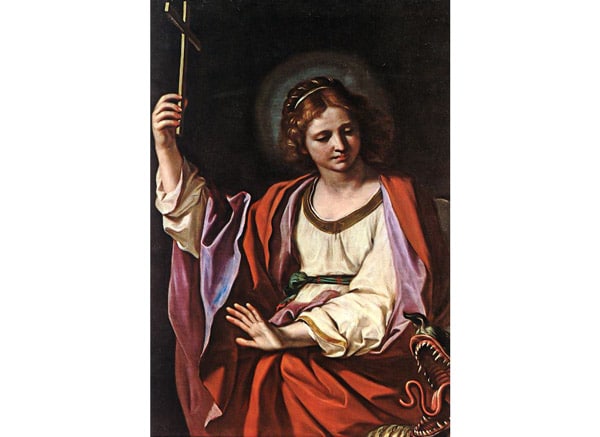
- On the left—“The Immaculate Madonna” (1585) by Giovanni Paolo Lolmo.
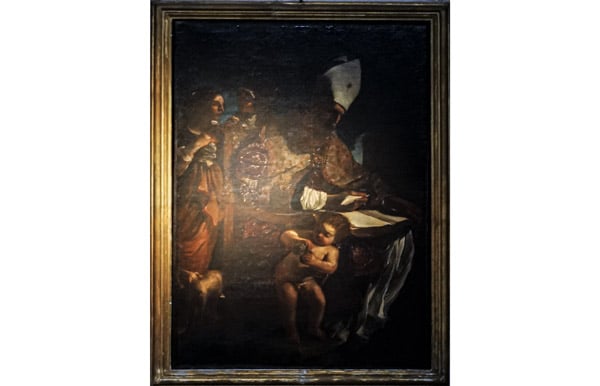
At the first altar of the right nave, there is another work by Guercino, “Saint Augustine” (mid-17th century).
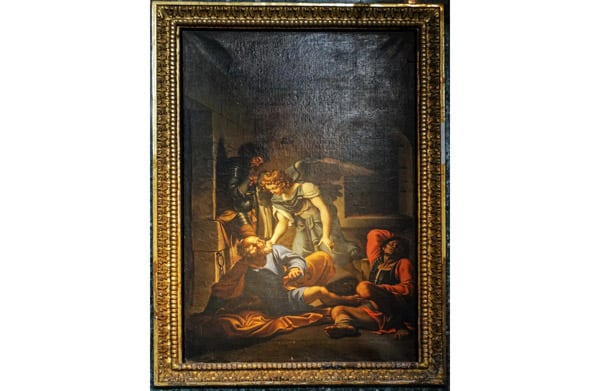
Along the right aisle at the second altar, note the painting “The Liberation of Saint Peter” (1683) by Pietro Santi Bartoli, a copy of the 1604 original by Domenichino, which is kept in the sacristy.
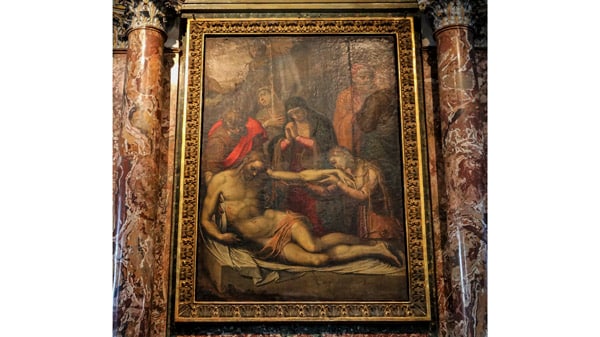
In the left nave, the first altar, dedicated to Our Lady of Sorrows, holds a 16th-century painting, “The Lamentation over the Dead Christ,” attributed to Cristoforo Roncalli, known as Pomarancio.
Funerary Monuments
The funerary monuments of the basilica, dating from both the Renaissance period and later eras, captivate visitors primarily as magnificent works of sculpture. Popes and cardinals made wise choices in commissioning talented masters who immortalized their names.
Along the right aisle, noteworthy artistic monuments include:
-
- The marble funerary monument (1611) of Cardinal Lanfranco Margotti;
-
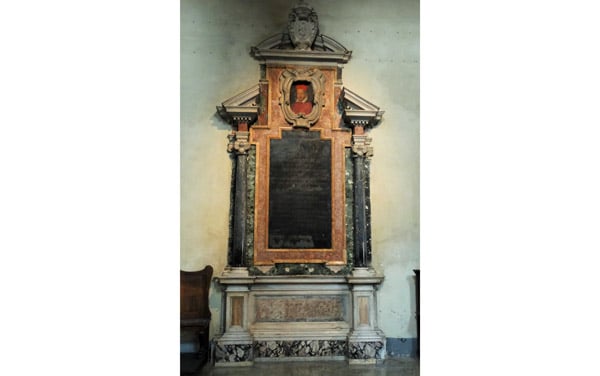
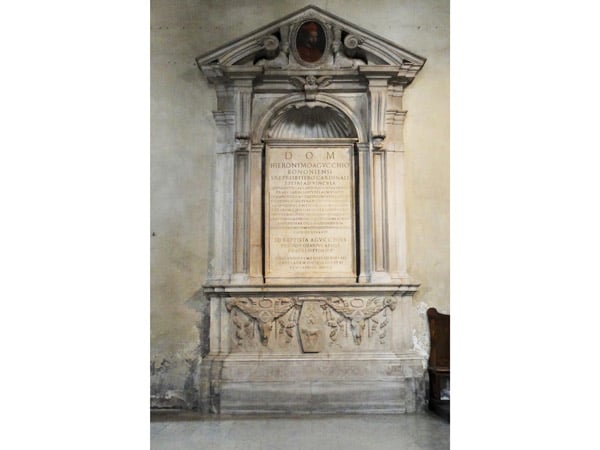
- The 1605 tomb of Cardinal Girolamo Agucchi, designed by Domenichino.
Between the first and second altars of the left nave stands the striking marble funerary monument of Cardinal Cinzio Passeri Aldobrandini.
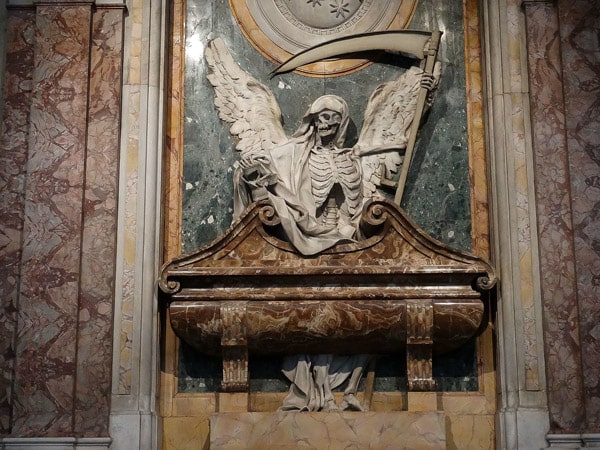
The tomb, featuring a winged skeleton, was erected between 1705 and 1707, nearly a century after the cardinal’s death. It was designed by architect Carlo Francesco Bizzaccheri and French sculptor Pierre Legros the Younger.
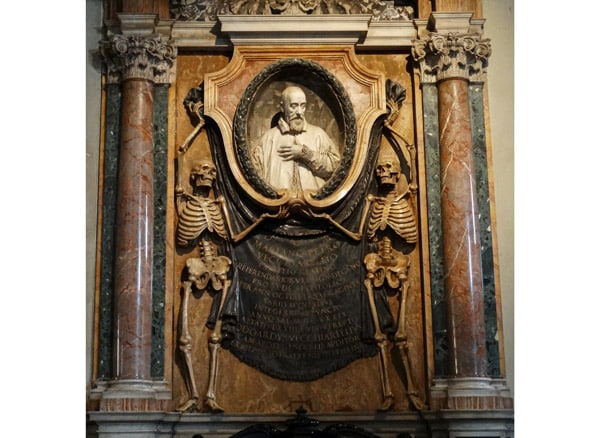
Beyond the second altar of the left nave is the 1639 funerary monument featuring two skeletons supporting a medallion with the image of Cardinal Mariano Pietro Vecchiarelli.
Visitor Information
Opening Hours
The Basilica of San Pietro in Vincoli is open daily from 8:00 AM to 12:30 PM and from 3:00 PM to 7:00 PM. Admission is free.
Masses are held as follows:
- On weekdays at 8:00 AM and 12:00 PM (except July and August);
- On Saturdays at 5:00 PM;
- On Sundays and Catholic holidays at 8:00 AM and 11:00 AM.
Confession is available in Italian, French, and Polish.
How to Get There
Address: Piazza di San Pietro in Vincoli, 4/a, 00184 Rome
The Basilica of San Pietro in Vincoli is a 5-minute walk from the Colosseum and the Colosseo metro station.
San Pietro in Vincoli may not rival Rome’s architectural masterpieces in grandeur, but it is truly a gem among the city’s earliest Christian churches.
Located near the Colosseum and the Roman Forum, this basilica deserves a place on any must-see list. It offers an encounter with history and art dating back to the 5th century—and, of course, unforgettable impressions of Michelangelo’s Moses, a masterpiece for the ages.