 Italy for me From Italy with love


The heart of Milan is its grand Cathedral Square, a dazzling stage that showcases the city’s most iconic landmarks—the Duomo Cathedral, the Royal Palace, and the Galleria Vittorio Emanuele II.
The Milan Cathedral (Duomo di Milano) is a truly unique architectural masterpiece in the Flamboyant Gothic style.
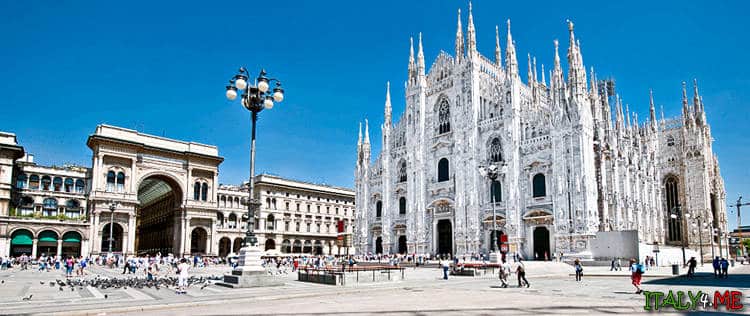
It stands as a symbol of the Catholic faith for both Milan and Italy. This monumental building, entirely constructed from white marble, stuns visitors with its vast scale and intricate blend of architectural styles. It is the fourth-largest Christian church in the world, after St. Peter’s Basilica in Vatican City (La basilica di San Pietro in Vaticano), Seville Cathedral, and St. Paul’s Cathedral in London.
Page Contents
Opening Hours, Ticket Prices, Rooftop Access
As of July 2026, the Duomo is open daily from 7:00 AM to 7:00 PM, with final entry no later than 6:45 PM. Early morning entry for worshippers is free, restricted to the left section of the cathedral. Modest attire and respectful behavior are required.
A standard tourist ticket, which includes entry to the cathedral, rooftop terraces, and museum, costs €20 and is available from 8:00 AM.
Visitors may take photos inside the cathedral with prior identity documentation (fee: €2). Photography must not be used for commercial purposes. On weekends, the Duomo is open from 8:30 AM to 6:00 PM. Special hours apply during religious holidays. Rooftop access during the winter season runs from 9:00 AM to 7:00 PM, with the last elevator at 6:10 PM. The winter schedule starts on September 16.
There are various ticket types for the cathedral, crypt, and rooftop, ranging from €3 to €19.50.
From Monday to Wednesday, rooftop access is available from 9:00 AM to 7:00 PM (last elevator at 6:10 PM). From Thursday to Sunday, hours extend to 9:00 PM, with the last elevator at 8:10 PM. The summer season begins April 10.
Advance tickets are highly recommended and available in English at tiqets.com.
For an additional fee, visitors can explore the Duomo’s Treasury (€3) and the Baptistery of San Giovanni alle Fonti (€4). Discounted combo tickets are also available.
- Group tours of the Duomo in English: www.tiqets.com – €27, 1.5 hours, elevator ticket included.
- Official website of the Milan Cathedral (Duomo) in English, with current ticket prices and visiting hours: www.duomomilano.it
Construction History
The construction of Milan’s cathedral began in the late 14th century. To lay the foundation for this massive structure, the ruins of the old winter basilica (Basilica vetus), which had stood on Cathedral Square until the end of the 12th century, had to be cleared. Numerous territorial wars and later religious conflicts had caused widespread destruction throughout Milan. The city authorities decided to erase remnants of older religious buildings and create space for a new, enduring, and magnificent cathedral.
Archbishop Antonio da Saluzzo ordered the foundation stone of the Duomo to be laid in 1386. However, the original building plan underwent several changes. By the mid-15th century, a second church on the square was also dismantled.
This was the summer basilica (Basilica di Santa Tecla), which had served worshippers after taking over the role of the earlier demolished winter basilica.
Work on the new cathedral began with meticulous land surveying. In a practical move, Italians decided to repurpose building materials from demolished structures. For the cathedral’s cladding, the archbishop chose a delicate white-and-pink marble sourced from the Candoglia quarry in Piedmont. A team of craftsmen from Lombardy, led by architect Simone da Orsenigo, was tasked with bringing the plans to life. The chosen architectural style was Late Gothic, strongly influenced by the Bohemian school.
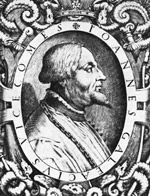
The construction of the new cathedral resonated deeply with the citizens of Milan, a sentiment noted by Gian Galeazzo Visconti (Gian Galeazzo Visconti), who was then head of the city. By the early 15th century, the monumental project was overseen not by the Church, but by the state. Visconti, aiming to strengthen Italy’s monarchy and elevate Milan’s religious prestige, pushed hard for the cathedral’s progress. Building materials were exempted from taxation, and especially valuable ones were marked with the initials AUF—meaning “for construction use.”
Architectural Style Transformation
Given that the construction of the Duomo Cathedral spanned nearly seven centuries, it’s no surprise that the structure exhibits a stunning blend of architectural styles. The original blueprint envisioned a three-nave layout with two chapel towers on either side. However, a French successor to the Italian architects introduced Gothic elements popular in his homeland. The decision was made to replace the side chapels with an expanded five-nave basilica.
To accurately design such a monumental building, mathematician Gabriele Stornaloco was brought in to assist the architects. Thanks to his calculations, it became clear that the central nave should not exceed 148 feet (45 meters) in height, and the side aisles would be constructed in a descending gradient. Jean Mignot, an engineer, helped resolve technical challenges related to hoisting massive marble slabs and stone blocks to the upper levels.
The efforts of Milan’s ruling authorities bore fruit—by the mid-15th century, nearly half the cathedral was complete. However, political unrest and funding shortages in the following 40 years drastically slowed progress. Some finishing touches were made, and the central altar was installed and consecrated.
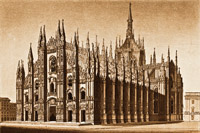
The early 16th century saw the completion of the cathedral’s dome, which was richly decorated with statues. In fact, four rows of statues depicting Catholic saints and martyrs were installed, each row containing 15 figures. On the exterior, the pointed spire stretching skyward became a Renaissance hallmark designed by Giulio dell’Amadeo.
By the mid-16th century, the Spanish influence over northern Italy was growing, which inevitably impacted the cathedral’s fate. The new rulers repurposed the structure for church functions, but failed to provide substantial financial support to continue its construction. Interior enhancements during this period included the addition of pilasters around the altar, a grand pipe organ, a statue of Saint Bartholomew—the patron saint of fishermen—and an antique 16-foot (5-meter) Loreto candelabrum.
At the end of the 16th century, a newly appointed Archbishop of Milan took charge of the project. Carlo Borromeo disapproved of the heavy influence of foreign architectural styles. He eliminated several design elements and appointed Italian architect Pellegrino Pellegrini to lead the works.
The unfinished Gothic cathedral was to be softened with Renaissance embellishments. Pellegrini envisioned a façade adorned with tall columns and rows of statues.
Although much of the cathedral’s interior and exterior remained unfinished, it was consecrated by the archbishop in 1577. Renaissance-style exterior work continued through the 1640s. However, a change in lead architect marked a return to Gothic styling. As a result, five doors and two central windows were crowned with pointed arches instead of the flowing curves typical of the Renaissance era.
Shaping the Exterior Appearance
The Milan Cathedral was dedicated to the Nativity of the Blessed Virgin Mary, a theme cleverly reflected in the exterior design. Francesco Croce calculated and designed the 335-foot (102-meter) spire that crowns the central dome of the Duomo. Atop this spire stands a 13-foot (4-meter) gilded statue of the Virgin Mary, known as *La Madonina*, who is also the patroness of Milan.

Napoleon Bonaparte, of Italian descent, chose Milan’s cathedral for his coronation. In preparation, extensive finishing work took place over the next seven years. The building’s unique style was finalized with a fusion of late Gothic and Neo-Gothic details. Napoleon’s grand coronation as King of Italy took place under the cathedral’s intricate vaults on May 20, 1805. To commemorate the event, a statue of Bonaparte was created and now adorns one of the cathedral’s spires.
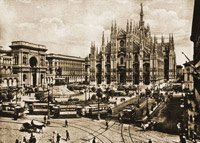
More than 150 years passed before the cathedral was officially completed in 1965. In the meantime, both the interior and exterior were continually refined. From the mid-16th century until completion, the church remained partially open and was used for ceremonies only on special occasions. The latest renovations took place from 2003 to 2009.
What Makes the Milan Cathedral Famous
This magnificent Gothic-Renaissance monument in the heart of Milan is known for several remarkable features. To start with the numbers—the cathedral can accommodate around 40,000 people, slightly less than the Basilica of Saint Paul Outside the Walls in Rome.
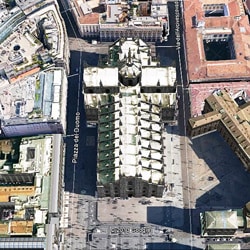
Viewed from above, the Duomo is shaped like a Catholic cross—its vertical arm stretches 518 feet (158 meters), while the horizontal nave spans 302 feet (92 meters). The tallest point of the cathedral is the spire topped by the Madonina, rising to a total height of 348 feet (106 meters).
Yet visitors’ first impression is far from just statistics. The massive white marble structure seems to grow in size as you approach it. Every step on Cathedral Square reveals new details and marvels. The five-nave basilica thrusts 135 finely decorated spires skyward, each adorned with elaborate late Gothic carvings.
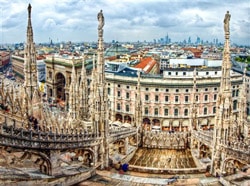
The façade, spires, and interiors are adorned with an astounding 3,400 statues. These include depictions of historical figures, saints, martyrs, prophets, and other biblical characters. True to the medieval Gothic tradition, you’ll also find gargoyles and chimeras perched on the walls, warding off evil spirits. Among the more unusual carvings are a likeness of Mussolini and even a figure that resembles the Statue of Liberty—centuries before the American version was built.
Another unique charm of the Duomo is the way its white-and-pink marble changes with the light. Some visitors prefer it bathed in the golden glow of sunrise, others in the soft hues of sunset. German poet Heinrich Heine famously said that nothing is more mystical or beautiful than Milan’s Duomo under the silver light of the moon.
Fascinating Facts and Myths
Stepping inside Milan’s Duomo, visitors are greeted by a refreshing coolness and soft, filtered light. The cathedral’s vibrant stained-glass windows illustrate biblical stories, casting kaleidoscopic reflections of red, blue, and yellow across the marble floors and stone walls. Above the central altar, high in the dome, lies a revered relic—a nail believed to have been used in the crucifixion of Jesus Christ.
Once a year, on September 14 during the Feast of the Exaltation of the Holy Cross, the Archbishop of Milan ascends to retrieve the nail and presents it to the faithful.
In the late 18th century, the Duomo was fitted with a meridian line—essentially a sun clock—designed to mark the moment of noon. This device appears as a long metal strip embedded in the cathedral floor, running from the entrance all the way through the nave. Zodiac signs and corresponding markings are etched along the line. Precisely at noon, a ray of sunlight strikes the strip, indicating the current zodiac constellation for that month. Beyond its astronomical purpose, this “miracle meridian” revealed a structural risk to the cathedral. In the 20th century, repeated inaccuracies in its readings helped experts detect subtle foundation settling under the cathedral.
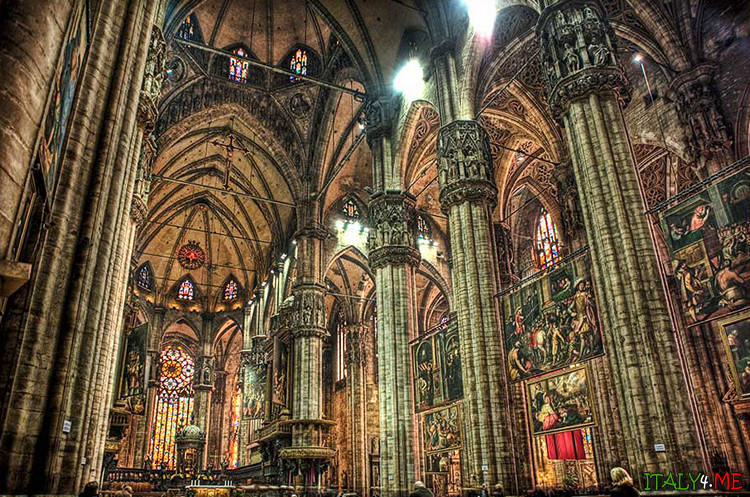
Inside, the cathedral houses elaborately adorned sarcophagi of notable historical figures. One such tomb belongs to Archbishop Alberto da Intimiano, whose stone coffin is inlaid with fine copper plates forming a cruciform design. Nearby, visitors can admire the mausoleum of Gian Giacomo Medici, adorned with three statues, elegant columns, and marble plaques.
For many years, the mausoleum was attributed to Michelangelo. However, in the 20th century, art historians confirmed that the sculptural work was actually created by Leone Leoni—though the craftsmanship remains no less remarkable.
This tomb was one of the last interments within the cathedral. In the late 16th century, an edict was issued prohibiting burials inside church walls to prevent the spread of disease and potential epidemics.
If you happen to visit Milan in late autumn, make sure to stop by the Duomo. Every November and December, the cathedral displays the *Quadroni of Saint Charles Borromeo*—a series of 54 paintings depicting the life and miracles of the saint. A prestigious lineup of Italian artists created these works specifically for the cathedral.
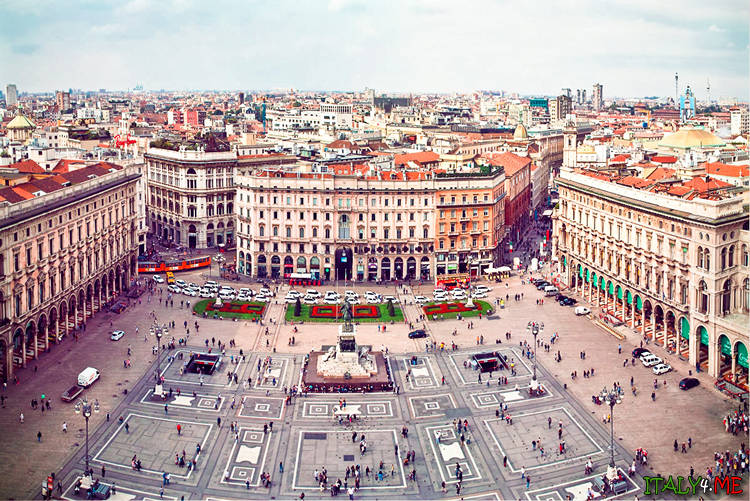
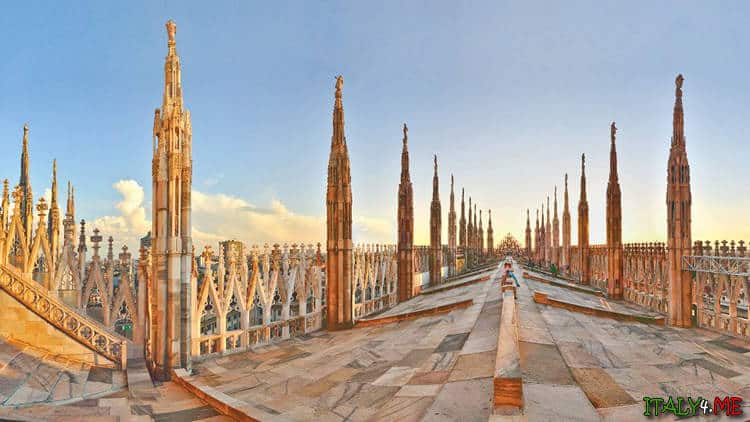
Another highlight of the Duomo is the breathtaking panoramic view from the rooftop terrace. The well-designed viewing platform allows visitors to walk freely across the cathedral’s roof. It’s one of the best viewpoints in all of Milan.
From here, you can admire the lace-like spires up close, marvel at the intricate exterior decorations, and study the detailed statues—experiencing the grandeur of this seven-century-old masterpiece in a way few places allow.
Address
The Duomo Cathedral is located at: P.za del Duomo, 20122 Milano
The most convenient way to reach this magnificent attraction is by metro. Lines 1 and 3 both stop at the Duomo station, right at the square.
Read more about the Milan Metro system.
Nearby Attractions – What Else to See?
As mentioned earlier, Cathedral Square is home to several noteworthy landmarks besides the Duomo itself.
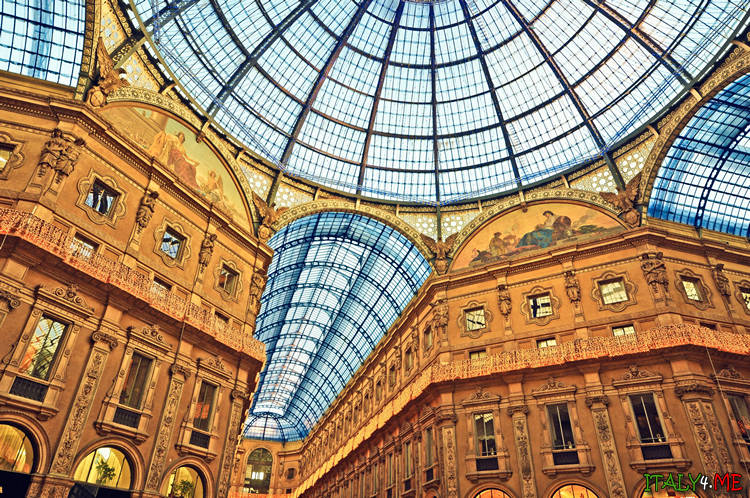
Take a stroll through the glass-covered arcade filled with high-end boutiques and designer shops, dedicated to Vittorio Emanuele II, and you’ll soon reach Via Filodrammatici 2. This address is home to the most famous opera house in the world—La Scala—as well as its adjoining museum.
While the theater’s exterior might not rival the dazzling marble of the Duomo, the interior has its own unique charm. But the true treasure of La Scala lies in the world-class performances that unfold on its stage.