 Italy for me From Italy with love

Want to feel the touch of noble antiquity? Our ranking of the ten most famous Roman emperors reveals who the world owes for the grandeur and beauty of the Eternal City.
- Octavian Augustus
(27 B.C. – A.D. 14)
Founder of the Roman Empire and its first emperor. He was the youngest contender for the throne, but his intellect, cunning, and ambition for absolute power made the difference. As the great-nephew of Julius Caesar, he inherited his legacy and initially ruled in a triumvirate. This arrangement didn’t suit him, and he soon eliminated co-rulers Mark Antony and Marcus Lepidus.
Octavian ruled Rome wisely and justly for over 40 years. He earned public recognition during his lifetime, which is rare for such great figures. His personal life, however, was far less successful. None of his three marriages brought happiness, and his only daughter Julia caused him grief with excessive drinking and promiscuity. Among her lovers, notably, was the poet Ovid. Like many men wild in their youth, Augustus later upheld traditional family values. He poetically expressed his dismay: “Far better to live childless and perish without heirs!” - Nero
(A.D. 54 – 68)

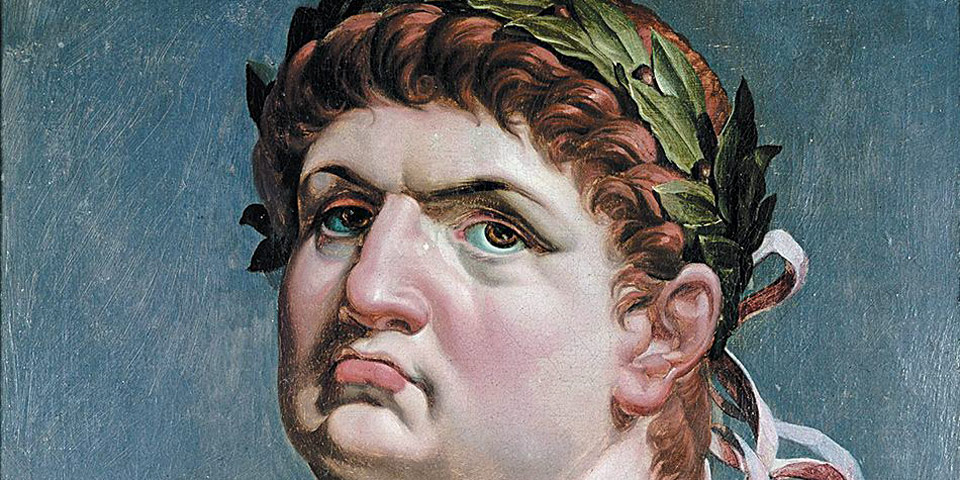
The cruelty and tyranny of Emperor Nero became legendary. His mother was told that if her son rose to power, he would kill her. The ambitious woman replied: “Let him kill me, so long as he rules!” The prophecy came true—and then some. Nero not only had Agrippina killed, but also both of his wives, his adoptive brother, and many nobles who displeased him. His teacher Seneca and the famous Petronius Arbiter were ordered to commit suicide. In addition to his crimes, Nero was passionate about writing poetry and playing the lyre, though he lacked any talent. Seeking inspiration for a song about the burning of Troy, he set fire to Rome and blamed the Christians. Before that, Christians had been treated neutrally. Nero began their brutal persecution. Even followers of the Roman gods suffered. The whole of Italy rose against him, and the Senate declared him an enemy of the people. Realizing the end was near, Nero fled to one of his country villas and ordered a freedman to stab him. The order was fulfilled. - Trajan
(A.D. 98 – 117)

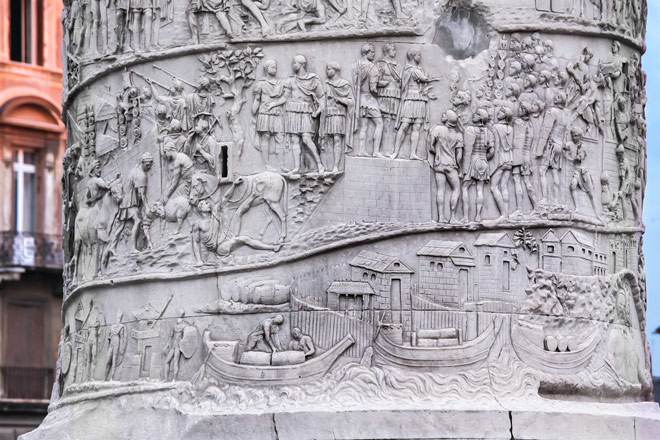
Emperor Trajan was a conqueror. Under his reign, the Roman Empire reached its greatest territorial extent. His most notable achievement was the conquest of Dacia (Transylvania) and parts of Parthia (Arabia). Trajan’s Column in Rome is decorated with reliefs depicting the Dacian campaigns. - Constantine
(A.D. 306 – 337)

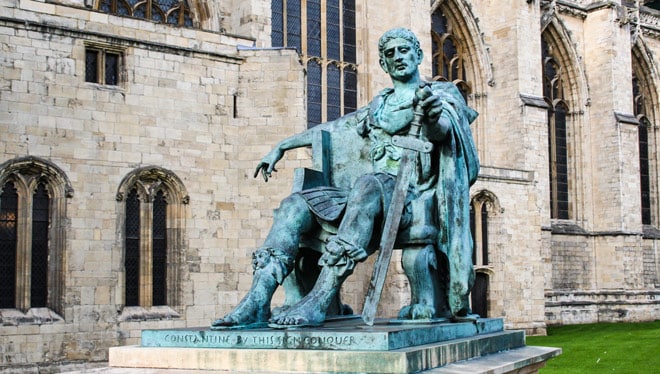
Emperor Constantine, known as the Great, forever changed the face of the Roman Empire. The capital was moved to Byzantium, which was renamed Constantinople (Istanbul). Remnants of Constantine’s defensive wall can still be seen in Istanbul today. During his reign, Christianity became the dominant religion. Although pagans were not persecuted, public rituals were banned.
He was baptized at the end of his life and buried in the Church of the Holy Apostles. Constantine hoped this would atone for his sins—in the past, he had killed his eldest son based on a false accusation by his second wife Fausta, and then had her executed as well. Today, the Arch of Constantine (Arco di Constantino) stands near the Colosseum in Rome. - Vespasian
(A.D. 69 – 79)
He was famed for his sharp wit, frugality, and true statesmanship. He ended Rome’s civil war and crushed the revolt in Jerusalem. Eager to fill the state treasury, he even taxed public toilets. When his son Titus criticized him, he immediately replied: “Money doesn’t stink!” That brilliant phrase has lived on for over two millennia.
But when it came to glorifying Rome, Vespasian forgot frugality. During his reign, the Capitoline Hill was restored, and the Colosseum was built. - Hadrian
(A.D. 117 – 138)

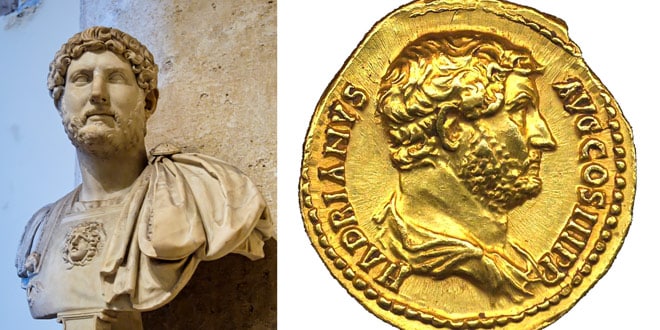
Emperor Hadrian was an ancient version of Peter the Great—he studied and taught, built and traveled. He toured the entire Roman Empire and recreated some of its provinces in miniature at his Villa in Tivoli (Villa Adriana). His marriage was unhappy—he despised his beautiful wife and favored his freedman Antinous. Yet both the wife and the favorite were immortalized in marble at the legendary villa. - Marcus Aurelius
(A.D. 161 – 180)
https://youtu.be/96RreEUHZFQ[/embed>
A renowned Stoic philosopher and author of the book “Meditations”. He severely persecuted Christians; under his rule, investigations and forced renunciations of faith became standard. These measures led to the execution of over a hundred saints. - Septimius Severus
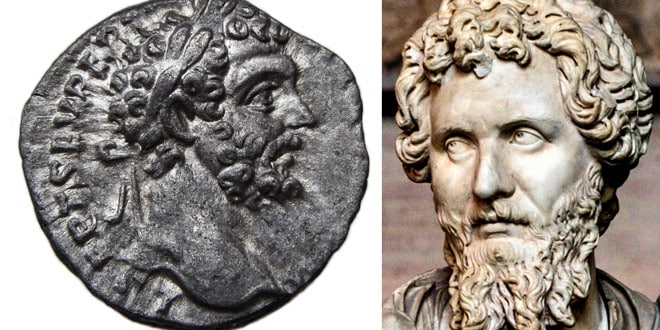
(A.D. 193 – 211)
He was known for his energetic and determined character. He loved the rugged life of military campaigns and shunned aristocratic decadence. He conquered Parthia and contributed to the strengthening of Roman law. Learn more about the Arch of Septimius Severus at the Roman Forum. - Diocletian
(A.D. 284 – 305)
Famous for subjecting Saint George the Martyr, his former centurion, to brutal torture after he converted to Christianity. He was the last emperor to try to eradicate Christians. In old age, he retired to a villa.
When senators asked him to return to power, he pointed to his garden beds and said: “Look at the cabbages I’ve grown!” - Romulus Augustulus
(A.D. 475 – 476)
The last emperor of the Western Roman Empire, who held the title only nominally. His realm was conquered by the Germanic king Odoacer, who spared the boy for his youth and beauty. Ironically, the man bearing the names of Rome’s founder and first emperor did not get to rule even a single day, for one year he was emperor only in name.