 Italy for me From Italy with love


Triumphal arches are a legacy of the Roman Imperial era, a time of power and prosperity.
The people of Rome rejoiced and praised their rulers returning from victorious campaigns. These grand moments needed to be preserved in the memory of future generations. Thus emerged a special form of architecture that became popular in Ancient Rome—triumphal gates or arches, designed to emphasize the might of the victors.
Page Contents
Arch of Titus
The Arch of Titus (Arco di Tito) is the oldest triumphal arch in Rome. It features a single span, built from white Pentelic marble, and stands 50.5 feet (15.4 meters) high and more than 16.4 feet (5 meters) wide.
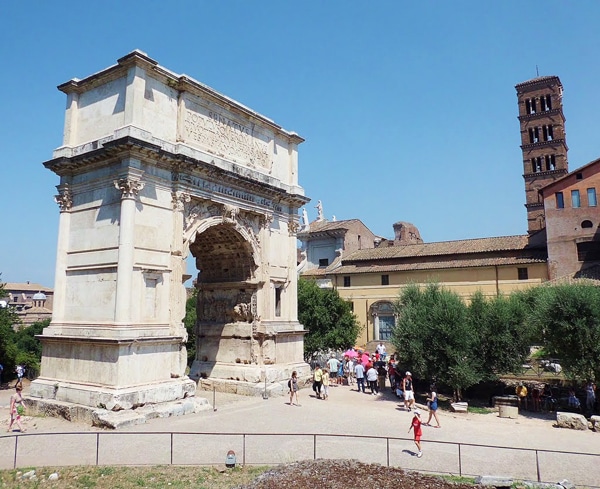
It is dedicated to the Roman Emperor Titus’s victory over the rebellious Jews. The event took place in 70 AD, when the Temple of Solomon in Jerusalem was destroyed, and thousands of Jews were taken captive.
The bas-reliefs depict the triumphant emperor crowned in gold, riding a chariot drawn by white horses, holding a scepter as a symbol of imperial power. In the background are captured slaves and valuable spoils of war. On each side of the arch opening are Corinthian columns. Above the cornice sits a rectangular structure—the attic—with an inscription dedicating the monument to Titus.
The central part of the Arch of Titus features two winged figures of the goddess Victory. The structure is decorated with relief scenes depicting the ceremonial procession of the victor and legions carrying Jerusalem’s treasures. Originally, a statue of the emperor stood atop the arch, but it has not survived to the present day.
Interesting Facts
- The Arch of Titus was built in 81 AD, shortly after the death of the emperor himself, by the initiative of his successor Domitian and by the hands of the very Jewish slaves that Titus had brought from his victorious campaign. Over 50,000 Jews arrived in Italy at that time, marking the beginning of the Jewish diaspora.
- The ashes of Titus were buried in the attic of the Arch of Titus—an honor granted to only three rulers in the history of the Roman Empire: Caesar was buried in the Forum, Trajan at the base of his column in the Forum of Trajan, and Titus in his arch. Thus, the Arch of Titus is not only the prototype for later triumphal arches in Rome but also a memorial.
How to Get There
- The Arch of Titus is located on an elevated area in the eastern part of the Roman Forum (Foro Romano), near the Colosseum. The nearest metro stop is Colosseo, Line B.
- Admission to the Forum costs €12.
- Check this guide on how to buy tickets for the Forum and Colosseum in advance to skip the lines.
Arch of Septimius Severus
Another well-preserved monument of this type in the Roman Forum is the three-arched Arch of Septimius Severus (Arco di Settimio Severo), erected in 205 AD.
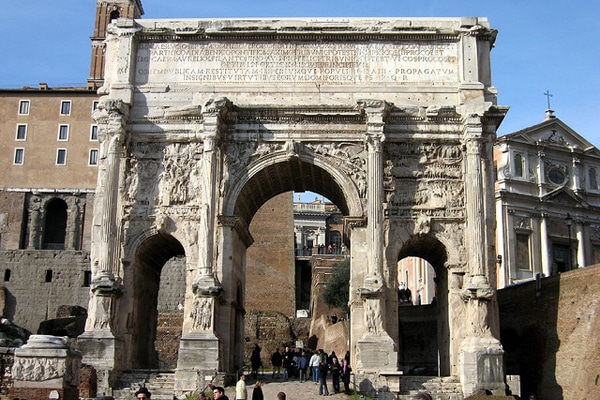
Each side is adorned with paired columns whose capitals feature elements of different classical orders. Above them is a prominent entablature. The entire structure is 68.5 feet (20.9 meters) high and 76.4 feet (23.3 meters) wide. The core materials are brick and travertine, while the exterior is clad in marble. All three arches are interconnected by interior passageways.
On one side of the Arch of Septimius Severus, several steps lead to the base. A staircase also leads to the upper attic, which is divided into four chambers. The walls and base are decorated with reliefs celebrating the victories of Septimius Severus and his two sons, Caracalla and Geta, over hostile tribes. Ancient coins reveal that the monument was once topped with sculptures of Severus and his sons, though these statues have not survived.
Interesting Facts
- After their father’s death, Caracalla refused to share the throne with his brother Geta and seized power through a classic Roman method—fratricide. Geta’s name was later erased from the Arch of Septimius Severus. Caracalla would go down in history as one of Ancient Rome’s most brutal emperors.
How to Get There
- The Arch of Septimius Severus is located in the Roman Forum in Rome, near the Colosseum. The nearest metro stop is Colosseo (Line B), and it’s also easily accessible from the Parco Celio tram stop.
- Forum admission is €18.
Arch of Constantine
The Arch of Constantine (Arco di Costantino) dates from a later era—the 4th century AD—and has become one of the most popular landmarks among tourists.
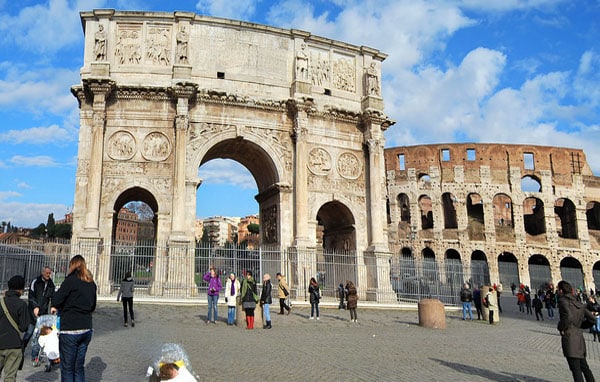
The Arch of Constantine is a three-arched gateway standing 69 feet (21 meters) tall and more than 82 feet (25 meters) wide, adorned with Corinthian columns topped by sculpted figures of captives. The monument is divided into three main sections, each richly decorated with reliefs illustrating scenes from Roman history and religion.
The arch was built to commemorate Constantine’s victory over Maxentius at the Battle of the Milvian Bridge in 312 AD. This key moment not only brought Emperor Constantine the Great to Christianity, but also marked a turning point in establishing a new religious order across the Western world.
Interesting Facts
- Most of the arch’s reliefs were repurposed from earlier Roman monuments. The original 4th-century carvings stand out unfavorably when compared to their predecessors, reflecting a decline in artistic skill at the time—rigid geometric sectioning and excessive ornamentation give the structure an element of architectural kitsch.
How to Get There
- The Arch of Constantine stands next to the Colosseum on Via di San Gregorio. The nearest metro station is Colosseo on Line B.
- Visiting this monument is free of charge.