 Italy for me From Italy with love

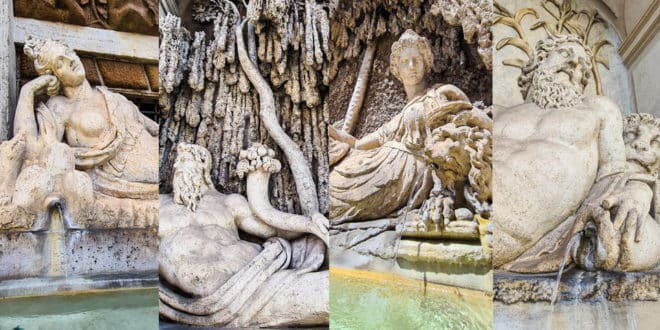
The Four Fountains (Quattro Fontane) are Roman fountains from the Late Renaissance period, set into niches of corner buildings at the intersection of three streets—Via delle Quattro Fontane, Via del Quirinale, and Via XX Settembre.
The sculptural compositions, crafted in the Baroque style and unified by themes from ancient mythology, became so popular in Rome that they lent their name to the street, the intersection, and the nearby church known as San Carlo alle Quattro Fontane.
Page Contents
When and Why They Were Built
The group of four fountains at this crossroads, situated at the highest point of the Quirinal Hill, was created in the 16th century during the reconstruction of the ancient Alexandrine Aqueduct (Acquedotto Alessandrino). At that time, one of the most pressing needs in the decaying city of Rome was to improve the water supply and to develop neglected areas, much of which resembled farmland.
The city’s aqueduct was renewed between 1585 and 1587 by order of Pope Sixtus V of the Felice family, hence the aqueduct’s name, Acqua Felice.
According to the underground distribution plan of the aqueduct in the Quirinal area, several fountains were designed not only to provide water to the residents of Rome but also to beautify the city.
I recommend also reading about aqueducts and baths in Ancient Rome.
Many tourists often confuse the Four Fountains with the Fountain of the Four Rivers (Fontana dei Quattro Fiumi) in Piazza Navona.
Location on the City Map
The choice of location for the construction of the Four Fountains was no coincidence.
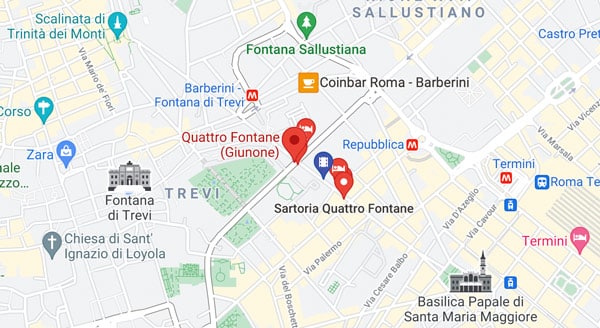
The intersection at the summit of the Quirinal Hill already appeared on maps of Ancient Rome. It was a key point along one of the city’s most important roads—the Alta Semita—which connected the Colline Gate (Porta Collina) in the Servian Wall to the Temple of the Flavian Dynasty (Tempio della gens Flavia).
The area, which had been abandoned during the Middle Ages, began to quickly redevelop in the 16th century with the construction of wealthy mansions, while the intersection, known since antiquity, retained its place in Rome’s urban layout.
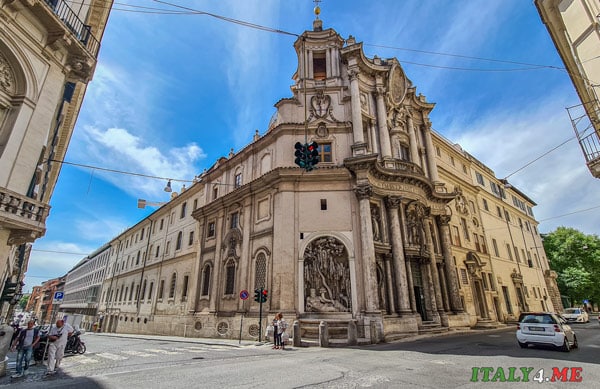
At that time, it was formed by streets known as Via Porta Pia (today’s Via del Quirinale and Via XX Settembre) and Via Felice (now Via delle Quattro Fontane). The first revived the route of the ancient Alta Semita, while the second led from the church of Trinità dei Monti to the Basilica of Santa Maria Maggiore (Basilica di S. Maria Maggiore).
Design
The designer of the Four Fountains intersection is believed to be the talented architect and civil engineer Domenico Fontana, whose services were frequently employed by Pope Sixtus V.
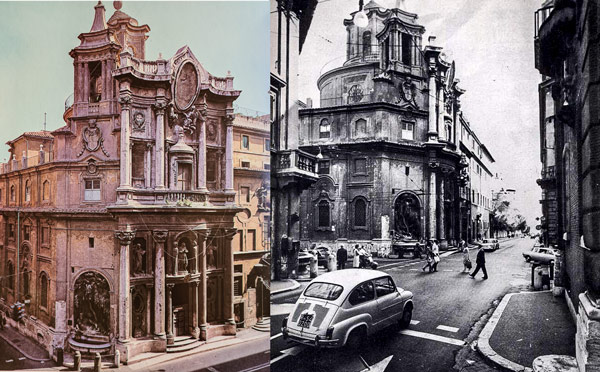
This master of original architectural projects developed a plan placing the fountains in the chamfered corners of each of the four buildings at the intersection:
- Palazzo Albani del Drago;
- Palazzo Volpi Galloppi;
- The church of San Carlo alle Quattro Fontane;
- A building at the corner of what would later become the gardens of Palazzo Barberini.
This design did not impede traffic flow on the rather narrow roadway of the busy intersection.
The 16th-century urban plan still holds some surprises today. Few realize that the intersection marks the meeting point of three Roman districts (Rione): Monti, Trevi, and Castro Pretorio.
Additionally, thanks to the architect’s unique vision, from the center of the small square, three obelisks are visible along three visual axes:
- Esquiline Obelisk (Obelisco Esquilino) on Piazza dell’Esquilino;
- Sallustian Obelisk (Obelisco Sallustiano) on Piazza della Trinità dei Monti;
- Quirinal Obelisk (Obelisco del Quirinale) on Piazza del Quirinale.
A fourth axis, pointing northeast, aligns with the city gate Porta Pia, one of the final works of Michelangelo.
I also recommend reading about Rome’s obelisks.
Funding
The unique Four Fountains project was not financed from the papal treasury, as was typical for most public fountains in Rome, but rather by private individuals.
\
Two of the fountain sculptures were commissioned by Muzio Mattei, a Roman aristocrat from a noble family. He originally owned the plots where the Palazzo Albani del Drago and the church of San Carlo alle Quattro Fontane now stand. The other two fountains were financed by Monsignors Antonio Grimani (bishop of Torcello) and Giacomo Gridenzoni, who owned the remaining corners of the intersection.
Description
The sculptural compositions of the Four Fountains appeared at the namesake intersection between 1588 and 1593. They form a unified stylistic ensemble divided into sections, each dedicated to a specific mythological theme.
It is known that the fountains underwent several modifications and additions over time, partly due to the need to adapt to the new facades of the intersection’s buildings.
The fountain statues depict reclining figures: two male figures representing the rivers Tiber and Arno, and two female figures representing the goddesses Juno and Diana, symbolizing Strength and Fidelity, and possibly also personifying rivers. The decorative background and symbolic details accompanying the deities’ figures reflect the sculptor’s intent and offer many intriguing interpretations.
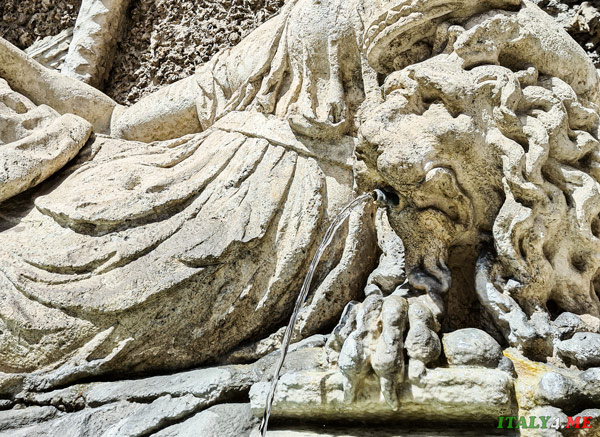
A small basin collects the water flowing in a thin stream from a single spout. The area around each fountain is protected by a series of short posts, safeguarding the sculptures from accidental collisions or damage. The materials used in the fountains’ construction include marble, peperino, travertine, cement, and plaster.
An interesting fact: with the permission of Pope Sixtus V, rare marble was sourced from the ruins of the ancient Septizodium, a monumental nymphaeum built at the foot of the Palatine Hill by Emperor Septimius Severus in 203 AD.
I also recommend reading about sculpture in Ancient Rome and the Arch of Septimius Severus.
Artists
Currently, there is no definitive information about the sculptors of the Four Fountains. It is possible that the statues were created at different times and may have originally stood in the gardens of Roman aristocrats’ villas.
It is generally believed that the fountains depicting the Tiber, the Arno, and Juno were the work of Domenico Fontana.
Another theory suggests that the latter two statues were sculpted by Pietro Paolo Olivieri.
The figure of the goddess Diana is often attributed to the architect and master of monumental painting Pietro da Cortona, though he most likely only participated in the restoration of this sculpture.
Statues
Each sculptural composition of the Four Fountains holds special interest and conceals mysteries about its creation that remain unsolved. Their complex iconography continues to spark debate and varied interpretations regarding who created them, when they were made, and what or whom they represent.
Tiber
The fountain depicting the Tiber River, the symbol of Rome, belongs to the Monti district and is located at the corner building that houses the church of San Carlo alle Quattro Fontane.
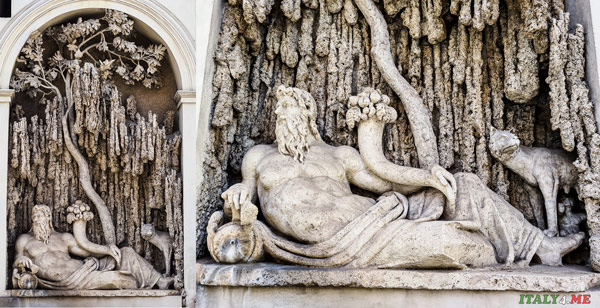
The church, dedicated to Saint Charles and the Holy Trinity, is a Baroque masterpiece designed by Francesco Borromini\</a) and constructed between 1638 and 1663. The architect skillfully incorporated the existing fountain into his brilliant church design.
The allegory of the Tiber is represented by a bearded male figure reclining on his side, partially covered by a draped cloth. His right hand rests on a jug (gargoyle), while his left hand holds a cornucopia filled with fruit, symbolizing Rome’s abundance.
In the background, a fig tree and lush grapevine evoke the city’s fertility and prosperity. In the right corner, the Capitoline Wolf, the heraldic animal of the Eternal City, can be seen (this addition appeared later).
Arno
At the corner of Palazzo Albani del Drago, located in the Castro Pretorio district, stands the fountain depicting the god of the Arno or Aniene River.
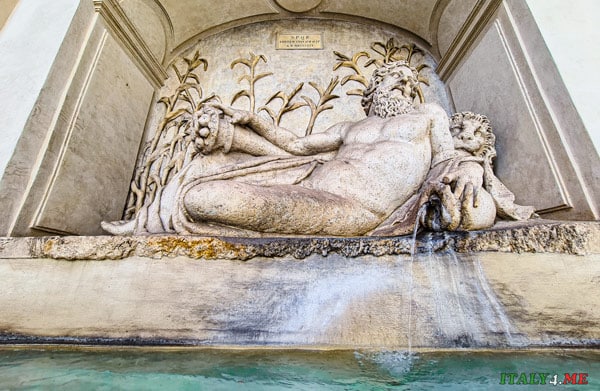
He is portrayed in a softer and more romantic manner than the robust figure of the Tiber, reclining on his left side. Resting one hand on a jug, he holds a bouquet of flowers in the other.
Why did the sculptor choose the Arno? The river god is known as a symbol of Florence, which had close ties to Rome in the late 16th century.
Italy’s most beautiful city was founded by the Romans and named Colonia Florentia in honor of the goddess of flowers and plants. The Arno River was a tributary of the Tiber and a water source for ancient Roman aqueducts. The meaningful details of the sculpture recall Florence: the flowers represent the city’s name, the rare reed in the background suggests the partially marshy Arno valley, and the lion’s head behind the deity symbolizes the city’s heraldic animal.
Juno
The reclining figure of Juno adorns the fountain in the Trevi district (Rione Trevi) at the corner of a modern government building—the Institute for the Supervision of Insurance (Istituto per la Vigilanza sulle Assicurazioni). In the past, this building was known as Palazzo Volpi Galloppi.
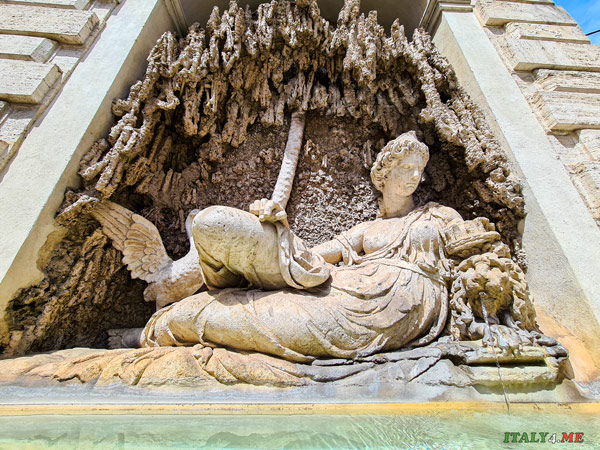
The goddess, protector of Rome, can be recognized by the depiction of a goose flapping its wings, a reference to the famous legend in which sacred geese from Juno’s temple at the Capitoline fortress saved Rome.
The niche’s background alludes to the other fountains in the group: lush vegetation connects it to the Tiber, while the seated lion to the left of the goddess refers to the Arno.
Diana
The statue of Diana was added somewhat later than the other fountains in the Four Fountains group. It adorns the corner of a building in the Trevi district, situated opposite Palazzo Barberini. The fountain was integrated into the building’s facade only in 1920.
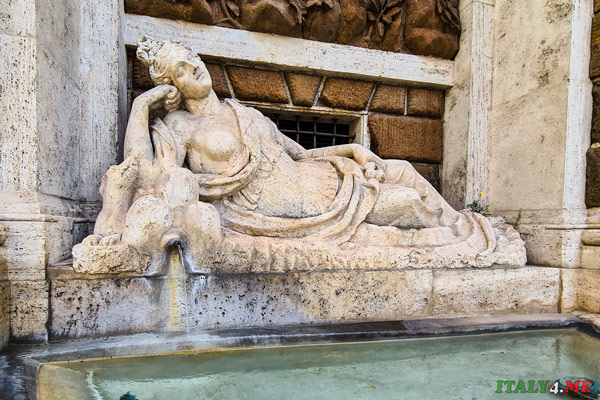
The female figure, in a languid pose, is dressed in a long gown gracefully slipped from her shoulder, revealing her chest. With her right hand, the goddess leans on a stone from which water flows. Both the exposed chest and the flowing water symbolize Diana’s roles as a goddess of femininity and fertility. A dog, often seen accompanying the goddess of the hunt, sits in the foreground.
Unlike the other sculptures, this statue is not set within a niche. The reclining figure of the goddess has only a rear wall decorated with vegetal patterns. A decorative window was added during a 1665 restoration. Among the leaf motifs, one can spot the Barberini bee.
The fountain is not solely dedicated to Diana, as several concealed decorative details also pay tribute to Sixtus V.
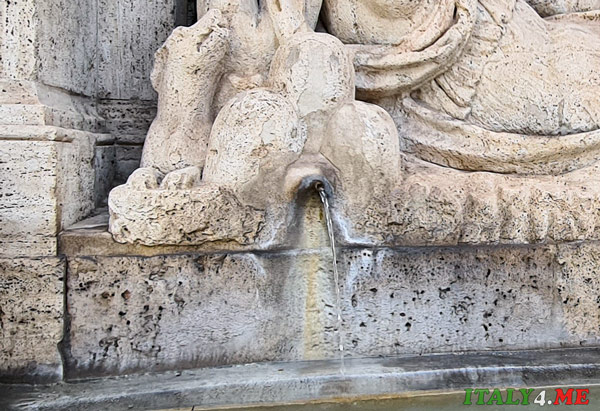
The stone from which the water flows and upon which the goddess leans her elbow represents the three hills of the Sixtine coat of arms, while the stars and lion’s head carved into the basin wall are emblems of the pontiff’s family.
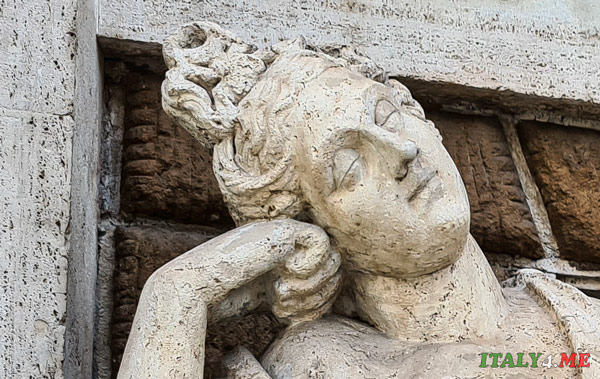
Another interesting detail is the crescent moon in Diana’s hair. The sculptor may have represented Luna, a rare ancient deity whom the Romans often identified with Diana.
The Four Fountains are not included in Rome’s main tourist routes, yet they undoubtedly deserve attention.
Among the city’s numerous fountains and squares, both grand and famous, the Quattro Fontane stands out not only for its original placement and compositional design but also for a subtly touching charm of antiquity and the mystery concealed beneath the gentle murmur of its waters.