 Italy for me From Italy with love


How can you save money while traveling in Rome? Is there a way to get both museum discounts and access to public transportation at the same time? One possible way to save both time and money is the Roma Pass, a tourist card that promises discounted access to public transit and many of Rome’s top attractions. In reality, however, the savings aren’t always so clear-cut—let’s break down the details.
Page Contents
Types and Prices
What benefits are included with the Roma Pass cards?
There are two types of cards:
- Roma Pass 72 Hours – €38.50
- Roma Pass 48 Hours – €28. Price is the same for adults and children.
The Roma Pass is an all-in-one tourist card that offers discounted access to museums and cultural landmarks in central Rome (Zone A) for 3 or 2 days, plus access to the following transportation:
- All ATAC surface transport (buses, trams, and trolleybuses);
- Unlimited metro rides on lines A and B;
- Regional trains to Lido, Viterbo, and Giardinetti. You can even take a trip to the sea.
The 72-hour Roma Pass expires at midnight on the third day, and the 48-hour pass expires at midnight on the second day from the moment of activation.
What You Can See
- Roma Pass 72 Hours gives you free skip-the-line access to two attractions. For all other sites, you must present the card at the ticket office and book your entrance in advance to receive a discount.
- Roma Pass 48 Hours grants one free skip-the-line entrance and discounts for all additional cultural sites.
You can download the full list of museums where the Roma Pass offers free or reduced entry.
However, at major landmarks like the Colosseum, Castel Sant’Angelo, or the Borghese Gallery, the Roma Pass does not offer fast-track turnstiles or special privileges. You’ll still pay about the same as a regular visitor and must collect tickets at the standard counters.
The following combined museum entries count as one visit with the Roma Pass:
- Colosseum, including the Roman Forum and Palatine Hill;
- Museum of Contemporary Art and its satellite locations (Museo di Arte Contemporanea di Roma);
- Planetarium and Astronomical Museum (Planetario, Museo Astronomico), and others.
Both passes also grant discounted access to temporary exhibitions held within these museums during their normal opening hours.
Some of the most popular attractions have entry restrictions. Even with the Roma Pass, advance booking is still required:
- Colosseum – reservation required, €2, ideally 3–4 days in advance

- Borghese Gallery – must reserve at least a week in advance by phone or online, €2 fee;
- Palazzo Valentini (Domus Romane).
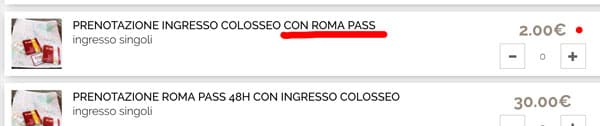
Reviews from travelers who’ve used Roma Pass in Rome suggest that the card’s real advantages are limited—especially since the most popular attractions still require advance reservations, making it less convenient than expected.
The one real benefit of the Roma Pass might be the map included with the card, but you can also get a free map at any hotel or simply download it here in PDF format.
Should You Buy It?
Before deciding whether to purchase a Roma Pass in Rome, there are a few important details to keep in mind.

The Roma Pass does not include access to certain cultural sites or cover travel on the following types of transport:
- Temporary exhibitions at the Ara Pacis Museum (Altar of Peace);
- Attractions and museums of the Vatican;
- Trenitalia national railway services;
- The Leonardo Express train between Fiumicino Airport and Rome;
- Any transportation to and from Fiumicino or Ciampino airports;
- Taxis.
Here are a few additional things to consider before buying a Roma Pass:
- Children under 10 (from any country) travel for free on public transport.
- Disabled visitors and their companions are granted free entry to museums and cultural heritage sites.
Most museums in Rome are closed on Mondays, December 25, January 1, and May 1. When planning your visit, double-check the opening hours of the places you want to see.
All tourists, regardless of card ownership, can visit the following 8 attractions for free (no Roma Pass required):
- Library of the National Academy of San Luca (Accademia Nazionale di San Luca);
- Museum of the Earliest History of Rome (Museo di Casal de’ Pazzi);
- Napoleon Museum (Museo Napoleonico)
Where and How to Buy
You can collect your Roma Pass from unified ticket kiosks or public transportation points of sale (PIT) 5 days after payment. They’re located at several convenient spots:
- At railway stations and airports;
- At ATAC ticket kiosks;
- At metro stations on lines A and B;
- Near popular landmarks in the city center.
Here are a few easily accessible pickup locations:
- Lungotevere Vaticano (Piazza Pia) from 9:30 AM to 7:00 PM – near Castel Sant’Angelo.
- At the baggage claim exit at Ciampino Airport, 8:30 AM to 6:00 PM.
- Piazza delle Cinque Lune, near Piazza Navona, 9:30 AM to 7:00 PM.
- At the baggage claim exit, Terminal 3 of Fiumicino Airport, from 8:00 AM to 8:45 PM.
- At the tourist info center on Via dei Fori Imperiali, 9:30 AM to 7:00 PM.
- Corner of Via Marco Minghetti and Via del Corso, 9:30 AM to 7:00 PM.
- At Termini Station, Via Giovanni Giolitti, 3, from 8:00 AM to 6:45 PM.
It’s not mandatory to buy your card in advance—you can buy it on-site for the same price. However, if you plan to use public transportation right away, it’s smart to order the card in advance and pick it up as soon as you arrive at the airport or train station.
Card pick-up points are open daily, including weekends, from 9:30 AM to 7:00 PM.
The Roma Pass can be paid by MasterCard or in cash.
If the card is lost or your trip is canceled after online payment, there are no refunds.
How to Use
Using the Roma Pass is easy. Just write your full name and purchase date on the back. The card activates with the first use in a museum or on public transportation—just tap it on the black circle of the ticket machine and wait for the green light.
At museum entrances, show the Roma Pass along with your ID to the staff.
If you have questions about how to use the Roma Pass, feel free to ask in the comments below the article.
How to Visit the Borghese Gallery with Roma Pass
- Call the gallery at +39 06 32 810 and reserve tickets in English or Italian under the same name that will appear on your Roma Pass. You can do this before arriving in Rome.
- Arrive at the gallery an hour before your reserved time to collect your tickets with the card.
We highly recommend visiting the Borghese Gallery with a professional art historian guide who can bring to life the works of Bernini and Caravaggio.
Conclusion and Cost Analysis
Let’s do the math on whether the Roma Pass is actually worth it—strictly numbers, nothing personal.
A single ride on Rome’s public transport (valid for 100 minutes) costs €1.50. A 48-hour pass costs €12.50, and a 72-hour pass costs €18. Prices are based on the official website www.atac.roma.it
Subtracting transportation costs from the Roma Pass price:
- Roma Pass 48 = €28 – €12.50 = €15.50 remaining for one attraction;
- Roma Pass 72 = €38 – €18 = €20 remaining for two attractions.
People usually buy the Roma Pass for top attractions: Colosseum tickets cost €14, and Borghese Gallery tickets (since 2019) cost €15. However, booking is required for the Borghese Gallery, and during high season (March–November), tickets may be unavailable even 3–7 days out. On major holidays like May Day or Christmas, you may need to book 1–2 weeks in advance.
So, if you make full use of public transport and squeeze in multiple attractions, you may save €5–15—but only if you manage to get a spot at the Borghese Gallery. Without that, the card’s value is questionable. Still, it’s a convenient option for unlimited public transport.
Official site in Italian: www.romapass.it