 Italy for me From Italy with love


According to one version of the founding of Rome, the story begins after the fall of ancient Troy. A handful of Trojan warriors managed to escape, led by none other than the legendary Aeneas—known for his courage and determination. The exiles wandered across the sea aboard their ships, searching for a new home. After a long and arduous journey, they finally landed on a welcoming shoreline. At the mouth of a wide river flowing into the sea, they saw forests and dense shrubs lining the banks. Beyond them, a sunlit, fertile plain stretched under the open sky.
Exhausted from their travels, the Trojans decided to settle on this hospitable land—which, as it turned out, was the coast of Italy. In time, Aeneas’s son would go on to found the city of Alba Longa on this very site.
Page Contents
The Legend of Romulus and Remus
Several decades later, the city of Alba Longa was ruled by Numitor—a descendant of Aeneas. Unfortunately, Numitor had a treacherous relative: his younger brother Amulius, who deeply resented the reigning king and longed to seize the throne. Through a series of cunning schemes, Amulius overthrew Numitor but chose to spare his life. However, fearing revenge from Numitor’s descendants, Amulius ordered the murder of Numitor’s son. His daughter, Rhea Silvia, was forced into service as a Vestal Virgin in the Temple of the goddess Vesta.
Despite the strict vows of chastity imposed on the priestesses, Rhea Silvia soon gave birth to twin boys. According to one version of the myth, the father of the children was none other than Mars, the Roman god of war.
When Amulius learned of this, he was enraged. He ordered Rhea Silvia to be killed and demanded that the newborn twins be thrown into the Tiber River. The servant tasked with this grim duty placed the babies in a basket and carried them to the riverbank. However, due to the strong floodwaters, the man hesitated to step into the raging current.
Instead, he left the basket on the shore, hoping the river would carry it away and the twins would drown. But fate had other plans—the river simply swept the basket downstream to the base of the Palatine Hill, and the floodwaters soon receded.
The She-Wolf
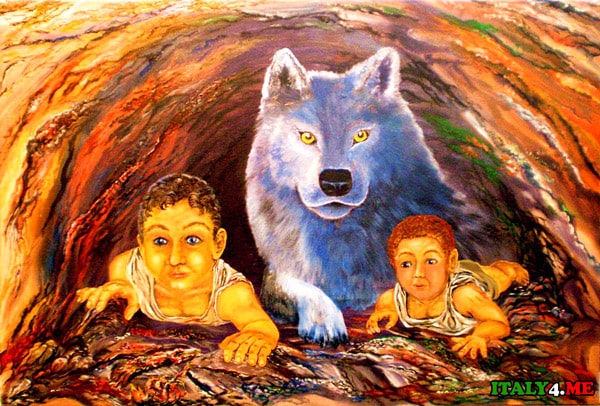
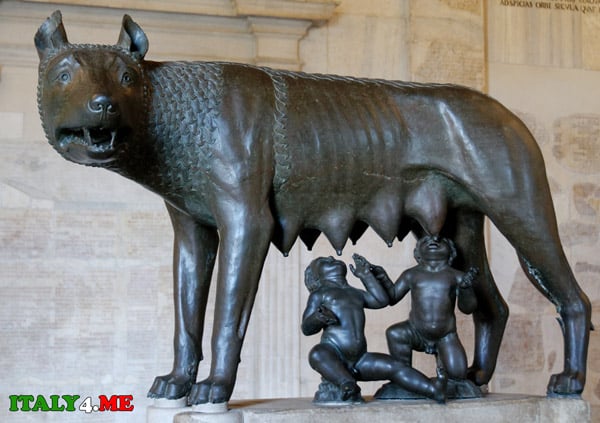
As the water withdrew, the basket toppled and the babies fell out, crying. Their cries reached the ears of a she-wolf, who had recently lost her cubs. Drawn to the sound, she approached the infants. Her maternal instincts overpowered her predatory nature. The she-wolf gently licked the boys and nursed them with her own milk.
Today, the statue of the Capitoline Wolf stands in the Capitoline Museum and is a powerful symbol of Rome’s origins.
Who Raised Romulus and Remus?
Later, a royal shepherd noticed the boys. He took them in and raised them. The shepherd named the twins Romulus and Remus. The children grew up in the wild and became strong, agile warriors. When they came of age, their adoptive father revealed the secret of their birth. Upon learning the truth about their origins, the brothers decided to return the throne to their grandfather, Numitor. Each gathered a small force and marched to Alba Longa. The city’s inhabitants supported the rebellion of Romulus and Remus, as Amulius had been a cruel ruler. Thanks to the people, the grandsons were able to restore the throne to their grandfather.
The young men had grown fond of their way of life and chose not to remain with Numitor. Instead, they headed toward the Palatine Hill, to the very spot where the she-wolf had once found them. There, they decided to build a city of their own. However, a serious argument broke out between the brothers as they debated where to build the city, what to name it, and who should rule. During the quarrel, Romulus dug a trench marking the future city wall. In mockery, Remus jumped over both the trench and the embankment. Enraged, Romulus struck down his brother, saying: “So shall it be for anyone who crosses the walls of my city!”
Founding of Rome
Romulus then founded the city on that very spot, beginning with a deep furrow to mark its boundaries. He named the city after himself—Rome (Roma). At first, it was no more than a cluster of humble clay huts with straw roofs. But Romulus was determined to grow both the population and prosperity of his city. He welcomed outcasts and fugitives from other places and led military raids against neighboring peoples. According to early Roman custom, a man had to steal a wife from a nearby settlement to marry.
The Abduction of the Sabine Women
Legend says that one day, military games were held in Rome, and neighbors were invited to attend with their families. In the midst of the festivities, the Roman men suddenly rushed toward the guests, seized young women, and fled.
Since most of those taken belonged to the Sabine tribe, the event became known in history as the Abduction of the Sabine Women. Thanks to these women, Romulus was able to unite the Sabines and Romans into a single people, thus expanding the population of his city.
Growth of Ancient Rome
Years, decades, and centuries passed. Rome grew and laid the foundation for one of the most powerful ancient civilizations—Ancient Rome. At its peak, the empire’s influence, culture, and traditions stretched across most of Europe, North Africa, the Middle East, and the Mediterranean. At the heart of this vast empire stood Italy.
Ancient Rome laid the groundwork for the development of European civilization.
It introduced unique architectural styles, Roman law, and much more. It was also within the Roman Empire that a new faith—Christianity—emerged.
The capital of Italy has gone through multiple cycles of decline and rebirth. In this Eternal City, built on seven hills, various epochs and architectural styles coexist in harmony. Antiquity and modernity, freedom and faith—all contribute to the multifaceted identity of this great city. In modern Rome, ancient temple ruins, majestic cathedrals, and luxurious palaces stand alongside billboards for popular brands, and busy storefronts buzzing with loud vendors.