 Italy for me From Italy with love


The Capitoline Museums (Musei Capitolini) are among the oldest public museums in the world, located in Rome on the elegant Piazza del Campidoglio. They form part of a magnificent architectural ensemble—an embodiment of the brilliant design by Michelangelo Buonarroti (Michelangelo di Lodovico di Leonardo di Buonarroti Simoni).
Across its many galleries, the museum houses extraordinary collections of Roman sculptures dating back to antiquity, along with paintings, ceramics, mosaics, jewelry, and coins.
Page Contents
Foundation
The progressive idea of creating a public museum—ahead of its time—belonged to Pope Sixtus IV (Papa Sisto IV). In 1471, he decided to make art accessible not only to the aristocracy but to all citizens of Rome.
To inaugurate the first exhibits, the head of the Vatican selected several bronze antiquities from his personal collection stored in the Lateran Palace (Palazzo del Laterano). These artworks were highly symbolic of Ancient Rome’s grandeur: fragments of the statue of Emperor Constantine the Great, the sculpture “Boy with Thorn” (Cosiddetto Spinario), and the iconic Capitoline Wolf (Lupa Capitolina).
The location chosen to display this small initial collection was deeply symbolic as well—the summit of the most important of Rome’s seven hills: the Capitoline Hill (Monte Capitolino). In ancient times, this was the spiritual heart of the Eternal City. It once housed the Temple of Jupiter, the most sacred Roman shrine. Later, the site became home to the Roman state archives (Tabularium) and the Republican mint. Visitors can still see remnants of these ancient buildings both inside the Capitoline Museums and outdoors nearby.
In the 12th century, the hill gained further significance with the construction of the Palazzo Senatorio (Senators’ Palace), also known as the Capitoline. This building became the seat of the Roman Senate—the main governing body of the state.
The ancient sculptures donated to the city by Sixtus IV were displayed for several decades outdoors, on the façade and courtyard of the Palazzo dei Conservatori. Only later were they moved into the museum’s interior halls.
Expansion of the Collection
The collection of ancient artifacts gathered in the Palazzo dei Conservatori grew rapidly, especially during the first century. All newly discovered works of ancient art in Rome were sent to the Capitoline Museums, except for those selected for the Belvedere in the Vatican (Stato della Città del Vaticano).
Conversely, sculptures whose images were considered too provocative or inappropriate for the papal palace were transferred to the Palazzo dei Conservatori. For example, Pope Pius V (Pius PP. V), in his attempt to cleanse the Vatican of depictions of “pagan idols,” donated 140 ancient statues to the public museum, transforming it into a collection of classical sculpture.
By the mid-16th century, the ancient collection had grown to include a gilded bronze statue of Hercules, the equestrian sculpture of Emperor Marcus Aurelius, marble fragments of the acrolith of Constantine the Great, and several new discoveries from excavations in Rome. From the Quirinal, two colossal statues—Tiber and Nile—were moved to adorn the façade of the Palazzo Senatorio.
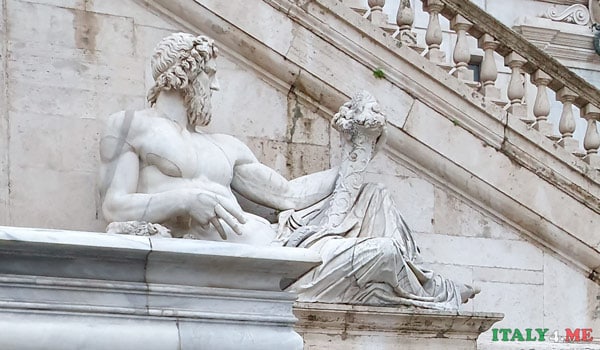
The Capitoline Museums were officially opened to the general public in 1734 by Pope Clement XII (Clemens PP. XII). At that time, a renewed wave of enthusiasm for Antiquity swept through both secular and ecclesiastical circles.
Restoration projects of ancient monuments began appearing everywhere, archaeological excavations were organized in search of new classical masterpieces, and numerous galleries were founded. The display of ancient artworks took on a commercial aspect—foreign tourists were willing to pay generously to view them.
Clement XII changed the museum’s profile, which until then had featured only sculptures, by incorporating paintings acquired from Cardinal Albani—a passionate admirer of Antiquity—alongside his vast sculpture collection. These paintings dated to the Middle Ages and the Renaissance.
In 1870, the exhibition halls of the historical complex expanded significantly with the addition of new artifacts, including a notable collection of Greek, Etruscan, and Italian vases received as gifts.
Recommended reading: Vatican Museums
Architectural Ensemble
The architectural ensemble of the Capitoline Museums was designed by Michelangelo Buonarroti at the request of Pope Paul III (Papa Paulus III). The execution of the project began in 1536 during the great artist’s lifetime and continued for the next 400 years, with interruptions and resumptions. Interestingly, Michelangelo’s original plan was barely altered over time and is considered a realized ideal of urban planning.
To reach the square, visitors ascend a gently sloping stairway known as the Cordonata. At its summit, statues of the mythical twin brothers—immortal Pollux and mortal Castor—welcome guests.
At the center of the square stands the equestrian statue of Emperor Marcus Aurelius—a replica of the bronze original, which was moved indoors to a specially equipped hall in the Palazzo dei Conservatori for preservation.
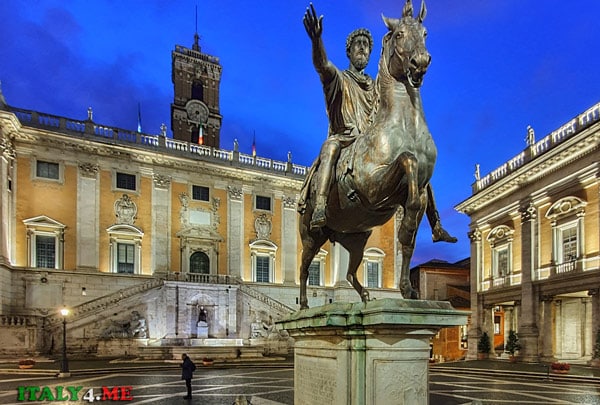
The imposing pedestal for the sculpture was designed by Michelangelo himself.
The square was paved with stone as early as the 15th century, but the starburst design was added only in 1940, precisely following the sketch of the genius architect.
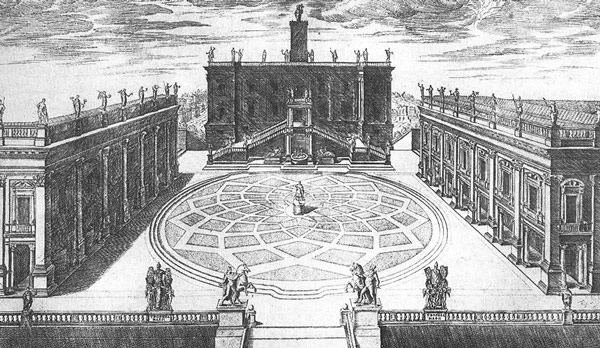
Three buildings face the trapezoidal Piazza del Campidoglio, unified in form and style: the Palazzo Senatorio, the Palazzo dei Conservatori, and the Palazzo Nuovo.
The latter two, featuring symmetrical façades, stand opposite each other and frame the square beautifully. They are connected by an underground gallery built in 1930, which became part of the Capitoline Museums.
In this space, one can see traces of residential buildings dating back to the 2nd century. The Palazzo Senatorio is positioned perpendicularly to the other two, creating a partially enclosed space that now faces the Vatican—unlike the original orientation of the Capitoline Hill, which looked toward the Roman Forum.
In the 20th century, the museum complex was expanded with the addition of the Palazzo Caffarelli-Clementino to increase its exhibition space.
Palaces
The museum complex is housed in three buildings—the Palazzo dei Conservatori, the Palazzo Nuovo, and the Palazzo Caffarelli-Clementino. The Palazzo Senatorio is not open to visitors, as it serves as the city’s town hall.
Palazzo dei Conservatori
The Palazzo dei Conservatori was rebuilt in 1560 from a 15th-century structure based on Michelangelo’s design as part of a unified project.
The palace’s façade stands out for its monumental pilasters—used for the first time in architecture—which are decorative elements shaped like protruding square columns. This stylistic feature later gained wide popularity in construction across various countries. As part of the redesign, round columns were added on the ground floor to frame the pilasters, along with a balustrade adorned with statues on the building’s roof.
The refined interior of the Palazzo dei Conservatori is highlighted by carved doors and ceilings, frescoes, stucco work, and antique tapestries.
The museum exhibits in the palace feature ancient Roman, Greek, and Egyptian sculptures, paintings by Italian masters, vases, a coin collection, and precious jewelry.
Palazzo Nuovo
The Palazzo Nuovo was envisioned by Michelangelo as a mirror image of the Palazzo dei Conservatori, situated directly across from it. Construction funding began in 1603 at the initiative of Pope Clement VIII (Papa Clemens PP. VIII), but the building was completed only in the 17th century under the direction of Italian architect Girolamo Rainaldi and his son Carlo Rainaldi.
The interior space is characterized by a symmetrical layout of rooms, primarily showcasing sculptures.
Palazzo Caffarelli-Clementino
The Palazzo Caffarelli-Clementino was built between 1538 and 1680, located adjacent to the Palazzo dei Conservatori, and belonged to the Caffarelli family. From the early 19th century until the end of World War I, the building housed the Prussian Embassy.
In 1918, following a reconstruction, a splendid terrace (Terrazza Caffarelli) replaced the upper floors, while a new museum area was created on the ground floor featuring 400 artifacts, including coins, jewelry, and gemstones.
The terrace offers views of the Theater of Marcellus (Teatro di Marcello), the Synagogue, the Jewish Ghetto district, and the Pantheon (Panteon).
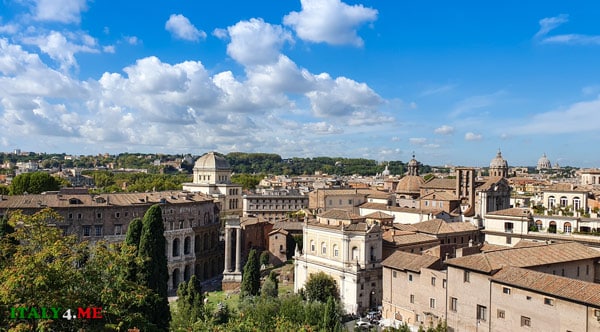
This palace also hosts temporary themed exhibitions.
Exhibits
World-renowned masterpieces can be seen in their original form at the Capitoline Museums. Among them, particular interest surrounds the very first exhibits that became the core of this unique collection.
Capitoline Wolf
The Capitoline Wolf—a bronze sculpture depicting a she-wolf nursing the twin infants Romulus and Remus, founders of Rome—has become a symbol of the Eternal City.
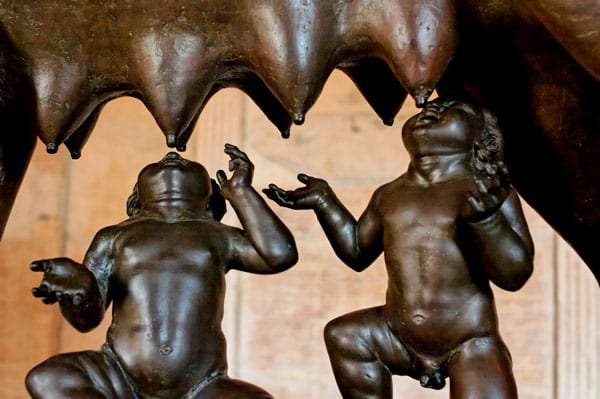
To the left of the entrance to the Palazzo dei Conservatori, a replica of the sculpture stands atop a tall column, while the original is displayed inside the museum. Experts still debate the origins of this famous exhibit.
Based on the casting techniques of ancient bronze sculpture and stylistic analysis, it has been established that the she-wolf was not created by Etruscan artisans in the 5th century BCE, as previously believed, but at a later date—sometime between the 8th and 10th centuries CE. The legendary infants were added only in the late 15th century and are believed to be the work of Florentine artist Antonio del Pollaiolo (Antonio del Pollaiolo).
Bronze Statue of the Boy Removing a Thorn
This small bronze sculpture from the 1st century BCE, depicting a seated boy pulling a thorn from his foot, arrived at the Capitoline Hill in 1471.
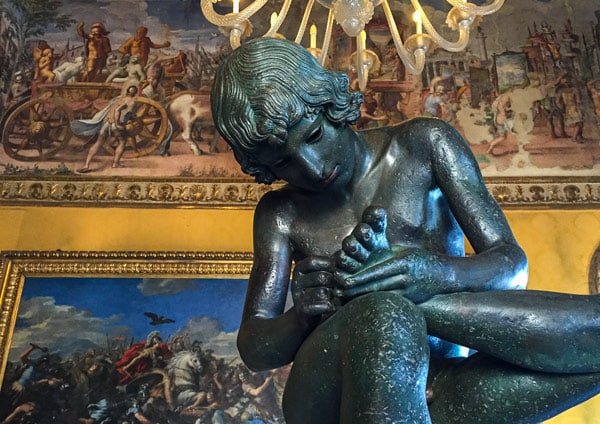
It was part of the first group of artworks donated to the people of Rome by Pope Sixtus IV. The astonishing realism and the unusual posture of the figure made this work by an unknown ancient artist highly valued and widely reproduced, especially during the Renaissance.
Gilded Statue of Hercules
The magnificent statue of Hercules, crafted from bronze and gilded, was discovered during excavations at the Forum Boarium (Forum Boarium).
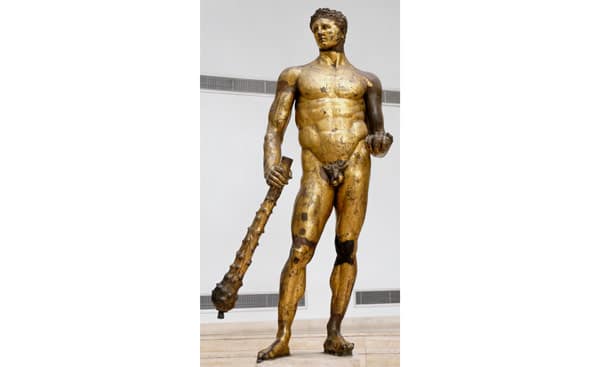
The excavation at this ancient site in Rome was organized by Pope Sixtus IV in search of new classical artworks.
Slightly larger than life-size (7.9 ft or 2.41 m tall), the statue impresses with its monumental scale and stylistic execution. It is believed that this cult statue once stood at the entrance to the Temple of Hercules and may be attributed to the school of the renowned ancient sculptor Lysippos.
Equestrian Statue of Marcus Aurelius
The equestrian statue of Marcus Aurelius, which stood from the 12th century to the early 16th century in the square in front of the palace and the Basilica of Saint John Lateran (Basilica San Giovanni in Laterano), was restored by order of Pope Sixtus IV.
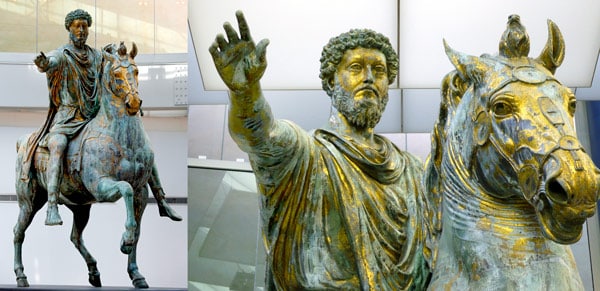
This monumental bronze monument from the 2nd century BCE, standing 13.9 ft (4.24 m) tall, is the only surviving equestrian statue of a Roman emperor from antiquity. Originally gilded, its golden covering was later stripped by barbarians during raids on Rome.
For centuries, the statue was mistakenly identified as Constantine the Great—the first Christian emperor—which likely spared it from destruction at the hands of early Christians targeting pagan imagery. It was not until the 15th century that the Vatican librarian, comparing the rider’s face to depictions of emperors on ancient coins, identified the statue as Marcus Aurelius. In 1538, Pope Paul III ordered the ancient monument relocated to the square in front of the Capitoline Hill.
Colossus of Constantine the Great
In the courtyard of the Palazzo dei Conservatori are marble fragments of the Colossus of Constantine the Great. The statue is believed to date between 312 and 315 CE.
The original sculpture depicted the Roman emperor seated on a throne, executed in the style of colossal Greek gods, which were typically placed at temple entrances.
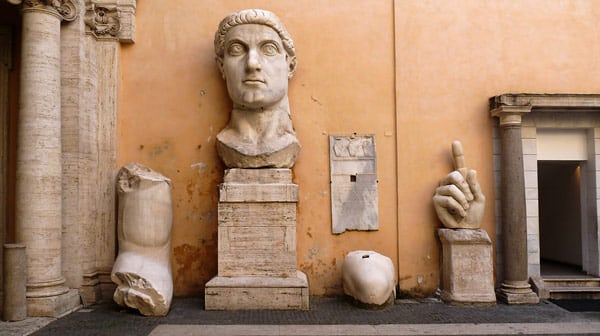
Considering the human body’s proportions and the sculpture’s 8.2 ft (2.5 m) tall head, it is estimated that the statue originally stood at least 39 ft (12 m) high. The colossus was broken during Late Antiquity, likely to extract the bronze that once covered it. The enormous statue fragments were collected by Michelangelo and placed in the Palazzo dei Conservatori in 1487.
Famous Sculptures Inside
Among the ancient sculptures on display in the halls of the Capitoline Museums, several masterpieces evoke deep admiration, including the Capitoline Venus and Esquiline Venus, the Bust of Brutus, the Dying Gaul, the Bust of Emperor Commodus depicted as Hercules, Cupid and Psyche, and the Medusa by the brilliant Giovanni Lorenzo Bernini, along with many other works from Antiquity and the Renaissance. Be sure to also take note of Marforio—one of the famous talking statues of Rome.
Famous Paintings Inside
The unique Capitoline Pinacoteca showcases artworks ranging from the late Middle Ages through the end of the 18th century. The gallery features works by Rubens, Titian, Guido Reni, Tintoretto, Veronese, Caravaggio, Van Dyck, Pietro da Cortona, Guercino, Correggio, Ludovico Carracci, and other gifted masters of visual art.
The museum complex on Capitoline Hill stands as one of Rome’s premier historical, architectural, and artistic landmarks—preserving priceless treasures of antiquity and making them accessible to every visitor.
Opening Hours, Tickets, Tours
The Capitoline Museums are open daily from 9:30 AM to 7:30 PM, with the ticket office closing at 6:30 PM. The entrance ticket costs €11.50.
An audio guide for children is available for €4 in English and Italian. The video guide (Android, Apple) costs €5, is available in Italian, and hasn’t been updated since 2019.
Private tours are available with a guide from ITALY FOR ME. Duration ranges from 2 to 4 hours, with prices from €100 to €200.
- Official website: www.museicapitolini.org