 Italy for me From Italy with love


Florence can only be imagined with its main waterway, the Arno River (Arno), which crosses the city and creates a unique urban landscape. The river’s banks offer stunning views of ancient buildings, palaces, and cathedrals, while boat rides under the famous bridges on barchettos (barchetto) are especially popular among tourists.
Page Contents
Geographical Data
Banks
Flowing through the hilly landscape of Florence, the Arno River divides the city into two parts, connected by ten bridges.
Right Bank
On the right side is the historic center of the Tuscan capital. Here, you will find major restaurants, shops, hotels, and main tourist attractions. Among the most popular are:
- Piazza del Duomo and its unique cathedral complex;
- Piazza della Signoria, where the Palazzo Vecchio and the magnificent Loggia dei Lanzi with priceless sculptures from antiquity and works by Renaissance masters like Donatello, Michelangelo, and Bartolomeo Ammannati are located;
- The centuries-old Basilica of San Lorenzo (Basilica di San Lorenzo);
- The Biblioteca Medicea Laurenziana, known for its collections of ancient manuscripts;
- Palazzo Medici Riccardi – a model of early Renaissance secular architecture;
- Piazza Santa Croce and its namesake basilica, the resting place of famous Italian artists, cultural figures, and politicians;
- Piazza della Santissima Annunziata – a prime example of Renaissance architectural forms;
- Palazzo Strozzi and Palazzo Rucellai – examples of Renaissance palace architecture;
- Loggia del Mercato Nuovo – a favorite spot for visitors to Florence looking to purchase souvenirs and other interesting items.
Left Bank
The left (southern) bank of the Arno River is known as Oltrarno and was once considered home to the city’s poorer residents. This part of Florence is called “green” because of its picturesque hilltop landscapes and rich examples of garden and park art, carefully preserved since the Renaissance era. Both visitors and locals come here to enjoy breathtaking views. A must-see for tourists is the Piazzale Michelangelo, situated between the Boboli Gardens and the Bardini Gardens (Giardino Bardini).
Floods
In the city’s historical chronicles, which span over 900 years, there are about 56 mentions of floods caused by the Arno River overflowing its banks.
The first mention dates back to 1177. Almost every century, the waterway brought catastrophic damage to the residents of the Tuscan capital. The most tragic years were 1333, 1557, 1740, and 1844.
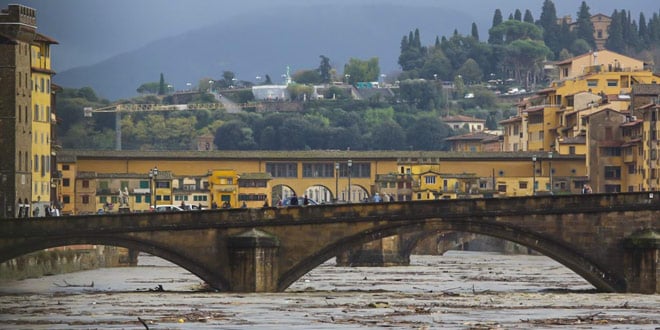
The most recent flood occurred in 1966 and is considered the most extensive and destructive. Dozens of lives were lost, and thousands of priceless artworks and architectural monuments were destroyed or damaged. The river’s waters rose to a level of 6 meters (19.7 feet). Particularly affected were the storerooms of the National Central Library, which lost over a third of its collection (one and a half million items).
Bridges
Most of Florence’s bridges were destroyed by the German army at the end of World War II and later restored or rebuilt. 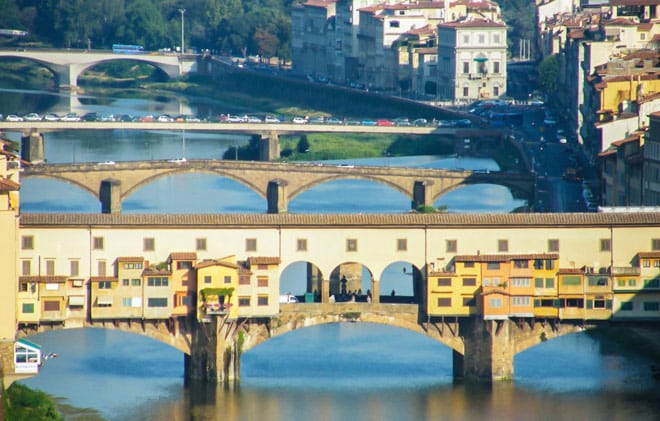
The retreating German forces left only the Ponte Vecchio intact. The construction of four of the ten bridges was carried out in the second half of the 20th century, including modern car and railway engineering structures connecting both sides of the city.
Ponte Vecchio
The three-arched Ponte Vecchio (meaning “old bridge” in Italian) ranks among the most popular attractions in the Tuscan capital. The construction date is 1345. Notably, it was built in the part of the river where there once existed a less extensive wooden and stone structure connecting the banks during the ancient Roman era. The elegant and durable structure, which has remained unchanged to this day, is attributed to the architect Neri di Fioravante (Neri di Fioravante).
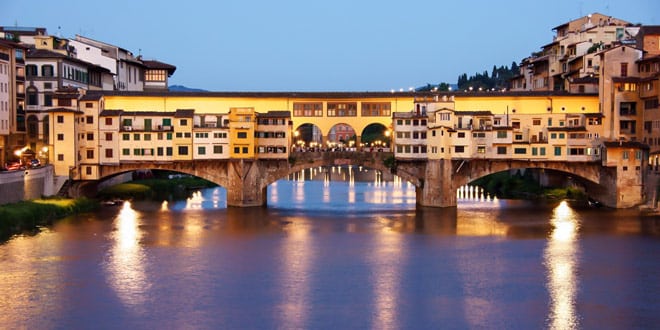
A distinctive feature of the 32-meter (105-foot) bridge is the row of tightly packed buildings on both sides and the presence of an observation deck in the middle. Until the 16th century, the shops sold meat and fish, which were later replaced by jewelry stores, which are still in existence today. Thanks to these shops, the bridge earned the nickname “Golden.”
Ponte alle Grazie
The modern Ponte alle Grazie (Ponte alle Grazie) was rebuilt in 1957 on the site of the old bridge destroyed by German troops in 1944. 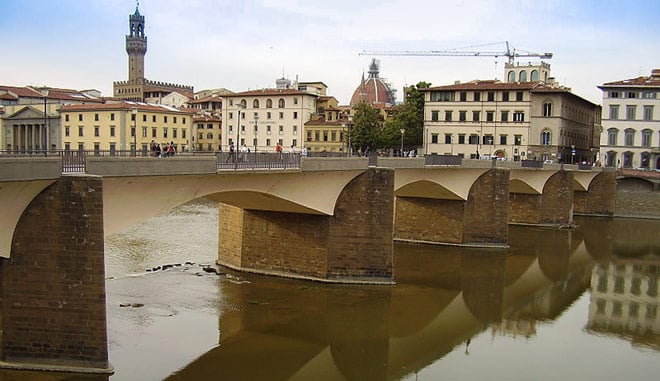
The unique structure, created in 1227, was considered the most extensive and durable structure connecting both parts of the city in the mid-20th century.
Throughout its centuries-long history, the bridge underwent many transformations and was repeatedly modernized. 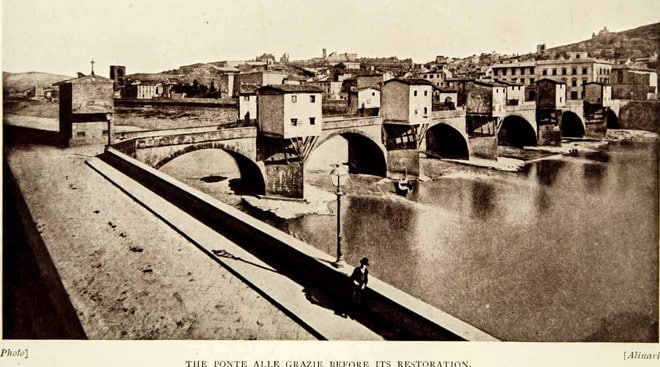
It acquired its current name in the 15th century thanks to a chapel of the same name, located here until 1876, alongside workshops, shops, monasteries, and other buildings.
Ponte Santa Trinita
Ponte Santa Trinita (Ponte Santa Trinita) was built in the mid-13th century. After another devastating flood in 1333, the light wooden structure was replaced with a stone one, and in 1557 the bridge took on its present form. It was destroyed by the German army in 1944 and restored 13 years later, entirely copying its original medieval appearance.
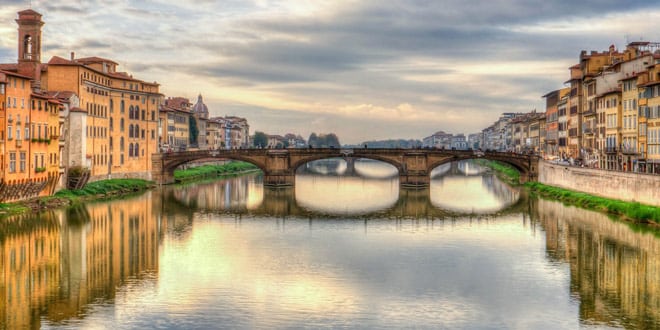
The monumentality of the structure is combined with the elegant, soaring arches over the water, creating a sense of lightness and sophistication. Statues at the bridge’s entrance, symbolizing the seasons, enhance the architectural style.