 Italy for me From Italy with love


The Basilica of Saints Cosmas and Damian (Santi Cosma e Damiano) is the oldest Christian church located in the very heart of Rome. It was established on the Vespasian Forum (Foro di Vespasiano) in the 6th century and remains one of the most important Catholic pilgrimage sites in the city.
The basilica is dedicated to two twin brothers from Arabia, Cosmas and Damian—healer-martyrs who, in 303 AD, became among the first victims of Emperor Diocletian’s persecution of Christians.
This remarkable church is renowned for preserving architectural structures from Rome’s imperial period and its magnificent 6th-century mosaic, considered a masterpiece of early Christian art.
Page Contents
Historical Landmark
Santi Cosma e Damiano was built on a site that, in ancient times, was considered the center of Rome’s public life. The Forum of Vespasian, located next to the Forum of Augustus (Foro di Augusto) and bordering the Roman Forum (Foro Romano), was known as the Temple of Peace (Templum Pacis)—Pliny regarded it as one of the wonders of the world, a marvel that inspired awe.
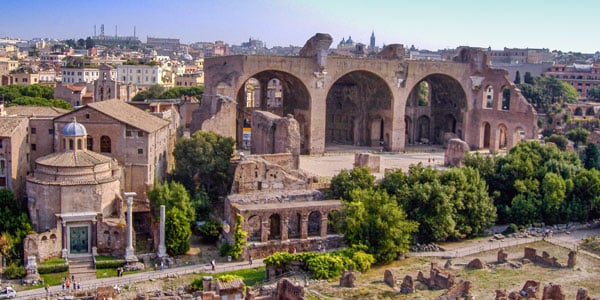
The Temple of Peace was erected between 71 and 75 AD by Emperor Vespasian to celebrate victory in the First Jewish–Roman War. This part of the Imperial Forums (Fori Imperiali) was an extraordinary space, even by the standards of Ancient Rome. The 443 by 361 feet (135 by 110 meters) square included not only an extensive complex of buildings and marble colonnades but also flowerbeds with rare plants, a pool, and podiums adorned with fountains and statues. It is believed this was the first botanical garden integrated into the urban landscape of Rome.
Unlike other forums, the Forum of Vespasian featured not cult temples but secular and educational structures. These included a bank, the prefect’s office, a library, a museum of Greek art, and a treasury containing spoils from the Jewish War, including treasures from the Temple of Solomon.
A fire in 192 AD severely damaged the forum, but it was restored in 203 AD under Septimius Severus. When Constantine the Great visited Rome in 357 AD, he still admired the Temple of Peace. However, the sack of Rome by the Goths in 410 AD led to the final destruction of the ancient structures on the Forum of Vespasian.
Restoring pagan temples had become both pointless and impossible, as imperial decrees banned worship of the Roman pantheon.
Between 495 and 525 AD, some buildings of the Temple of Peace were restored by order of King Theodoric the Great, sole ruler of the Ostrogothic Kingdom with its capital in Ravenna. Upon his first entrance to Rome in 500 AD, he was so impressed by its ancient forums that he granted the city special privileges and generous donations to preserve its monuments from further decay.
Construction and Dedication
In 526 AD, following the death of the Italian king Theodoric the Great, his daughter Amalasuntha, who assumed the regency and held favorable views toward Christians, gifted Pope Felix IV two restored ancient buildings located within the Roman Forum and the Temple of Peace. 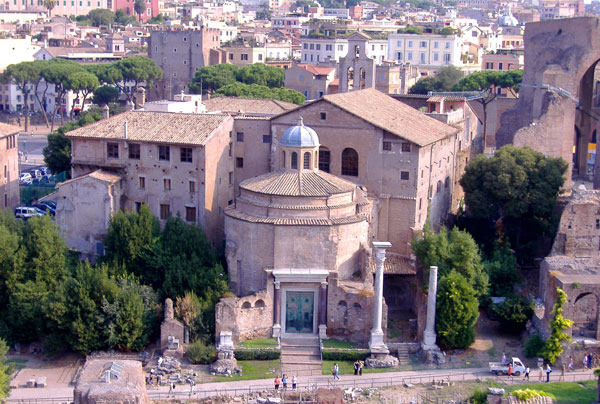
Felix IV combined both structures and built upon them the first church in Rome dedicated to the Eastern Church saints—the twin brothers Cosmas and Damian. This decision by the pope was driven by an effort to foster friendly relations between the Roman Church and Orthodox Constantinople, as well as to counter the still-popular pagan cult of another set of twin brothers, Castor and Pollux, whom Romans continued to worship in a neighboring temple.
The choice of martyrs Cosmas and Damian, patrons of physicians and pharmacists, is further explained by another interesting and well-supported fact. At some point (likely in the 5th century), a large abandoned hall of the Temple of Peace served as the center of the city’s medical services, where doctors treated the sick and shared knowledge in their noble profession.
The cult of Saints Cosmas and Damian was highly popular during the Middle Ages and beyond. It was believed that if a sick person spent the night within the church walls, they would be healed through visions sent by the saintly physician brothers.
Pope Felix IV held the apostolic throne briefly, from 526 to 530 AD, and it was during this period that the basilica was constructed and consecrated by the pontiff.
Ancient Structure
The two ancient buildings from the 1st century AD that form the original structure of the Basilica of Cosmas and Damian are of particular interest and continue to spark debate regarding their names and original purposes. According to the most widely accepted theory, these are the Library of Peace (Bibliotheca Pacis), which became the main part of the basilica, and the Temple of the Divine Romulus (Tempio del Divo Romolo), which served as the entrance vestibule from the Roman Forum.
Library of Peace
The rectangular hall incorporated into the basilica’s layout was built within the Temple of Peace grounds in the 70s AD and became known as the Library of Peace. This was a massive structure with walls 35 inches (90 cm) thick and up to 59 feet (18 meters) high, enclosing an area measuring 66 by 131 feet (20 by 40 meters). The enormous hall featured 15 windows through which sunlight flooded the entire space, creating an incredible atmosphere.
The Library of Peace remained active into the 3rd century and served as a gathering place for writers and physicians to attend lectures and engage in scholarly discussions.
Under Emperor Septimius Severus, between 203 and 211 AD, the library was converted into the residence of the city prefecture, which housed Rome’s cadastral office. At that time, a relief made up of 150 marble slabs (covering an area of approximately 59 by 43 feet, or 18 by 13 meters) was mounted on the northeastern wall of the hall. This monumental map of Rome (Forma Urbis Romae) was destroyed in the Middle Ages, but fragments have survived and can be seen at the Palazzo dei Conservatori, one of the buildings of the Capitoline Museums (Campidoglio).
Traces of the marble slab fastenings are still visible along the Via dei Fori Imperiali to the left of the basilica’s entrance.
On the southeastern side of Santi Cosma e Damiano, the original wall of the Library of Peace remains well-preserved to this day, although its view has been obscured by a monastery building constructed later.
Temple of the Divine Romulus
The brick round rotunda adjoining the Basilica of Cosmas and Damian on the opposite side from the main entrance and located within the archaeological zone of the Roman Forum is known as the Temple of the Divine Romulus. Along with the Pantheon, it is one of the oldest pagan temples in Rome and holds many mysteries. 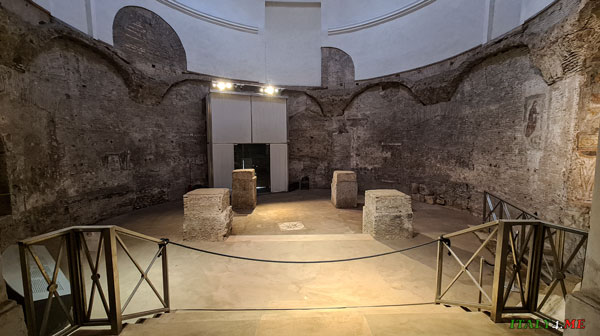
Some historians boldly suggest that the brick rotunda was a reconstruction of the Temple of Jupiter Stator, founded in 750 BC by the legendary Romulus—the first king of Rome. It may also have been built on the site of a temple dedicated to the Penates, the ancient Roman household gods. This sanctuary was destroyed in the Great Fire of 64 AD, which left no trace of the original structure.
In 75 AD, when the Forum of Vespasian was built, the Temple of Romulus served as a vestibule providing access to the Temple of Peace from the Sacred Road (Via Sacra).
The abandoned structure was later used by Maxentius (Marcus Aurelius Valerius Maxentius), the self-proclaimed emperor who ruled Rome between 306 and 312 AD. In 309 AD, he restored the ancient vestibule and dedicated it as a temple to his prematurely deceased son, Valerius Romulus, who was later deified. This identification is supported by the discovery of a coin from 307 AD depicting a similar temple with an inscription dedicating it to Maxentius’s son. After the emperor’s death, the structure in the Roman Forum was abandoned.
From the outside, the Temple of the Divine Romulus appears as a cylindrical brick structure crowned with an octagonal domed roof—one of the largest in Rome. The massive lantern with eight windows was added recently and complements the building’s ancient architecture beautifully. The temple walls were once covered with marble slabs, but during the Middle Ages, they were removed and repurposed for new construction.
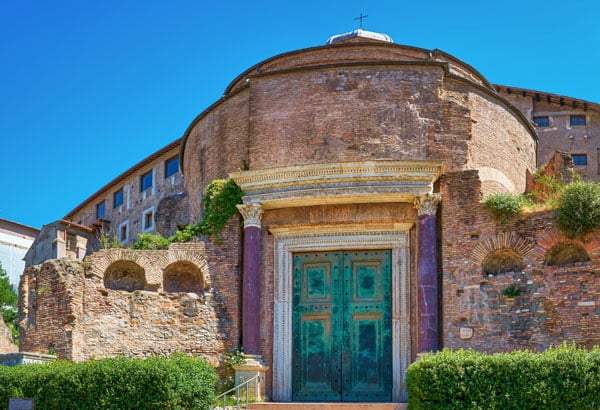
Perhaps the most remarkable feature of the Temple of Romulus remains its incredibly large and beautiful bronze door dating back to the 3rd century AD. It was taken from a building from the time of Septimius Severus, which was destroyed in 283 AD by Emperor Marcus Aurelius Carinus, and later relocated to serve as the entrance to the Temple of Romulus.
The door has been so well preserved that its simple mechanical lock still opens and closes using an ancient bronze key.
Restoration Phases
Since its construction by Pope Felix IV, Santi Cosma e Damiano remained largely unchanged for a long period.
A significant milestone in the basilica’s history came in 1503 when it was entrusted to the Franciscan monks of the Third Order, who still maintain the building today. It is worth noting that in caring for the church, the mendicant order adhered strictly to its rule of absolute poverty and did not spend money on costly finishes or decorations.
The earthquake of 1600 caused considerable damage to the ancient Christian church and necessitated radical changes to its structure.
The first restoration efforts aimed at protecting and stabilizing the building were undertaken during the pontificate of Clement VIII. At that time, side chapels with high concrete walls were added to the nave, along with a renovated interior in the Baroque style.
The basilica acquired its current appearance between 1626 and 1632 under Pope Urban VIII. He oversaw a comprehensive reconstruction that introduced a new ceiling and main altar, as well as a wooden choir and organ. A major transformation involved the demolition of Roman walls and the division of the church into upper and lower levels. The difference in elevation resulted from work carried out by Luigi Arrigucci based on a design by the Roman architect Orazio Torriani.
During this period, monastic buildings and a beautiful cloister with a well were erected on the former vineyard area adjacent to the basilica.
Interesting fact: The funds for such extensive work, so to speak, were found within the church itself. In 1630, the ancient tuff walls, which were at risk of collapse, were sold by the monks to Pope Urban VIII’s nephew, Taddeo Barberini, who used them in the construction of his palace (Palazzo Barberini).
The year 1870 marked the beginning of excavations at the Roman Forum. The entrance to the Temple of Romulus was lowered to its original position, but access was closed due to the risk of collapse. The basilica’s vestibule became a separate ancient monument located within the archaeological zone of the Roman Forum.
Description
The Basilica of Saints Cosmas and Damian has a complex architectural history. At its founding, it combined two ancient Roman buildings, but after several reconstructions, they became separated. Until 1947, the main entrance to the basilica was on the Roman Forum side, leading through the vestibule—the Temple of the Divine Romulus. After the restoration of the Imperial Forums, the main entrance was moved to the opposite side, through the monastery facing Via dei Fori Imperiali.
The basilica’s layout consists of a single nave, seven chapels, and a large apse preceded by a wide triumphal arch. The side walls, which are the original parts of the 4th-century Roman hall, are not visible from the main entrance as they are concealed by the monastery building.
The Temple of Romulus is separated from the main part of the basilica by a glass door, through which only the brick walls and preserved 13th-century frescoes can be seen. Beneath the temple floor lies an ancient well, whose water was once used for washing and drinking.
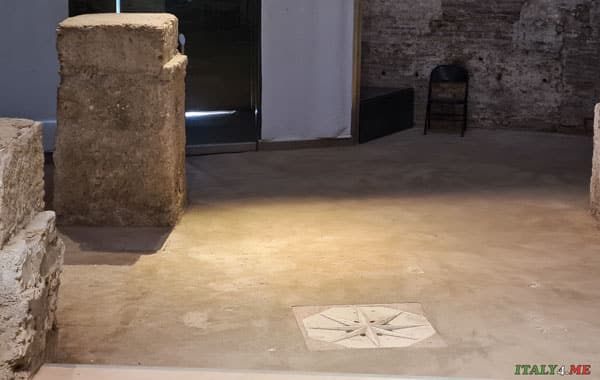
This feature of the temple has led scholars to suggest that the entrance vestibule served as a healing sanctuary and the most important part of the church, while the large hall was used simply for liturgical services.
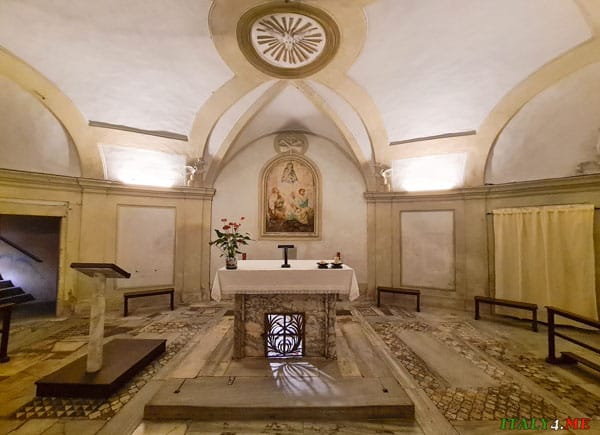
Beneath the main altar lies a crypt containing the relics of the church’s patrons, Cosmas and Damian, as well as those of the martyrs Anthimus, Leontius, Euprepius, and Tranquillinus. The remains of two other sainted twin brothers, Marcus and Marcellian, were accidentally discovered in the church in 1583 and have been kept in the basilica’s crypt ever since.
Artistic Interior Design
The artistic interior design of the basilica will impress even the most discerning art connoisseur. Before admiring the ceiling, frescoes, paintings, and chapel decorations, one should proceed to the main altar. Here stands a masterpiece of church art—an enormous, magnificent 6th-century mosaic that fills the entire domed space of the apse.
Apse Mosaic
The mosaic was the first adornment of the ancient basilica. It was created by an unknown master between 526 and 530 AD during the papacy of Felix IV. 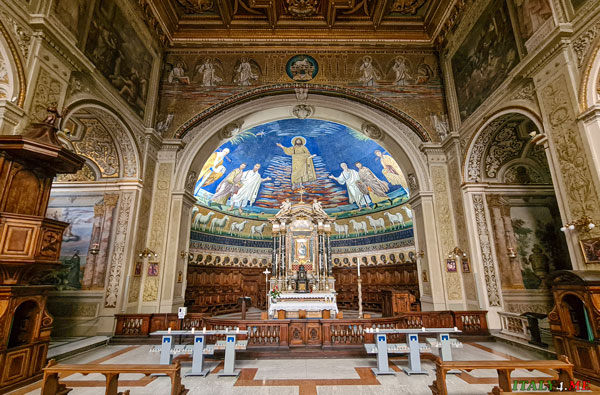
The image covers the entire semi-dome of the apse, which measures a substantial 51.8 feet (15.80 meters) in diameter. This is the only part of the basilica that remained untouched during its reconstruction.
It should be noted that during the 17th-century restoration, the floor level was raised by 23 feet (7 meters), resulting in the loss of the mosaic’s lower section and altering the viewing angle of the entire image. A small fragment of the ancient decoration (lower left corner) had to be restored after the collapse of the first bell tower during an earthquake.
The colorful mosaic, executed in the Byzantine style, is dedicated to the theme of the Second Coming of Jesus Christ as described in the Apocalypse of John. The scene features life-sized figures conveying numerous details that together create a narrative composition. The ultramarine sky and soft sandy tones of the mosaic form an incredibly beautiful color palette.
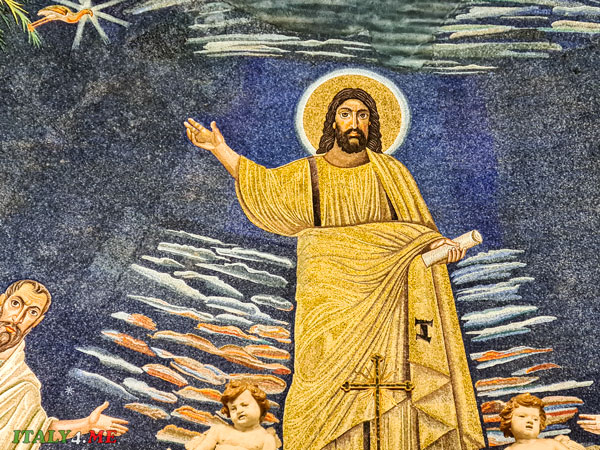
God, dressed in golden garments and holding the scroll of the Law, is depicted at the center. He stands on multicolored clouds bathed in the rays of the rising sun. 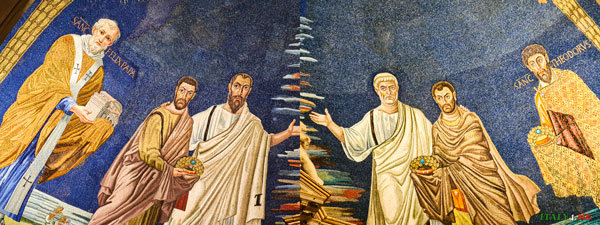
To the left of the Savior of the world stands Saint Paul, and to the right, Saint Peter. The apostles are holding the hands of and presenting the martyrs Cosmas and Damian to God. By tradition, the twin brothers are depicted identically, making it impossible to distinguish who is on the left and who is on the right. Both hold a martyr’s crown and a red surgical bag. At the far left stands Pope Felix IV, shown as the founder of the basilica, presenting a scaled-down model of the church. In the opposite corner is Saint Theodore, holding a martyr’s crown.
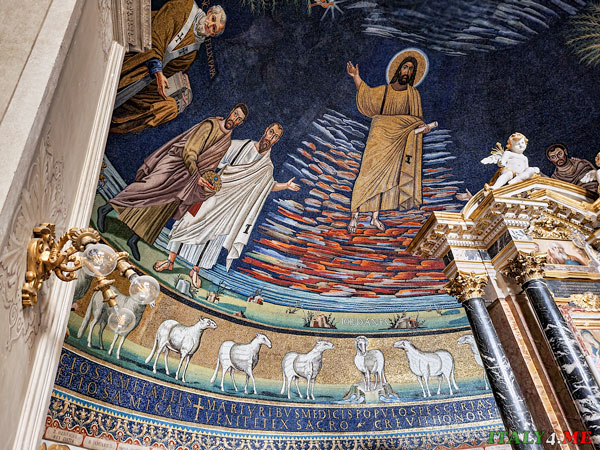
The figures stand on golden water lilies symbolizing the River Jordan, confirmed by the inscription IORDANES. Palm trees and a phoenix at the top of the mosaic signify the Holy Land and resurrection.
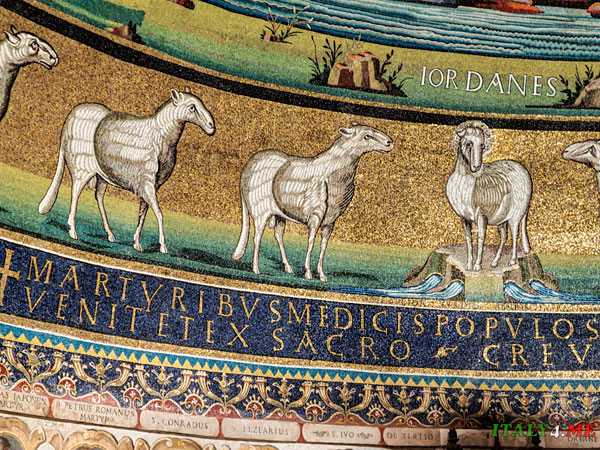
Below the figure of Jesus is another image of Him—the Lamb of God with a silver halo. He stands on a hill from which flow the four rivers of Eden or the four Gospels. To the left and right of the Lamb of God are twelve sheep in a row, symbolizing the apostles.
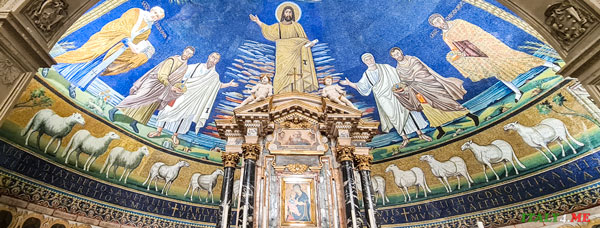
The animals are depicted with particular elegance and resemble unusual mythological creatures with intelligent gazes and muscular bodies. Interestingly, this part of the mosaic (the band with the sheep) was later replicated in the decoration of the churches of San Clemente (Basilica di San Clemente) in Rome and Sant’Apollinare in Classe (Basilica di Sant’Apollinare in Classe) in Ravenna.
Arch Mosaic
The decoration of the basilica’s arch continues the theme depicted in the apse. The mosaic was created in the 6th century, though it was likely completed during the papacy of Sergius I (692–701). It is believed that he conceived the theme of the arch’s decoration, which carried specific theological and political significance. 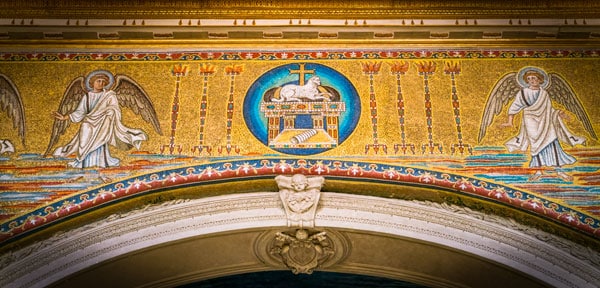
Sergius I refused to accept the ruling of the Council held in Constantinople, which prohibited depicting Christ as a Lamb. Defying this, the arch features the Lamb of God reclining on a throne adorned with precious stones. Flanking Him are seven candlesticks, representing the seven spirits of God, and four angels.
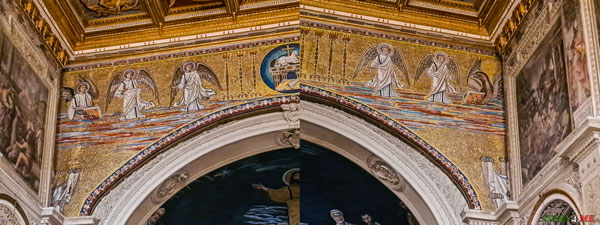
To the left stands a winged man symbolizing the evangelist Matthew; to the right, an eagle representing John the Theologian. The images of the Lion of Saint Mark and the Ox of Saint Luke—the symbols of the two other evangelists—have not survived.
A common question arises regarding the hands reaching out to the Lamb, offering crowns. These belong to the 24 Elders from the Book of Revelation, that is, God’s anointed ones reigning in heaven (some of the depictions of the hands have not survived).
I recommend reading about the Byzantine mosaics of Ravenna
Main Altar
The apse and arch mosaics provide a splendid backdrop for the Baroque-style main altar. It was constructed by Domenico Castelli in 1637 during the basilica’s grand renovation. The design features beautiful marble columns salvaged from an older structure. 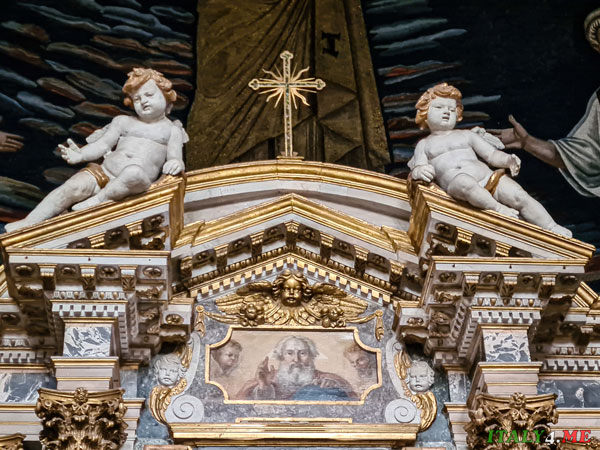
The altarpiece, dating from the 13th century, depicts the Madonna and Child enthroned, known as the Madonna della Salute (Our Lady of Health). Devotion to the Virgin Mary, which began during the papacy of Gregory the Great (590–604), has always been a central part of the basilica’s spiritual life. Originally, the Madonna was depicted in full length, but later, due to damage to the painting, the lower portion of the image was removed.
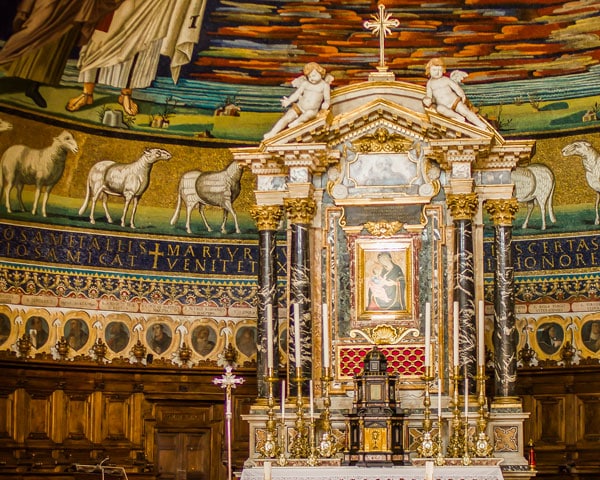
To the right of the altar stands a magnificent Paschal candlestick—a twisted marble column supported on the backs of two small lion figures.
Beneath the apse mosaic, a semicircular row of tondi features images of Franciscan saints, with the male saints on the left and the female saints on the right.
Chapels
The unique apse mosaic outshines all other artworks in the basilica, yet they also hold great interest. The seven chapels feature works from the 13th to the 17th centuries that deserve attention.
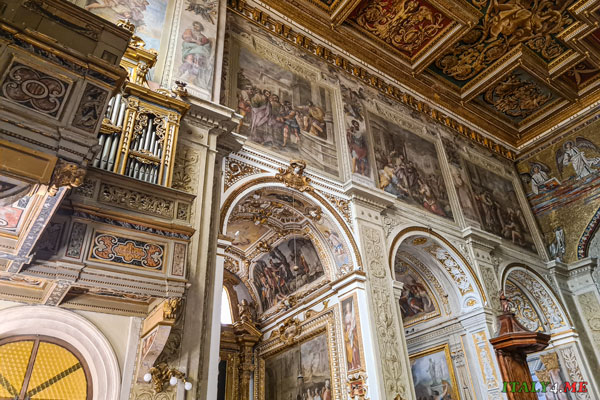
Left side of the nave (from the entrance toward the main altar):
Chapel of Saint Barbara:
- magnificent stucco decoration
- frescoes by Francesco Allegrini, circa 1655
2. Chapel of Saint Alexander:
- crucifixion in the style of Rubens
- frescoes by Francesco Allegrini, Martyrdom of Saint Alexander, circa 1655
3. Chapel of Saint Rosalia:
- altar from the early 16th century
Right side of the nave (from the entrance toward the main altar):
Chapel of the Holy Crucifix:
- 13th-century fresco transferred from the lower church and restored in the 17th century
- frescoes on the side walls by Giovanni Battista Speranza
5. Chapel of Saint John the Theologian:
- paintings by Giovanni Baglione, executed in 1638 in oil on canvas
6. Chapel of Saint Anthony of Padua:
- a painting from the first half of the 17th century by Giovanni Antonio Galli, known as Spadarino, depicting the saint with the Child Jesus
- fresco by Francesco Allegrini, The Descent of Jesus Christ from the Cross, second quarter of the 17th century
7. Chapel of Saint Francis of Assisi:
- altarpiece Saint Francis of Assisi in Prayer, created in the late 16th century and attributed to the school of Italian Mannerist painter Girolamo Muziano
Ceiling
While observing the basilica’s interior, one cannot overlook the magnificent coffered ceiling with fine carvings and gilding. 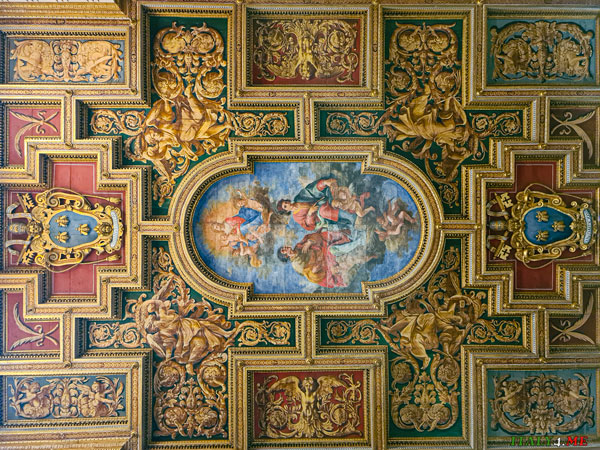
The central painting by Marco Tullio Montagna depicts the martyr brothers Cosmas and Damian. Nearby, two shields display three golden Barberini bees, the family coat of arms of Pope Urban VIII.
Nativity Scene
In the monastery vestibule, visitors will encounter another masterpiece of applied art. In the 20th century, the Basilica of Cosmas and Damian acquired a remarkable work by Neapolitan craftsmen—the 18th-century Nativity scene. It was donated to the church in 1939 by Enrico Cataldo and Raffaella Perricelli, a couple who had moved from Naples to Rome.
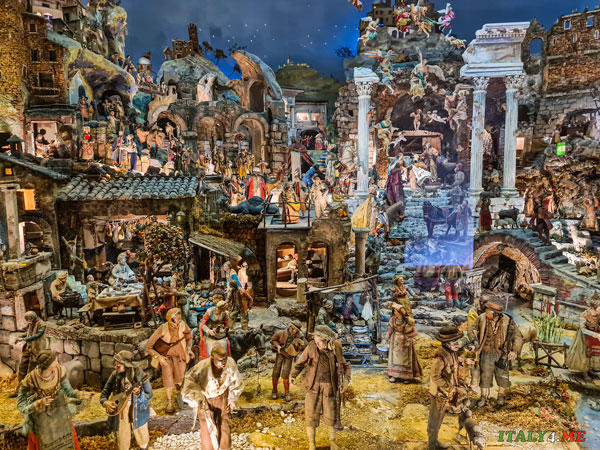
The Nativity scene, crafted with numerous fascinating details, depicts events taking place on Christmas Eve at the Roman Forum.
The colorful and lively composition features an urban landscape and real-life characters from the 1700s, including peasants, soldiers, an innkeeper, and a chestnut vendor. The figurines are made of wood and terracotta, with colored glass used for the eyes and various fabric pieces for the clothing.
This exquisite Nativity scene is considered one of the most beautiful in Rome. In 1988, some of its pieces were stolen by a thief unable to resist the charm of such delightful objects. In 1994, the Nativity scene was restored and returned for display.
Hours and Directions
The Basilica of Cosmas and Damian is open daily from 10 AM to 1 PM and from 3 PM to 6 PM. Admission is free and the entrance is located on Via Dei Fori Imperiali. Masses are held on Sundays at 11:30 AM and on holidays at 7:30 AM.
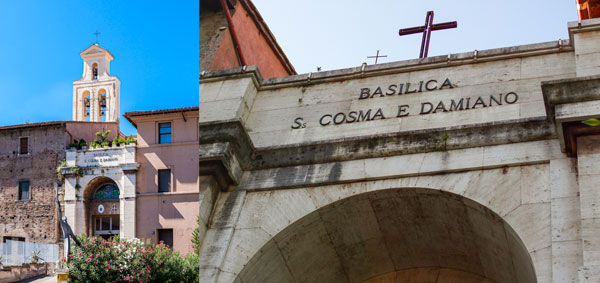
From the Colosseo metro station, it is a 5-minute walk. From the Altar of the Fatherland at Piazza Venezia, it is a 10-minute walk.
Address: Via dei Fori Imperiali, 1
Official website of the basilica: www.cosmadamiano.com
Santi Cosma e Damiano remains an invaluable architectural monument and a powerful symbol of the triumph of Christianity over the ruined splendor of pagan Rome.
No other basilica in the city can claim a more beautiful archaeological panorama or a more historic setting than Santi Cosma e Damiano. It is no wonder that couples choosing to marry favor this church. Wedding ceremonies are held here, and photos taken against the backdrop of the Temple of Romulus with its bronze doors are especially beautiful and uniquely romantic.