 Italy for me From Italy with love


Tempietto is an ancient Roman chapel-rotunda that forms part of the Christian complex of San Pietro in Montorio, located on the Janiculum Hill (Gianicolo) in the Trastevere district of Rome.
The masterpiece of the brilliant High Renaissance architect Donato Bramante is a jewel among the landmarks of Rome and a sacred site for believers worldwide. It is traditionally believed that it was on the summit of Janiculum Hill where Saint Peter, one of Jesus Christ’s closest disciples, was crucified.
The chapel gained fame for its miniature dimensions (Tempietto means “small temple”) and its recognition as a model of the new architectural style.
Page Contents
Patron
Tempietto was built in 1502 by commission of the Spanish royal couple Ferdinand II of Aragon (Ferrando II d’Aragon) and Isabella I of Castile (Isabel I la Catolica). In the 16th century, San Pietro in Montorio became home to a Spanish religious community. 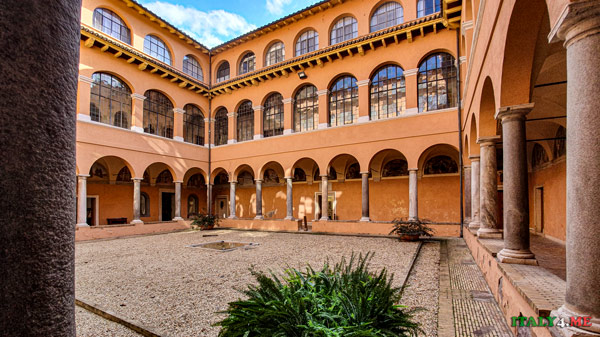
Christian monarchs around the world sought to associate themselves with holy sites and claim glory for themselves, while the Pope readily welcomed foreign funding for the construction and renovation of religious buildings.
One of the main goals of erecting the new temple was to glorify the apostle Peter as the pontiff under whom Rome became the center of the Christian world.
In the 19th century, after the unification of Italy, the church complex of San Pietro in Montorio was sold to Spain, and it remains under Spanish ownership to this day. The former monastery building now houses the Royal Spanish Academy in Rome (Real Academia de España en Roma).
A New Style in Architecture
The primary purpose of the chapel was to venerate the site of Saint Peter’s martyrdom, as legend holds that the center of the crypt beneath the Tempietto marks the exact spot where the martyr’s cross stood.
Before taking on the commission, the young Bramante spent considerable time studying monuments of ancient culture with passion and dedication, seeking the correct proportions and mastering the subtleties of perspective.
Bramante was inspired by ancient rotunda chapels and dreamed of creating a new Christian temple based on them. The Tempietto was the talented architect’s first work in constructing a sacred building in Rome.
The construction of this chapel marked the beginning of his brilliant career as one of Italy’s foremost architects. Bramante’s entirely new creation became the realization of the ideal temple and a model of the High Renaissance style.
In 1506, Bramante was commissioned to design the Basilica of Saint Peter (Basilica di San Pietro) in the Vatican, where he applied the principles he had developed when designing his earlier, smaller masterpiece.
An interesting historical detail is that even before the Tempietto was built, a round temple appeared in the 1475 painting “The Ideal City” (Città ideale) by an unknown artist. At the center of this idealized architectural landscape stood a temple strikingly similar to the Tempietto, though with less graceful proportions and without a dome.
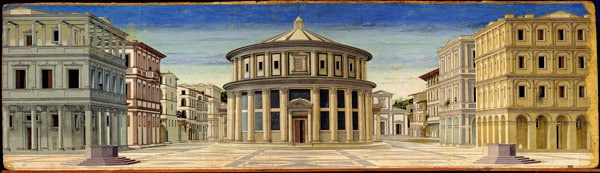
Official website: gndm.it. The Ducal Palace is listed as a UNESCO World Heritage Site.
The Master’s Vision
Bramante envisioned the chapel as the centerpiece of a courtyard surrounded by a taller colonnade with four entrances, the primary entrance being the one that still exists today. This main entrance provides the sole viewpoint from which the temple appears as a static picture, despite the possibility of walking around it. 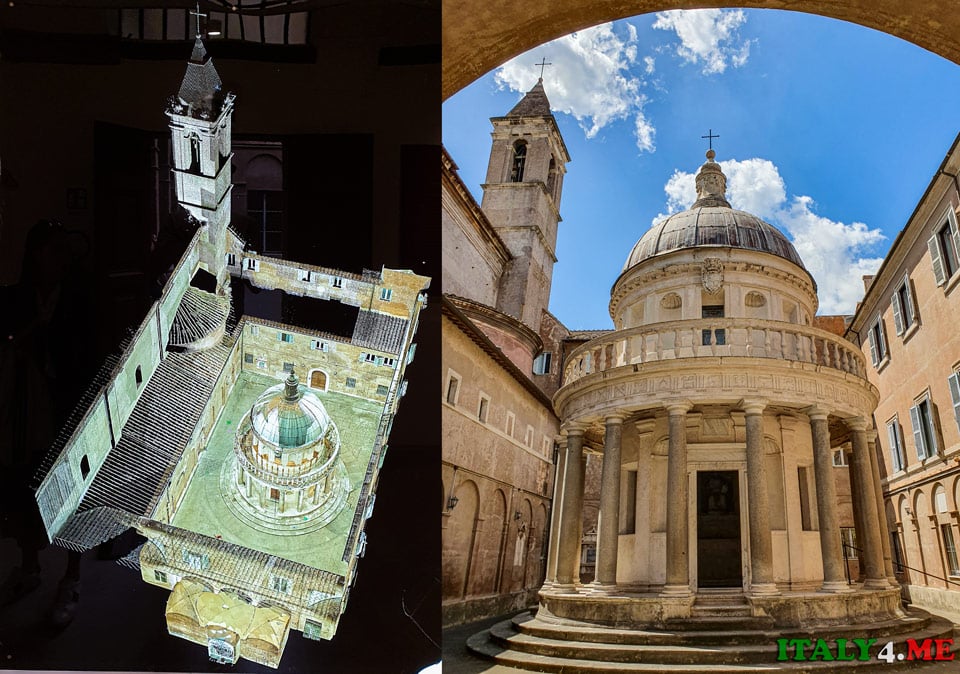
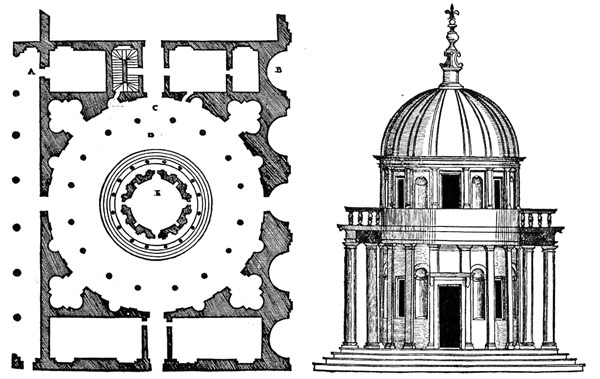
The use of sophisticated perspective techniques and the integration of forms throughout the interior space made the architect’s concept more akin to the design of an architectural landscape. However, Bramante’s full project was never realized and survives only in preserved sketches, which can be seen in the engravings of Sebastiano Serlio, a leading architectural theorist of his time.
The chapel became a standalone structure within the complex and appeared as a marvelous architectural creation surrounded by the monastery’s less distinguished stone facades.
The Choice of Architectural Form
The view of the Tempietto opens from a narrow passageway through the monastery courtyard’s arch. At first glance, the chapel resembles the ideal form of an ancient temple, characterized by the symmetrical central-dome system aligned along a vertical axis. Such structures were built in Ancient Greece and Rome. 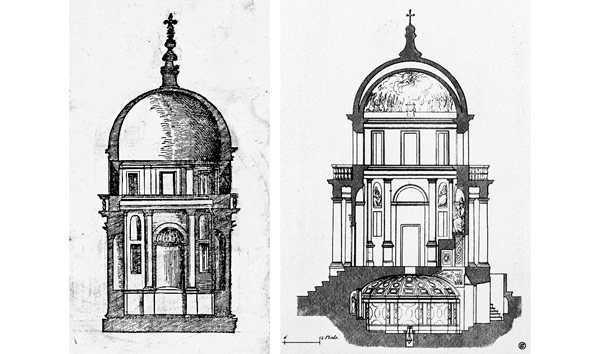
As he began designing, Bramante understood that the requirements of Christian worship conflicted with the single-space plan of ancient buildings, as clergy needed to be separated from the congregation. The chapel became the perfect architectural solution: a small, free-standing church building without a designated altar space.
It serves more as a monument for veneration than a religious space for conducting church services. The Tempietto was designed exclusively to be admired from the outside.
Exterior Description
The rotunda chapel (rotonda meaning “round”) is classically defined as a miniature cylindrical structure crowned with a dome and encircled by columns.
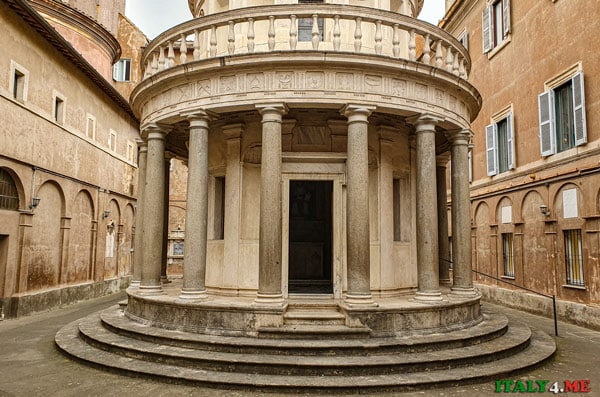
The temple stands on a low circular podium. Since antiquity, this geometric shape has been considered the ideal form for expressing divine perfection and cosmic harmony. Models for Bramante’s design likely included the Temple of Vesta in Tivoli and the Temple of Vesta in Rome. The goddess’s role as protector of the family resonated with Saint Peter’s role as protector of the Church.
The architectural forms were constructed symmetrically along a vertical axis, from the building’s base to its summit topped by a cross. This classical technique, also used in antiquity and even in the construction of Egyptian pyramids, imparts a monumental appearance to the small chapel.
The Tempietto comprises three symbolic architectural sections:
- The crypt, where Peter’s cross was believed to have been planted—symbolizing the birth of a new religion;
- The body of the temple—representing the coming of God’s Kingdom and the salvation of humanity (with four statues of the Evangelists set in interior niches);
- The dome—symbolizing the triumph of the Church.
The chapel stands 11 meters tall. Its core structural element is an elongated cylinder surrounded by 16 columns and crowned by an elegant dome. The interior diameter is just 4.5 meters.
According to the Roman architect and mathematician Vitruvius, the number of columns is perfect, as the sum of 6 and 10 were considered ideal numbers in the religious and philosophical teachings of the Pythagoreans. Moreover, when seen as 8 plus 8, the number of columns acquires symbolic meaning, representing infinity, death, and resurrection.
The Tempietto is imbued with perfect numbers. The harmonious proportions of its architectural elements create a sense of grandeur despite its modest size.
The spherical dome has a simple form and is reinforced by broad ribs—a design later used in the construction of St. Peter’s Basilica in the Vatican. The dome sits on a drum that elevates the sphere significantly. A light, non-functional balustrade acts as a visual mediator between the chapel’s two levels. Atop the dome rests a lantern, a decorative feature that draws the viewer’s gaze upward.
The gray granite columns, reminiscent of ancient forms, lend the chapel a majestic solemnity. Above them runs a frieze bearing reliefs of Saint Peter’s attributes and liturgical symbols. The coffered ceiling is adorned with numerous floral rosettes.
The chapel’s outer walls feature niches with decorative shell motifs symbolizing pilgrimage. These niches are separated by rectangular pilasters that mirror the external columns. The façade has minimal window space, but Bramante skillfully placed small side windows without disrupting the overall harmony of the design.
The main entrance is just 90 centimeters wide. Bramante boldly interrupted the pilaster’s vertical line, topping it with the door portal’s cornice.
In addition to marble, more affordable materials were used: the column pedestals are made of travertine, and the pilasters are carved from ordinary stone.
Interior Description
The chapel’s interior is as understated as its exterior.
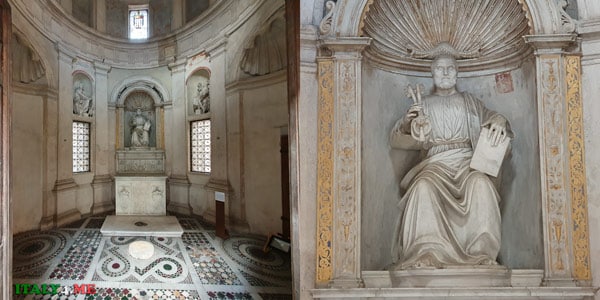
Small sculptures of the Evangelists—Saint Luke, Saint Matthew, Saint Mark, and Saint John—are set in niches above the windows. In the main altar niche stands a statue of the apostle Paul seated on a throne. The chapel’s interior pilasters are aligned along diagonal axes and are half the number of the external columns, allowing room for the placement of windows and doors.
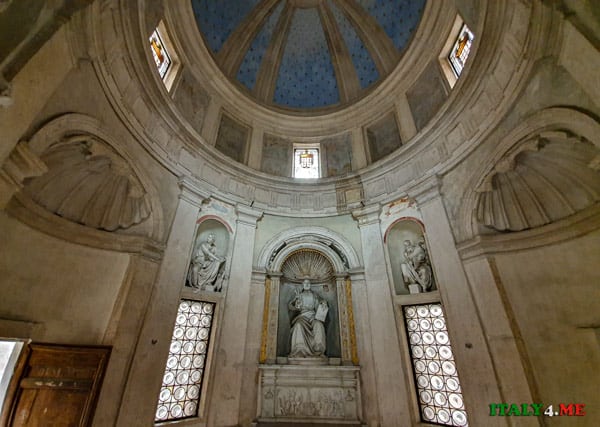
The dome lacks decorative elements or frescoes. Bramante believed that nothing should distract viewers from the beauty of the architectural forms. Instead of traditional frescoes, the dome resembles the evening sky, scattered with stars that create an impression of airy spaciousness.
The floor features a Cosmatesque design using marble inlaid mosaic technique!
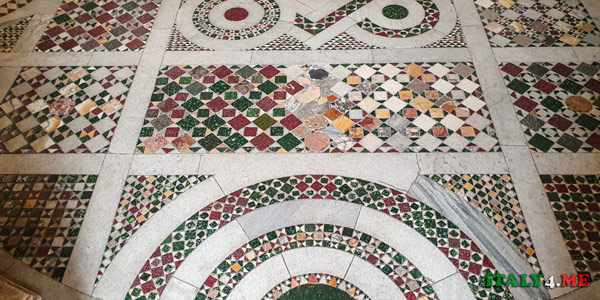
In the chapel floor, a grated window reveals a view into the crypt below.
Visitors can descend into the crypt through a narrow staircase located behind a side door, adorned with Bramante’s favored decorative element, arabesques—an intricate medieval motif of Eastern origin.
The crypt is stunning in its beauty and refinement!
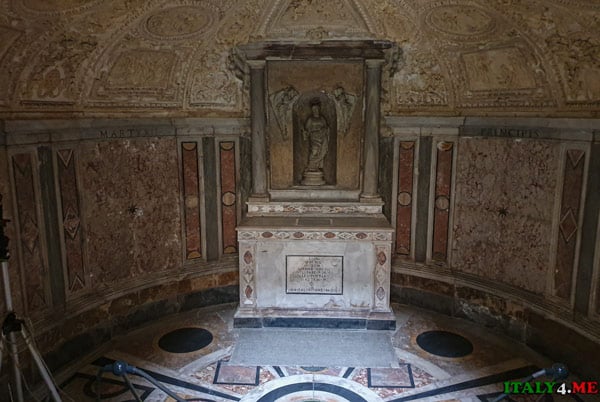
The domed ceiling is richly embellished with stucco decoration. The crypt’s interior finishing was completed later, beginning in the mid-16th century under the direction of the last Renaissance pope, Paul III (Paulus PP III).
The chapel underwent several restorations and renovations over the centuries. In 1628, work in the crypt included widening the doorway, constructing a double staircase, and adding marble paneling. Later, the crypt was decorated with reliefs depicting scenes from the life of Saint Peter, created by the Italian sculptor Giovanni Francesco Rossi.
Today, it is impossible to imagine the Eternal City without Bramante’s creations and, of course, without his small temple. The Tempietto has become not only a benchmark of High Renaissance architecture but also a place imbued with the spirit of history and faith.
Because the Tempietto is slightly off the path of the most popular tourist attractions, it is rarely crowded. I strongly recommend that all readers of our website visit this unique masterpiece.
How to Get There
Please note that the chapel is located within a monastery complex, and tourist entry is allowed only during specific visiting hours.
You can view the Tempietto through the gate’s ironwork at any time. Typically, the Tempietto is open daily except Mondays from 10:00 AM to 6:00 PM. Access is through the Royal Academy.
- Official website of the Royal Spanish Academy in Rome: www.accademiaspagna.org
- Address: Piazza di San Pietro in Montorio, 3, 00153 Rome.
The nearest public transportation is bus No. 115. Disembark at the Garibaldi/Iacobucci stop and walk to the Church of San Pietro in Montorio.
Alternatively, buses 44, 75, or H, as well as tram No. 8, will take you to the Trastevere/Min. Pubblica Istruzione stop, from where you can walk uphill to the church.
What to See Nearby
Close to the Tempietto, you’ll find my favorite, the Aqua Paola Fountain (Fontana dell’Acqua Paola), as well as the charming and rarely touristed Villa Sciarra. The Janiculum Hill viewpoint is a 15-minute walk away.