 Italy for me From Italy with love

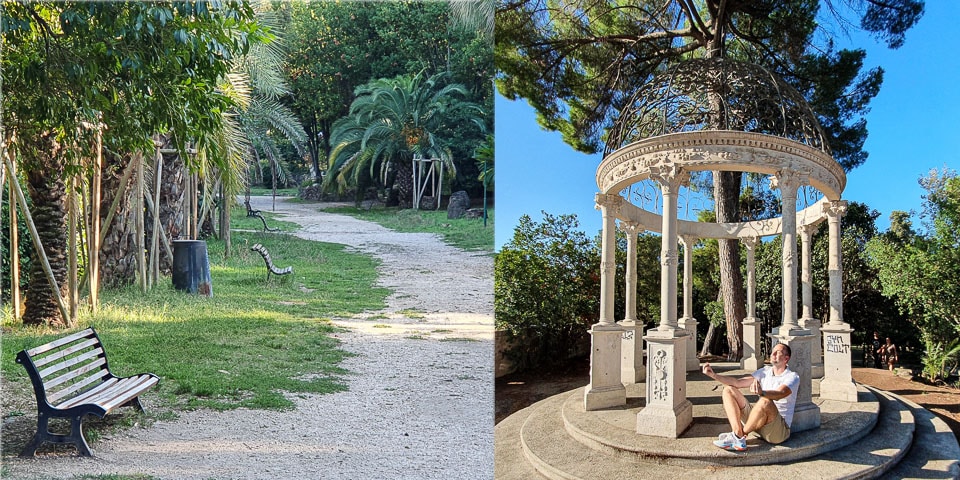
A small yet incredibly beautiful park, Villa Sciarra is located in Rome’s Monteverde Vecchio district on the slope of the Gianicolo Hill, covering 18.5 acres and serving as one of the most beloved retreats for local residents.
Although the villa is just a 20-minute walk from the Trastevere district, it is rarely visited by tourists—except for the discerning readers of the “Italy for Me” website.
I love Villa Sciarra for its tranquility and the chance to enjoy the greenery of the Eternal City. Before your visit, I recommend reading the article “In Rome Like a Local.”
Page Contents
History
The villa’s history dates back to a time when the site was home to a temple dedicated to the nymph Furrina, believed to have been built in the 1st century AD. Over time, gardens expanded around it, eventually stretching all the way to the Tiber River.
In 1549, the land was purchased from private owners, and the first building was erected. In 1575, Archbishop Innocenzo Malvasia acquired the property, which then featured a two-story villa with a loggia.
In 1614, the villa changed hands again, purchased by Papal representative Gaspare Rivaldi. As the surrounding area developed, especially with the construction of the Mura Gianicolensi, the villa transitioned from a suburban estate to an urban residence.
In 1647, Cardinal Antonio Barberini purchased the villa, but by 1710 it had been sold again, this time to Cardinal Pietro Ottoboni, who owned it until his death in 1740.
Afterward, the villa returned to the Barberini family, led at the time by Cornelia Costanza. The building was expanded to occupy the entire area of the Gianicolo Hill.
During the Roman Republic in 1849, Villa Sciarra suffered serious damage when Giuseppe Garibaldi and part of his forces barricaded themselves inside. However, a few years later, Casino Malvasia restored the building to its original condition.
He also acquired the struggling newspaper La Tribuna, quickly transforming it into one of the country’s most influential publications. To house both the printing press and the editorial offices, the prince renovated a palace he owned on Via del Corso, as the original building had only auxiliary spaces.
Sciarra also funded other publications and financed a luxurious edition of Gabriele d’Annunzio’s poetry collection Isaotta Guttadauro and Other Poems. He later ventured into real estate, reclaimed land in the Tiber Valley, bred rare horse breeds, and even opened the Quirino Theater.
However, his countless projects eventually led to financial ruin. The villa’s grounds were divided into plots and sold off for residential development. In 1902, the remaining estate was purchased by American George Wurts and his wife Henrietta Tower.
Wurts had two great passions—lavish gardens and Italian Baroque. Thanks to his investments, the once-neglected park was redesigned in the Lombard style, and the villa itself was transformed into a splendid Baroque residence. To realize this vision, George had 18th-century statues transported to the park, which had once adorned the Visconti Palace and now harmoniously complemented the hedges.
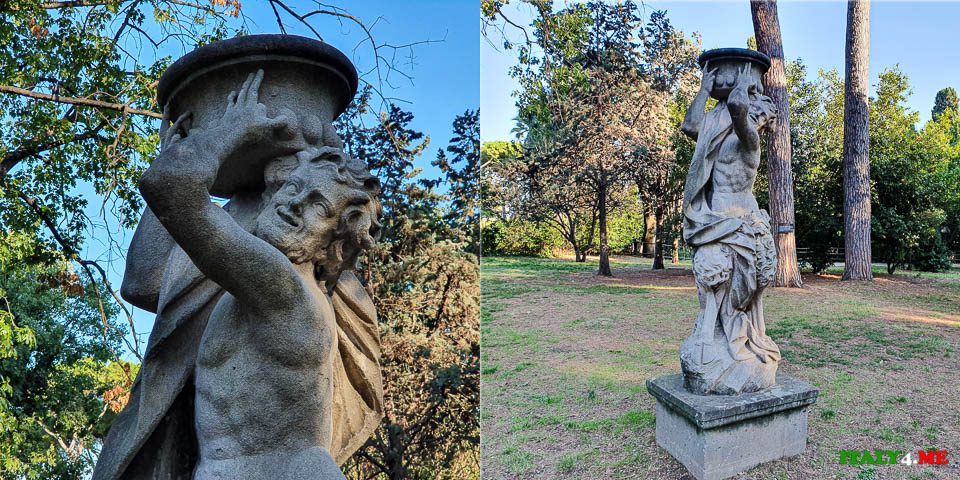
This artistic approach was meant to symbolize the extraordinary love between the couple.
After Wurts passed away in 1928, his widow donated Villa Sciarra to Benito Mussolini, who decided to convert the estate into a public park. To this day, a plaque on the building commemorates the American benefactor who transformed the villa’s appearance.
The villa has undergone only one major restoration in its history—in 2005, when topiary sculptures shaped like animals were added to the park.
Description
Near the Calandrelli Gate, in a small square, stands an elegant fountain featuring rock art motifs, known as the Belvedere. It was created by Enrico and Ugo Gennari between 1910 and 1912. The grounds also feature a laurel exedra adorned with sandstone sculptures representing the twelve months of the year.
Three paths extend from the square, and if you take the one to the right, you’ll come across a large aviary, originally built by the American owner to house white peacocks.
One of the most renowned sculptures is Apollo and Daphne, dating from the early 17th century and made of sandstone.
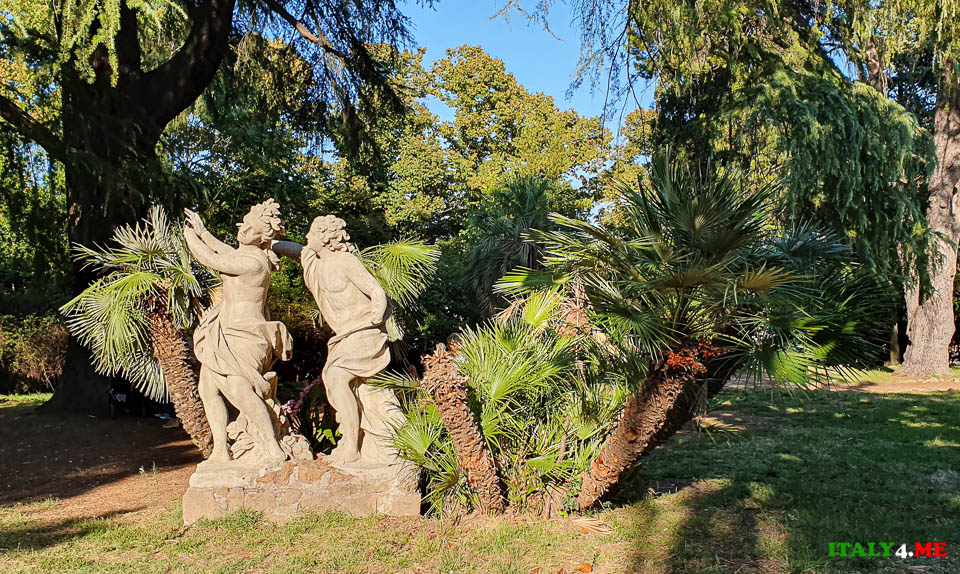
Do not confuse it with the more famous version by Bernini in the Borghese Gallery.
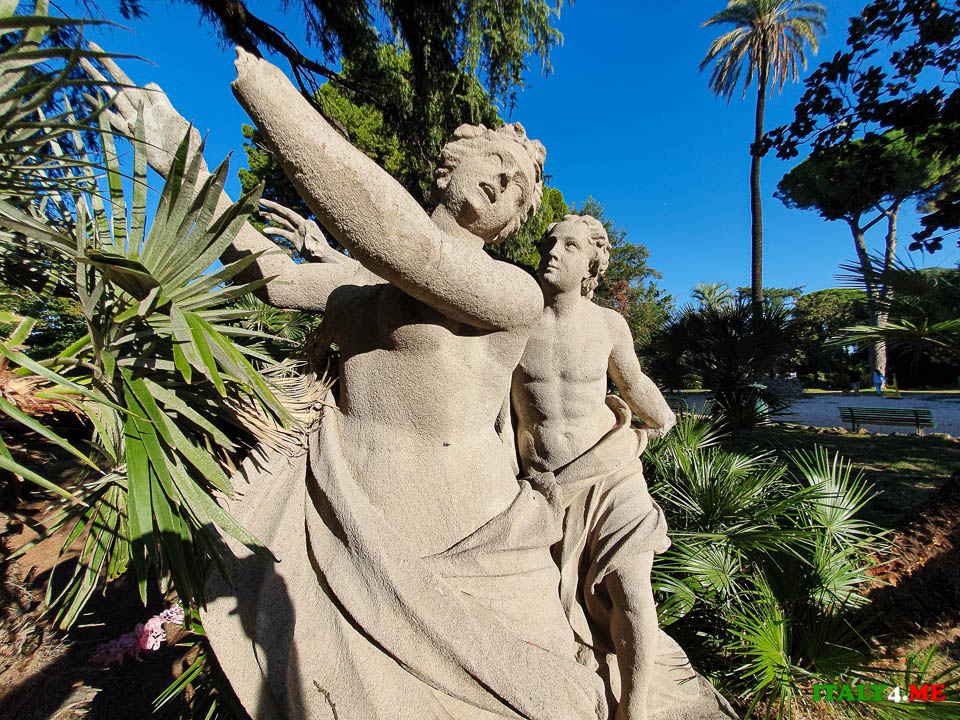
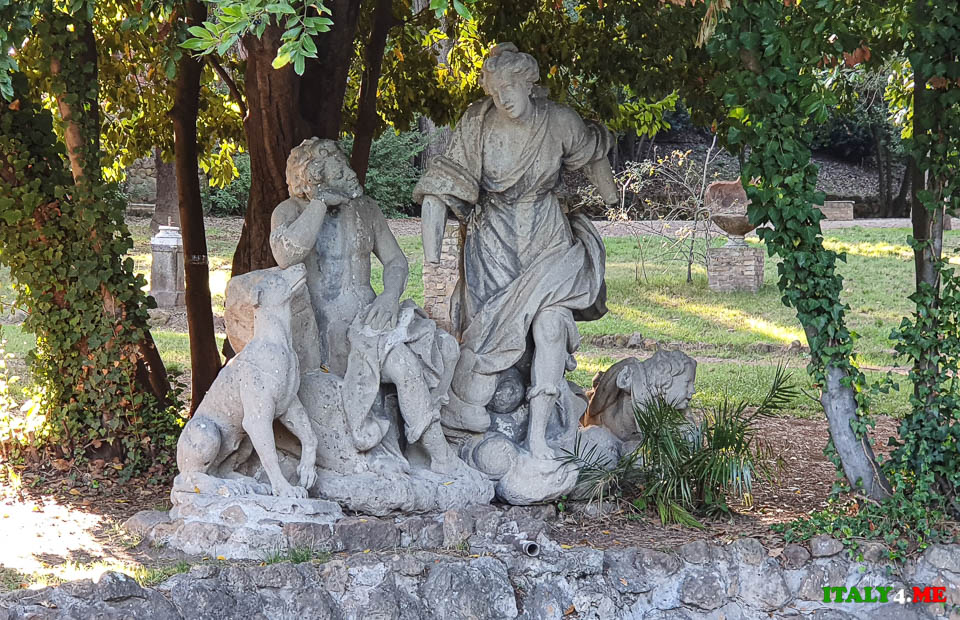
Another highlight is the statue of a Nymph and a lovestruck Satyr.
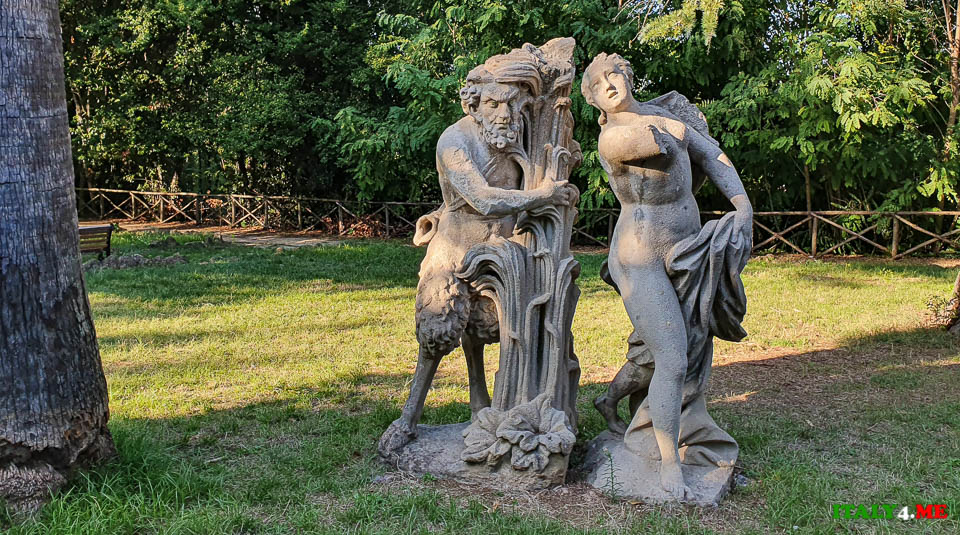
The park also boasts a rich variety of flora, including cypresses, cedars, palms, violets, and many others.
Fountains
The park features the Fountain of Human Vices (Fontana dei Vizi), where four sphinxes symbolize the mortal sins—Gluttony, Lust, Wrath, and Greed.
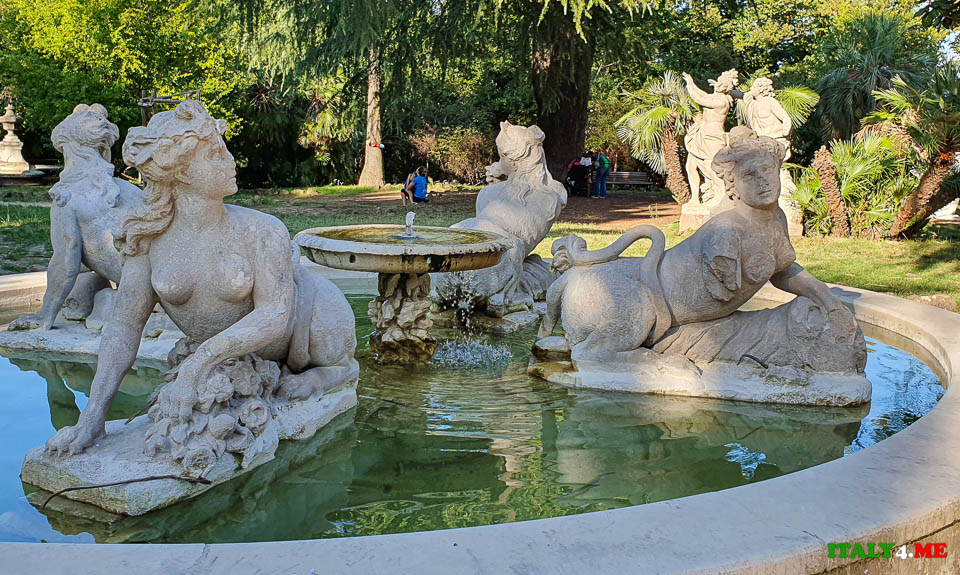
One sculpture stands with a foot on a skull, another sits atop a cornucopia, the third reclines on a bed of flowers, and the fourth devours a luscious fruit. Wrath eyes Gluttony, while Greed faces Lust, illustrating how one vice can lead to another.
Also on the grounds is the Fountain of the Fauns (Fontana dei Fauni), imported from northern Italy.
A mythological couple attempts to carry off a giant seashell, while their playful children frolic beneath them. At the top, you’ll find the heraldic emblem of the Visconti family—a snake with a child emerging from its mouth.
The Faunetti Fountain (Fontana dei Faunetti) welcomes visitors at the main square near the gate. It features two basin-like bowls positioned along the parapet.
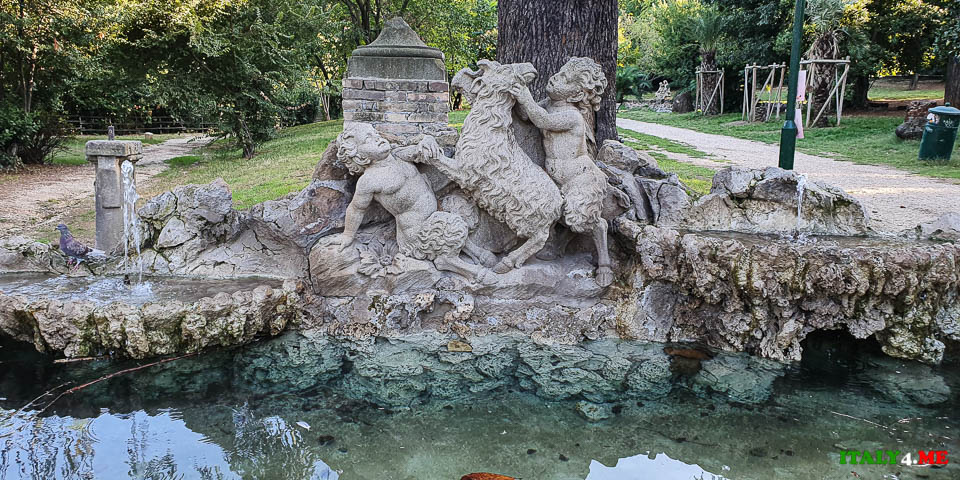
A pair of fauns lean against the basins, playing with a third horned creature. The fountain was crafted from stone by Lombard artisans in the 18th or 19th century.
The Putti Fountain (Fontana dei Putti o del Biscione) resembles a large tub, featuring four cherubs.
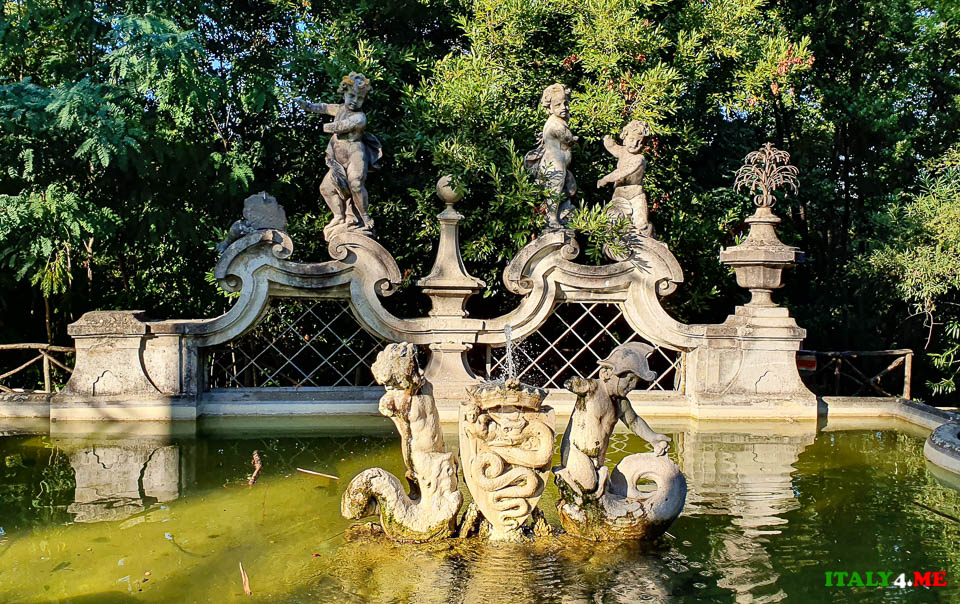
Two angels clasp hands in a dance, while another pair sits near the center of the basin, water flowing from the open mouths of two dolphins.
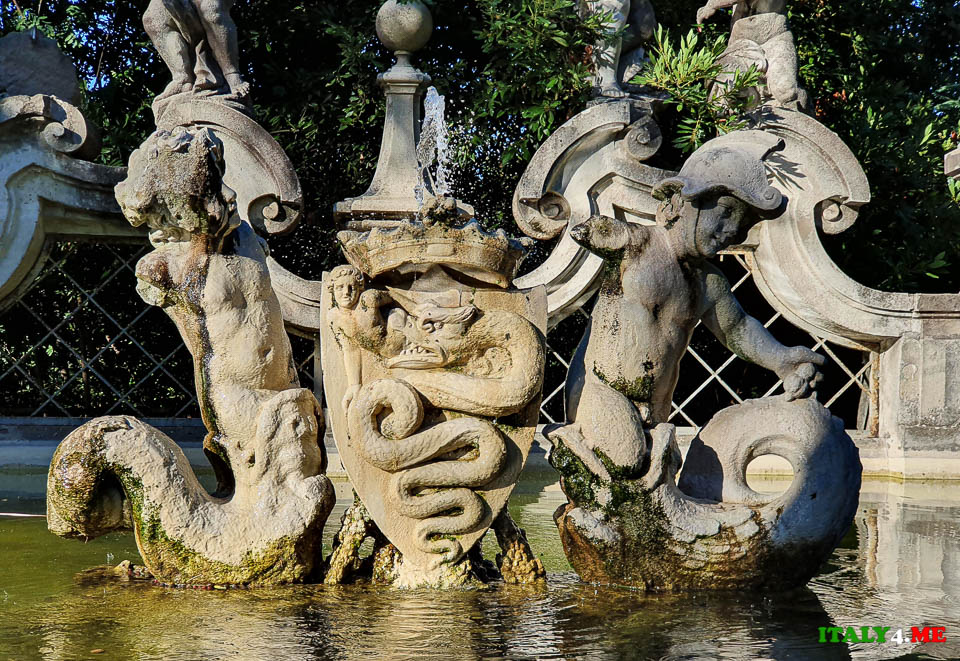
Together, they lift a shield bearing the Visconti family crest—a crowned serpent.
The Fountain of Diana and Endymion (Fontana di Diana ed Endimione) tells the story of the Roman goddess in love with the beautiful youth Endymion, a symbol of eternal beauty.
Temple of the Gods
According to legend, the Temple of the Gods was built by a wealthy Syrian merchant, Marcus Antonius, who traded extensively. The elongated sanctuary, resembling a factory building, was constructed using cuboid stone blocks and consists of three areas: a central rectangular courtyard, a pentagonal space to the right containing small rooms with two doors, and an octagonal room west of the apse. Here you’ll find ancient sculptures, including an Egyptian black basalt statue and a statue of Bacchus with golden hands and face.
In the center of the octagonal room, within one of the altar recesses, archaeologists discovered a bronze figurine depicting a man entwined with a snake. Historians believe this symbolizes the burial rite of the god Adonis, who died annually to be reborn through seven heavenly spheres, represented by the coils of the snake.
Atrium
To the left of the courtyard lies a basilica preceded by an atrium with two side entrances. The first leads into the central nave, ending in an apse with a semicircular niche housing statues of the Heliopolitan triad god Jupiter and the goddess Atargatis. According to myth, Atargatis offended Aphrodite, who cursed her to fall in love with a mortal. After bearing Semiramis, Atargatis, overcome with shame, threw herself into a lake and transformed into a fish, often depicted with scales in art. The atrium also features a statue of “Sim,” or “Mercury.”
The second passage leads to the Fountain of Wildlife.
Townhouse
The townhouse façade has two arches, one leading to a vestibule with a low cylindrical vault. The rear courtyard was later converted into a library during the 1932 restoration. The townhouse concludes with an elegant terrace topped by a rooftop turret and five sculptures—four representing the continents and a fifth symbolizing the phases of the day.
Today, locals and visitors alike stroll through the park, enjoying its beauty, exquisite architecture, and tranquil atmosphere. Unfortunately, the grounds have begun to fall into neglect. Invasive beetles damage the plants, moss covers the statues of nymphs and fauns, and the lawns often go untrimmed for months.
How to Get There
To reach Villa Sciarra from the center of Rome, take bus 44 or 75. Your stop is Carini/Bonnet, stop code 72996.
- Bus 44 departs from Teatro di Marcello, with boarding near the Capitoline staircase.
- Bus 75 departs from Termini Station, stop Indipendenza, code 70294, and passes by the Colosseum.
The distance from the Fontana dell’Acqua Paola is just 550 meters, a 7-minute walk. Nearby, you’ll also find Rome’s largest park, Villa Doria Pamphilj.
Villa Sciarra is open daily from 7 AM to 9 PM. Admission is free.