 Italy for me From Italy with love


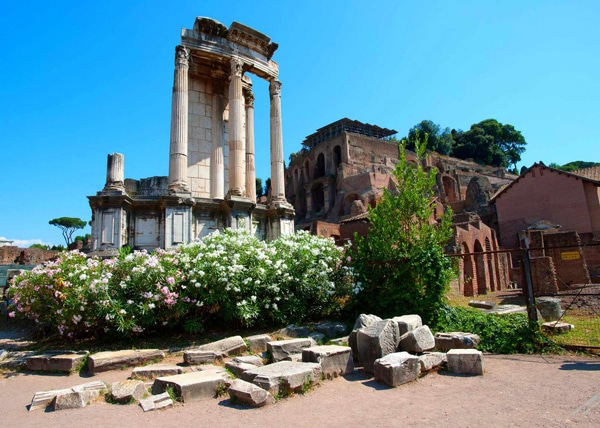
Temple of Vesta (Tempio di Vesta) is one of the most ancient temples in Rome, dedicated to the goddess-protector of the hearth. It is located in the Roman Forum (Foro Romano) at the southern end of the Sacred Road (Via Sacra).
The temple served as the main hearth of the “House of the King.” Today, only fragments of the once grand temple complex remain. The complex also included the House of the Vestal Virgins and was connected to the Regia—the residence of the Pontifex Maximus, the chief priest of the Roman religion. Another Temple of Vesta is known in the outskirts of Rome, in Tivoli.
Page Contents
History
The history of the temple begins in the 7th century BCE, likely during the reign of King Numa Pompilius. Over the centuries, the temple suffered many fires and was rebuilt several times until it eventually took the form of a round structure with a white marble façade, surrounded by twenty Corinthian columns and elevated on a podium. In 64 CE, during the great fire of Rome, the temple once again burned but was promptly restored.
The modern Roman Forum preserves the remains of the Temple of Vesta that was reconstructed after the fire of 191 CE. The reconstruction was overseen by Julia Domna, wife of Emperor Lucius Septimius Severus, and a devoted follower of the goddess. In 394 CE, Emperor Theodosius I banned pagan worship, and the cult of Vesta came to an end. The temple fell into ruin, and only the remnants, uncovered during excavations in 1877, remain as a testament to the reverence Romans once held for the goddess of the hearth.
Vesta’s Cult
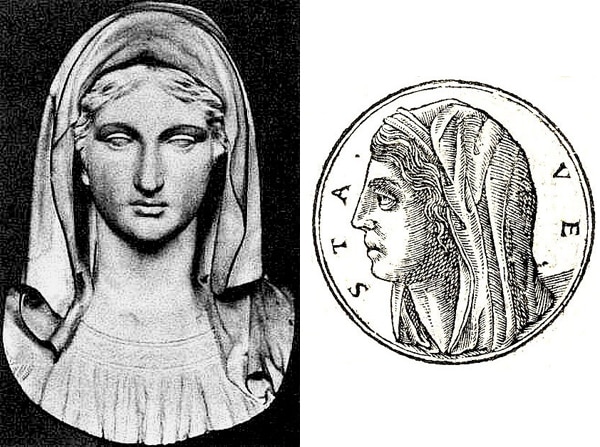
Vesta, daughter of the god Saturn, embodied the household hearth and protected the family. She was one of the most revered goddesses of antiquity. She never married—turning down both Apollo and Mercury—and swore on the head of Zeus to remain a virgin. In honor of her vow, Zeus decreed that she be worshipped in every temple and be the first to receive offerings at household altars, where images of other deities were traditionally placed. Vesta herself was almost never depicted: her presence was symbolized by the sacred flame burning at the family hearth.
The eternal fire burning on the altar in the Temple of Vesta symbolized the eternity of Rome, the stability of the state, and its sacred order.

In the temple’s inner sanctum, a hidden chamber held one of Rome’s most sacred relics—the Palladium, a wooden statue of Aphrodite brought from Greece by Aeneas, the legendary ancestor of Romulus and Remus. Once a year, on the first day of the new year, the sacred flame was ceremonially rekindled—either by using a magnifying glass to focus sunlight or by friction—to ensure it had a natural origin. Initially tended by royal daughters, this duty later passed to the priestesses of the goddess—the Vestal Virgins.
Vestal Virgins
Six Vestal Virgins—priestesses of Vesta—were selected from girls aged 6 to 10, daughters of free and respected Roman citizens (patricians), and remained at the temple for thirty years.
The first ten years were dedicated to training, the last ten to teaching newcomers, and only the middle decade was spent in active service. Many Vestals are known by name, and their statues adorned the temple for centuries.
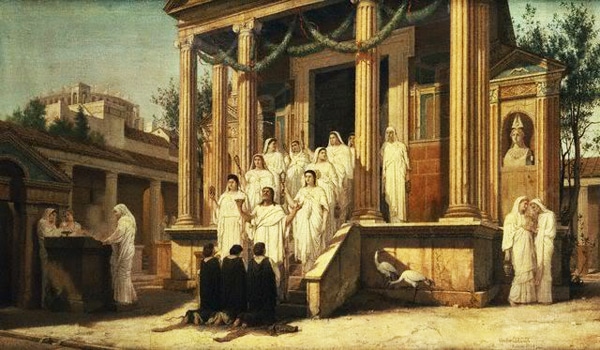
Vestal Virgins were strictly required to maintain their chastity. A priestess who broke her vow was buried alive in the “Field of the Wicked.”
She was carried there in complete silence, hidden inside a closed litter, and was expected to descend into the tomb on her own, where a bed, a lamp, and some food awaited. Her seducer met a grim fate as well: he was beaten to death with rods for sacrilege.
However, after completing their thirty years of service, Vestals were allowed to marry, and it was considered a great honor to wed one.
Over the 1,100-year history of the cult, only thirteen Vestals are known to have broken their vow, though this does not mean the rest obeyed out of fear of death.
In Rome, the Vestals enjoyed immense respect. Wherever they appeared, they received the most honorable seats, and even a chance encounter with a Vestal on the way to execution could grant a condemned person their life.
The Donkey’s Head
Lamps in Vesta’s sanctuaries often depicted donkey heads, commemorating the moment a donkey’s bray woke the sleeping goddess and saved her from disgrace—she was about to be violated by Priapus, the god of fertility.
In memory of this, June 9 was set aside as a celebration. On this day, Romans would bring offerings to the Temple of Vesta and were forbidden to make their donkeys work.
How to Get There
You can easily reach the Temple of Vesta and the House of the Vestals on foot from the Colosseum (Colosseo), which is located right next to the Roman Forum. It’s also a short walk from Piazza Venezia or from the Capitoline Museums (Museo Capitolino) on Piazza del Campidoglio.
The nearest metro station is Colosseo, on line B