 Italy for me From Italy with love

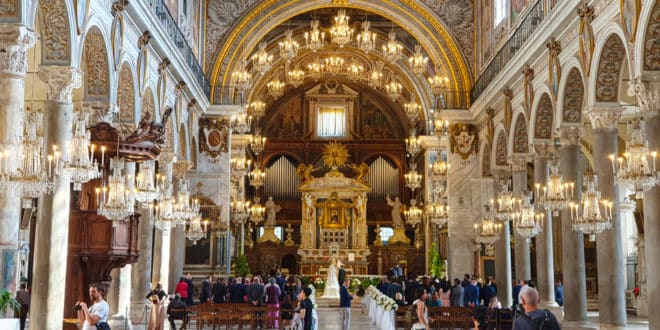
Santa Maria in Aracoeli is an ancient basilica located in the historic center of Rome atop the Capitoline Hill (Campidoglio).
Among the city’s many religious sites, it stands out for its miraculous relics and the breathtaking beauty of its interior, hidden behind a simple and austere façade. The church is steeped in beautiful legends, including one that claims it houses the oldest Christian altar.
Beside the grandiose Vittoriano monument, this Romanesque church dedicated to the Virgin Mary, with its modest architecture, may not always catch the eye of tourists, but it can be a true discovery for those seeking to uncover the mysteries of the Eternal City.
Page Contents
History and Legends
Santa Maria in Aracoeli took on its current Roman-Gothic appearance between the 13th and 18th centuries, but its history traces back to Ancient Rome. It is linked to the legend of the Capitoline geese, the meaning of the word “money,” and a vision of the Virgin Mary on the Capitoline Hill long before Christianity arrived in Rome.
The Founding Site
The Capitoline has always been at the heart of Rome’s spiritual and political life. Settled as early as the Bronze Age, it served both as a fortress and as a dwelling place for the gods in Ancient Rome. On the southern, higher summit of the Campidoglio, from 509 BC, stood the city’s main temple dedicated to the triad of Jupiter, Juno, and Minerva.
On the northern slope of the hill’s second summit, where Santa Maria in Aracoeli now rises, a citadel known as the Arx existed as early as 753 BC. The fortress was never a permanent base for military garrisons but played a more symbolic role in Roman military strategy as the last stronghold in the defense of the city.
Within its grounds stood one of Rome’s three auguraculums—open-air temples where augur priests interpreted the will of the gods by observing the flight of birds. This sacred ritual, adopted from the Etruscans and traditionally introduced by Romulus himself, was also practiced on the Palatine (Palatino) and the Quirinal (Quirinale).
Read more about the Seven Hills of Rome and the Gods and Goddesses of Ancient Rome.
The Capitoline Geese and Coins
The earliest legend surrounding the founding of the Christian basilica on the Capitoline is linked to the famous story of the geese from the Arx courtyard, kept for sacrifice to Juno, who saved Rome.
This event, which took place in 390 BC, is described in Livy’s work History of Rome from Its Foundation. The Gauls, led by Brennus, attempted a nighttime assault on Rome’s last stronghold—the Capitoline Hill. They managed to slip past both the guards and the dogs undetected. Only the alarmed geese raised a clamor, waking Marcus Manlius Capitolinus, the commander of the fortress. Thanks to these feathered heroes—who, fortunately, had not been eaten by the besieged and starving defenders—the barbarians were repelled in time, and Rome was soon liberated.
In memory of this episode, between 345 and 344 BC, a Temple of Juno Moneta (Tempio di Giunone Moneta) was erected on the site of the courtyard where the sacred geese lived, near the house of Marcus Manlius. The Latin word moneta means “to warn,” and the goddess Moneta, identified with Juno, was also regarded outside Rome as the guardian of the city’s finances.
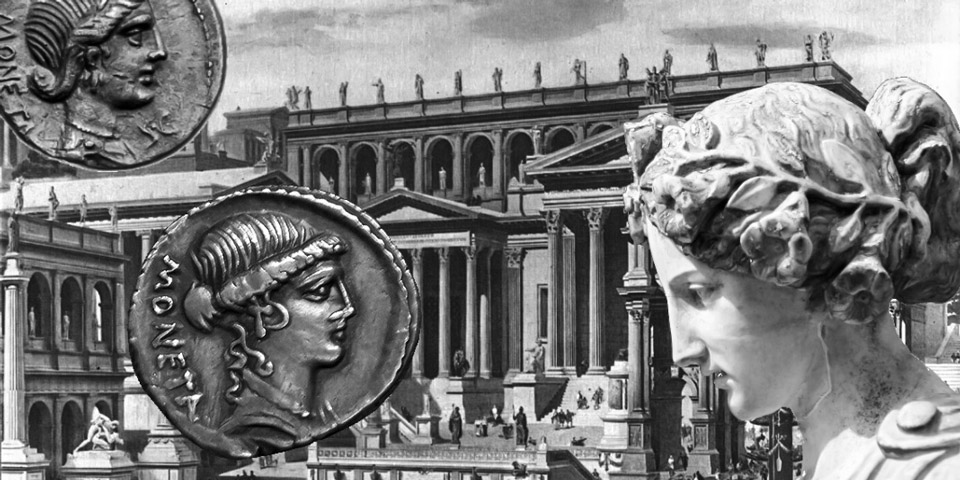
In 249 BC, near the new temple on the Capitoline, a mint was established to produce Roman silver coins. Soon, the goddess’s name came to denote both the mint itself and Roman currency—and, eventually, the very word “money” in many languages.
The ruins of the pagan Temple of Juno Moneta may lie beneath the foundation of the Christian church dedicated to the Virgin Mary. Today, this theory is supported by architectural artifacts discovered in the church’s garden, which attest to the existence of the ancient sanctuary and citadel.
Read more about coins of Ancient Rome.
The Sibyl and Augustus’s Vision
The current name of the Basilica of Santa Maria in Aracoeli first appears in documents from 1323, but the beautiful legend behind its origin dates back much earlier. Emperor Augustus (Octavianus Augustus) sought guidance from the Tiburtine Sibyl on whether he should accept divine honors, as proposed by the Roman Senate. In response, the prophetess revealed a vision of a young woman standing on an altar holding a child, during which a heavenly voice proclaimed: “This is the Virgin who will conceive the savior of the world.”
This event is commemorated by the figures of Augustus and the Sibyl depicted on either side of the arch above the basilica’s main altar.
Rome would not become Christian until the 4th century, but by the 6th century, a church already stood where Santa Maria in Aracoeli now rises. It was regarded as very old, and it is possible that Augustus’s “Heavenly Altar,” established before the birth of Christ, was never entirely lost.
The Early Church
Tradition holds that Santa Maria in Aracoeli was founded in the 6th century by Gregory the Great (Pope Gregory I), who may have consecrated it in 590 AD, the year he ascended the Holy See, though no definitive records confirm this.
The first known Christian structure on the Capitoline Hill was a Byzantine-rite monastery, likely established in the 7th century by Greek monks fleeing Muslim persecution. The church they built, dedicated to the Holy Virgin, gradually expanded with new monastic buildings, residential quarters, and a market square. The monastery was closed in the 9th century, possibly due in part to the earthquake of 847 AD, which damaged many Roman structures.
Read more about earthquakes in Italy.
In the late 9th and early 10th centuries, Benedictines took over the monastery, which had been accepted by the papacy. They effectively controlled the entire hill, using the ruins of ancient buildings for new constructions. The church they built, incorporating fragments of Roman structures, was first mentioned in 11th-century documents as Sancta Maria in Capitolio.
With the restoration of the Roman Senate in 1143, public life revived on the Capitoline Hill: laws were proclaimed and assemblies were held near the monastic holdings, and legal proceedings even took place within the church itself.
Franciscan Reconstruction
By the late 12th century, the Benedictine order had declined, and the monks abandoned the Capitoline. In 1250, the church and monastery found new guardians—the Franciscans. This generous gift from Pope Innocent IV inspired the Friars Minor to undertake the reconstruction of the dilapidated structures, starting with the old church, which they used for the transept of the new basilica. Funds for the project were secured, as the mendicant order readily accepted donations from wealthy citizens in exchange for burial spaces within the church.
The basilica’s redesign in the Roman-Gothic style is attributed to Arnolfo di Cambio. Construction took place between 1285 and 1287, and the church was re-consecrated in 1291, though work on the interior continued until the 15th century.
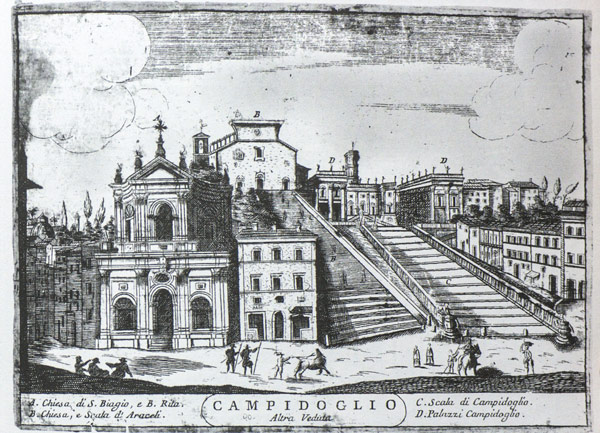
By the 14th century, the church became known as Santa Maria in Aracoeli, a name that harkened back to its origins and the beautiful legend of the Heavenly Altar.
Under the Franciscans, the basilica became Rome’s principal church for many years, aided by its proximity to the city council. Under the protection of the senators, the church also became a venue for discussions and the proclamation of new laws.
Desecration
A dark chapter for Santa Maria in Aracoeli came during the Roman Republic (1798–1799). French forces, who invaded Rome in 1798, showed little reverence for ancient sanctuaries, turning the church into a stable and destroying much of its magnificent decor. They looted valuables and demolished chapels, including the one housing the relics of Saint Helena. The desecrated church remained closed until 1815, when it was restored by the Franciscans with the support of new benefactors.
Following the unification of Italy under the Risorgimento, the monastic complex on the Capitoline became state property. The new government showed little concern for the interests of the Holy See. For a time, the basilica even housed barracks and the headquarters of the local police.
The construction of the monumental Vittoriano complex, which took place between 1882 and 1911, led to the demolition of the monastery, the Tower of Paul III, and the ancient sacristy. However, the church itself was spared.
Today, Santa Maria in Aracoeli is a titular church, assigned since 1998 to Italian Cardinal Salvatore De Giorgi.
The present appearance of Santa Maria in Aracoeli is the result of a series of construction, renovation, and decorative efforts that began in the 13th century with the Franciscan monks and continued into the 18th century.
Façade
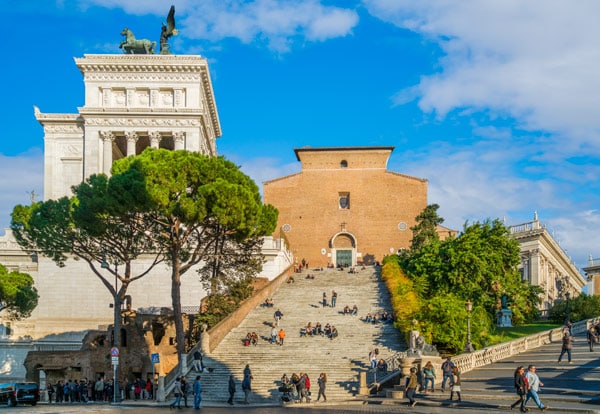
The modest and massive façade of Santa Maria in Aracoeli consists of brickwork dating back to the 13th century. The numerous holes visible in the wall are traces from scaffolding attachments used for finishing work that was either never completed or has not survived.
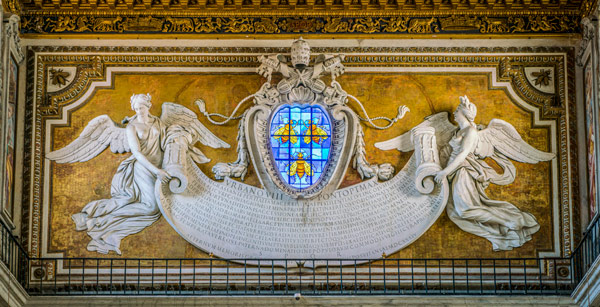
Set into the wall are three windows—the central one, heart-shaped in silhouette, and two side windows in the form of round Gothic roses. The central window once held a Jerusalem cross, which was replaced during the time of Pope Urban VIII (1623–1644) from the Barberini family with a stained glass window featuring bees from the family’s coat of arms.
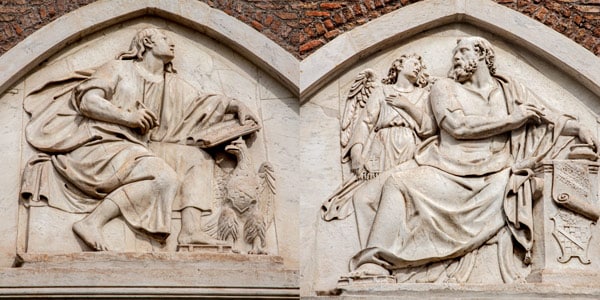
The three portals on the façade were built in the 14th century and reconstructed between the 15th and 16th centuries. The central entrance is framed by an arch under which only traces of a 15th-century fresco remain. Above the side doors, however, beautifully preserved 16th-century marble reliefs depict the Evangelists John and Matthew.
The old portal on the right became a side entrance from Capitoline Square. It was preserved during the church’s reconstruction to facilitate access to court hearings. In the lunette of the arch, a 13th-century mosaic depicting the Madonna and Child between two angels has survived. This work may be attributed to the mosaic artists Jacopo Torriti or Pietro Cavallini.
Directly above the old portal rises a simple bell tower with three brick arches. It was constructed between 1534 and 1549, replacing an earlier version from 1260 that remained unfinished when the humble Franciscans could not afford such luxury.
The curve at the top of the façade once accommodated a mosaic panel meant to be seen by worshippers ascending to the church. It is believed that a 13th-century mosaic by Jacopo Torriti once adorned this space, depicting the dream of Pope Innocent III (his vision led to the approval of the new monastic order founded by Saint Francis).
From 1412 to 1806, the façade featured the city’s first public clock with a bell. The complex mechanism required daily adjustment to align with Rome’s traditional division of day and night hours, which often led to problems and frequent breakdowns.
The Staircase
A monumental marble staircase, the Scalinata di Aracoeli, leads up the hill to the Basilica of Santa Maria in Aracoeli and is believed to possess miraculous powers.
The staircase was constructed in 1348 as a gift from the people of Rome to the Virgin Mary. The residents themselves gathered the funds and materials needed for its construction. It is believed that the miraculous icon Madonna d’Ara Coeli saved Rome from the bubonic plague of 1346–1353, the deadliest pandemic in human history, which claimed around 200 million lives.
After the sacred icon was carried in procession around Rome, the plague subsided, taking far fewer lives than in other cities. A memorial plaque to the left of the main entrance commemorates this event.
The staircase was built using remains from the ancient Temple of Serapis on the Quirinal Hill (Tempio di Serapide del Quirinale) and consists of 124 steps, some of which still bear carved decorative patterns. In the past, pilgrims and homeless beggars often slept directly on the steps, viewing this opportunity as a blessing.
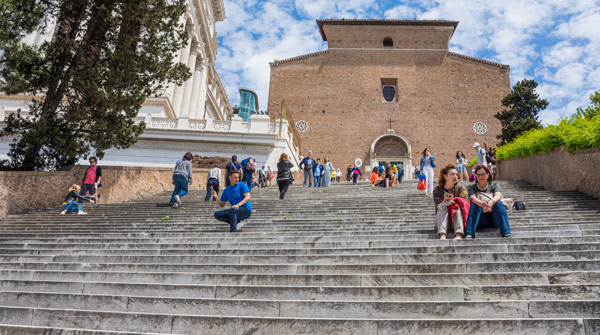
The staircase was inaugurated by Cola di Rienzo, an Italian scholar and popular tribune who, in the mid-14th century, fought to overthrow papal rule and unify Italy. Ironically, he was later executed at the foot of the same staircase, where other condemned prisoners would also meet their end. To the right at the base of the staircase, near a small surviving garden, stands a monument to this medieval hero, created in the 19th century by renowned Italian sculptor Girolamo Masini.
Several legends surround the marble staircase leading to the basilica. It is said that childless women who climb the steps on their knees will be granted the child they long for, while sinners will receive absolution for all their sins.
Interior
Santa Maria in Aracoeli boasts impressive dimensions (131 feet wide and 279 feet long) and features the classic structure of a Romanesque basilica with an incredibly beautiful interior.
The Latin cross layout consists of three long naves and a slightly projecting right-hand transept (the old church), behind which lies a rectangular apse containing the main altar and choir, as well as four chapels (two on each side of the altar) and a sacristy.
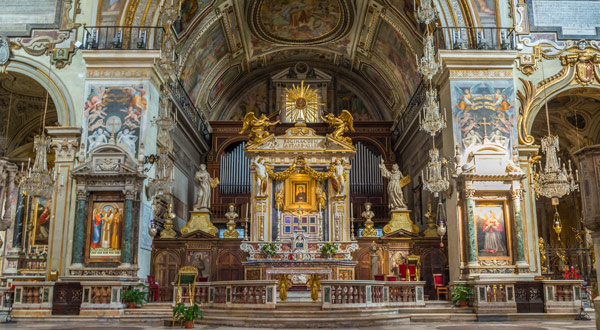
A series of magnificent isolated chapels lines the side aisles—nine on the left and eight on the right.
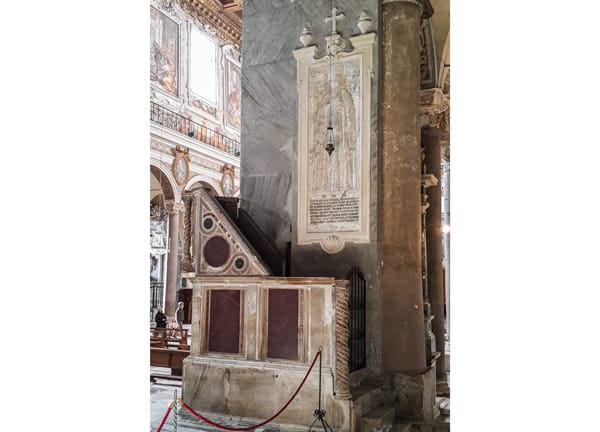
At the junction of the main nave and the transept, where a tall arch marks the entrance, the early church’s pulpit has been preserved. Made of polychrome marble, it was crafted in the 12th century by the Anagni master Lorenzo Cosmati and his son Jacopo.
In the central aisle to the left, there is another pulpit, carved from wood in the 17th century, believed to be based on a design by Giovanni Lorenzo Bernini.
Columns
The central nave is separated from the side aisles by 22 Roman columns, no two of which are alike. They were salvaged from the ruins of ancient temples and vary in color, style, and even height, which explains the differing levels of the bases at the columns’ foundations. 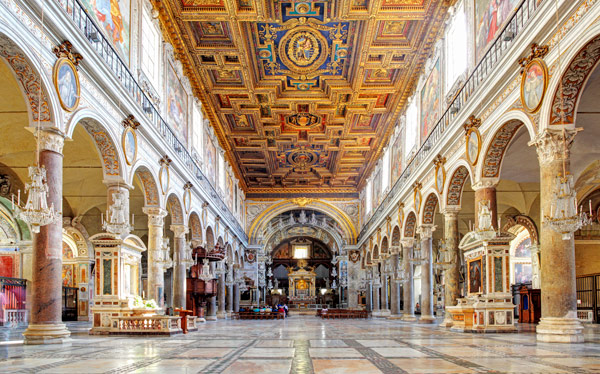
These ancient architectural elements give the Christian church a unique character and evoke the legendary history of Santa Maria in Aracoeli’s founding. Some of the ancient columns may have originally stood in the temples of Juno Moneta or Jupiter Capitolinus.
A Latin inscription on the third column of the left nave states that it is “from the room of Augustus,” where the Virgin Mary is said to have appeared to the emperor. Moreover, according to legend, a hole in this column marks the spot where a divine ray of light shone during the apparition of the Virgin.
The fourth column on the left became part of a small chapel built in the 18th century, designed by architect Gerolamo Fabi. A 15th-century fresco adorning the column drew many worshippers who came to pray before the image of the Madonna and Child.
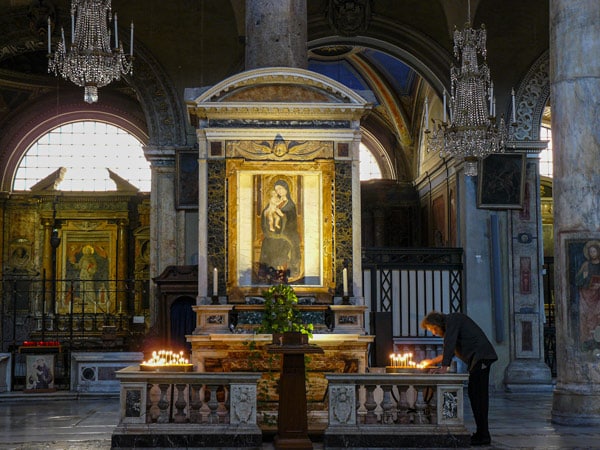
The altar painting, attributed to the Viterbo school, is known as the Madonna del Rifugio.
Floor
The basilica retains its mosaic floor of white marble and colored stone, created in the second half of the 13th century in the Cosmatesque style. Its pattern, reminiscent of a carpet, was interrupted in the 14th and 15th centuries by numerous tomb slabs, which introduced some irregularity into the overall design. 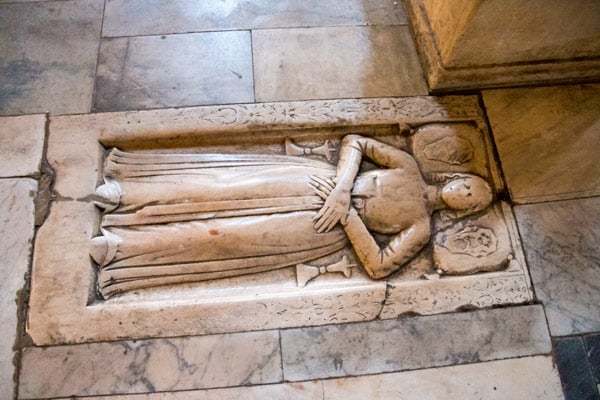
Significant damage was inflicted on the church’s floor by the hooves of horses stabled here during the French occupation in the 18th century. It is also worth remembering that over the course of more than seven centuries, millions of people have walked these ancient tiles, leaving a visible mark of their passage.
Ceiling
In the 16th century, Santa Maria in Aracoeli was adorned with a wooden coffered ceiling—a masterpiece created between 1572 and 1575 by a group of craftsmen led by the renowned French woodcarver Flamminio Boulanger. The ceiling was commissioned by the city senate and Pope Pius V to commemorate Rome’s victory over the Turks at the Battle of Lepanto in 1571.
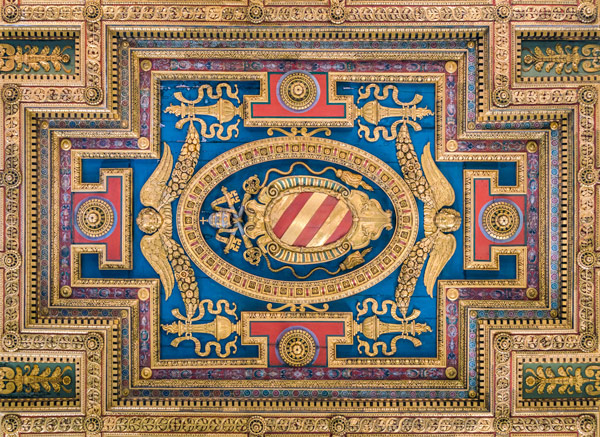
A solemn mass was held in the basilica on the day of the triumphant procession of Admiral Marcantonio II Colonna, the hero of the military campaign.
The intricate woodcarving, lavishly gilded and accented with rich colors, weaves together historical and mythological narratives.
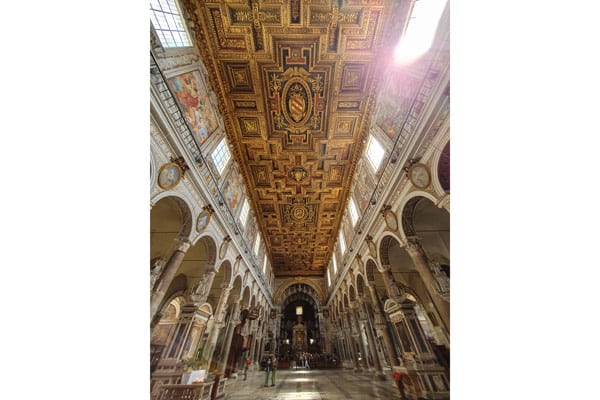
At the center of the ceiling, within a massive medallion, appears the Madonna holding the Child. This is the very image, as envisioned by the artist, in which Augustus saw her during the Sibyl’s prophecy. Along the same axis as the Madonna are the coats of arms of the Roman Senate, Pope Pius V, under whom the ceiling’s construction began, and Pope Gregory XIII, under whom it was completed.
Unusual for a Christian church are the bas-reliefs depicting military trophies and an inverted crescent moon, symbolizing Christianity’s victory over the terror of Ottoman expansionism.
The transept of the basilica features a similarly styled ceiling, though visitors often pay it less attention.
A unique quest for visitors is to search the wooden bas-relief ceiling for the image of the Capitoline Wolf nursing the twins Romulus and Remus. This splendid motif does indeed exist!
Main Relics and Works of Art
The Christian relics and artistic treasures of the ancient Basilica of Santa Maria in Aracoeli attract millions of visitors who come to see them with their own eyes and to venerate the beauty and sanctity of these priceless treasures.
The Infant Jesus
In the Chapel of the Infant Jesus (Cappella del Bambinello), built in the 19th century within the sacristy to the left of the altar, stands a replica of the ancient wooden statue of the Holy Infant (Santissimo Bambinello). The original, which arrived at the basilica in 1647, was carved in the 15th century by a Franciscan monk in Jerusalem from a piece of olive wood from the Garden of Gethsemane.
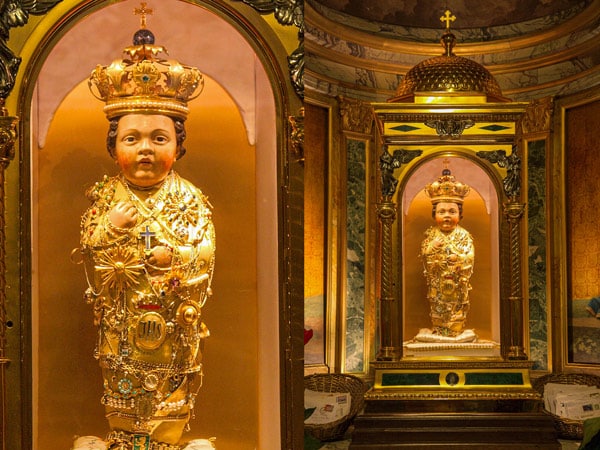
The figure of the Infant Jesus was baptized in the holy waters of the Jordan and was considered miraculous. It healed the gravely ill and became incredibly popular, for which it was “rewarded” with precious adornments. The sacred statue was kept in the sacristy and brought out at Christmas or on special occasions when it was taken directly to the bedside of the sick. It was believed that if the lips of the Infant Jesus turned pink, it was a sign that the illness would recede, but if they remained unchanged, there was little hope for recovery.
In 1994, the statue of the Holy Infant was stolen, and its whereabouts remain unknown. It is unclear whether the thieves were more attracted by the miraculous power of the wooden figure or the abundance of precious jewels that adorned it.
The replica of the Santissimo Bambinello is also held in great reverence and continues to receive letters from around the world requesting healing, forgiveness, and deliverance from evil and shame. These letters are placed directly on the floor before the statue and are never opened before being burned, as they are intended for the Infant Jesus, not for the eyes of the priests.
Relics of Saint Helena and the Ancient Altar
In the center of the left transept, at the site of the ancient altar, stands the Chapel of Saint Helena (Cappella di Sant’Elena), dedicated to the mother of Rome’s first Christian emperor, Constantine I (Flavius Valerius Aurelius Constantinus).
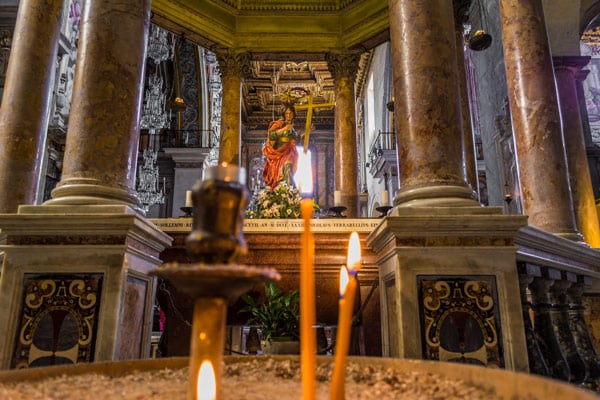
A devout woman, Helena made a pilgrimage to Palestine, where she fervently searched for relics connected to the life and death of Jesus. She returned from Jerusalem with several sacred items, the most important being the “True Cross” on which the Son of God was crucified.
Through the glass at the lower level of the chapel, visitors can see an ancient and ornate marble altar in the Cosmatesque style, known as the Altare di Augusto or Ara Coeli. It was crafted and installed in the 12th century at the spot where, according to legend, the Virgin Mary with the Infant Jesus appeared to Augustus.
Research conducted in 1963 confirmed that beneath the marble altar lies an ancient worship site with remains of a Roman structure. This may indeed be the very first Christian altar.
Madonna Aracoeli
The basilica’s main altar, created in 1723, houses a relic of great importance to Romans—the miraculous icon of the Madonna Aracoeli. For centuries, according to church tradition, the image of the Holy Virgin has been the source of healing miracles and protection for the people of Rome from hardships and disease. 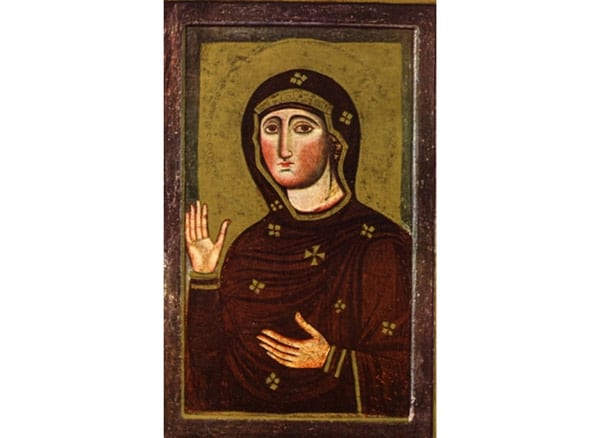
The icon is believed to have been painted by the Evangelist Luke in Jerusalem (from which it also bears the name Madonna di San Luca), later taken to Constantinople, and eventually brought to Rome. The exact date of its creation, executed in the Byzantine style, is unknown, though it was likely copied from the original in antiquity and dates to the 10th or 11th century. The Madonna Aracoeli was already present in the Capitoline church during the Benedictine era and was moved to the central altar by the Franciscans in 1565.
In 1636, the image of the Holy Virgin was crowned by Pope Urban VIII, an honor reserved in the Catholic Church for only the most venerated icons. For the French occupiers, the crown became a prize for looting, and in 1797 it was stolen. A new crown was created in 1938 but later removed, as adorning icons with jewels fell out of fashion.
May 30, 1948, became a significant day in the city’s history—before the Madonna Aracoeli icon, Pope Pius XII conducted the rare and solemn rite of dedicating the people of Rome to the Immaculate Heart of Mary.
Frescoes
The frescoes of the basilica are among its most treasured medieval artworks and are a major reason why visitors come to Santa Maria in Aracoeli.
The Life of Saint Bernardino of Siena
In the first chapel on the right, named after Saint Bernardino of Siena (Cappella di S. Bernardino da Siena) and also known by the name of its patron as the Bufalini Chapel (Cappella Bufalini), visitors can admire the magnificent fresco cycle The Life of Saint Bernardino of Siena. This masterpiece was painted between 1482 and 1485 by the Italian artist Bernardino di Betto di Biagio, known as Pinturicchio.
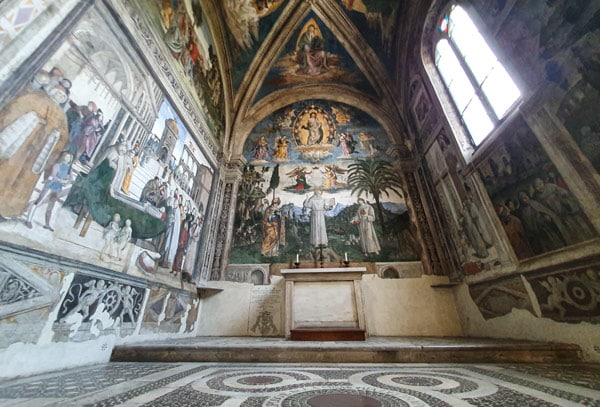
In this work, Pinturicchio surpassed even Pietro Perugino, under whose shadow he had previously worked. Pinturicchio’s masterpiece, with its somewhat unusual scenes and finely detailed figures, can be admired endlessly.
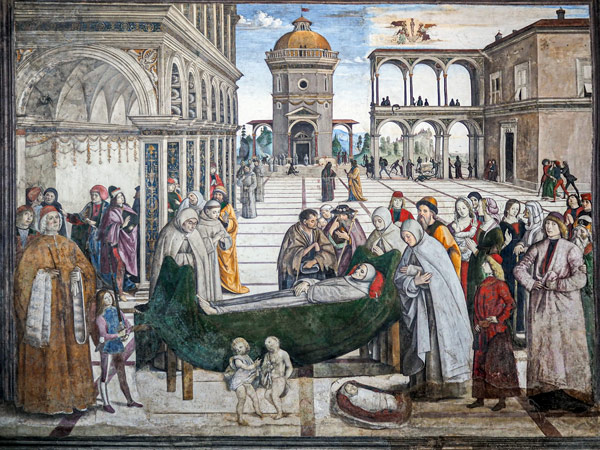
The depiction of Saint Bernardino himself is also of interest. In 1472, he was accused of heresy by a Roman court and could have been executed at the foot of the Santa Maria in Aracoeli staircase.
The Unusual Fresco of Anthony of Padua with a Book
Another highlight is the altarpiece fresco by Benozzo Gozzoli, portraying Saint Anthony of Padua with angels and the donor. This fresco is the surviving portion of the decoration that once covered the entire Chapel of Saint Anthony of Padua (Cappella di Sant’Antonio di Padova) between 1447 and 1449. 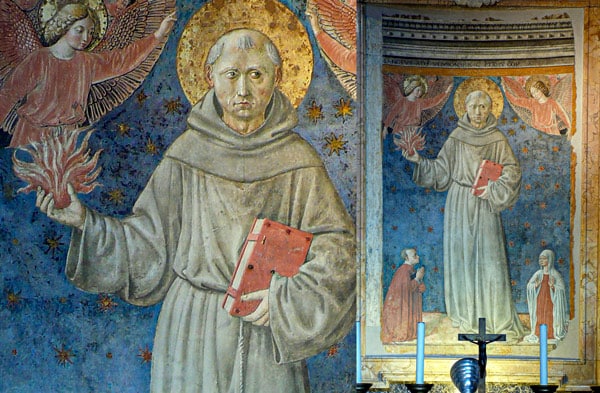
The fresco is unusual because it depicts the saint not with the Infant Jesus and a lily, but with a book, a symbol of eloquence, and a flaming heart, the very heart that the risen Lord ignited in the travelers returning from Jerusalem to Emmaus, as described in chapter 24 of the Gospel of Luke. Saint Anthony of Padua is regarded as the patron of the poor and travelers, as well as his birthplace, Lisbon, where he is known as Santo Antonio de Lisboa.
Franciscan Saints Tondo
The upper level of the central nave is also adorned with rows of frescoes. Between the round arches of the columns are 22 tondi depicting Franciscan saints. 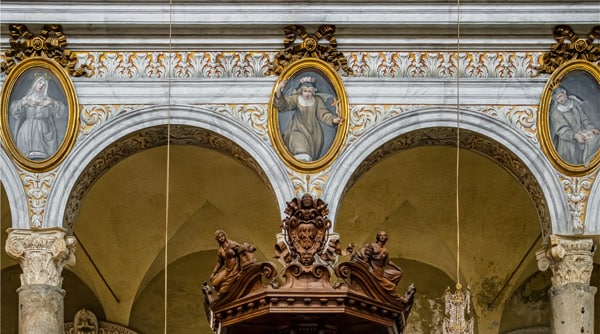
The frescoes were completed in the 17th century by the monk Fra Umile da Foligno, who, together with Giovanni Odazzi and Giuseppe Passeri, also contributed to the large rectangular frescoes between the windows of the main aisle. Thanks to the artists’ refined craftsmanship, the scenes from the life of the Virgin Mary and stories from the Old Testament in this joyful cycle are filled with light and spirituality.
The chapels of the basilica also feature frescoes by other medieval painters, including Francesco Pichi, Cristoforo Roncalli known as Pomarancio, Nicolò Martinelli, Marzio Ganassini, and others.
Tombs and Sculptures
Like all Roman basilicas, Santa Maria in Aracoeli served as a burial place for members of ancient aristocratic families and clergy of various ranks in the church hierarchy.
Tomb of Catherine of Bosnia
Among those laid to rest here are Queen Catherine of Bosnia (1424–1478), beatified by the Catholic Church (her tomb is located above the ancient 12th-century pulpit), and Pope Honorius IV (1210–1287).
Savelli Chapel
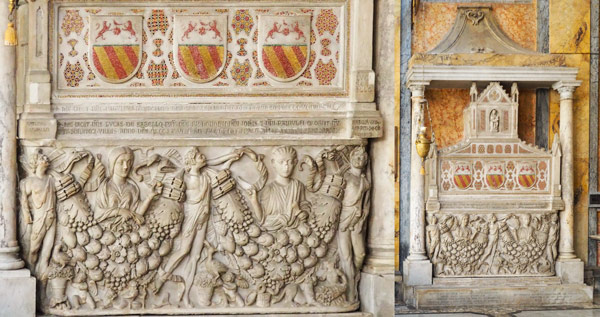
A pontiff from the Savelli family is buried alongside his mother in a beautiful sarcophagus of original design in the Chapel of Saint Francis of Assisi (Cappella di san Francesco), also known as the Savelli Chapel.
Tomb Slab of Giovanni Crivelli by Donatello
Among the floor and wall tombs are works by great masters. On the wall to the right of the entrance is the tomb slab of the archdeacon of Aquileia, Giovanni Crivelli, created by Donatello between 1432 and 1433 during his stay in Rome.
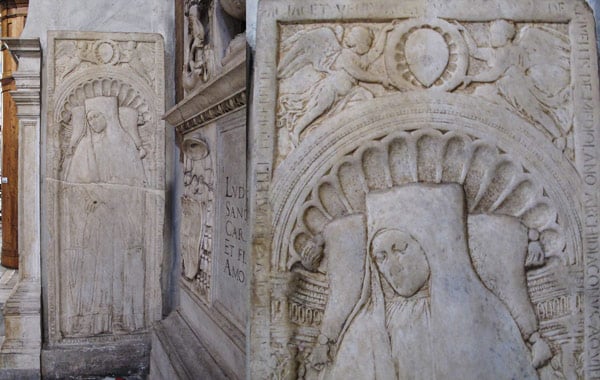
The marble relief has been noticeably worn and has lost much of its original expressiveness, as it was long positioned in the church floor.
Tomb of Cecchino dei Bracci Designed by Michelangelo
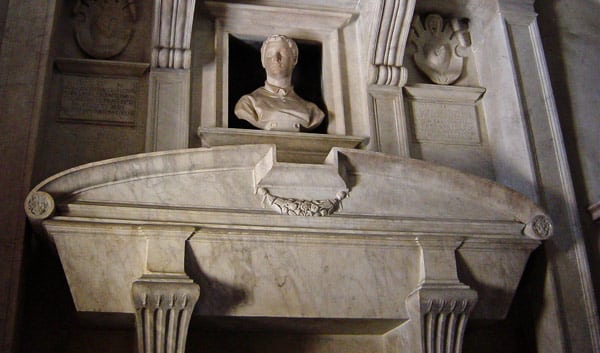
The modest tomb of Cecchino dei Bracci, a young man who died at the age of sixteen, was designed by the great Michelangelo, who knew him personally and mourned his passing deeply.
Sculpture of Pope Gregory XIII, Reformer of the Calendar
In addition to the basilica’s beautiful tombs, there is a monumental sculpture of Pope Gregory XIII seated in a chair, which cannot be missed when walking between the second and third chapels of the right nave.
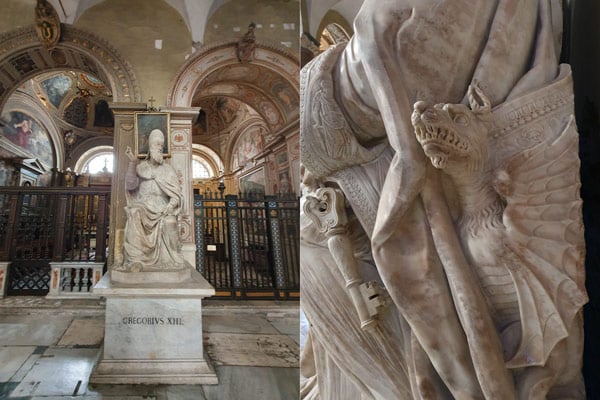
The marble statue was created between 1576 and 1577 by Pietro Paolo Olivieri for the Palazzo Senatorio, but after the fall of the papal government in 1876, it was moved to Santa Maria in Aracoeli.
Sculpture of Pope Paul III
Also transferred from the Palazzo Senatorio to the church on the Capitoline in 1876 was the sculpture of Pope Paul III, created by Guglielmo Della Porta in 1563. 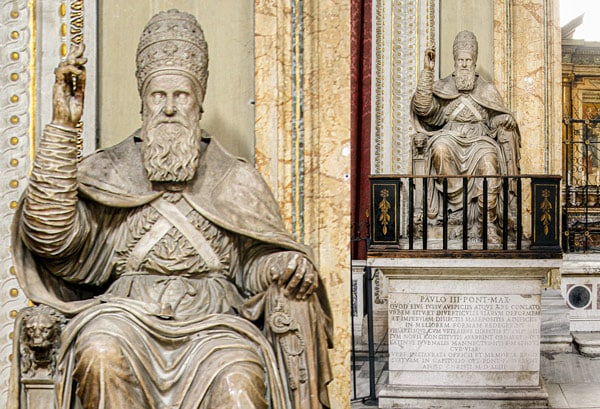
Sculpture of Pope Leo X
In the left transept stands a 16th-century statue by Domenico Aimo depicting Pope Leo X seated in a chair. 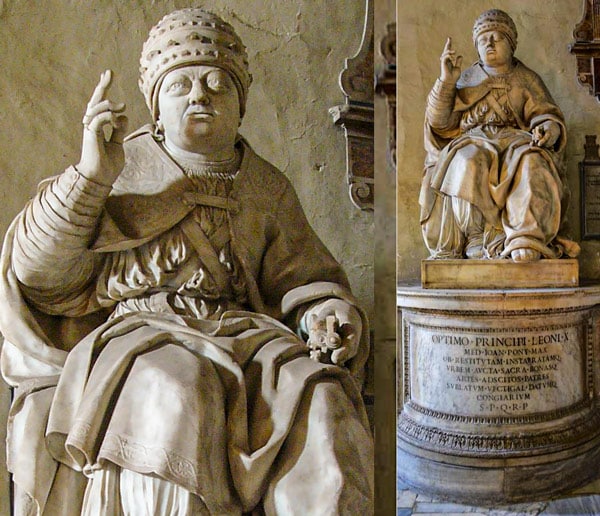
The pontiff from the Medici family had a direct connection to Santa Maria in Aracoeli, as it was during his papacy in 1517 that the church was granted its first cardinal title.
Santa Maria in Aracoeli is rightfully considered the people’s church and rivals the splendor of the famous St. Peter’s Basilica in the Vatican, whose magnificence owes much to the popes. Behind the simple and unassuming façade of this ancient Capitoline church lies the “Heavenly Altar,” a special world filled with spiritual richness and priceless works of art.
Words cannot capture the magical transformation of the church when chandeliers and candelabras are lit during Christmas, Easter, and weddings. One can only gaze in awe at this masterpiece of human craftsmanship and be enveloped in the divine atmosphere of the sacred space.