 Italy for me From Italy with love


The Fountain on Piazza d’Aracoeli (Fontana di piazza d’Aracoeli) is located in the historic center of Rome at the foot of the Capitoline Hill (Campidoglio), crowned by the ancient Basilica of Santa Maria in Aracoeli (Santa Maria in Aracoeli).
Amazingly, the medieval fountain somehow survived untouched during the large-scale redevelopment of the surrounding area when the Vittoriano (Vittoriano) was constructed and a section of Via del Mare (now Via del Teatro di Marcello) was laid out.
Page Contents
Part of the Aqueduct
During the Renaissance, the fountain on Piazza d’Aracoeli was among the first fountains that not only adorned Rome but also became an essential part of the much-needed water supply system for the hills of Viminal (Viminale) and Quirinal (Quirinale), as well as Tiber Island (Isola Tiberina).
Read more about aqueducts and baths in Ancient Rome, as well as about Rome’s most beautiful fountains.
Location
The site chosen for the new fountain was Piazza d’Aracoeli, in front of Palazzo Muti. It is worth noting that the Muti family did not contribute financially to the project, which explains the absence of their family coat of arms on the structure’s decorations.
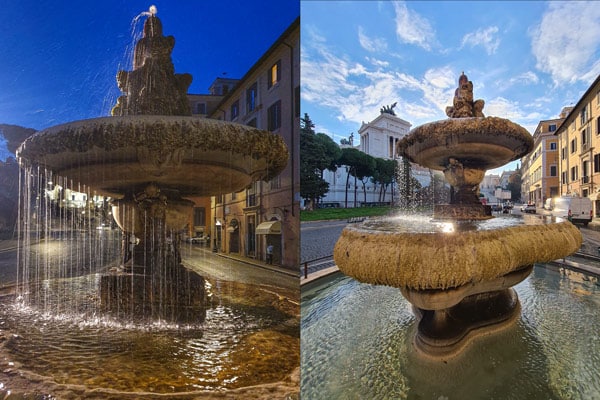
The façade of the Church of Saints Venantius and Ansovinus (Chiesa dei Santi Venanzio e Ansovino) once faced the fountain but was demolished in 1928 during the construction of the new road and park area of the Vittoriano.
Design
To execute the fountain’s design, Pope Sixtus V commissioned the Genoese architect Giacomo della Porta, a student of Michelangelo and Vignola. Incidentally, he also built the Palazzo Muti in 1585. In 1589, his design was brought to life by sculptors and stonemasons Andrea Brasca, Pietro Gucci, and Pace Naldi.
Description
The Fountain on Piazza d’Aracoeli features elegant forms and balanced proportions. The structure consists of two basins situated at the center of a circular pool, which is enclosed by a barrier made of iron bars and marble posts.
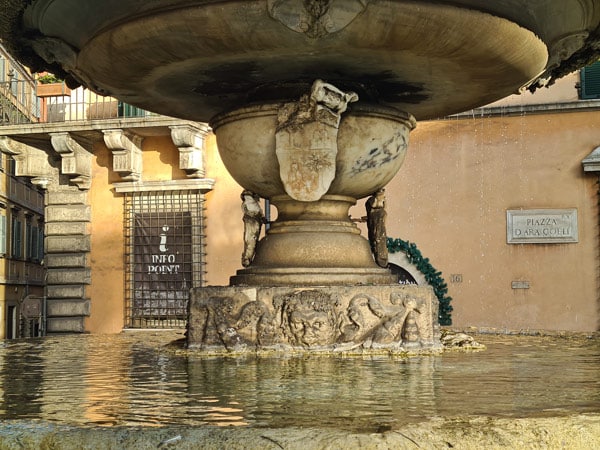
The large lower basin has a beautiful, undefined shape resembling an ellipse or a boat. A similarly contoured base elevates the basin and displays four grotesque masks from whose mouths streams of water flow.
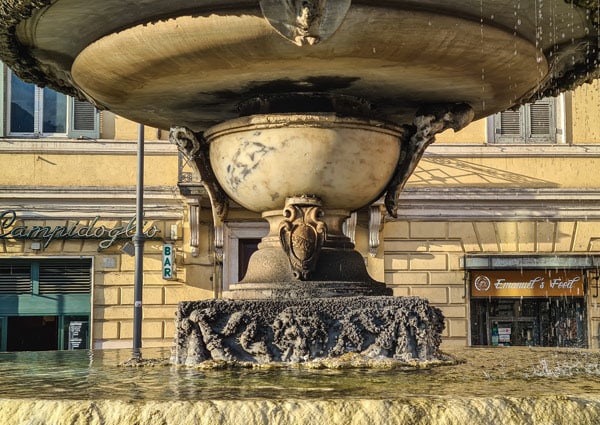
The smaller, round basin rests on an elegant square pedestal adorned with reliefs of masks and garlands. Originally, the fountain was topped by a marble sphere, which was later replaced by a triple-peaked hill—the heraldic symbol of Pope Alexander VII, born Fabio Chigi, who was involved in the fountain’s restoration in 1658.
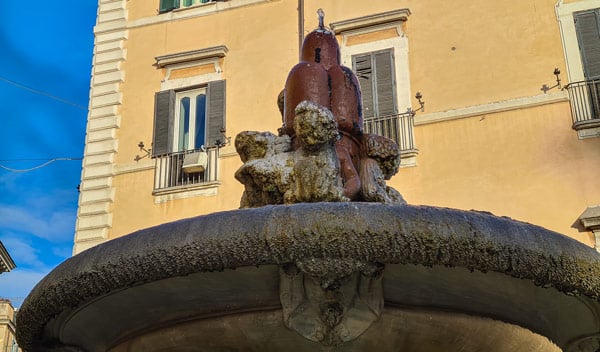
The baluster of the upper basin was decorated with the coat of arms of the city of Rome (S.P.Q.R) and of Pope Alexander VII. The entire composition is given special charm by four smiling cherubs pouring water from tiny amphoras.
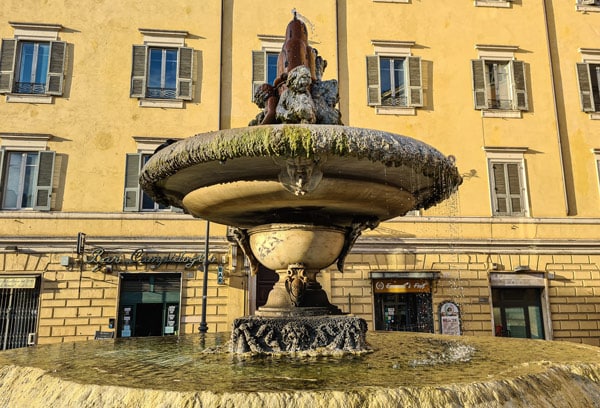
The fountain’s current appearance reflects some modifications made in the early 18th century, when the original stepped base with two levels—each echoing the shape of the lower basin and featuring a small pool—was replaced by a single large, traditionally round base.
At once simple and graceful, the Fountain on Piazza d’Aracoeli has become somewhat lost amid the new urban landscape and the busy road that now surrounds the once-picturesque Piazza d’Aracoeli. Many tourists pass by without realizing that the flow of modern cars and motorcycles circles a 16th-century landmark that remains a unique part of Rome and its history.