 Italy for me From Italy with love


An observant tourist on a sightseeing tour of Rome will inevitably ask the guide, “Who is that man in the hooded cloak?” Here’s the answer.
Cola di Rienzo (Cola di Rienzo) was a prominent political figure of the late Middle Ages, known in Italian history as the last popular tribune who tried to revive the glory of the Roman Republic. His memory is honored by a modest monument, the Monumento a Cola di Rienzo, located between the Capitoline Cordonata (Cordonata) and the staircase leading to the church of Santa Maria in Aracoeli.
The statue of Cola di Rienzo, symbolically set against the backdrop of the Vittoriano, references the earliest stirrings of the idea to abolish the papacy and unite Italy.
A 14th-century politician and a forerunner of the Risorgimento, he is less famous than Giuseppe Garibaldi but is no less deserving of recognition as part of the history of the struggle for the unification of the Italian peninsula.
Page Contents
Place of Birth
Nicola di Lorenzo Gabrini—his full name—was born in 1313 in Rome. To give himself an aura of distinction, he claimed to be the illegitimate son of Henry VII, Emperor of the Holy Roman Empire. In reality, the future politician’s parents were a humble innkeeper and a laundress.
The house where his modest family lived still stands. It is located in the Regola district (Rione Regola), near Rome’s oldest stone bridge, known as the Pons Aemilius (Ponte Emilio) or the Broken Bridge (Ponte Rotto).
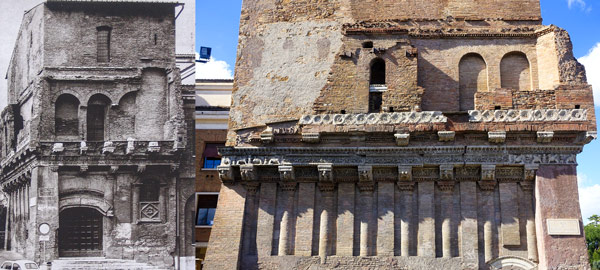
The old two-story building, constructed between 1045 and 1065, the Casa dei Crescenzi, is traditionally considered the birthplace of Cola di Rienzo, as indicated by a memorial plaque.
Personal Development
Cola di Rienzo spent much of his childhood and youth in the countryside near Anagni, where he pursued self-education by studying the works of Latin writers, historians, and orators. It was here that the intelligent and handsome young man first conceived the idea of restoring the power and glory of Ancient Rome. His native city, which had fallen into decline after a period of great prosperity, was to become, in Rienzo’s vision, a place of justice, peace, and freedom.
At the age of twenty, Cola di Rienzo returned to Rome and continued his education, achieving notable success. In 1343, while working as a successful notary, he entered the service of Pope Clement VI in Avignon, where he gained the pontiff’s favor despite openly expressing his disdain for Rome’s aristocrats.
Political Career
In 1344, Cola di Rienzo returned to Rome as a notary of the Apostolic Chamber and, with fully legitimate authority, began an active campaign aimed at restoring the city to its former grandeur.
Rienzo’s plan and lofty ideals won many supporters. He devised a way to engage Rome’s poor and illiterate citizens by displaying expressive and symbolic paintings on the Capitoline and in churches, illustrating the people’s suffering under the weight of brutal violence.
The Roman nobility, whose excesses the leader of the popular uprising had denounced, found themselves in the minority and accepted the new laws proclaimed by the man they had recently mocked. Thus, a peaceful revolution took place in medieval Rome.
Cola di Rienzo governed with strict justice and achieved unprecedented success in combating lawlessness. Justice became independent of social class, highway robberies ceased, the poor received assistance, and life in the city became more peaceful. Pursuing his vision, the People’s Tribune declared Rome the sacred capital of Italy and granted citizenship to all residents of the Italian peninsula.
Soon, Rienzo launched a campaign to unite Italy and sought support from the provinces. His leadership was welcomed by Venice, Milan, Apulia, Perugia, and Tuscany.
Downfall
Before long, Rienzo’s noble ambitions devolved into delusions and megalomania, and his threats against the aristocracy escalated into the executions of influential families. Cola di Rienzo’s character deteriorated as he began to see himself as a new emperor, living in luxury and indulging in gluttony. Pope Clement VI, outraged by Rienzo’s lifestyle, excommunicated him. The former people’s hero began to fear the disillusioned masses and sought refuge in the Castel Sant’Angelo, soon fleeing Rome altogether.
Thanks to Pope Innocent VI, Rienzo returned to Rome in 1354 with the title of senator and tried once more to win back the people’s trust. But he was no longer the same man. Corrupted by vice and driven by a thirst for vengeance over his exile, he imposed high taxes and wielded absolute power. Years of accumulated grievances finally boiled over, and on October 8, the citizens marched to the Capitoline Hill where Rienzo had taken shelter.
Although he disguised himself as a beggar in an attempt to escape unnoticed, the effort failed. Rienzo was captured and killed by the mob. His body was burned, and his ashes were thrown into the Tiber.
Sculpture and Memorial
Interest in Cola di Rienzo’s legacy revived in the 19th century, linked to the movement for Italian unification. Despite his contradictory and complex image as a medieval people’s tribune, it was decided to honor history by erecting a monument to Cola di Rienzo on the Capitoline Hill, where he had both achieved glory and met his end.
In 1886, the city council approved a proposal by municipal representative Biagio Placidi and mayor Leopoldo Torlonia to purchase and install a statue of Cola di Rienzo.
The life-sized bronze statue was created between 1886 and 1887 by the Florentine sculptor Girolamo Masini.
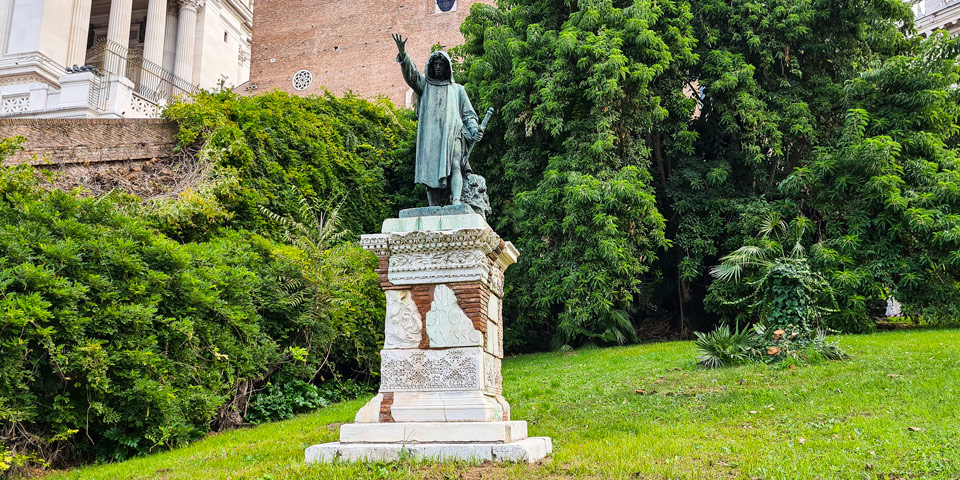
The monument’s pedestal, designed by architect Francesco Azzurri, features valuable fragments of ancient marble reliefs preserved from the restoration of the Basilica of Santa Maria in Aracoeli and its staircase during the 1890s.
The classical motifs serve as a reminder of Rienzo’s special reverence for Ancient Rome. Fittingly, it was Cola di Rienzo himself who ceremoniously inaugurated the church’s staircase in 1348, and it was here in 1354 that he was executed by an enraged crowd.
The monument was presented to the public without much ceremony on September 20, 1887, coinciding with the opening of a nearby garden. The figure of a man in a hooded cloak, his face passionately expressive and his hand extended toward the people with a dismissive gesture, bears only a single inscription: “Cola di Rienzo.”