 Italy for me From Italy with love


Octavian Augustus, the first emperor of the Roman Empire, remains one of the most influential figures in world history. We’ve selected ten fascinating facts that reveal the legacy, personality, and private life of this extraordinary Roman leader.
Augustus, also known as Gaius Octavius (Gaius Octavius), died on August 19, 14 AD. The nephew and adopted son of Gaius Julius Caesar (Gaius Iulius Caesar), he is credited with transforming the fragile Roman Republic into a powerful empire, which he led for over four decades. But beyond his monumental political career, Octavian’s personal life was equally compelling—marked by two failed marriages, a difficult daughter, and a third wife suspected of murder.
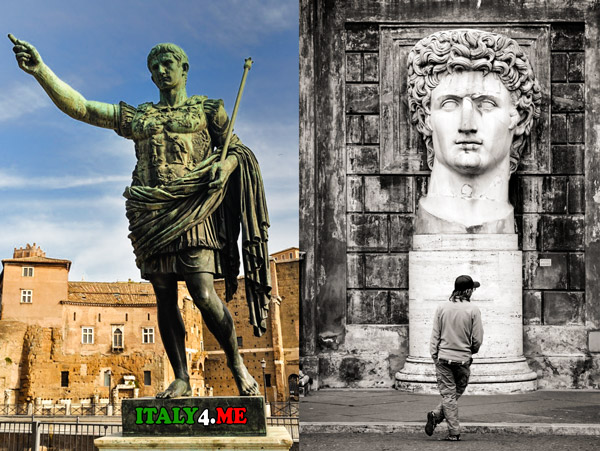
We’ve compiled what we believe are ten of the most intriguing and noteworthy facts about the life of the man who founded the Roman Empire — a political figure still regarded today as one of the most significant in world history.
- His real name wasn’t Augustus. Many people dislike the names they’re given at birth, but few go so far as to change them. Gaius Octavius did just that. Believing his name lacked masculine power, he adopted the title “Augustus,” meaning “the exalted one,” or “blessed by the gods.”
- Rival of Mark Antony. Despite being married to Octavian’s sister, Mark Antony remained a political rival. The infamous romance between Antony and Cleopatra only fueled tensions. The rivalry intensified after Octavian’s victory at the Battle of Mutina. Eventually, Antony took his own life, marking the end of their fierce political struggle.
- A striking appearance. According to the Roman historian Suetonius, Augustus was “exceptionally handsome and graceful in both youth and old age.” He had “bright, shining eyes” and “lightly curled hair.” However, not all was perfect—he suffered from skin issues, liver abscesses, and walked with a slight limp. Some even claimed that the arrangement of moles on his body resembled the constellation Ursa Major.
- A modern family? Augustus married off his only daughter to his best friend, Marcus Vipsanius Agrippa, who was 25 years her senior. Agrippa, a trusted general, had long fought alongside Octavian. After Agrippa’s death, Julia was wed again—this time to Tiberius, the future emperor.
- His rebellious daughter. Julia, Augustus’s daughter, was known for her strong will and scandalous lifestyle. She was romantically linked to several prominent Romans, including the poet Ovid and Antyllus, the son of Mark Antony. Disgusted by her behavior, Augustus, who valued family order, exiled her to the island of Pandateria (modern Ventotene), where she was forbidden alcohol and male company.
- A powerful uncle. Augustus rose to power thanks to Julius Caesar, who adopted him as his son. After Caesar’s assassination, tensions between Octavian and Mark Antony escalated, sparking a new power struggle within Rome.
- The eternal groom. Augustus married three times. His first wife was Clodia Pulchra, the adopted daughter of Mark Antony. His second wife, Scribonia, gave birth to his daughter Julia, but he divorced her on the day of the birth. He then married the love of his life, Livia Drusilla, who remained his partner until the end.
- Securing the dynasty. With no biological sons, Augustus adopted Tiberius, Livia’s son from her previous marriage. Upon Augustus’s death, Tiberius succeeded him and ruled as emperor from 14 to 37 AD.
- Poisoned by his wife? Augustus died on August 19, 14 AD, in Nola, the same town where his father passed away. Some Roman accounts claim his wife Livia poisoned him. His famous last words were: “If we have played our part well, applaud us as we exit.” He also proudly declared: “I found Rome a city of bricks and left it a city of marble.”
- His legacy? Just check the calendar. Ever wonder why August is named August? The Roman Senate renamed the month (formerly Sextilis) in honor of Augustus after his triumph over Antony. To match the prestige of Julius Caesar’s July, a day was added to August, giving both months 31 days.