 Italy for me From Italy with love


Garibaldi Bridge (Ponte Garibaldi), built between 1884 and 1888, spans the Tiber River and features two arches. It connects the Trastevere district with the historic center of the Eternal City.
The bridge was officially inaugurated on June 6, 1888, and named in honor of Giuseppe Garibaldi, a key figure in the Risorgimento who played a significant role in shaping modern Italy.
Page Contents
Garibaldi’s Connection to Rome
Garibaldi first came to Rome in 1848–1849 and immediately ordered the formation of troops to oppose the French army, which supported the interests of the Vatican. However, during a fierce battle on the Janiculum Hill, his forces were defeated. Forced into exile, Garibaldi fled to Venice with a small group of loyal supporters.
In 1861, with the formation of the Kingdom of Italy, Garibaldi saw a new opportunity to free the Eternal City from papal control. Years of preparation followed, but sadly, his efforts were again in vain.
In 1867, Garibaldi traveled through Italian cities rallying people to rise up and reclaim papal territory. As a result, he was arrested and deported. He escaped custody and attempted to raise a new army, but after another failed campaign, he was exiled to his estate on the island of Caprera.
In 1874, Garibaldi was elected to the Chamber of Deputies after Rome became part of the Kingdom of Italy. From then on, he channeled his efforts into improving and transforming the capital.
One pressing issue was regulating the flow of the Tiber River. To increase water flow and prevent future flooding, Garibaldi proposed demolishing several ancient bridges, including Ponte Fabricio, Ponte Cestio, Ponte Sublicio, and Ponte Sisto.
He wanted to replace them with single-arch iron bridges. However, other deputies were cautious about the proposal. After careful consideration, they deemed the idea too radical and ultimately rejected it.
Construction of the Bridge
The decision to build the Garibaldi Bridge was made on May 16, 1884, with Angelo Vescovali, head of the municipal utilities department, appointed as the architect. A key factor influencing this decision was the construction of the Roma Trastevere railway station. The Garibaldi Bridge was completed in record time and officially opened on June 6, 1888—timed to coincide with the 27th anniversary of Italy’s unification.
Lawmakers held a vote, unanimously agreeing to name the bridge in honor of Giuseppe Garibaldi for his outstanding service to the nation.
At the time, the bridge was the third-largest in Europe, after the Pont au Change and Pont Alexandre III in Paris, both spanning the Seine. It was adorned only with four small columns, each topped with a sphere engraved with the names of battle participants and significant dates.
By the 1950s, traffic volume had grown considerably, and the left-side support of the bridge began to gradually sink. In 1953, the situation became critical, prompting authorities to close the bridge and begin restoration efforts to prevent its collapse.
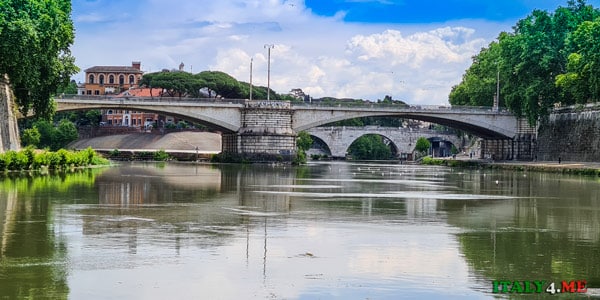
Repairs lasted three years, from 1955 to 1958, based on a design by Professor Giulio Krall of the Ferrobeton company. As a result, the bridge’s structure was reinforced with additional reinforced concrete arches.
The metal elements were clad in travertine, increasing the overall width to 75 feet (23 meters). Although the bridge lost its elegant features and took on a more austere appearance, it is now structurally sound and capable of withstanding any load.
The Bridge Today
Today, the Garibaldi Bridge offers scenic views of Tiber Island (Isola Tiberina),
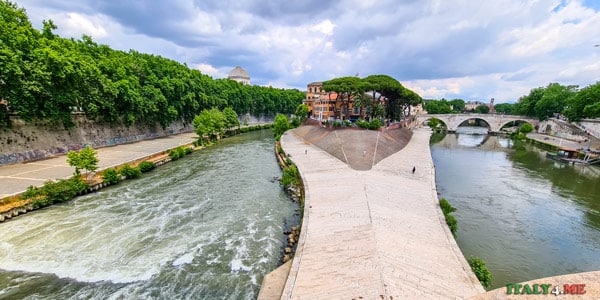
as well as of the Ponte Sisto and St. Peter’s Basilica (Basilica di San Pietro).
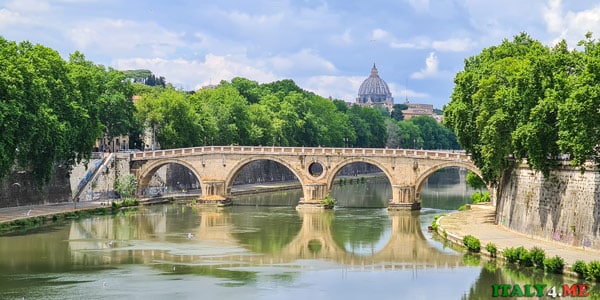
The scene becomes even more atmospheric in the golden light of sunset.
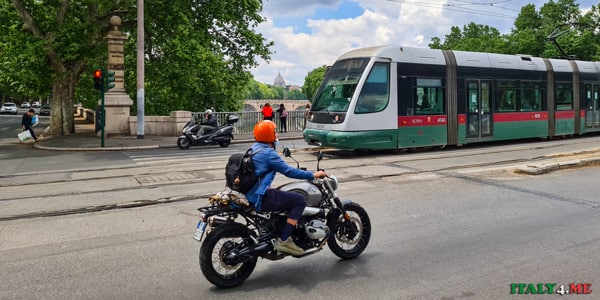
Tram N8 crosses the Garibaldi Bridge, taking just 5 minutes to travel from Piazza Venezia to Trastevere.
We recommend reading our off-the-beaten-path Rome guide and downloading our exclusive travel app.