 Italy for me From Italy with love


The Janiculum Hill (Gianicolo) in the Trastevere district is home to several remarkable cultural and historical landmarks of Rome, including the monument to Anita Garibaldi — the wife and comrade of Italy’s national hero, Giuseppe Garibaldi.
Page Contents
Location and Creator
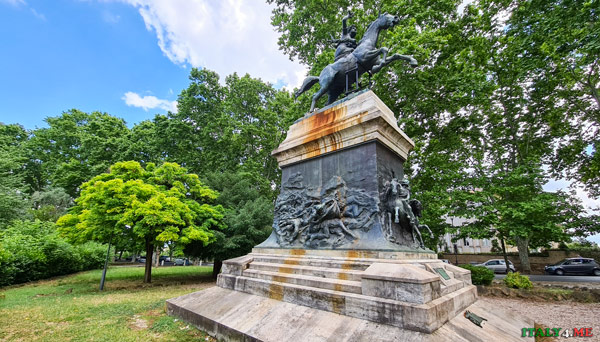
This is not just a sculptural work but also the burial site of a devoted and courageous woman whose fate and role in history are less known than those of her husband.
The magnificent monument to Anita Garibaldi, erected in the square bearing her name and surrounded by a green park, sparks interest in the life and character of Garibaldi’s companion.
The bronze statue was created by the brilliant Sicilian sculptor Mario Rutelli. He had already gained recognition for his acclaimed works in Italy — the bronze quadriga of Apollo atop the triumphal arch of the Politeama Theater (Teatro Politeama) in Palermo and the famously controversial yet beautiful nymph sculptures for the Fountain of the Naiads (Fontana delle Naiadi) on Piazza della Repubblica.
Uniqueness
To design the monument to Anita Garibaldi, the sculptor employed a very rare and complex technique, supporting the stone sculpture with only two points of contact. Achieving proper balance and stability for such a statue required precisely calculated structural designs, including the center of gravity and the thickness of the bronze casting’s walls.
This challenging problem had been addressed as far back as the High Renaissance by the great Leonardo da Vinci (Leonardo di ser Piero da Vinci). He left behind invaluable arithmetic and geometric formulas that enabled the design of a rearing stone horse supported by only two points.
Leonardo managed to realize his concept only in a small-scale clay model of the horse, as there were not enough funds to create the colossal full-sized sculpture. Rather than risk engineering a technically challenging rearing statue, he chose a simpler pose of a walking horse for his final design.
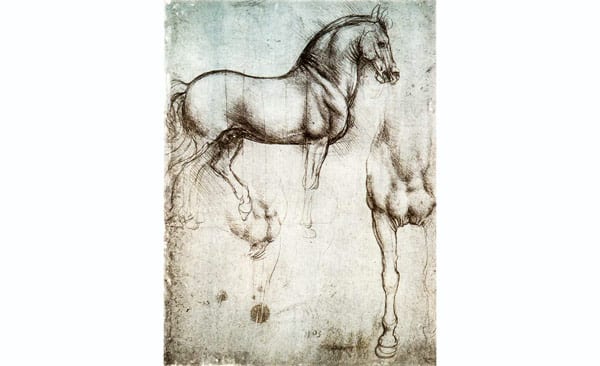
The initiative to revive Leonardo’s grand project was taken up by American art enthusiast Charles C. Dent, who succeeded in bringing Leonardo’s ingenious model to life.
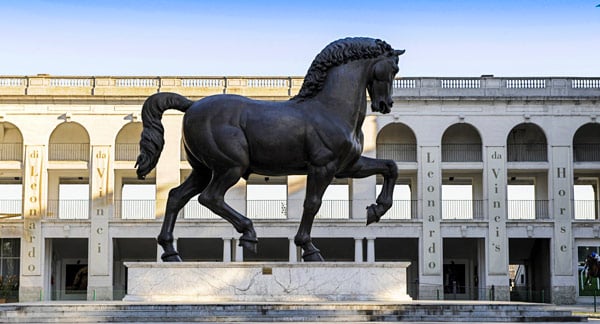
After 15 years of work, in 1999, thanks to the efforts of a large group of enthusiasts and specialists, the fully restored “Leonardo’s Horse” statue was unveiled at the Milan racecourse, bringing to life a masterpiece whose history had been shrouded in tragic mystery for centuries.
There are only a handful of equestrian statues worldwide that employ the unique two-point support technique and honor outstanding figures:
To Russian Tsar Nicholas I at St. Isaac’s Square in Saint Petersburg, sculpted by Baron Peter Clodt von Jürgensburg, 1859.
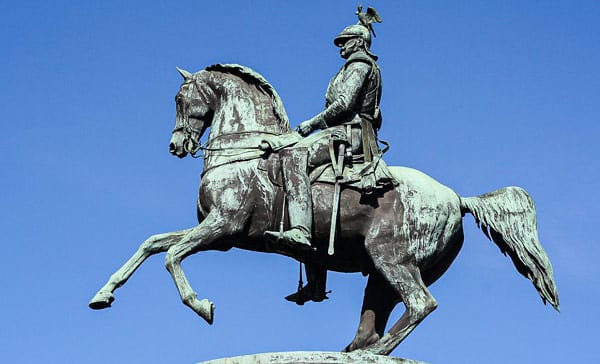
To U.S. President Andrew Jackson in Washington, sculpted by Clark Mills, 1852.
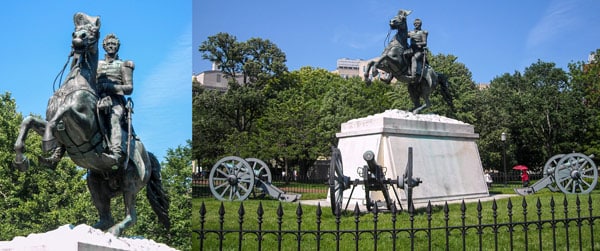
To General and Argentine independence leader José Francisco de San Martín y Matorras in Buenos Aires, sculpted by Louis Joseph Dom.

To Turkey’s first president, Mustafa Kemal Atatürk, in Samsun, sculpted by Heinrich Krippel, 1932.

To the famous military commander Archduke Charles of Austria, or Charles of Teschen, at Heroes’ Square in Vienna, sculpted by Anton Dominick Ritter von Fernkorn, 1860.
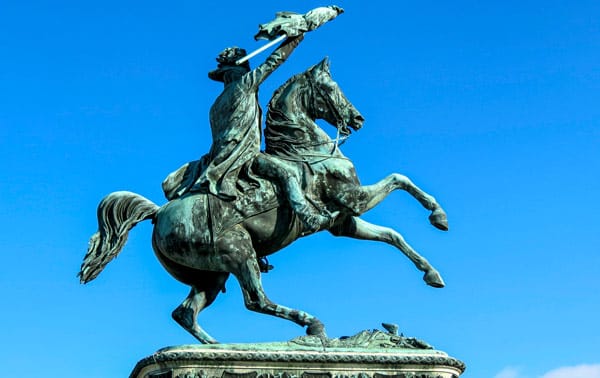
To Archduke Leopold V in Innsbruck (Leopold Ferdinand von Österreich), sculpted by Christoph Gump and Caspar Grasse, 1620.

Description
The bronze monument dedicated to Anita Garibaldi leaves a powerful and unforgettable impression, appearing even more emotional and dynamic than the statue of Giuseppe Garibaldi himself.
An equestrian sculpture of a woman at such a scale is a rarity in art. Most known statues depict goddesses, mythological valkyries, warrior Amazons, and other legendary heroines. The monument to Anita Garibaldi stands apart as the only equestrian statue of a woman crafted using the challenging two-point support technique.
The sculptor portrayed Anita as a fierce rider on a rearing horse, pistol in hand and ready for battle. With her other arm, she holds her newborn son, evoking a poignant image reminiscent of the Madonna and Child.
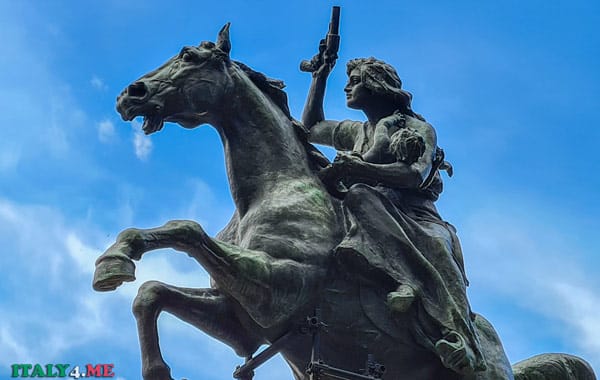
The scene was inspired by real events from the Ragamuffin War (a revolutionary movement in southern Brazil) during a clash between rebels and government troops in San Luis.
In September 1840, in a small village, Anita gave birth to her first child, Menotti, named in honor of the Italian revolutionary and hero of Modena, Ciro Menotti. Just twelve days after giving birth, while her husband was away, the young mother was forced to flee from pursuing imperial soldiers, placing her baby in front of her in the saddle of a galloping horse. This moment from Anita’s life is immortalized in bronze.
The high pedestal features bas-reliefs on all four sides, depicting vivid scenes from the life of this heroic woman. The panels facing south and east show a group of soldiers led by Anita marching through the Pampas — the grasslands of Brazil.
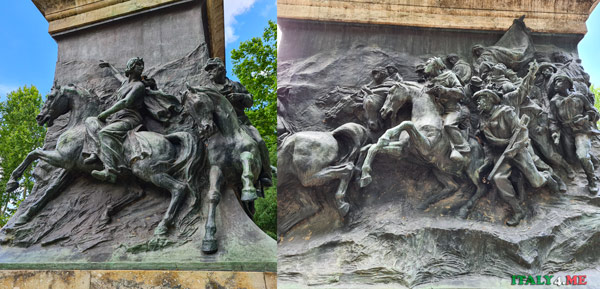
The western bas-relief depicts a desperate Anita searching for her husband among the dead soldiers after the Battle of Curitibanos.
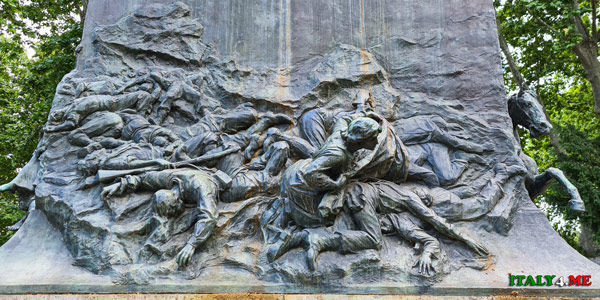
The northern bas-relief shows a weakened, dying Anita in the arms of Garibaldi during his flight from Rome to the Comacchio valley.
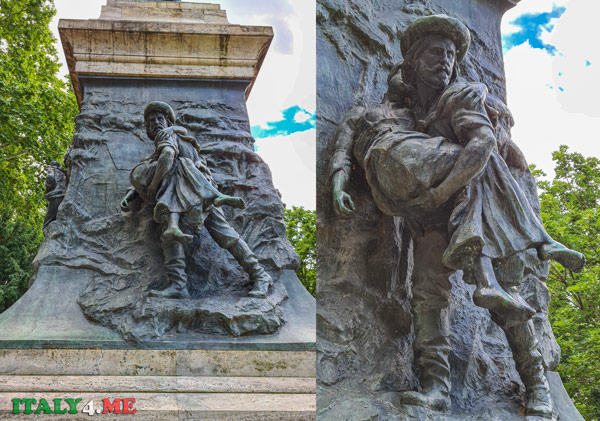
Despite the heroic vigor of the scene, the monument evokes deeply touching emotions — a beautiful young woman, clutching her infant to her chest, risks the child’s life and is ready to sacrifice her own at any moment, sharing her husband’s ideals of freedom.
Unveiling of the Monument and Reburial of the Remains
The grand unveiling ceremony of the Anita Garibaldi monument took place on June 4, 1932, during the celebrations marking the 50th anniversary of Giuseppe Garibaldi’s death. Queen Elena of Montenegro, wife of Vittorio Emanuele III, honored the event with her presence.
With the rise to power of the fascist dictator Benito Amilcare Andrea Mussolini, Garibaldi’s legacy was used to promote the ideals of a strong, revived Italian empire reminiscent of Ancient Rome. Mussolini was inspired by the national hero’s words: “Oh, Rome! You are truly one and eternal! Once you rose above human greatness, and now you are humbled…”
Mussolini’s regime supported the creation of a monument to Garibaldi’s comrade in the fight for Italian unification — Anita Garibaldi — as a means of drawing public attention to Garibaldi’s enduring legacy.
Shortly before the sculpture’s unveiling, Anita’s remains were exhumed and transported by a special train to Rome for final interment beneath the marble slab of the new monument.
Watch archival footage from Rome’s Cinecittà studio:
The coffin, draped with the same flag that had accompanied Mazzini’s funeral procession in 1872, was carried by former Garibaldian soldiers. Family members and surviving comrades walked alongside.
The ceremony was attended by Mussolini himself, as well as delegations from Brazil, Poland, France, Japan, Uruguay, Hungary, Greece, and Cuba.
Watch Mussolini’s speech at the monument’s inauguration:
This was actually the third reburial of Anita’s remains. The first transfer to Nice was arranged during Giuseppe Garibaldi’s lifetime, as he wished for his wife to rest beside his mother and their daughter Rosa.
With the local archbishop’s permission, the transfer took place on November 20, 1859. Their children, Menotti and Teresa, were present with their father at the time.
The second exhumation and reburial occurred in 1931 at the Staglieno Cemetery in Genoa, alongside Garibaldi’s comrades. This process followed lengthy negotiations with the French government, as the matter had gained political and historical significance.
How to Get There
The Anita Garibaldi monument is located at Piazzale Anita Garibaldi, just a few minutes’ walk from the Terrazza Piazza Garibaldi viewing platform, where the monument to her husband stands.
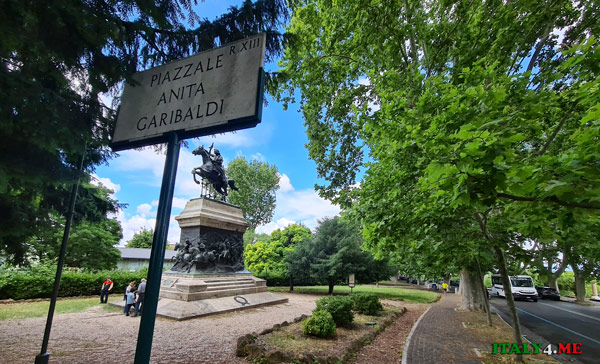
You can reach the monument by bus 115 or 870, though service is infrequent.
A taxi ride from the Pantheon will cost no more than €12, and from the Vatican Museums no more than €8.
Life and Death of Anita
Anita Garibaldi’s life was short yet brilliant. The years she spent alongside the hero of the Risorgimento, passionately fighting for Italy’s freedom and unification, earned her fame as a courageous, devoted, and loving wife.
In Anita’s Homeland
Ana Maria de Jesus Ribeiro — Anita Garibaldi’s full name — was born on August 30, 1821, in the city of Laguna, Santa Catarina, in southern Brazil, to a poor family of Portuguese descent. The family’s hardships forced her widowed mother, left alone with three daughters, to marry Anita off at the tender age of 14. Her husband was Manuel Duarte Aguiar, a modest and weak-willed cobbler.
Fate brought Garibaldi and Anita together when she was 18, with a 14-year age difference between them. By then, Garibaldi’s name had already gained romantic fame in Brazil and had become a symbol of freedom and the fight for independence. He had fled to South America in 1834 after being sentenced to death in absentia in Piedmont (Piemonte) for his involvement in the “Young Italy” conspiracy.
Following his heart, Garibaldi joined the rebels in his new land and participated in the liberation war of the South American republic of Rio Grande against the imperial government.
On July 22, 1839, the day Anita’s hometown was liberated, Garibaldi first laid eyes on the blooming and enchanting young woman with large almond-shaped eyes. All he could say was, “You must be mine.” Anita gave her heart to the hero instantly — it was love at first sight.
Despite the obedience and family loyalty typical of Latin American women, Anita made her choice and dared to escape and become Garibaldi’s companion. In October 1839, the dark-haired beauty set sail with Giuseppe aboard the Itaparica, leaving her homeland behind. Her strong character, determination, and passionate heart overcame tradition, and she chose a vibrant life full of risks alongside the man who became her life’s purpose and happiness.
Anita fought alongside men in battles near Laguna and the town of Imbituba, aiding the wounded and managing the supply of uniforms.
Months of continuous fighting, the constant threat of ambush, and hardships neither broke nor frightened Anita. Under conditions unbearable for most women, she became Garibaldi’s greatest treasure — steadfastly loyal to him and their sacred cause of freedom.
On September 16, 1840, in a small village, Anita gave birth to their first child, Menotti. Unconcerned with comfort or wealth, she was simply happy to be by Giuseppe’s side with their newborn son in her arms.
Montevideo
Disillusioned with the regime of the new Republic of Rio Grande (República del Río Grande) and the policies of its president, Gonçalves, who failed to fulfill the will of the people, Garibaldi decided in 1841 to leave with Anita for the Uruguayan capital, Montevideo, to be closer to his beloved Italy.
The seven years they spent in this city would be the calmest and happiest of Anita’s life, despite their modest home and constant financial hardships.
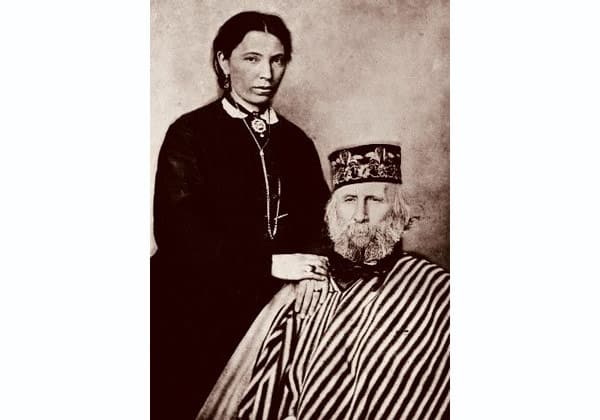
After the losses and hardships they had endured, Garibaldi longed for family life, and on March 26, 1842, the couple was married in a church. Garibaldi deceived the priest by claiming that Anita’s first husband had died.
During their marriage, they had three more children, each named after someone dear to their hearts. Their first daughter, Rosita (who died at the age of two), was named after Giuseppe’s mother, Rosa. Their second daughter, Teresita, was named in memory of Anita’s sister Teresa, who had perished in a fire. Their youngest child was named after the Italian patriot Nicola Ricciotti, who was executed by firing squad in 1844.
In Montevideo, Garibaldi briefly worked as a teacher of mathematics and history at a college, but a quiet life was not for him. He was driven by an unrelenting thirst for struggle. He could not remain idle during Uruguay’s turbulent period of resistance against the tyranny of Argentine dictator Juan Manuel de Rosas, who was backed by powerful European nations.
Garibaldi agreed to take command of the Uruguayan fleet and, at the age of 40, became a general. Thanks to his decisiveness and military experience, he emerged victorious from an uneven naval battle for Montevideo. On land, he defended the city against the forces of former Uruguayan dictator Manuel Oribe and his Argentine ally, Rosas. By his side was the ever-loyal Anita.
In Montevideo, Garibaldi formed his famous “Italian Legion,” distinguished by its soldiers’ red shirts and a flag bearing Mount Vesuvius against a black background — a symbol of explosive and unstoppable struggle.

Garibaldi’s popularity grew not only in Uruguay but also throughout Europe. Italy was already waiting for its liberator, and the coming unification seemed possible only under the banner of the chosen hero.
Return to Italy. Final Days
Fearing for his family’s safety, Garibaldi sent Anita and their children first to Genoa and then to Nice, to his mother’s house. Genoa welcomed the hero’s wife with great enthusiasm — more than 3,000 people gathered beneath her windows, waving tricolor flags and shouting, “Long live Garibaldi! Long live the family of our Garibaldi!”
While in Italy, Giuseppe realized that neither the king nor the Pope had the resolve to rally the people and stand against the Austrians and French for the unification of the country. Garibaldi’s words, “The king’s war is over. The people’s war begins,” became a rallying cry for Italy’s liberation.
One of the most grueling and terrifying battles the Garibaldians faced was the siege of Rome by a French army of 30,000 soldiers with powerful artillery, led by General Oudinot. The ancient holy city was under threat of destruction. Assaults were relentless, with bloody hand-to-hand combat lasting for days.
On June 26, as the encirclement tightened around the city, Garibaldi was astonished to see his Anita. She could not bear to stay in Nice, so far from her husband when he faced mortal danger. Five months pregnant, having read about the brutal battles in the newspapers, she managed to sneak into Rome through enemy lines to be by his side in his darkest hour. Garibaldi was deeply worried by her arrival — noticeably thinner, Anita looked ill and exhausted, with sadness and anxiety in her eyes.
On the night of June 30, as the city celebrated the feast of Saint Peter, General Oudinot launched his final assault. The forces were unequal, and Garibaldi was forced to retreat, leaving the city with the words: “Wherever we are, there will be Rome.”
About 3,000 infantrymen, 400 cavalry, and wagons carrying supplies set out toward Venice, which still held out behind its bastions. The journey was long and arduous — hunger, thirst, and desertions greatly reduced Garibaldi’s forces. At his side, riding a horse, Anita — pregnant and suffering from malaria — endured every hardship of the journey. Her condition worsened as the heat and fatigue took their toll.
By the time Garibaldi reached the small independent Republic of San Marino, only 1,500 men remained in his group. He offered Anita the chance to seek refuge in the picturesque town, but she refused, fearing she might be left behind by her husband.
As they continued toward Venice, Anita, now gravely ill, never complained and even tried to reassure Giuseppe: “Enough, calm yourself.” Garibaldi carried his weakened wife in his arms for much of the journey and finally stopped at a small village, resting in a peasant’s house only when she began to slip into agony. Despite efforts by nearby doctors, there was no relief — on August 4, 1849, exhausted by malaria and a difficult late-stage pregnancy, Anita, the beloved wife and mother of his children, passed away at the age of just 27.
Heartbroken and in tears, Garibaldi had no choice but to continue his journey immediately, to avoid endangering the villagers. Anita’s body was hastily buried by kind locals at the Mandriole estate, between Ravenna and Comacchio.
Though Garibaldi would marry twice more and name one of his daughters in his new marriage after Anita, he always considered his first wife his greatest love and inseparable companion through all the adventures of his life. The legendary image of Anita was celebrated not only in Italy but also in Brazil, where she was honored in the “Book of National Heroes.”
Films
Several paintings and engravings depict episodes from the courageous life of Anita Garibaldi, and her story has also inspired a number of documentaries and feature films.
Red Shirts
In 1952, audiences were introduced to the film Red Shirts, an Italian-French production directed by Goffredo Alessandrini and Francesco Rosi. The role of Anita was portrayed by actress Anna Magnani, while Raf Vallone played Giuseppe Garibaldi.
Anita Garibaldi
In 2012, the film Anita Garibaldi was released, a co-production between Italy, Portugal, and Bulgaria. The biographical drama was directed by Claudio Bonivento and starred Valeria Solarino and Giorgio Pasotti in the lead roles. Despite some artistic liberties, the film vividly and movingly tells the story of Anita’s life.
Anita and Garibaldi
In 2013, Brazil premiered the film Anita and Garibaldi, directed by Alberto Rondalli. Brazilian actors Ana Paula Arósio and Gabriel Braga Nunes delivered outstanding performances in the leading roles.
The film narrates the lives of the lovers, beginning with their romantic meeting. The gripping plot unfolds against authentic historical backdrops, featuring stunning landscapes of Brazil and Italy. The superb performances of the attractive cast are accompanied by a sensitive and evocative musical score.