 Italy for me From Italy with love


Many tourists strolling through the Eternal City often feel surrounded on all sides by museums and works of art—and that impression is completely understandable. In truth, it’s nearly impossible to count the exact number of museums and galleries in Rome. Alongside giants like the Borghese Gallery and the Capitoline Museums (Musei Capitolini), there are countless smaller collections, many of which are not open to the public.
In their rush to see as many popular attractions as possible, tourists often miss out on hidden, lesser-known places that are no less fascinating.
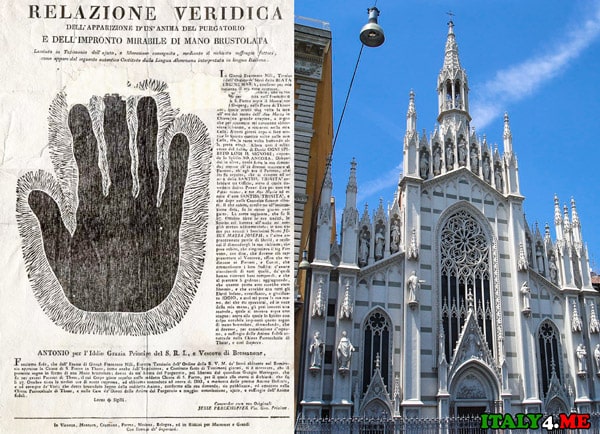
One such place is the Museum of the Souls in Purgatory (Museo delle Anime del Purgatorio), located just a ten-minute walk from the Vatican, near the sacristy of the Church of the Sacred Heart of Jesus (Chiesa del Sacro Cuore del Suffragio)—a rare example of Gothic style in Roman architecture.
Page Contents
Concept and Creation
This unique museum is quite small by comparison. Housed in a compact room are numerous otherworldly artifacts—objects that send chills down the spine and raise goosebumps at first glance. According to the museum’s claims, these are physical traces left by souls in Purgatory.
Although Purgatory is not mentioned in the Bible, the concept has been known to the faithful since the 11th century. It is believed that souls enter Purgatory to atone for their sins before reaching heaven. Their time there can be shortened through the devoted prayers of loved ones on Earth.
Driven by deep faith and empathy for the suffering, the missionary-priest saw in this apparition a cry for help from Purgatory. Believers hold that persistent, heartfelt prayer can help a soul ascend to heaven. Jouët speculated that other tangible signs of the afterlife might exist in the physical world, and he spent several years collecting surviving items. The oldest artifact in the museum, acquired by Victor Jouët, dates back to 1637.
Exhibition
One of the first items to appear in the museum was a photograph of the human face that Victor Jouët claimed to have seen on the wall of the burned chapel. Several other documented artifacts and extraordinary events offer a glimpse into the museum’s eerie collection.
One inscription beneath an exhibit reads: “A fiery mark left on the book of Margareta Demmerlé from the parish of Ellinghen, Diocese of Metz, by her mother-in-law 30 years after her death; 1814–1815.”
Another striking item includes the fingerprints left by a deceased wife, discovered on the nightcap of her widowed husband, Luigi Le Sénechal. Through this spectral visit, the soul of the wife reminded him to pray for her rather than enjoy the company of pretty women during his mourning.
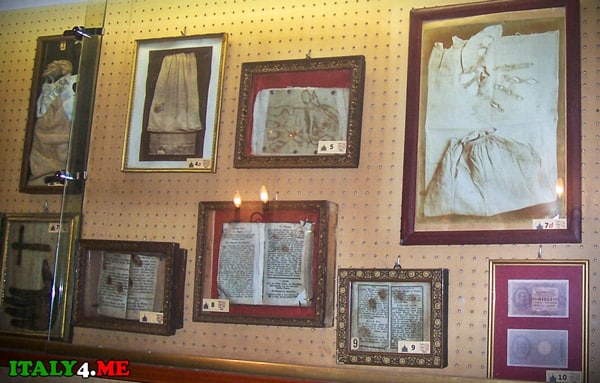
The objects themselves are genuinely fascinating. The supposed marks left by souls in Purgatory appear on various surfaces, including wood, fabric, paper, and more. Each exhibit is accompanied by a multilingual label detailing its backstory. One particularly curious item is a nightcap marked with ghostly fingerprints, attached to a compelling legend.
According to the tale, in the 1870s, a man lost his wife. Though in mourning, he continued to entertain the company of beautiful women. One night, the jealous ghost of his wife appeared, pinched his nose several times, and yanked off his nightcap. From that night onward, the widower honored her memory more devoutly.
That ghostly nightcap, marked with her spectral fingerprints, entered the collection of the Museum of the Souls in Purgatory in 1912, becoming the very first official exhibit. Over time, this unique collection continued to grow, with spiritually charged objects arriving from France, Belgium, Germany, and elsewhere across Europe. However, you won’t find any photographs of the souls to whom the museum is dedicated. The church’s rector maintains that the souls of the dead do not tolerate intrusion into their realm—though that doesn’t prevent them from occasionally crossing into ours.
Among the museum’s most remarkable artifacts is a wooden tabletop scorched with a handprint and the shape of a cross. The table once belonged to Isabella Fornari, abbess of the Monastery of Saint Francis in the town of Todi. On November 1, 1731, while working in her study, she was visited by the tormented soul of Father Panzini—a deceased priest from the Benedictine order in Mantua—who begged for help. To prove his presence, he touched the table with his burning hand and traced a cross with his finger. He also left a scorched hole in her dress. The event was debated by theologians and clergy throughout the diocese and eventually deemed a verified supernatural occurrence.
Visiting the museum leaves visitors with deeply mixed emotions. In 1990, the Vatican considered closing it, as many theologians deny the existence of Purgatory as a physical space of suffering. There is no scientifically accepted evidence of such posthumous encounters—yet the artifacts exist. Whether one believes is a personal choice. Sometimes, grief over lost loved ones can feel lighter if you believe their soul is already in paradise.
Interestingly, photography is permitted inside the museum. In fact, visitors are not charged for photos—or even for entry to the Museum of the Souls in Purgatory. However, a small donation to the church is kindly encouraged.
How to Get There
Address: Lungotevere Prati 12
You can reach this unusual museum by walking along the riverbank past the Castel Sant’Angelo, heading in the opposite direction from St. Peter’s Basilica (Basilica di San Pietro). The Palace of Justice and the Umberto I Bridge are also nearby.
Opening Hours
Daily from 8:00 AM to 12:00 PM and from 3:30 PM to 7:30 PM.