 Italy for me From Italy with love


Castel Sant’Angelo in Rome (Castel Sant’Angelo) boasts a monumental appearance and an equally imposing history. This cylindrical mausoleum, built at the dawn of Christianity on the banks of the Tiber River, has, over the centuries, served as the final resting place of a Roman emperor, the residence of popes, a fortress, a prison, and eventually became both a museum and a treasury.
Page Contents
History
Mausoleum of Hadrian
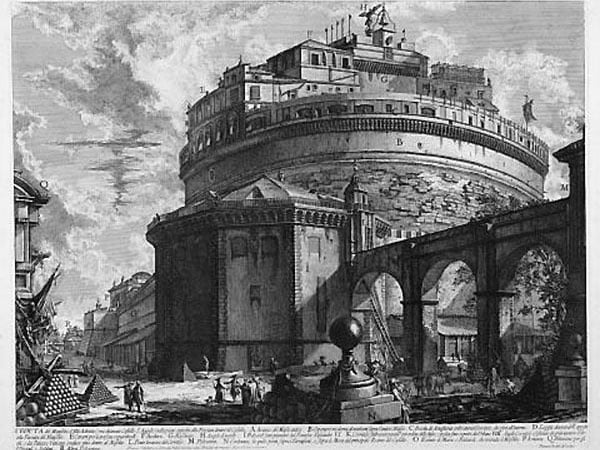
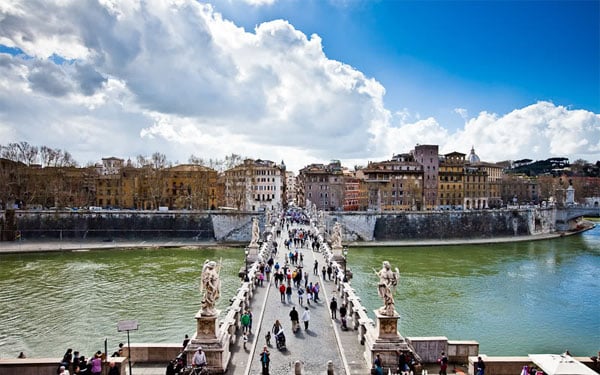
The tomb of Emperor Publius Hadrian (Latin: Publius Hadrianus) was built on the high bank of the river around A.D. 139. Originally, the mausoleum had a cylindrical shape and was richly decorated. A decorative garden adorned the flat roof of the structure, and at its center stood a gilded quadriga. In 138, the ashes of Emperor Hadrian were placed inside the tomb, along with the urns of his wife Sabina and his adopted son. Hadrian also commissioned the construction of the Bridge of Angels (Ponte Sant’Angelo), which connects the center of Rome to the mausoleum.
Decline
By the 5th century A.D., Hadrian’s Mausoleum had lost its former splendor and solemnity, as it had gradually been converted into a military fortress. During the Gothic invasions, much of the bronze decorations, urns, and statues were either stolen or destroyed.
According to legend, the Archangel Michael appeared above the mausoleum, sheathing his sword. This event was said to mark the end of the plague epidemic in A.D. 590. In honor of this divine sign, the mausoleum received its present name.
Another curious fact: in Italy, as in many other European countries, when someone sneezes, people say “Bless you!”—similar to the English phrase. In the Middle Ages, sneezing was believed to be a sign of the plague’s onset. Once infected, only divine intervention was thought to help!
Fortress, Papal Residence, and Prison
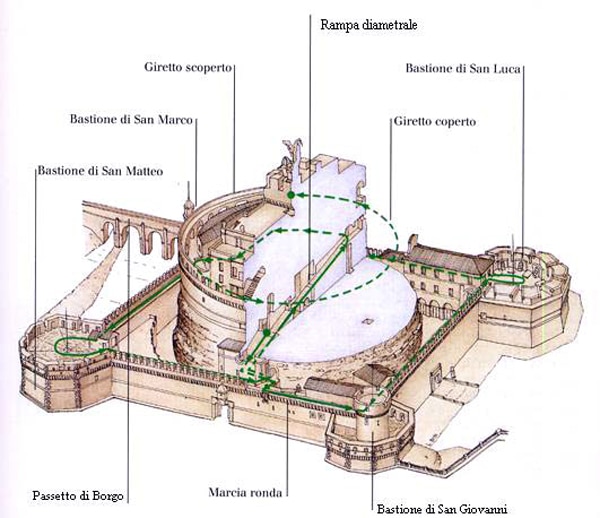
By the 14th century, Castel Sant’Angelo had become the residence of the Roman popes. Pope Nicholas III (Latin: Nicolaus III) connected the castle with St. Peter’s Basilica (Basilica Papale di San Pietro in Vaticano) by means of a covered passage known as the Passetto di Borgo. During the 1527 invasion of Rome by the troops of Emperor Charles V (Carolus V), Pope Clement VII (Latin: Clemens VII) took refuge within the castle walls. Defenders of the besieged fortress fiercely resisted the invaders through the arrow-slit windows. Among these heroic defenders was the sculptor and goldsmith Benvenuto Cellini.
Soon after, the pontificate outfitted comfortable apartments within the mausoleum in case another siege of the capital occurred. Sadly, the Catholic Church also had to establish a prison inside the fortress walls.
Thus, the famous medieval scholar, astrologer, and Dominican friar Giordano Bruno was imprisoned within Castel Sant’Angelo for six years!
Interestingly, the fortress defender Benvenuto Cellini later fell out of favor with the pontificate and also ended up behind bars. A crafty and skilled sculptor, Cellini managed to escape from the castle.
Since 1901, Castel Sant’Angelo has been officially recognized as a national museum (Museo Nazionale di Castel Sant’Angelo).
Architecture
The main architectural ensemble of Castel Sant’Angelo took shape during the reign of Emperor Hadrian. A powerful cubic base was clad in expensive marble. Atop this pedestal rose the mausoleum’s “disc,” built from volcanic stone. The outer structure was covered in travertine and decorated with carved pilasters shaped like the heads of large cattle (Bucrani). The tomb was enclosed by a wall that served both decorative and defensive purposes.
Today, the castle appears far more modest than it did in Hadrian’s time. The travertine, marble, pilasters, and bronze have been lost over the centuries. However, the exterior structure of the mausoleum has remained largely unchanged. The interior, however, has undergone significant transformation. The ancient burial chambers of the emperor, his family, Antoninus Pius, Marcus Aurelius, and their close associates were heavily damaged. The urns with their ashes—lost.
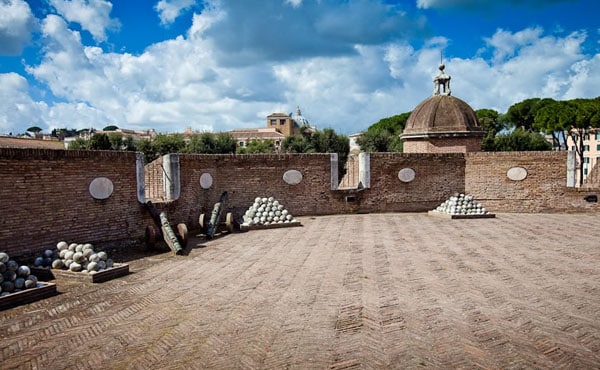
By the 14th century, the mausoleum had been transformed into a fortress. Pope Boniface IX (Latin: Bonifacio IX) commissioned the architect Niccolò Lamberti to reinforce the castle walls, build bastions, and create a single entrance via a drawbridge. Within the structure, a new chamber was added—the Chapel of Saint Michael (Cappella San Michele Arcangelo).
In the 15th century, Pope Alexander VI (Alessandro VI) of the Borgia family tasked architect Antonio da Sangallo the Elder (Antonio Giamberti da Sangallo) with turning the castle into a full-fledged military stronghold. Four bastions reinforced the structure, and a moat was dug around the buildings. The fortress was equipped with papal apartments, featuring frescoes by Pinturicchio. This new palace served Alexander VI for grand receptions and ceremonial events.
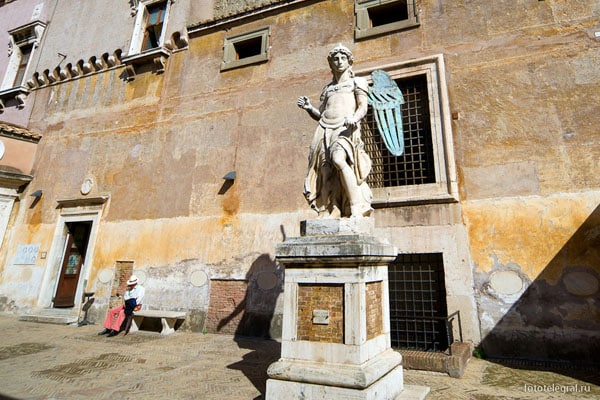
In 1536, Raffaello da Montelupo sculpted the statue of the Archangel Michael with a sword. The marble saint, adorned with bronze wings, reminds Romans of the events described in the legend and stands watch over the castle. In the 17th century, the Angel’s Courtyard was created within the castle grounds, providing a permanent home for Montelupo’s Archangel.
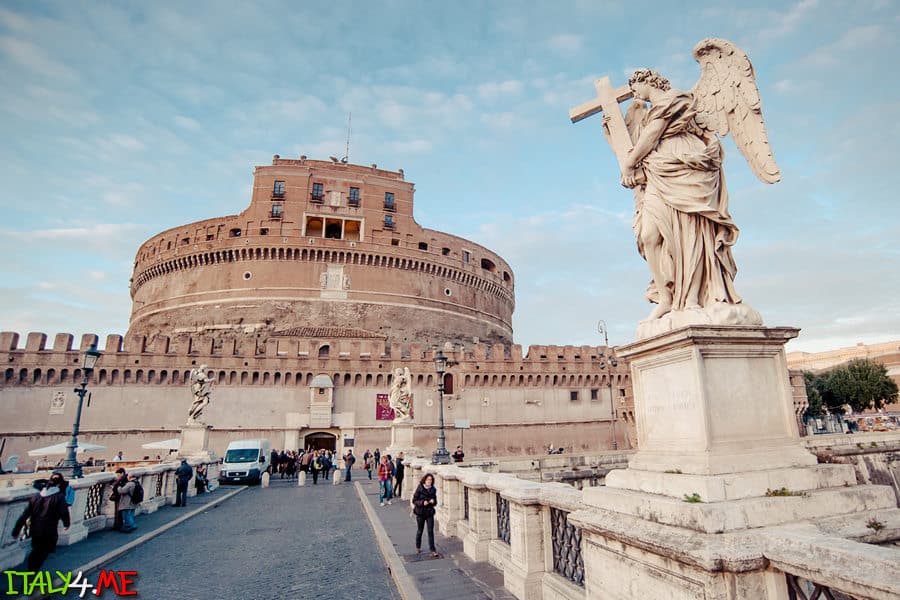
In the latter half of the 17th century, Pope Urban VIII (Latin: Urbano VIII) demolished much of the military and decorative architecture from the 15th and 16th centuries to create a new version of the fortress, featuring a powerful defensive wall and strengthened fortifications. In 1667, the Sant’Angelo Bridge (Ponte Sant’Angelo), which leads to the castle, began to be adorned with angel statues. Over the course of two years, Gian Lorenzo Bernini and his pupils created ten Baroque sculptures that still guard the bridge today.
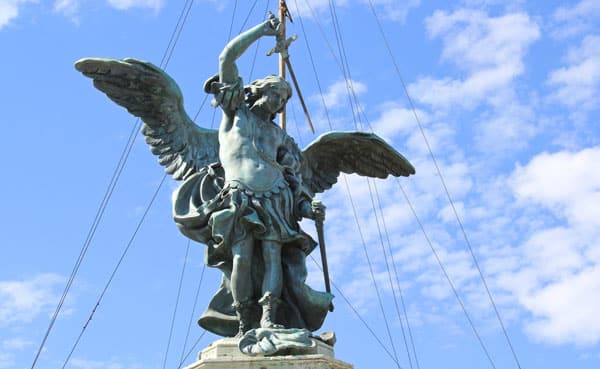
In the 18th century, the stone Archangel Michael was recreated in bronze. The work of Flemish sculptor Peter Anton von Verschaffelt still crowns the roof of the castle to this day.
What to See Inside
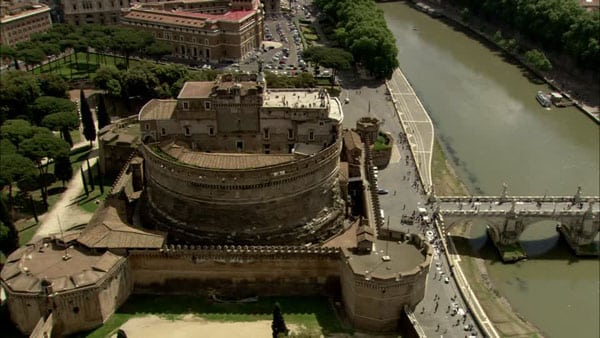
For today’s visitors, Castel Sant’Angelo is a landmark divided into six levels:
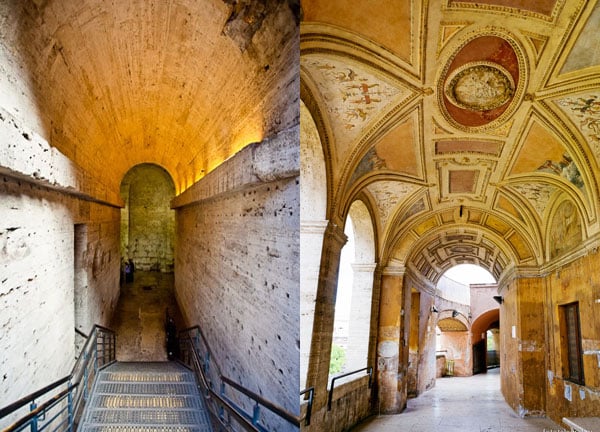
- Court of the Savior, the working rooms of Boniface XI, the inner courtyard once used for executions, the Chapel of the Holy Crucifix where condemned prisoners prayed their final prayers, the Roman atrium—an ancient arch leading to Hadrian’s tomb, and the spiral ramp descending into the mausoleum.
- The corridor and chamber that once held the ashes of the emperor and his family, the prison cells, granaries built in the 16th century, and storage rooms for oil—a vital supply during sieges.

- Angel’s Courtyard, the Hall of Clement III (Latin: Clemens III) featuring a beautiful fireplace and carved door, the Hall of Judgment decorated with medieval cannons and cannonballs and part of a fresco of an angel, the Hall of Apollo used for papal receptions, the Chapel of Saints Cosmas and Damian (Capella dei SS. Cosma e Damiano), the Hall of Clement VII, the Court of Alexander VI with a well, the Court and Chapel of Leo X (Latin: Leone X), and the elegantly decorated Bath of Clement VII by Giovanni da Udine.
- The Covered Gallery once used by medieval pilgrims to approach the Pope, the rooms of Pius IV (Latin: Pio IV), the Loggia of Julius II (Giulio II), offering views of the city and the Aelian Bridge, attributed to Giuliano da Sangallo, the expansive armory housing a collection of weapons and military uniforms from the 15th to 20th centuries, the Loggia of Paul III on the opposite side, facing Via Flaminia, the Hall of Paolina, part of Paul III Farnese’s (Latin: Paulus III) richly adorned apartments, and the Hall of Perseus, which continues the mythological theme with the Hall of Cupid and Psyche.
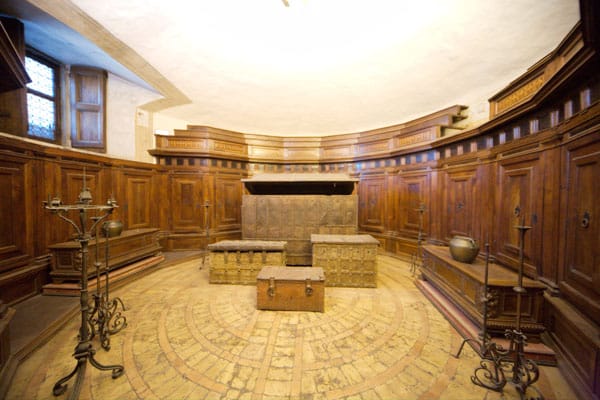
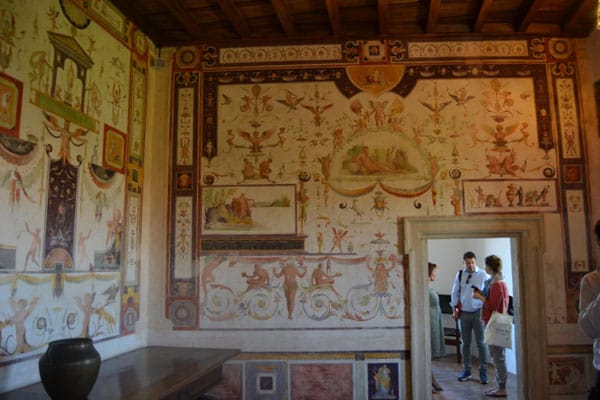
- The Treasure Room—a circular chamber once used to store the wealth of the papacy in the 15th–16th centuries, the library established by Paul III, the Halls of Hadrianeum and Garlands decorated with 16th-century frescoes, and the triple rooms known as Cagliostra, once the apartments of Count Cagliostro. Between the library and the Hall of Apollo lies the Pompeian Corridor, adorned with elaborate ceiling paintings, and the 18th-century castle warden’s room.
- The Round Hall and the Hall of Columns, built and adorned with marble columns by order of Benedict XIV, now serve as a display space for the banners of the Italian infantry. From the Round Hall, you can access the Terrace of the Angel (Terrazzo dell’Angelo), offering an unforgettable panoramic view of all of Rome.
How to Get There and Tickets
- Address: Lungotevere Castello, 50
- By Metro: Line A (stations: Lepanto, Ottaviano-San Pietro).
- By bus: Routes 62, 40, 23, 271, 982, 280 (stop: Piazza Pia), route 34 (stop: via di Porta Castello), routes 49, 87, 926, 990 (stop: intersection of Piazza Cavour and via Crescenzio), routes 46, 64 (stop: Santo Spirito).
- Opening hours: 9:00 AM to 7:30 PM; last ticket sold at 6:30 PM.
- Ticket price: €15, reduced price for EU citizens aged 18 to 25 — €7.50. Group bookings (minimum 20 people) require a €1 reservation fee per visitor.
- Online tickets (skip-the-line access): tiquets.com – €21 with fast and convenient booking. Holders of the Roma Pass also enjoy skip-the-line access.
- Free entry on the first Sunday of each month.