 Italy for me From Italy with love


The Monument to Pope John Paul II (Monumento a Giovanni Paolo II) is a modern sculpture that recently appeared in Rome’s Piazza dei Cinquecento, directly in front of the Termini train station (Stazione di Roma Termini).
Page Contents
Dedication
Almost every pope has been immortalized by painters or sculptors, but this large-scale statue, prominently placed in such a public space, immediately attracted attention and sparked mixed reactions among the locals.
The Original Version of the Statue
The monumental sculpture, unveiled on May 11, 2011, stood on a small green island in the square before the busy train station. Yet it hardly reflected the feelings of the citizens toward the canonized head of the Vatican, whose good deeds had earned him their deep admiration. 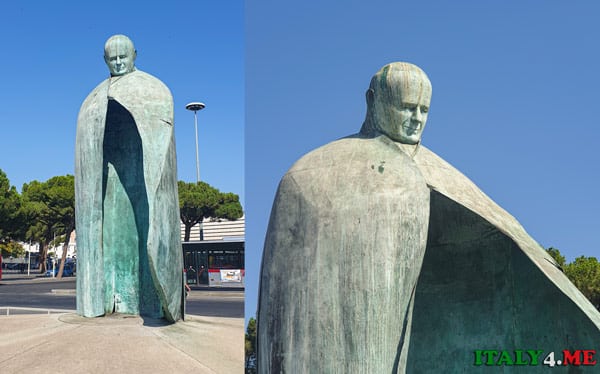
The massive bronze monument, coated with silver and standing 18 feet (5.5 meters) tall, resembled an awkward box with an open cavity topped by a round head bearing a distant, even unpleasant, facial expression. The statue shocked and bewildered both Italians and tourists.
The Sculptor’s Vision and Public Disapproval
The statue was created by sculptor Oliviero Rainaldi, who aimed to portray the pope in an open traditional cloak symbolizing his readiness to embrace and protect anyone in need of guidance.
However, the crude execution, lack of likeness, and absence of spiritual essence led Romans to wholly reject the new city monument. The press and the public declared it one of the world’s ten ugliest monuments, calling it a “shelter for the homeless” and comparing the statue’s appearance to that of dictator Benito Mussolini.
Most residents (over 90%) did not hide their emotions and openly expressed their negative views of the piece. The sculptor’s work did not receive approval.
Despite Rainaldi’s claims that the foundry responsible for casting the statue had introduced mistakes and distortions, he was ultimately compelled, at the request of Rome’s mayor Gianni Alemanno, to remove the statue for revision.
The Successful Version of the Statue
On November 18, 2012, the Monument to Pope John Paul II was reinstalled in its original location in the presence of Vatican representatives and city officials. Public opinion toward the updated statue shifted among both professional critics and ordinary Italians. 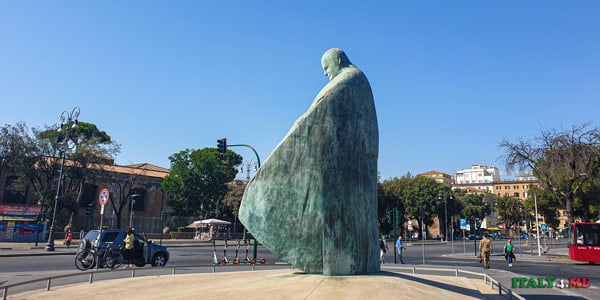
The second version proved much more successful — the likeness was unmistakable, and the facial expression appeared soft and lifelike. The head now featured a neck and the pope’s characteristic strong chin.
The box-like pedestal, which had previously resembled either a phone booth or a refrigerator, was redesigned with softer contours that better suggested a human figure draped in robes. The concept of the pope’s open cloak remained but was now perceived as a more harmonious element of the monument.
To gauge public reaction to the new statue, a video camera was installed. Some people paused to pray, others examined the innovative sculpture with curiosity, and tour groups with guides even stopped by.
Clearly, the monument to John Paul II has become both a place of reverence and a striking landmark that inspires interest and wonder in all who see it for the first time.
In Rome, alongside its ancient monuments, modern works are also emerging, becoming an integral part of the city and a new chapter in the history of art. It’s worth remembering that even the masterpieces of great artists of the past were not always immediately recognized as such.