 Italy for me From Italy with love


The Umberto I Bridge (Ponte Umberto I) connects the Prati district and the center of Rome. The bridge was inaugurated on September 22, 1895, in a ceremony attended by King Umberto I and his wife, Margherita of Savoy, after whom the bridge was named.
Page Contents
History
In the 1870s, after Rome was declared the capital of Italy, the authorities faced a serious challenge — the need to construct new housing, as this milestone event spurred a surge in demand for residences.
On June 26, 1872, a group of architects presented the municipality with a proposal to develop several neighborhoods near the main buildings, laying the groundwork for what would become the new Prati district. According to the plan, three bridges were needed to connect the future residents to the heart of the Eternal City.
In 1880, a different project was approved, leading to the construction of the Palace of Justice (Palazzo di Giustizia) on the site where the Apollo Theater once stood. In the 14th century, this location had housed the Tor di Nona prison, which belonged to the feudal Orsini family (Orsini).
I also recommend reading about the Garibaldi Bridge in Rome and the kings of Italy.
Interesting Facts About the Tor di Nona Prison
Tor di Nona was once considered the most dreaded prison in Rome. Before its grim reputation, it had served as a warehouse for various supplies. It officially became a prison in 1395. The renowned sculptor and artist Benvenuto Cellini was once imprisoned within its walls. Giordano Bruno was taken from here to his execution, and Beatrice Cenci spent her final days here with her mother. By 1655, the prison stopped accepting new inmates as other detention facilities emerged across the city.
Reconstruction efforts were led by Carlo Fontana (Carlo Fontana), and in 1795, the theater welcomed its first audiences. The building underwent further renovations, and after its latest restoration, it became known as the “Apollo Theater.”
Sadly, in 1889, a flood completely destroyed the structure. To commemorate this legendary site, a stele with a small decorative fountain was installed in 1925. The memorial features engraved lines by the poet Fausto Salvatori.
The Beginning of Construction
According to the vision of architect Angelo Vescovali, the future bridge was designed to visually complement the Palace of Justice. Construction began in 1885 but was halted a few years later. The culprits were local speculators who, having learned of the city’s expansion plans, began systematically purchasing land in the area.
The most notorious schemer was Monsignor Francesco Saverio de Mérode, who already owned part of the coveted land but had no intention of stopping there.
The situation was finally resolved in 1888. A group of entrepreneurs joined forces with bankers, led by Count Edoardo Cohen, and successfully defended their interests. Much of this success was due to the count’s strong influence in political circles. 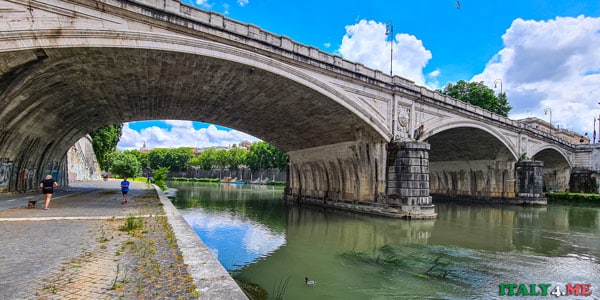
Construction of the Umberto I Bridge resumed but stretched on for an entire decade. The architect proposed naming it Ponte dell’Orso, meaning “Bear Bridge.” Angelo justified this idea by noting the proximity of one of the city’s oldest buildings, Albergo dell’Orso, which was renowned for having hosted Dante Alighieri. The poet visited Rome as a pilgrim during the Jubilee Year of 1300, which, according to records, was when he journeyed through Hell, Purgatory, and Paradise.
Vescovali’s suggestion was not taken seriously and was ultimately dismissed.
Inauguration
The bridge was officially opened on September 22, 1895, and was hailed as one of the most beautiful in the city. The inauguration ceremony was attended by King Umberto I and his wife. By the time construction was completed, the bridge measured 344 feet (105 meters) in length. 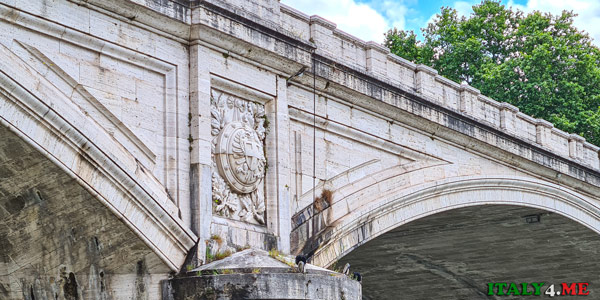
The bridge’s core is built of stone and faced with travertine slabs. Its three magnificent arches gracefully complete the architectural ensemble of the Palace of Justice, elegantly spanning the Tiber River.