 Italy for me From Italy with love


Тhe Theatre of Marcellus (Teatro di Marcello) is one of the most significant landmarks in Italy, located in the historic part of Rome (Roma), on the right bank of the Tiber River (Tevere), near Piazza Venezia (Piazza Venezia). It is a famous predecessor of the Colosseum (Colosseo) and one of the largest buildings in Ancient Rome.
Page Contents
History: Caesar’s Idea
During the Roman Empire, buildings for entertainment were actively constructed, as it was the easiest way to win the people’s favor and distract them from politics.
The idea of constructing a grand theater came to Julius Caesar (Caius Iulius Caesar); he wanted to build a theater larger than the one constructed in 55 BC by Caesar’s sworn enemy—Pompey (Gnaeus Pompeius Magnus).
After selecting the site, Caesar gave the order to clear the area on the Campus Martius (Campo Marzio) by demolishing several secular buildings and a number of religious structures, including the Temple of the Goddess Pietas (Tempio della Dea Pietas). Construction began in 44 BC, but it could not be completed due to the great emperor’s death.
The Vision of Augustus
In 17 BC, the Roman Emperor Octavian Augustus (Caius Iulius Caesar Octavianus Augustus) decided to bring Caesar’s project to life—on an even grander scale.
Octavian Augustus ordered the clearing of additional land in the Campus Martius, which required the demolition of the Circus Flaminius (Flaminia). Piles were driven into the ground at the construction site to reinforce the foundation of the structure. A concrete base, 20.8 feet (6.35 meters) thick, was then laid atop the piles.
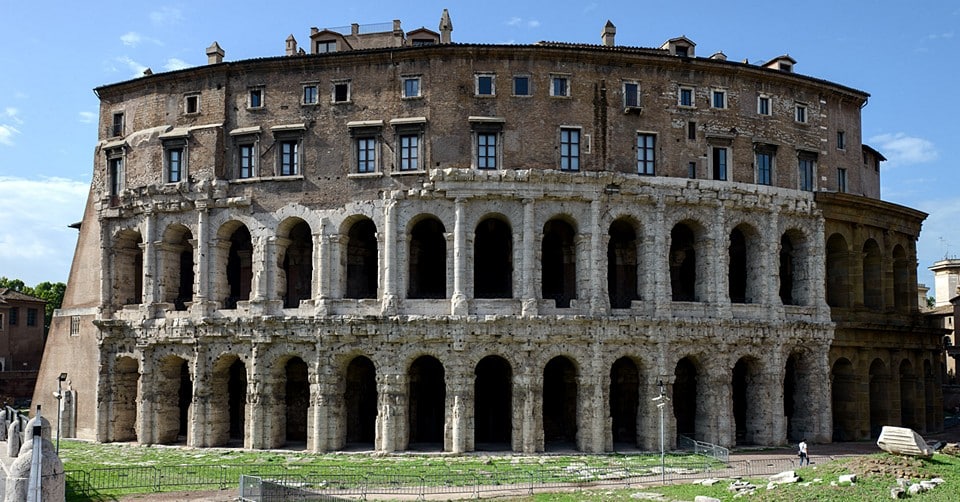
After preparing the site, Augustus ordered the construction of a large theater in memory of his nephew, the son of his sister Octavia—Marcus Marcellus (Marcus Marcellus), who had married Augustus’s daughter and was meant to be his successor, but died from a serious illness.
Artistic Features
By 12 BC, the three-tiered structure was completed, with seating for 12,000 spectators and standing room for another 2,000. The amphitheater amazed contemporaries with its size:
- 98 feet (30 meters) in height;
- 427 feet (130 meters) in diameter;
- A stage 295 feet (90 meters) long;
- 41 arches;
- 42 semi-columns.
Not only the size but also the stylistic design inspired admiration:
- The building, constructed on a concrete foundation, was made of tuff and faced with panels of white travertine;
- The first tier was executed in the Doric style (columns tapering upward, without decorative bases, and with capitals shaped like half-disks);
- The second level featured Ionic order columns (with ornate bases, volute capitals, and decorated cornices);
- The third tier was defined by a colonnade with Corinthian-style capitals;
- Inside the theater stood a chapel dedicated to the prophetic goddess Carmenta;
- A portico was added to the amphitheater in honor of Octavian Augustus’s sister—Octavia (Octavia).
Augustus ordered that the interior decoration of the theater should surpass in splendor all prior constructions. The Theatre of Marcellus was adorned with:
- Marble statues;
- 36 large bronze vases placed around the perimeter to amplify sound;
- Masks of comedic and tragic heroes.
The interior consisted of three tiers of marble steps, divided into sections: seats for noble citizens, a women’s section, a separate area for commoners and slaves. The emperor’s box was located apart from the spectators’ seating.
Opposite the audience rows stood a room for props and for preparing actors to go on stage—the scaena (stage). From this structure, the actors entered the orchestra—a circular area in front of or above the stage. The chorus, which accompanied the dramatic action, was also located there.
Interestingly, ancient theaters used a canopy to protect spectators from the sun, which could be stretched over the entire amphitheater.
According to ancient plans and the surviving remains of the theater, the stage and its side wings faced the Tiber River. The semicircular amphitheater opened toward the city. Storage areas and shops were located inside the arches of the amphitheater.
A Two-Thousand-Year History
The Theatre of Marcellus underwent restoration twice:
- In the 1st century under Emperor Vespasian (Titus Flavius Vespasianus);
- In the 3rd century under Emperor Alexander Severus (Marcus Aurelius Severus Alexandrus).
In the 4th century AD, the theater fell out of use. Locals began dismantling it to build houses and repair city bridges, and it was ultimately abandoned. During the Middle Ages, the structure was used as a fortified defensive building.
In the 12th century, members of the Favvi (Favvi) family built a fortress on the ruins of the ancient theater. In the 13th century, the Savelli (Savelli) family transformed the fortress into a palace. By the 16th century, the remains of the theater, the medieval fortress, and the palazzo formed the foundation for the residence of the noble and wealthy Orsini (Orsini) family, who owned the building until the 1930s. Shopkeepers and artisans rented space beneath the powerful arches.
In 1926, by order of Benito Mussolini (Benito Mussolini), the arches were cleared of shops and apartments, and restoration of the theater began, lasting until 1932.
The Theater Today
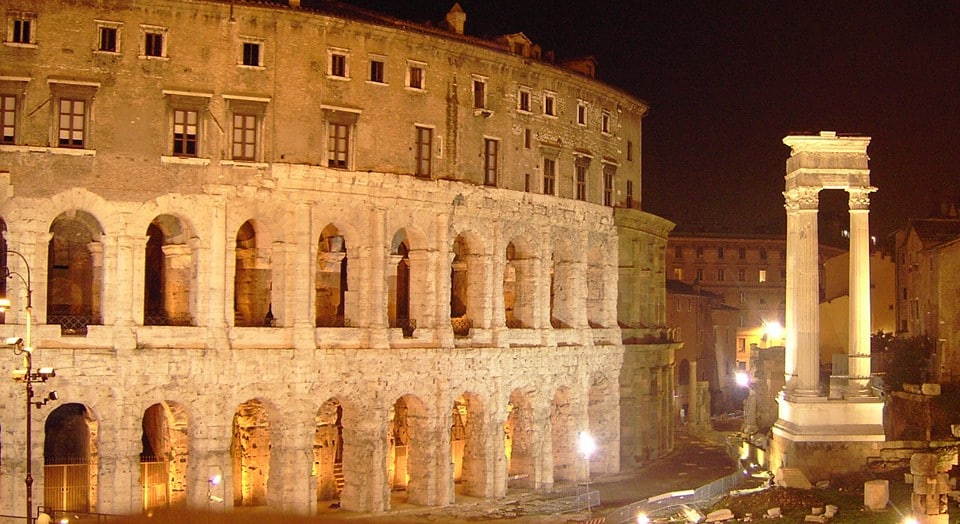
The Theatre of Marcellus is the only surviving theater from Ancient Rome that was built before our era. Today, visitors can see 16 well-preserved arches of the first tier, where concerts and celebrations are held, fragments of the second tier, and instead of the third tier, spectators are greeted by elements of a medieval superstructure from the 12th century and modern residential buildings.
Recommended reading:
- Arena di Verona
- Theaters in Rome – a theater lover’s guide
How to Get There
The Theatre of Marcellus is located at Via del Teatro di Marcello. It can be reached on foot from the Circo Massimo metro station.
Nearby, you’ll also find other famous attractions—the Capitoline Hill, the Mouth of Truth, the Circus Maximus, and the Jewish Ghetto district.