 Italy for me From Italy with love


The Archbasilica of Saint John Lateran (Basilica di San Giovanni in Laterano) is the Pope’s official cathedral and the highest-ranking church in Rome. In the hierarchy of Catholic churches, the Lateran Basilica holds the supreme position, outranking even the revered and ancient churches such as Santa Maria Maggiore (Basilica di S. Maria Maggiore) and St. Peter’s Basilica (Basilica di San Pietro). This church is home to the pope’s cathedra (throne), making it the ecclesiastical seat of the Bishop of Rome.
Page Contents
History
In pre-Christian times, the lands near the Celian Hill (Celio) belonged to the wealthy Roman Laterani family. The *Annals* of Tacitus mention that in the 1st century AD, Plautius Lateranus (Plauzio Laterano) was exposed for plotting against Emperor Nero.
The coup failed, and all the conspirator’s property was confiscated by the imperial treasury.
By the 2nd century AD, the site of the current basilica was home to a large cavalry barracks for the troops of Emperor Septimius Severus (Settimio Severo).
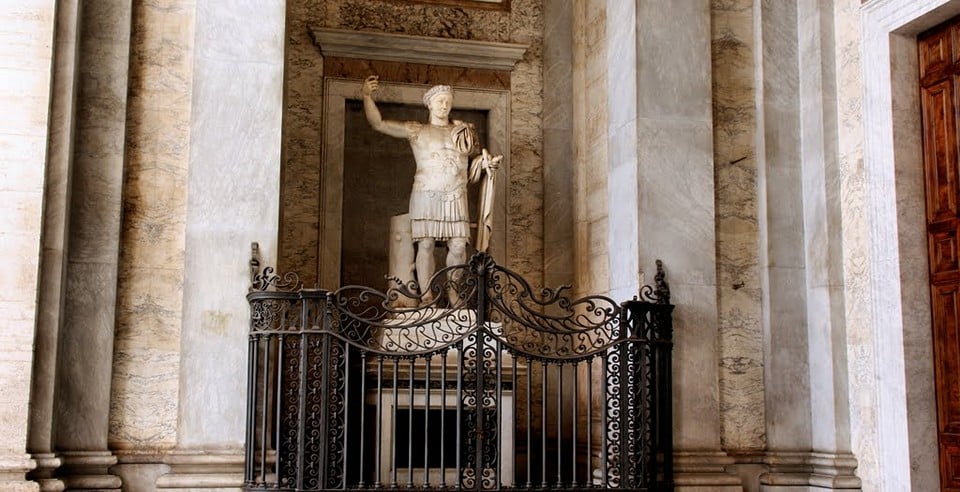
This was confirmed by archaeological excavations near the church. The founder of the basilica, however, is considered to be Roman Emperor Flavius Valerius Constantine (Flavio Valerio Costantino). Before a decisive battle against Maxentius, Constantine the Great reportedly saw the Chi-Rho symbol—an early Christian monogram—in the sky, which he took as a sign of victory. In the early 4th century, he legalized Christianity throughout the empire, and Rome welcomed its first Christian church.
Originally dedicated to Christ the Savior, the basilica was later also consecrated to Saint John the Baptist (San Giovanni Battista) in the 9th century and to Saint John the Evangelist (San Giovanni Evangelista) in the 12th century. From the 4th to the 14th century, the Cathedral of Saint John the Baptist remained the only papal church in Rome. The adjacent buildings housed the papal residence, and within the basilica stood the pontifical throne. The church was the site of five ecumenical councils—supreme ecclesiastical assemblies that addressed the most fundamental matters of Christian doctrine.
Restorations
The richly adorned Basilica of Saint John Lateran in Rome has endured multiple sackings and subsequent reconstructions throughout its history. In the second half of the 5th century, Pope Hilarius added a baptistery to the original basilica. Alongside the baptismal font, three chapels were built, dedicated to Saint John the Baptist, Saint John the Evangelist, and the Holy Cross. In the 9th century, Pope Leo III renovated the basilica’s ceiling and embellished the apse with stained glass. In the 10th century, a chapel dedicated to Saint Thomas was added.
During the 14th century, Rome lost its status as the center of Christianity when the papacy moved to Avignon, France.
During this period, the once-glorious basilica fell into decay and was twice ravaged by fire. Upon the papacy’s return to Rome, the Lateran Basilica was largely abandoned in favor of the newly designated Vatican residence. The ancient church was left in ruins.
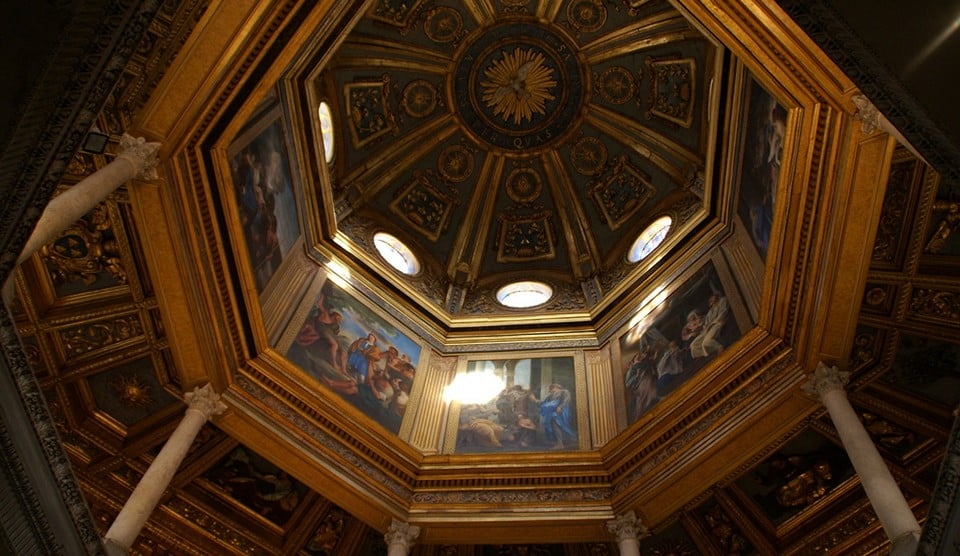
Restoration efforts began in the 15th century under Pope Martin V. Thanks to his initiatives, wall frescoes by Gentile da Fabriano and his pupil, Antonio Pisanello, were restored. In the following decades, much of the Romanesque colonnade was demolished to make way for the emerging early Baroque style. In the 16th century, the dome of the baptistery was redesigned in an octagonal shape, which it retains to this day.
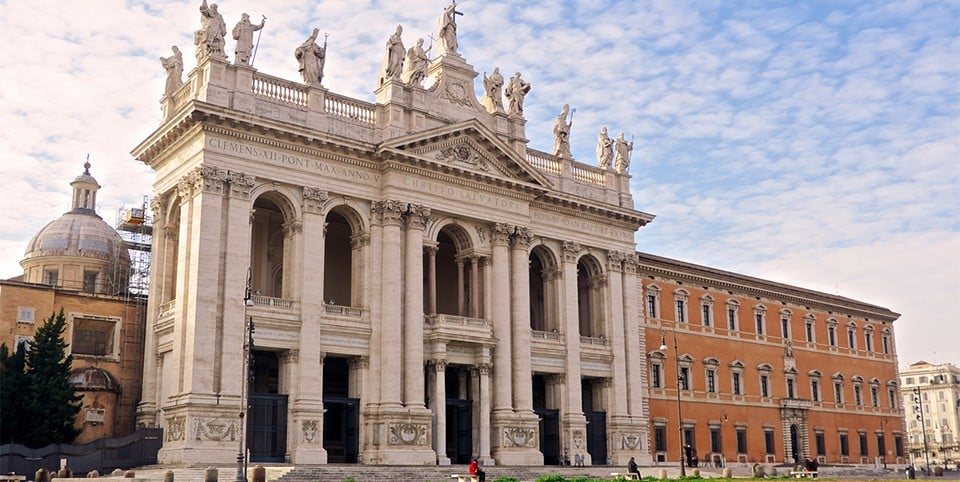
Over the centuries, the Basilica of Saint John Lateran has undergone extensive transformations. Its architectural exterior features a fusion of Romanesque, Classical, and Baroque elements. Many decorative features were added during the 17th century. Engineer and architect Domenico Fontana adorned the church’s façade with statues of the apostles. Later, Francesco Borromini remodeled the nave and aisles in the Baroque style. Majestic bronze doors from the Roman Forum now serve as the basilica’s main entrance.
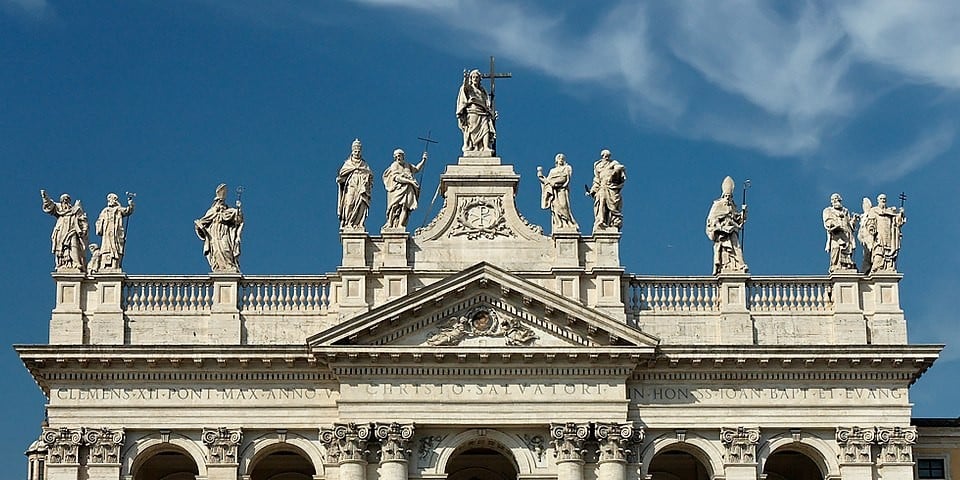
The current appearance of San Giovanni in Laterano took final form in the 18th century. Architect Alessandro Galilei led the reconstruction of the church’s façade, designing its classical columns and the imposing statues that line the rooftop above the entrance.
In the 19th and 20th centuries, the basilica underwent several restorations aimed at preserving its historic appearance and integrity. In honor of the Great Jubilee of 2000, the Holy Doors—created by sculptor Floriano Bodini—were opened to pilgrims and visitors.
Interior
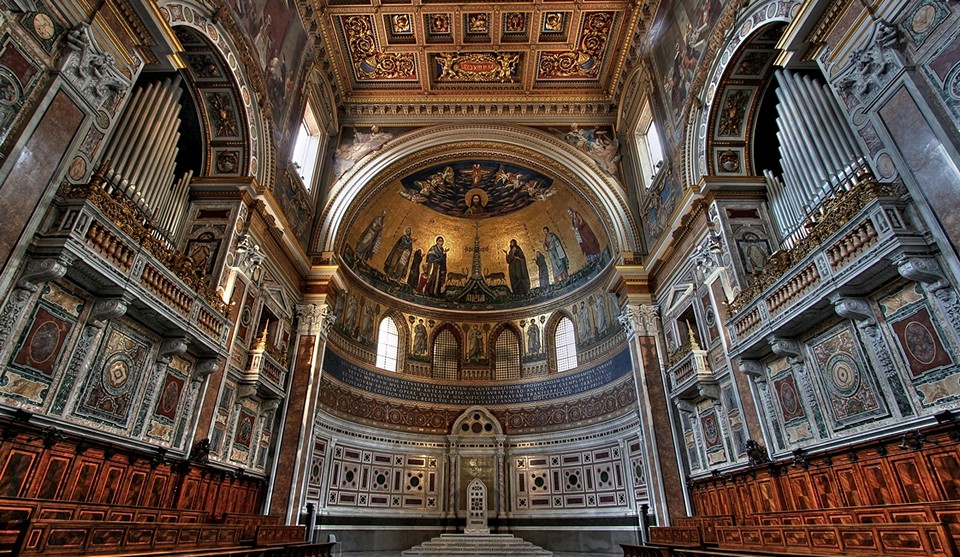
The interior of the Basilica of San Giovanni in Laterano is a masterpiece of grandeur and sacred art. Priceless mosaics dating back to the time of Emperor Constantine are preserved in the apse. Early Christian martyrs holding scrolls and the image of Christ above them are rendered in a striking Byzantine style. In the 13th century, these mosaics were restored by Giacomo Torriti, who added Franciscan symbols to the ancient artwork.
The papal throne is located beneath the vaulted apse. Precious porphyry columns and radiant Byzantine mosaics form the majestic backdrop for papal sermons. Above the main altar, within the ciborium, are preserved ancient Christian relics—the skulls of Saints Peter and Paul.
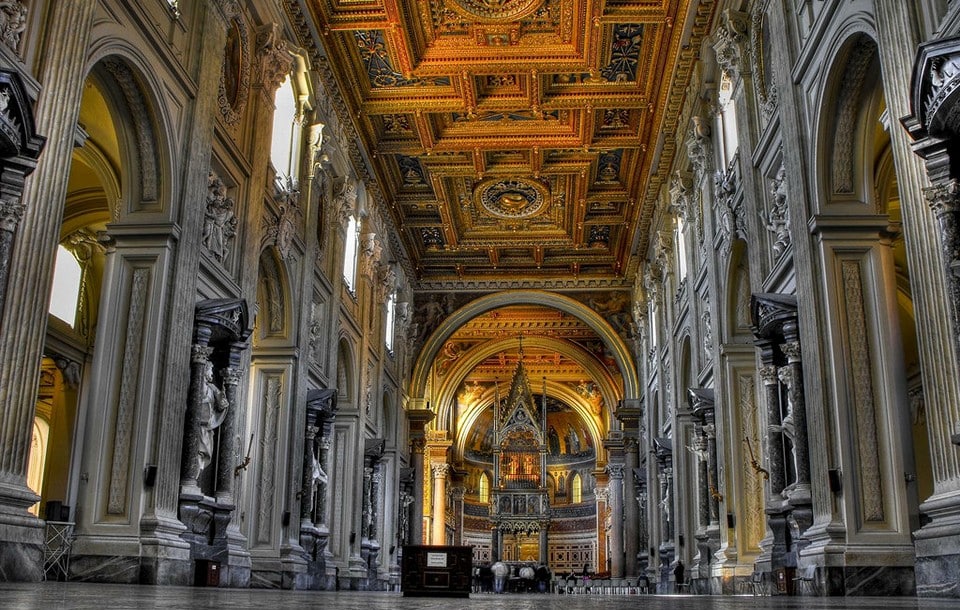
The nave impresses with its lavish decoration. The Cosmatesque mosaic floors are adorned with intricate patterns of circles and squares. The nave’s columns are faced with Numidian marble, their white surfaces carved with elaborate motifs and papal emblems. Much of the nave’s 17th-century restoration is credited to Francesco Borromini. Notably, the coffered wooden ceiling, restored with ornate detailing, features the coat of arms of Pope Pius V at its center. Between the marble columns, statues and paintings of the apostles were added during the 17th and 18th centuries.
A partially preserved fresco of Pope Boniface III, believed to be the work of the renowned Giotto di Bondone, can be seen in the nave.
The church houses several chapels, each dedicated to different saints.
The Chapel of the Assumption (Capella S. Maria Assunta), built in the 18th century, holds the tomb of Cardinal Giulio Acquaviva, who died in the 16th century. Another chapel is dedicated to Saint John of Nepomuk (San Giovanni Nepomuceno), created in the 19th century and notable for its rich decor: a gemstone-inlaid altar, sculptures, and the icon “The Descent from the Cross.”
The Massimo Chapel was designed by architect Giacomo della Porta in the 16th century. Its main relic is the painting “The Crucifixion of Christ.” Another chapel, dedicated to Saint John the Evangelist, features a fresco of the saint’s vision of the Virgin Mary and contains the tomb of Portuguese Cardinal Antonio Martinez de Chavez, who died in the 15th century.
Museum
The basilica also houses a museum, which showcases sacred relics from the 11th to the 19th century.
Among the most treasured items are a reliquary with 11th-century relics, a casket holding the cloak of Saint John the Evangelist, a jeweled 13th-century cross, relics of Saint Catherine, the silk-and-gem-encrusted coat of arms of Pope Clement VIII, numerous tapestries with papal crests, and sacred chalices and goblets made of silver and precious stones.
The museum was established in 1984 by Pope John Paul II. Its entrance is located just behind the statue of Pope Innocent III.
Interesting Facts
- Above the basilica’s entrance is the inscription “Mother of all churches in Rome and in the world.” This reflects the basilica’s supreme importance within the Catholic Church.
- Every year on November 9, Catholics celebrate the Dedication of the Lateran Basilica.
- Six popes are buried within the basilica: Sergius IV, Alexander III, Innocent III, Martin V, Clement XII, and Leo XIII.
- Nearby stands a red granite ancient Egyptian obelisk, brought to Rome in the 4th century AD from the temple of Pharaoh Thutmose III in Karnak.
Location and Opening Hours
The basilica is located at Piazza di San Giovanni in Laterano. It is easily accessible via the metro (San Giovanni station) or bus lines 116, 81, 85, 87, 810, and 16.
- Open daily: 7:00 AM – 6:30 PM
- Sacristy: 8:00 AM – 12:00 PM and 4:00 PM – 6:00 PM
- Baptistery: 7:00 AM – 12:30 PM and 4:00 PM – 7:00 PM
- Museum: 10:00 AM – 5:30 PM
- Official website: www.vatican.va
- Virtual tour: www.vatican.va/various