 Italy for me From Italy with love


Rome’s “Talking” Statues (Statue parlanti di Roma) are a unique symbol of free speech, tied to a group of ancient marble sculptures scattered throughout the historic city center. While they don’t literally speak, they have long served as powerful vehicles for criticism, protest, satire, and irony.
Since the 16th century, bold, anonymous messages began to appear in Rome—first on one statue, then on others—as these figures came to represent the voice of the people addressing those in power. These often biting pamphlets sometimes took the form of poems or anecdotes, boldly targeting even the highest authorities of the time, including the papacy itself.
Page Contents
Congress of Wits
Today, six of these “talking” statues remain, and since the 16th century, Romans have grouped them into what’s known as the “Congress of Wits.” Two stand out as the most prominent—Pasquino and Marforio—while four others play supporting roles: Madame Lucrezia, Abate Luigi, Babuino, and Facchino.
Pasquino
Pasquino is the very first and most iconic of Rome’s “talking” statues, dating back to the early 1500s. 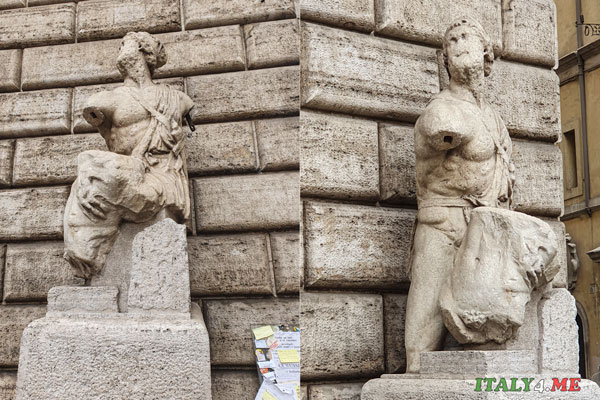
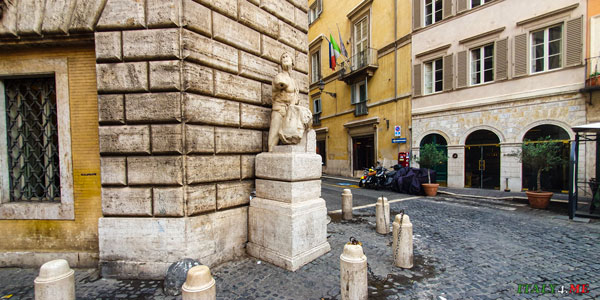
You’ll find it in the square of the same name, at the corner of Palazzo Braschi, just a short walk from Piazza Navona.
Origins and Description
The arrival of the Renaissance marked a revival of public interest in classical art. Collecting ancient artifacts became fashionable among both Rome’s aristocracy and the clergy.
In 1501, Cardinal Oliviero Carafa placed a statue unearthed during an excavation at the corner of Palazzo Santobono—today known as Palazzo Braschi. Despite its heavily damaged and even grotesque appearance, Carafa recognized its historical value. The statue’s subject matter wasn’t identified until the 18th century, thanks to archaeologist and art historian Ennio Quirino Visconti.
About 15 known Roman marble copies of this scene exist, grouped under the name “Pasquino Group” (Gruppo Pasquino). To imagine how the weathered original may have looked, visitors can view a more intact version in marble at La Loggia dei Lanzi in Florence.
The tradition of Rome’s “talking” statues began with a Catholic celebration of Saint Mark, held annually starting on April 25, 1505. On that day, Oliviero Carafa allowed the ancient statue to be adorned and its broad pedestal to be covered with sheets of verse.
Before long, provocative flyers—often satirical or accusatory in tone—began appearing at the statue’s base or even hanging from the marble neck of Menelaus. These included caricatures, biting poems, and witty critiques.
This cultural vandalism, targeting the only ancient Roman structure never to have been destroyed, sparked widespread outrage.
Name
The name that eventually stuck to this “talking” statue has little to do with what the sculpture actually represents. Several legends attempt to explain the origin of the name Pasquino, but one version stands out as the most plausible. 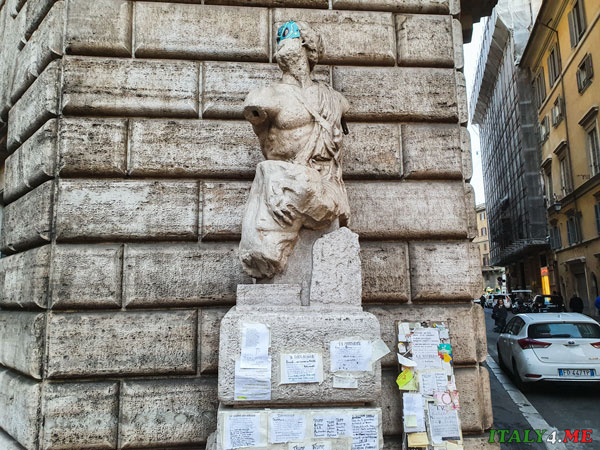
According to this version, a local man named Pasquino—perhaps a tailor or a barber—had access to the Vatican through his trade. There, he overheard scandalous tales about the private lives of papal courtiers. Eager to share this gossip, he wrote it down with biting commentary and pinned the notes to the statue of Menelaus at the corner of Palazzo Santobono (now Palazzo Braschi). After Pasquino’s death, other sharp-tongued locals took up the tradition. The statue, now widely recognized as a public platform for satire, became known as Pasquino in his honor, and the anonymous satirical postings earned the name pasquinades.
The term is also known in English as “pasquinade”—a biting lampoon or anonymous libel.
Address: Piazza di Pasquino
Pasquino’s Followers
It wasn’t long before Pasquino began to draw the ire of city authorities. The anonymous satire was often aimed at Rome’s most powerful figures—especially the popes. In an attempt to silence the statue, Pope Adrian VI (1459–1523) even considered throwing the infamous Pasquino into the Tiber River, but his brief reign from January 9, 1522 to September 14, 1523 ended before he could act.
Night patrols were also deployed to guard the statue, but these efforts failed—pasquinades simply began appearing on other statues throughout the city.
Marforio
Marforio is the second most famous of Rome’s “talking” statues, known for its majestic beauty and excellent preservation. 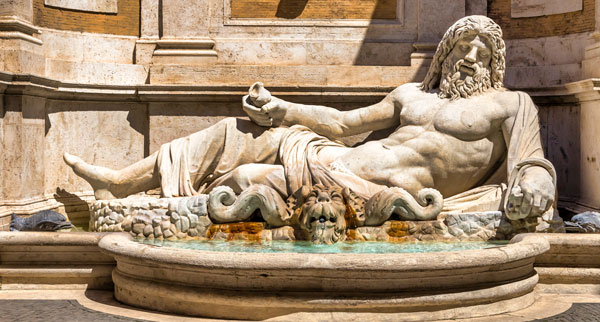
This massive marble sculpture, dating to the 1st century CE, was discovered at the Forum of Augustus, near the Temple of Mars Ultor. The area was later referred to as the Forum of Mars (Martis Forum), which may have inspired the statue’s name.
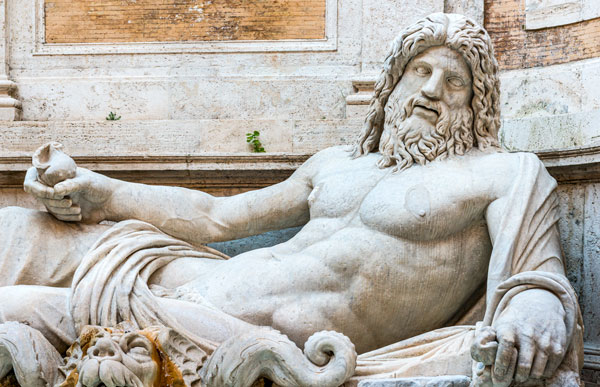
The statue depicts a bearded man reclining on his left side, representing a water deity—either Neptune or the Tiber River. However, some historians believe Marforio may personify the Nera River, a tributary of the Tiber.
Marforio was installed in 1592 on Piazza del Campidoglio, where it now adorns the fountain in the courtyard of Palazzo Nuovo. To view it up close, visit the Capitoline Museums (Musei Capitolini).
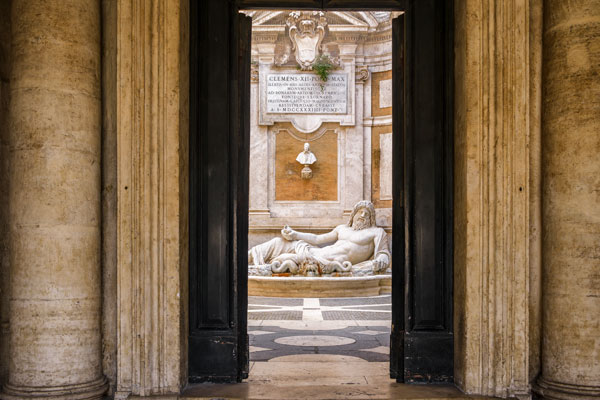
Romans noted that Marforio often “conversed” with Pasquino. The pasquinades posted on one statue would frequently provoke a witty response from the other. For example, when Pope Clement XI became overly preoccupied with his hometown of Urbino, Marforio asked, “Pasquino, tell me—what are you doing?” To which Pasquino sharply replied, “I’m watching Rome to make sure it doesn’t move to Urbino.”
Another classic exchange occurred during the French plundering of Rome from 1804 to 1818, when Marforio asked, “Is it true that all the French are thieves?” Pasquino quipped back, “Tutti no, ma Bona Parte”—a pun meaning “Not all, but a good part,” while slyly referencing Napoleon Bonaparte.
Address: Piazza del Campidoglio, 4 – Face the equestrian statue of Marcus Aurelius; Palazzo Nuovo is to your left, and the ticket office is to your right.
Madame Lucrezia
Madame Lucrezia is the only “talking” statue in Rome with a female face. It stands at the corner of Piazza di San Marco, nestled between Palazzo Venezia and the Basilica of San Marco Evangelista al Campidoglio, where it was originally placed in the year 1500. 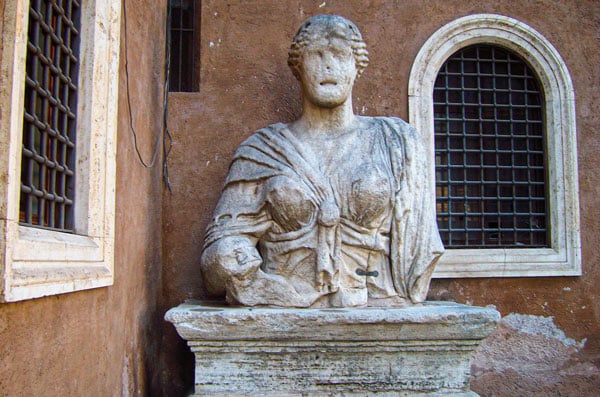
The colossal marble bust, standing nearly 10 feet (about 3 meters) tall and dating to the 2nd–3rd centuries CE, likely once adorned a temple dedicated to Isis and Serapis, located near modern-day Piazza di San Marco. Based on her draped clothing and a distinctive knot beneath the chest, experts believe the statue depicts either the Egyptian goddess Isis or one of her priestesses.
The name comes from Lucrezia d’Alagno, a noblewoman who received the statue as a gift from her lover, Alfonso V of Aragon, King of Naples. After his death, Lucrezia returned to Rome and took up residence directly across from the statue.
Though Madame Lucrezia wasn’t as “talkative” as Pasquino, a few biting pasquinades tied to her name have stood the test of time.
When Pope Gregory XIV, suffering from malaria, moved from the Vatican to Palazzo Venezia in 1591 hoping for a peaceful recovery, the “talking” statue pronounced a merciless verdict: “Death entered through the gates.”
Address: Piazza di San Marco, Roma – Stand with your back to the Altar of the Fatherland; the piazza will be to your left, and the statue is tucked in the far corner.
Abate Luigi
Abate Luigi is one of Rome’s six “talking” statues. Since 1924, it has stood against the side wall of the Basilica of Sant’Andrea della Valle, facing Piazza Vidoni. 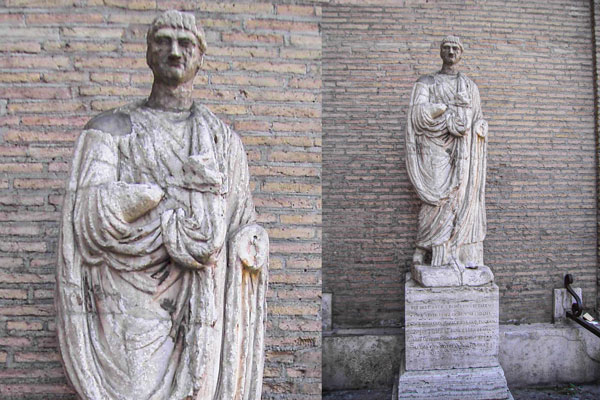
The statue, carved from white marble and dating from the late imperial period, was discovered in the foundations of Palazzo Vidoni-Caffarelli near the ancient Theater of Pompey. It depicts a high-ranking Roman official or orator wrapped in a toga. The name Abate Luigi was given by witty locals who thought the statue resembled a church verger named Luigi from the nearby Church of Santissimo Sudario dei Piemontesi.
In the 15th and 16th centuries, Abate Luigi became a favored outlet for especially caustic and irreverent pasquinades targeting the city’s elite.
In 1888, due to extensive damage, the statue’s original head was replaced. At that time, it was temporarily housed inside Palazzo Vidoni-Caffarelli. The event inspired a satirical note from the statue: “I lost my mind when I moved into this luxurious residence.”
The statue’s head was stolen multiple times. Each time, it was replaced with a replica based on a copy held at the Museo di Roma in Trastevere. In 1966, after another theft, the headless Abate Luigi “spoke” again, addressing the vandals:
“Oh you, who took my head,
Make sure you return it without dread.
You think it’s nothing, this cruel jest,
But they send me back to government—and I detest.”
Clearly, the thieves didn’t know art—the stolen head was merely a replica with little value.
Address: Piazza Vidoni, 4, 00186 Roma – Walk around the church on the left side.
Babuino
Located in the Campo Marzio district, near the Church of Sant’Atanasio dei Greci, Babuino is another of Rome’s “talking” statues. 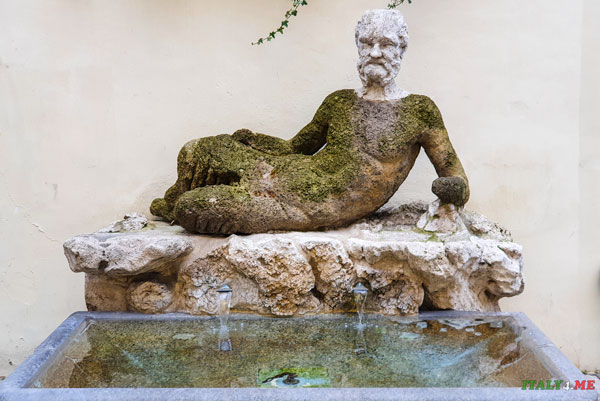
The statue represents a reclining Silenus—a half-man, half-goat figure from mythology, who was the companion and tutor of Dionysus. With his shaggy body and grotesque, monkey-like face, Romans jokingly nicknamed him “Babuino,” meaning “baboon.” The name stuck, and pasquinades from this statue came to be known as “babuinate.”
This ancient sculpture was part of a public fountain built in 1571 by wealthy merchant Alessandro Grandi against the wall of his palazzo on what was then Via Paolina (now Via del Babuino). Following Roman tradition, he received free water rights from Pope Pius IV.
When Pope Gregory XIII (Ugo Boncompagni) acquired the building in 1576, the statue was placed in a niche between two pilasters, with a cornice supported by capitals and adorned with dolphins. During sewer renovations in 1887, the fountain was dismantled and the statue moved temporarily to the Boncompagni Cerasi Palace.
Modern-day “babuinate” sometimes take less poetic forms. In 2002, graffiti appeared on the wall behind the fountain, prompting authorities to repaint the background with anti-vandal paint.
Statue address: Via del Babuino, 150/a, 00187 Roma – roughly halfway between the Spanish Steps and Piazza del Popolo.
Facchino
Facchino is the youngest of Rome’s “talking” statues. Its name comes from *facchino*, meaning “porter.” 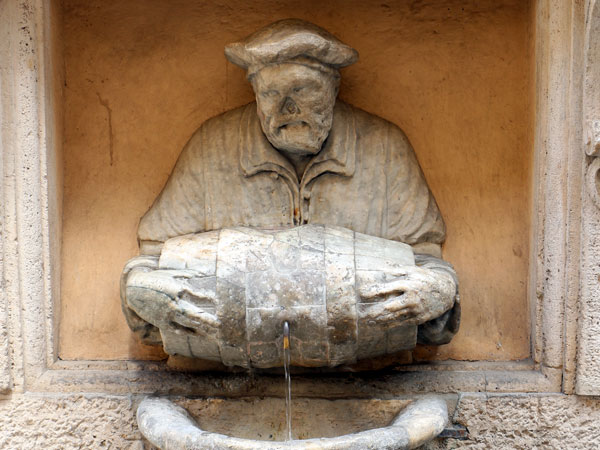
Unlike the other five ancient sculptures, this Renaissance-era statue is believed to depict a real person—Abbondio Rizzio, a famed water carrier.
In 1580, a modest fountain appeared on Via del Corso, adorning the main façade of Palazzo de Carolis Simonetti. Commissioned by the Water Carriers’ Guild (Acquaroli Corporation), the fountain served as a vital source during a time when aqueducts and public fountains had yet to be fully restored. The acquaroli fetched water from the Tiber or remaining fountains and delivered it for a small fee, door to door. Abbondio Rizzio was said to have died carrying a heavy load, and the statue likely combines features of various water carriers with Rizzio’s likeness.
By the early 1600s, Facchino had joined the ranks of the “talking” statues, using satire to challenge the arrogance and corruption of Rome’s elite.
In 1874, the statue was relocated from the main to the side façade of Palazzo del Banco (formerly Palazzo de Carolis Simonetti) for preservation.
Its worn face was damaged over time by street boys who mistook its headgear for that of Martin Luther—a hated figure in Catholic Rome—and pelted it with stones. An inscription once read: “To Abbondio Rizzio, crowned porter of the sidewalk, master of the load. He carried what he could, lived as long as he was able, and died with a barrel on his back.”
Address: Via Lata, 00186 Roma – From Piazza Venezia, follow Via del Corso past the Doria Pamphilj Gallery (No. 305), then a church and a small alley on the left. The Facchino fountain is right at the start of the street.
The Golden Age of the Genre
The street genre of pasquinades wasn’t always harmless or ignored. For some, it brought fame; for others, ruin. During his papacy, Benedict XIII (1649–1730) took drastic action—he issued a decree stating that the authors of these public satires would face execution and property confiscation. Yet even the threat of death did not deter Romans from voicing their grievances through the city’s “talking” statues.
Pasquinades became increasingly frequent and soon evolved into an unofficial literary genre that spread to cities like Venice and Florence.
These statues were not only a mouthpiece for the people—they also became tools in power struggles, used by rival factions to attack one another. Incredibly, during the papal election of 1523, a full-blown war of words erupted at the base of Pasquino, with supporters of various candidates exchanging poetic volleys.
A particularly famous figure from this era was Pietro Aretino, an Italian writer who boldly claimed authorship of his pasquinades. Unlike others who hid in anonymity, Aretino proudly publicized his satirical works. His talent and scandalous prose earned him powerful patrons, including Pope Leo X and Cardinal Giulio de’ Medici, the future Pope Clement VII. Respected and feared in equal measure, Aretino held no topic sacred. In his epigrams and sonnets, he audaciously critiqued the Catholic Church’s sale of indulgences, the lives of papal courtiers, and even addressed homoeroticism and moral corruption.
In fact, the scandalous yet brilliant Pietro Aretino is often considered the father of journalism in Europe. He appears among the figures in Michelangelo’s “Last Judgment” in the Sistine Chapel (Cappella Sistina), where the artist used Aretino as the model for Saint Bartholomew, who displays his flayed skin.
The Decline and Modern Era
After the unification of Italy in 1870, the “talking” statues fell silent. With free speech becoming a constitutional right, their primary function lost its urgency.
Pasquinades became rare, though not extinct. For example, when Hitler visited Rome, Pasquino delivered a scathing critique of the over-the-top preparations for welcoming the dictator. Likewise, the arrival of Mikhail Gorbachev did not escape the statue’s satirical attention.
This unique street tradition lives on today, continuing to give everyday people a platform to speak truth to power—without fear of persecution.
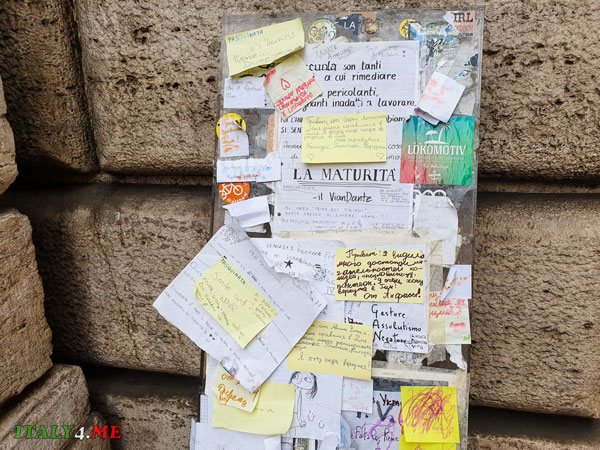
Anyone can still post flyers on the base of Pasquino, addressing current issues and public concerns. The ancient tradition has even gone digital. At www.pasquinate.it, users can now publish and read pasquinades online, keeping alive the spirit of critique, wit, and expression.
Cinema, too, has honored this tradition. The statue inspired acclaimed Italian director Luigi Magni to create the films In the Year of the Lord (1969) and The Night of Pasquino (2003).