 Italy for me From Italy with love


The Aurelian Walls (Mura Aureliane) was the last of three great fortification systems—following the Walls of Romulus and the Servian Wall—built to defend the city of Rome. This monumental structure, stretching 12 miles (19 km), was constructed between AD 271 and 275. Much of it still stands today and ranks among the major attractions in Rome.
Page Contents
History
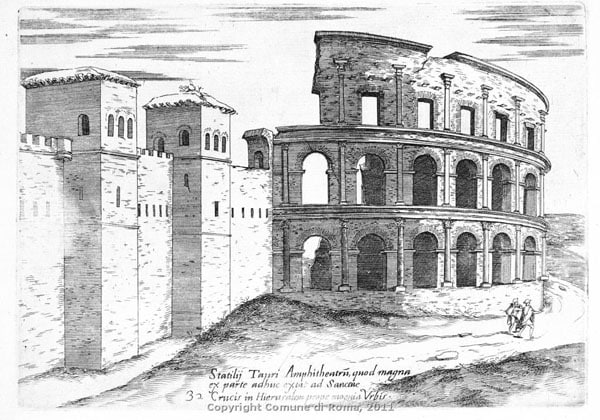
The expanding capital of a flourishing empire could no longer be contained within the Servian Wall (Latin: Murus Servii Tullii). When barbarian tribes began raiding northern Italy and threatened Rome itself in AD 270, Emperor Aurelian—renowned for his military conquests and political savvy—ordered the construction of a new defensive perimeter. Thus, from AD 271 to 275, the Eternal City was encircled by a new fortification system that would go down in history as the “Aurelian Wall.”
Construction
The Servian Wall enclosed Rome’s Seven Hills. The new fortifications expanded the city’s boundaries to include the Trastevere district and the Campus Martius (Latin: Campus Martius).
This ambitious plan, executed by the empire’s best engineers, became a source of pride for Roman citizens.
It’s unclear how many towers were part of the original wall, but by the 6th century, there were 383 towers. The wall stood up to 26 feet (8 meters) high and 13 feet (4 meters) wide. Arrow slits were spaced every 10 feet (3 meters), with five underground passages and 116 latrines built in. There were 18 gates, some of them double-portaled.
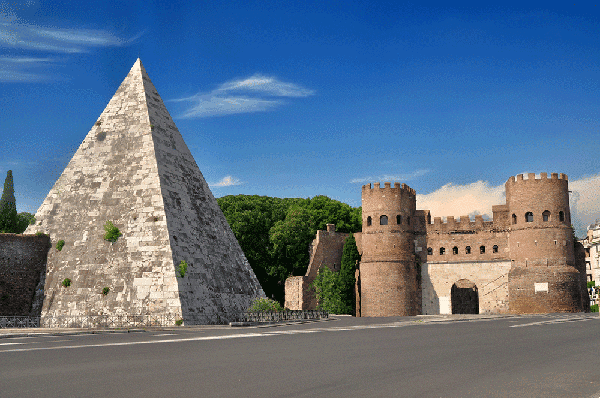
The fortifications had to be completed swiftly. Instead of the tuff stone used in the Servian Wall, builders opted for concrete faced with red brick. To save time and money, several existing structures were incorporated into the wall’s layout, including the Pyramid of Cestius (Piramide Cestia), the Castrense Amphitheater (amphitheatrum Castrense), and the Aqua Claudia aqueduct. Unfortunately, Emperor Aurelian did not live to see the wall’s completion. The project was finalized during the reign of Emperor Probus.
Restorations
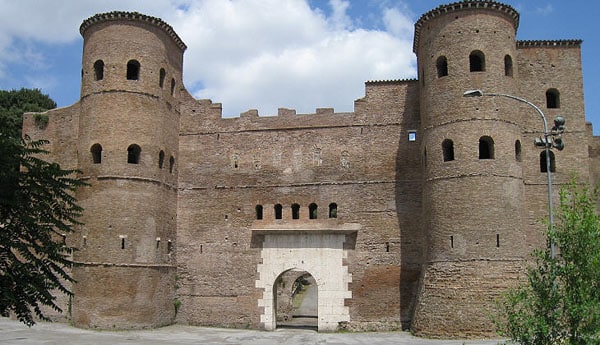
The first major restoration of the wall took place under Emperor Maxentius between AD 306 and 312. In the 5th century, Emperor Flavius Honorius doubled the height of the walls. In AD 546, Totila, king of the Ostrogoths, captured the city and ordered the destruction of Rome’s fortifications. A third of the wall was demolished. According to legend, his reverence for the city’s antiquity ultimately stopped him.
During the Renaissance, the ruined sections of the wall were restored. Michelangelo himself worked on the renovation of Porta Pia. The Aurelian Wall served as a dependable line of defense for centuries. It was only in 1870 that sharpshooters of the royal Italian army, the Bersaglieri, breached the wall near Porta Pia and entered the city.
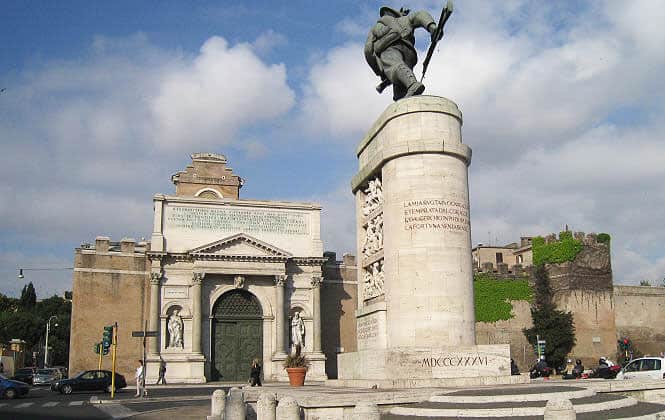
In the late 20th century, the fortifications of Rome underwent another major restoration. Soon after, heavy rains caused a collapse in one of the most historically significant sections of the wall, located between the Appian and Latin Gates.
City Gates
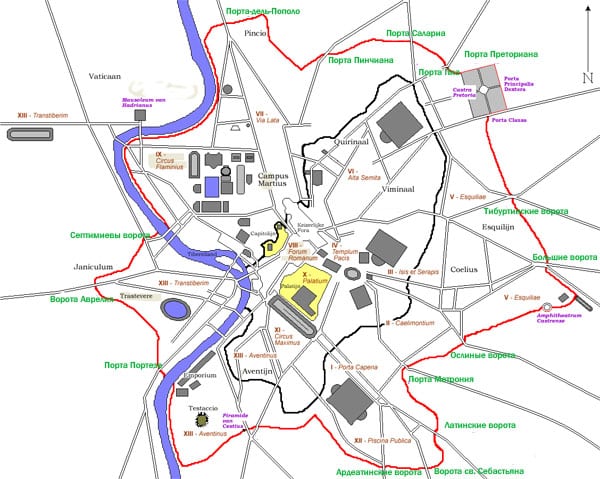
Of the 18 main gateways in the Aurelian Wall, the following gates have survived to this day:
- Porta San Sebastiano (Appian Gate) — the best-preserved from ancient Roman times. It was named during the early Christian period due to its proximity to the Catacombs of Saint Sebastian.
- Porta San Giovanni — named after the nearby Basilica of Saint John Lateran (Basilica di San Giovanni in Laterano). It was built near the ancient Porta Asinaria (Donkey Gate).
- Porta Pia — commissioned by Pope Pius IV of the Medici family and designed by Michelangelo, it replaced the earlier Porta Nomentana, which had been destroyed.
- Porta San Paolo — named after the Basilica of Saint Paul Outside the Walls (San Paolo fuori le Mura). In antiquity, it was called Porta Ostiensis, as it led to the road toward the port of Ostia. The Pyramid of Cestius stands nearby.
- Porta San Pancrazio — located on the site of the ancient Porta Aurelia, which led to the Via Aurelia.
- Porta Latina — this gate marked the beginning of the Via Latina. Its right tower dates back to antiquity, while the left was built in the Middle Ages.
- Porta del Popolo — named after the nearby Basilica of Santa Maria del Popolo. In ancient times, it was known as Porta Flaminia.
- Porta Maggiore (Great Gate) — originally part of the Aqua Claudia and Anio Novus aqueducts, it was converted into a city gate in AD 52, making it older than the Aurelian Wall itself.
- Porta Pinciana — built during the reign of Emperor Honorius and named after one of Rome’s hills. Interestingly, it was sealed off and reopened several times over the centuries.
- Porta Portese — the current structure dates to 1644 and is often referred to as the Port Gate.
- Porta Tiburtina — named for the monumental arch built of Tivoli travertine that forms its base. The arch was originally constructed in 5 BC.
Interesting Facts
In the classic film *Roman Holiday*, there’s a scene where the main characters, Gregory Peck and Audrey Hepburn, stop at a “wishing wall” adorned with plaques of gratitude. Many tourists still try to locate this mysterious spot in Rome.
This location doesn’t appear in typical guidebooks, leading many to believe it was a fictional set created for the movie. However, the segment of the Aurelian Wall featured in the scene can be found along Viale del Policlinico, near Piazza Girolamo Fabrizio. It’s not actually a wishing wall—the plaques once expressed thanks to various saints. Will the wall grant your wishes? Who knows. There’s no harm in trying.
How to Get There
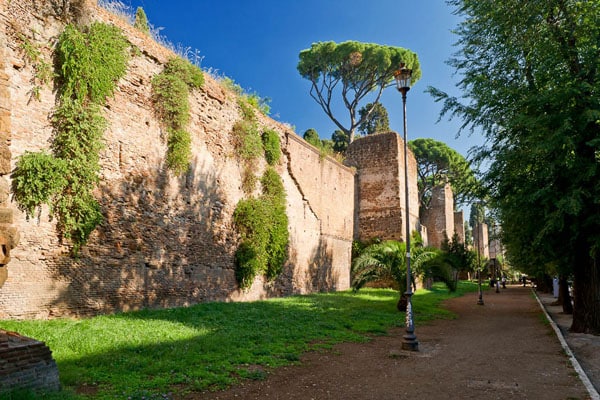
Today, approximately 7.5 miles (12 km) of the Aurelian Wall still remain. A great place to begin exploring is at the section near the Appian Gate (Porta San Sebastiano), at the start of the Via Appia. There you’ll also find the Museum of the Wall. Other well-preserved stretches include those between Muro Torto (near Villa Borghese), Corso d’Italia, and Castro Pretorio, as well as the section from Porta San Giovanni to the now-lost Ardeatine Gate, and from Porta San Paolo to the Tiber River.
Museum
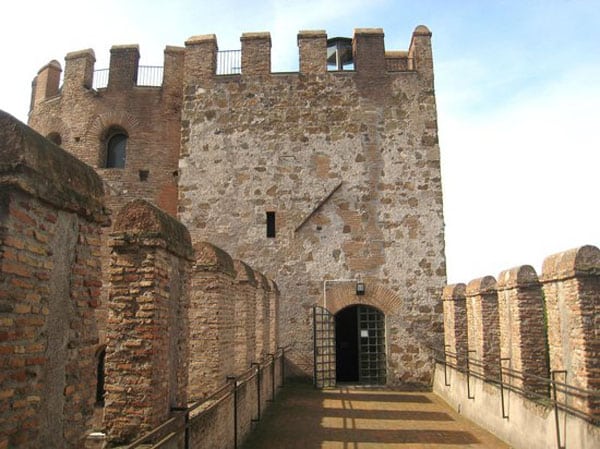
Address: Via di Porta San Sebastiano (near the Church of Domine Quo Vadis)
Established in 1990, the Museo delle Mura (Museum of the Wall) is dedicated to the history of Rome’s ancient fortifications.
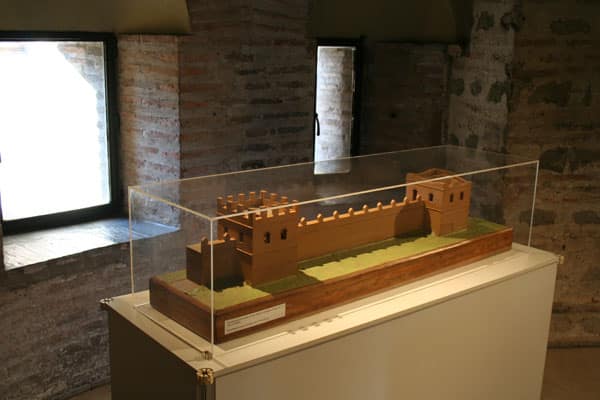
Spread across seven exhibition rooms, the museum presents documents and displays that trace the life of the wall from its construction to modern times. The exhibits highlight not only the technical aspects of its building but also the political role the wall played throughout Roman history.
- Opening hours: Wednesday–Saturday, 9:00 AM to 2:00 PM
- Website: www.museodellemuraroma.it