 Italy for me From Italy with love


The Appian Way (Via Appia) was the “highway” of ancient times, connecting Rome with Brundisium (Brundisium in Latin). This 540 km (335 miles) cobbled road was created in the 4th century BCE to link the capital of the Roman Empire with strategically important neighbors: Greece, Egypt, and Asia.
Page Contents
History
According to the chronicle History of the Founding of the City, the main portion of the road was built during the year 312 BCE. Its creation is credited to the Roman censor (a high-ranking official) Appius Claudius Caecus (Latin: Appius Caecus).
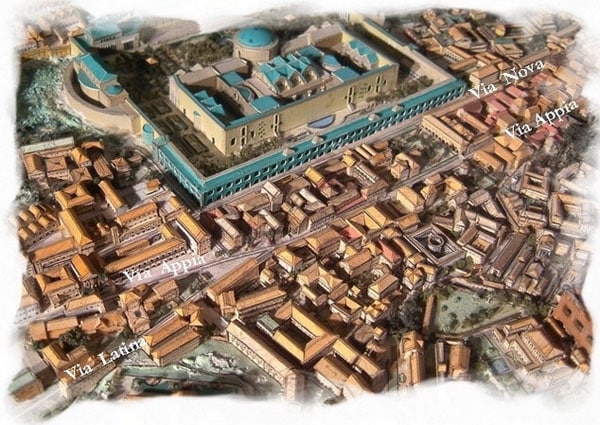
There had already been a route connecting Rome to Calvi (Latin: Calvi), but Appius envisioned a far more ambitious reconstruction of the roads and invested a significant portion of the treasury in the project. Historical accounts show that builders had to carefully plan the route through hilly terrain. Once compacted, the soil was paved with neatly cut slabs of volcanic basalt.
Construction Phases
In 312 BCE, the first section of the Appian Way was completed—a 195 km (121 miles) stretch leading to Capua. The road initially served military purposes. A prolonged conflict between the Romans and the Samnites demanded swift action from the Roman leadership.
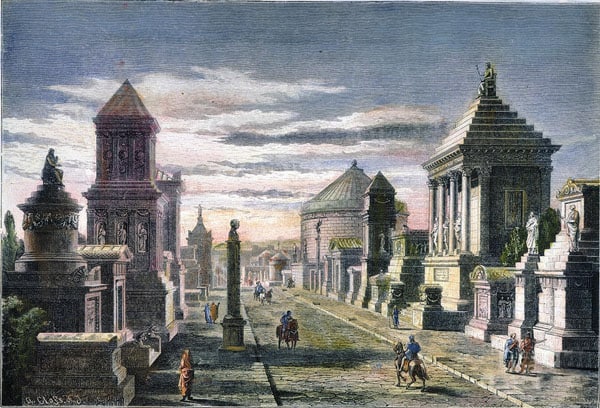
In the 3rd century BCE, Appius was granted the role of dictator and decided to strengthen Rome’s influence in the Campania region. To this end, the Appian Way was extended to Beneventum (Latin: Beneventum).
In the 2nd century BCE, the Romans pushed to open a direct route to the Balkan Peninsula. By extending the Appian Way from Beneventum to Brundisium, Rome gained a direct link to the Via Egnatia (Latin: Via Egnatia), a road that led eastward. This strategic expansion reinforced the empire’s economic strength.
Significance
Originally built for military use, the Appian Way eventually gained economic and cultural importance. Contemporary observers came to refer to it informally as the “Queen of Roads.”
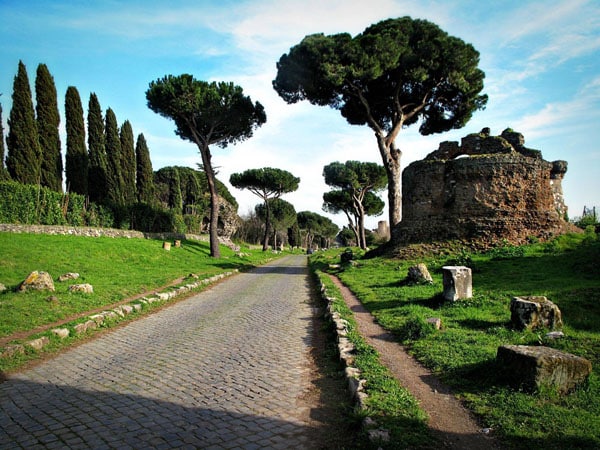
The stone-paved ribbon, lined with umbrella pines, outlived the glory of ancient Rome. Its significance was acknowledged by Byzantine emperors, Theodoric the Great (Theoderich der Große) of the Ostrogoths, and every ruler who held power in Rome up through the Middle Ages. Eventually, the “ancient road” became a path for pilgrims traveling to the city’s holy sites.
Notably, one of the branches of the Roman Catacombs (Catacombe di Roma) runs alongside the Appian Way. Early Christian martyrs and pontiffs were buried in the underground chambers near this main thoroughfare. Over time, many monuments from the Roman era were either destroyed, rebuilt, or dismantled for their stone.
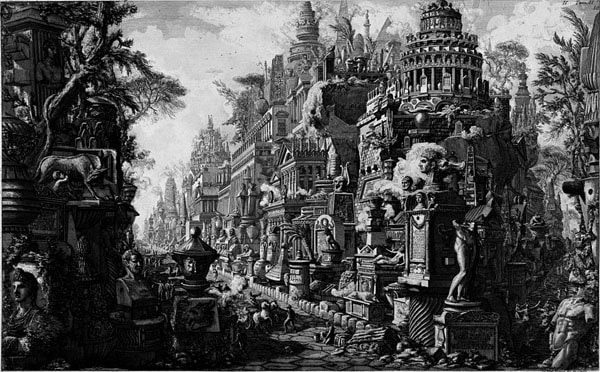
By the late Middle Ages, the Appian Way had largely lost its original function. Portions were dismantled, and much of the road was paved over. In the 18th and 19th centuries, extensive excavations took place around the historic route. Ancient artifacts were dispersed among hundreds of private collections and museums.
Route
The Appian Way began at the Porta Capena in Rome, which is now almost entirely destroyed.
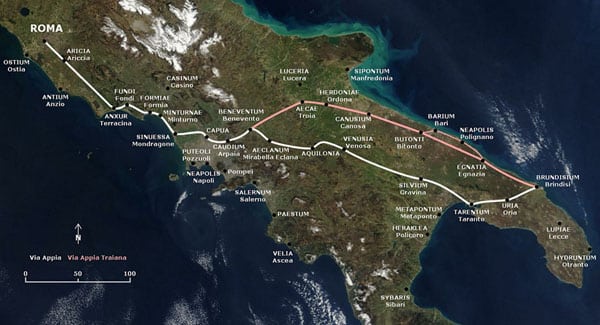
The first settlement outside the Aurelian Walls (Mura Aureliane) was the town of Ariccia. At the 88-kilometer mark lies the city of Terracina in the Lazio region. The route then continues through Fondi and Formia, located at the 142nd kilometer of the “Queen of Roads.”
The towns of Minturno and Sinuessa (modern-day Mondragone) are key stops before reaching Capua (present-day Santa Maria Capua Vetere) in the Campania region.
The Appian Way was extended via Benevento, Venosa, Tarentum (modern-day Taranto), and Uria. The final destination, at 540 kilometers, was the port city of Brindisi in the region of Apulia. Traveling from Rome to Brundisium on horseback took approximately 15 days!
Monuments
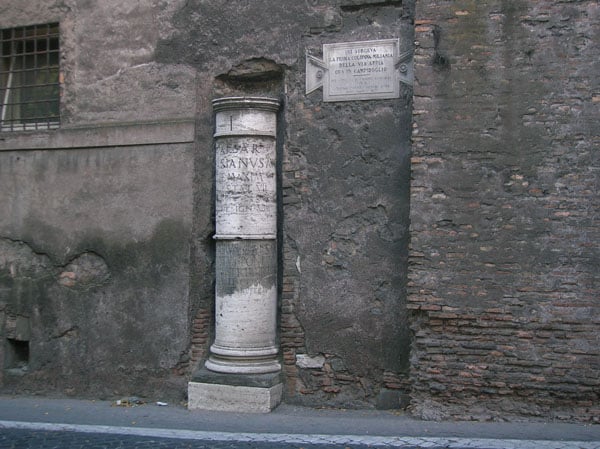
The Appian Way was marked at intervals of one Roman mile (1,478 meters). These markers (colonna miliaria) were columns with inscriptions honoring the emperors who ruled Rome. Today, only the first milestone and the final column in Brindisi still remain.
According to the Law of the Twelve Tables passed in 450 BC, burials within the city limits were forbidden.
Until the 2nd century BC, the wealthy built columbaria (columbarium) along the road, where urns with ashes were stored. Later, burial practices shifted to inhumation, and vast necropolises were carved into tuff underground. Many of these tombs feature impressive size and intricate design.
The First Mile
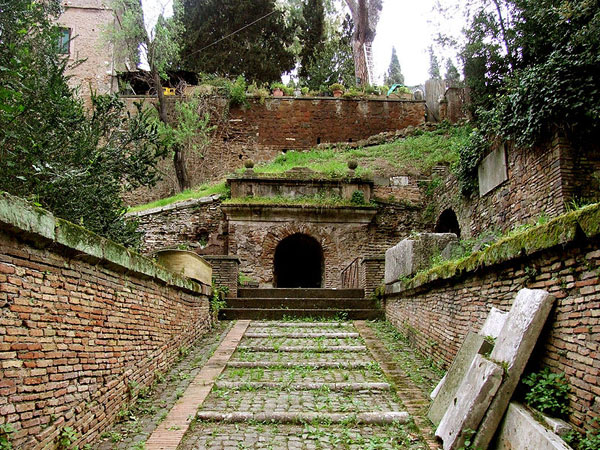
- The Tomb of the Scipios (Sepulcrum Scipionum) belonged to one of Rome’s most powerful families. Built in the 3rd century BC, it was rediscovered in the 18th century, and some parts were moved to the Vatican Museums.
- The Tomb of Pomponius Hylas was modest in size and belonged to a freedman of the emperor and his family.
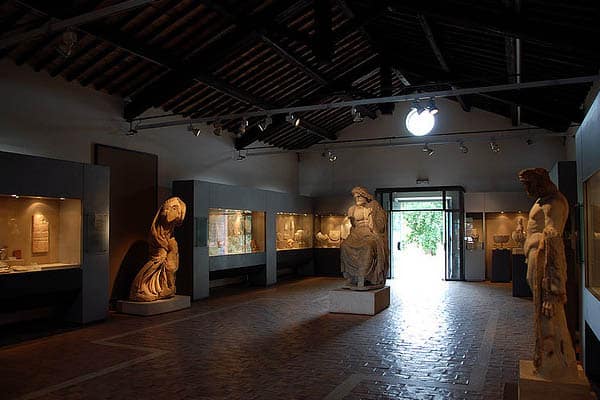
- Porta San Sebastiano (formerly Porta Appia) was constructed in the 3rd century AD by Emperor Aurelian. In the 5th century, it was topped with two crenellated towers. Today, it houses the Museum of the Wall (Museo della Mura), open Tuesday to Sunday from 9:00 AM to 2:00 PM. Admission is free. Official website: museodellemuraroma.it
- The first milestone is located about 100 meters from the Appian Gate. The original column is on Capitoline Hill; a replica stands by the road.
- The Tomb of Priscilla (Sepulcrum Priscilla) was built during the reign of Domitian for the wife of the freedman Flavius Abascantus. It was once richly decorated and finished in travertine. In the Middle Ages, a watchtower was added above the catacombs of Priscilla.
- The Church of Domine Quo Vadis (Santa Maria in Palmis) marks the spot where Christ is said to have appeared to Saint Peter. When Peter asked, “Lord, where are you going?” Jesus replied, “I am going to Rome to be crucified again.” The church preserves a slab said to bear the footprints of Christ.
The Second Mile
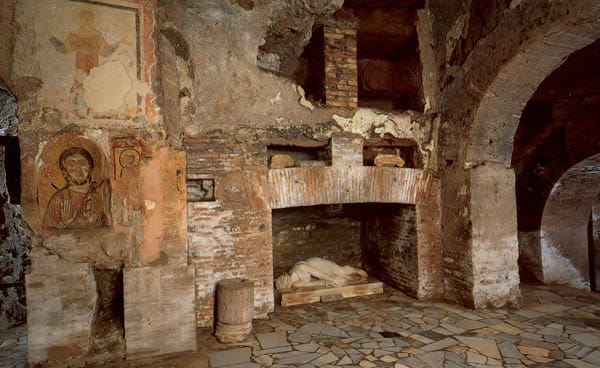
- The Catacombs of Saint Callixtus (Catacombe di San Callisto) date to the 2nd–4th centuries AD. Opening hours: 9:00 AM–12:00 PM and 2:00 PM–5:00 PM. Tickets: €8 full, €5 reduced, free for children under 6.
- The Column of Pius IX is a gray stone stele designed by Luigi Canina.
- The Catacombs of Saint Sebastian (Catacombe di San Sebastiano) lie beneath the Basilica of San Sebastiano. Opening hours: Monday to Saturday, 10:00 AM–5:00 PM. Tickets: €8 full, €5 reduced, free for children under 6. Official website: www.catacombe.org
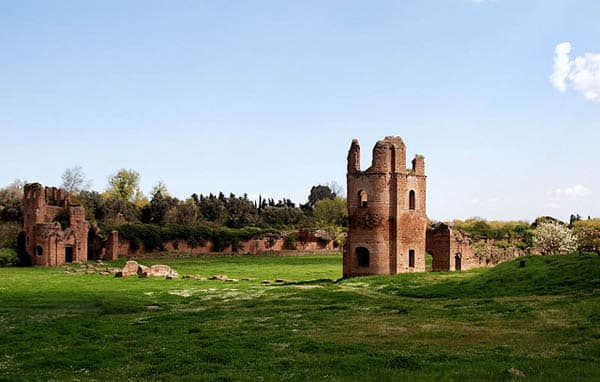
- The Tomb of Romulus and the Circus of Maxentius were built in the 4th century AD in honor of Emperor Maxentius and his son. Admission to the ruins is free. Opening hours: Tuesday to Sunday, 10:00 AM–4:00 PM.
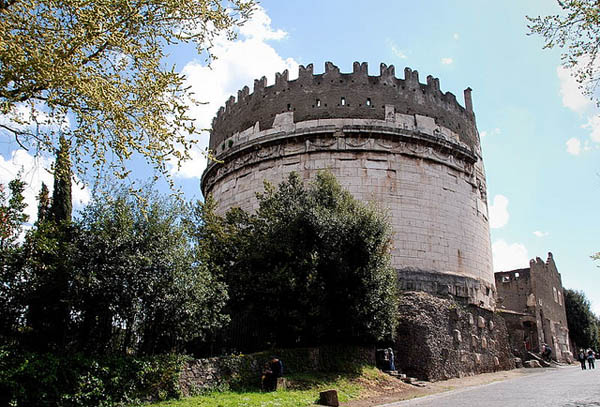
- The Tomb of Cecilia Metella (Sepulcrum Caecilia Metella), built in the 1st century BC, was the final resting place of the daughter of Consul Quintus Metellus. The massive round tower, 30 meters in diameter and 11 meters tall, was fortified in the 13th century.
The Third Mile
- The ruins of the Church of Sant Nicola a Capo di Bove are located near the Tomb of Cecilia. This 14th-century structure was a rare example of classical Gothic architecture.
- This section features well-preserved basalt paving, offering a clear view of how the Appian Way originally looked.
- The Tomb of Marcus Servilius (Sepulcrum Marcus Servilius) is an ancient crypt adorned with reliefs. In the 19th century, the façade was restored by Antonio Canova.
The Fourth Mile
- The Tomb of Sextus Pompey’s Sons (Sepulcrum Sextus Pompeus) was built by Sextus Pompey for his sons who died young. His grief is expressed in poetic verses inscribed on the tomb walls.
- The Mausoleum of Saint Urban (Mausoleo di Sant’Urbano martire) contains the remains of a Roman bishop from the 4th century AD.
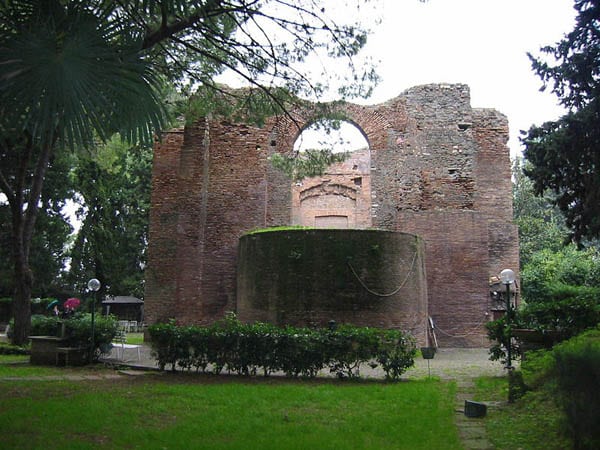
- The Tomb of Hilarus Fuscus (Sepolcro di Hilarus Fuscus) has suffered from time, but thanks to Luigi Canina’s efforts, visitors can still view a relief depicting the Fuscus family on its remaining wall.
- The Cenotaph of Annia Regilla, a noblewoman from 2nd-century Rome, is made of brick and notable for its architectural form.
- The Pyramidal Tomb stands out for its unique shape resembling Egyptian pyramids.
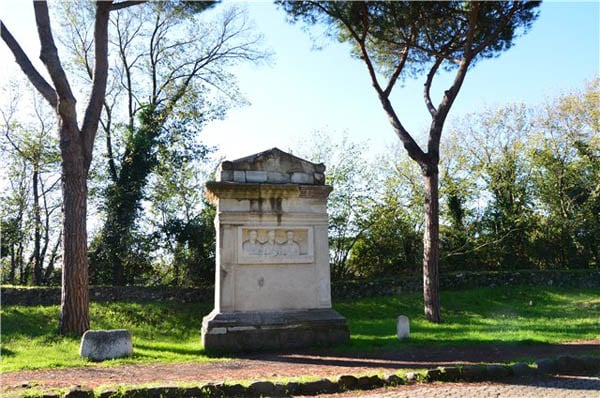
- The Tomb of the Rabirii (Sepulcrum Rabirii) was also restored by Canina, who reassembled the relief found during excavations. It depicts Gaius Rabirius and his wife.
The Fifth Mile
- The Tomb of the Curiatii (Sepulcrum Curiacii) is a long cylindrical monument set on a high hill near the Appian Way. This area is associated with the legendary duel between the Horatii and the Curiatii.
- The Villa of the Quintilii (Villa dei Quintili) was built in the early 2nd century by brothers Condinus and Maximus Quintilius. Their wealth and success provoked envy in Emperor Commodus, who had them executed and seized the estate. Over time, the villa was expanded and became one of the emperor’s residences. Artifacts found here are now housed in the Vatican Museums, the Louvre, and in Monaco.
- Casal Rotondo is a round, low mausoleum dating back to the Roman Republic. It is believed to have been the tomb of Messalla Corvinus, a prominent official from the 1st century BC. Today, the tomb is integrated into a rustic farmhouse surrounded by greenery.
The Sixth Mile – Brindisi (Brindisi)
Along the sixth mile of the Appian Way, travelers encounter monuments and tombs designed as rectangular blocks of basalt, tuff, and brick.
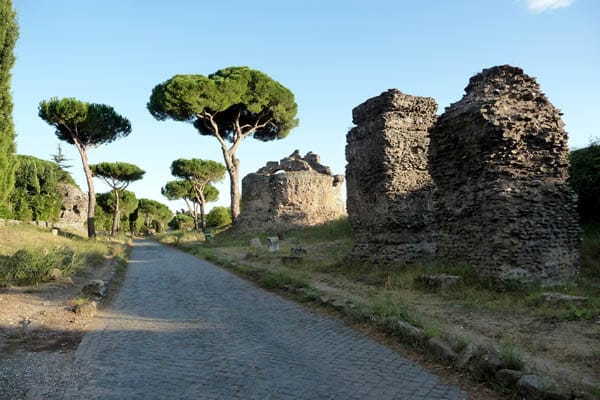
At the seventh-mile mark, travelers will find themselves near Ciampino Airport—less than a kilometer away. Among the most remarkable archaeological landmarks along the rest of the famed road are the remains of the Temple of Jupiter Anxur (Jupiter Anxur) located in Terracina.
Modern Life
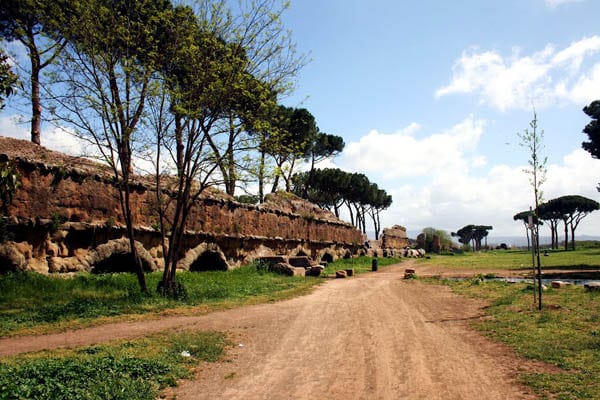
In 1988, part of Rome’s territory, including the Appian Way, was designated as an archaeological park (Parco Regionale Della’Appia Antica). While much of the historic road is now covered in asphalt, the most durable sections of the ancient pavement have been preserved. On weekends and holidays, vehicular traffic is prohibited along the historic route.
I recommend reading about the Park of the Aqueducts in Rome.
In Art
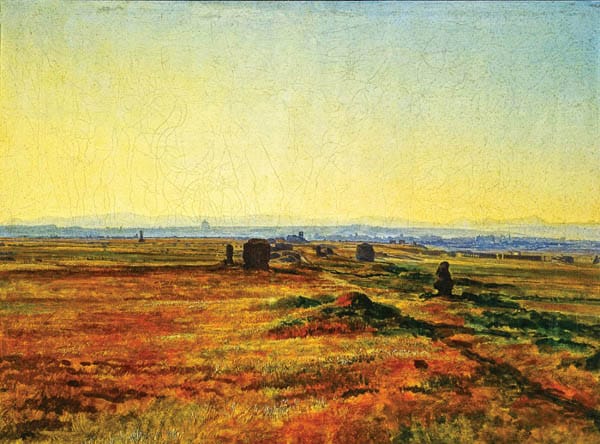
The Appian Way is so striking that it has long inspired painters. Among the earliest depictions are the 18th-century engravings by Giovanni Piranesi.
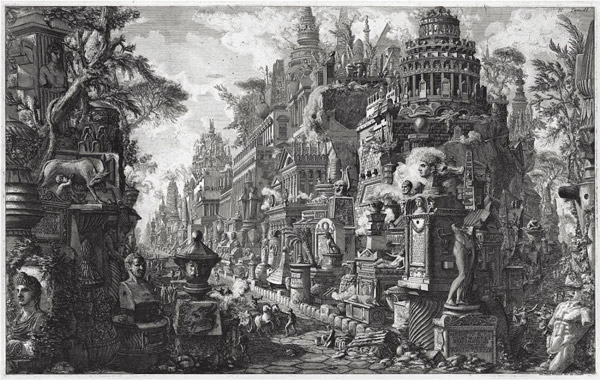
The Tretyakov Gallery in Moscow houses the painting “The Appian Way at Sunset” by 19th-century Russian artist Alexander Ivanov. Equally captivating were the surroundings of Via Appia for American artist John Chapman, who created a series of ten paintings in the late 19th century.
In 1924, 20th-century Italian composer Ottorino Respighi composed the grand symphonic work “Pines of Rome,” written for full orchestra. Renowned conductor Herbert von Karajan (Herbert von Karajan) performed this piece in major concert halls around the world. One of the most dramatic and evocative parts of the concert is titled “The Pines of the Appian Way.”
How to Get There?
The easiest way to reach the Appian Way is from the walls of the Colosseum (Colosseo).
The route is as follows: head south along Via Celio Vibenna and Via di San Gregorio, then turn southeast toward Piazza di Porta Capena (once the site of the ancient Porta Capena). Continue along Viale delle Terme di Caracalla and keep following the southeast direction onto Via di Porta San Sebastiano. The narrow historic road gradually shifts from asphalt to the long-awaited cobblestones, and the Porta San Sebastiano marks the beginning of Via Appia Antica.
Official website of the Appian Way: www.parcoappiaantica.it