 Italy for me From Italy with love

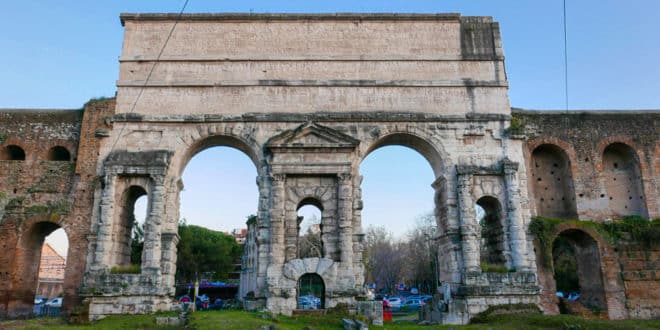
Porta Maggiore—monumental double-arched gates—are an important part of ancient Rome’s aqueducts. This ancient monument from the 1st century AD, located on the eastern side of the Aurelian Walls (Mura Aureliane), stands as a vivid reminder of the power and grandeur of one of the greatest empires of the ancient world.
At this spot, eight of the eleven ancient aqueducts supplying Rome—a city of a million inhabitants—once converged.
Page Contents
Name and Location
The name Porta Maggiore (Great Gate) emerged in the Middle Ages, not as a reference to the size of the structure, but as a landmark for pilgrims heading to the nearby Basilica of Santa Maria Maggiore (Basilica di S. Maria Maggiore).
Originally, the ancient structure was known as Porta Prenestina, a reference to the Prenestina Road (Via Prenestina), which extended from the Esquiline Gate (Porta Esquilina) and exited the city through the right arch of Porta Maggiore. It connected Rome to the ancient city of Praeneste (modern Palestrina) in the Lazio region, famed for its vast sacred complex dedicated to the goddess Fortuna Primigenia (Santuario della Fortuna Primigenia).
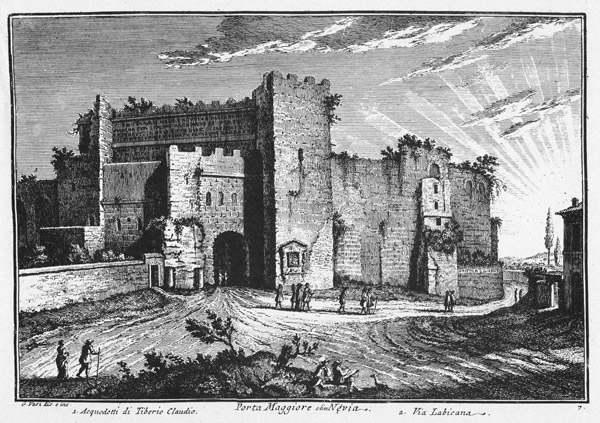
From the left arch of Porta Maggiore ran the Labicana Road (Via Labicana), also known as the Casilina. This road led to Casilinum, modern-day Capua—one of the largest and most significant cities of southeastern Italy, both before the Roman conquest and during the Imperial period.
Who Built It and When?
Porta Maggiore was built during the reign of Emperor Claudius (10 AD – 54 AD). The gates allowed for the uninterrupted passage along the Prenestina and Labicana roads, which were crossed by the new aqueducts Aqua Claudia and Aqua Anio Novus.
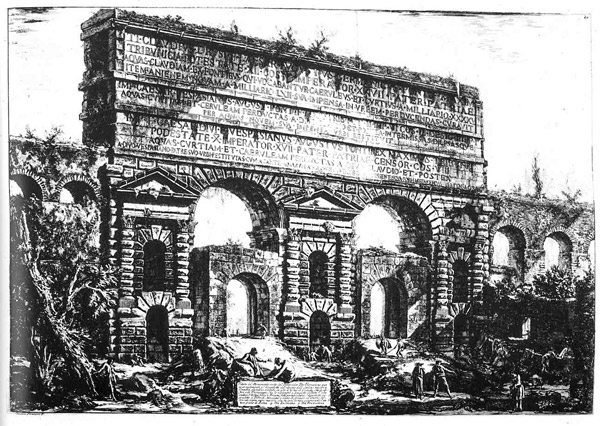
Both aqueducts were initially commissioned in 38 AD by Emperor Caligula but were completed and officially inaugurated on August 1, 52 AD by his successor, Claudius. At the top of the gates, in a cross-section of the attic, the channels of these aqueducts can be seen, one running above the other.
Besides their functional purpose, the monumental gates also served as a triumphal arch-style decorative façade, celebrating the emperors who contributed to the construction and restoration of this structure.
The inscriptions on the attic, divided into three sections and dating from 52, 71, and 81 AD, commemorate the achievements of Emperors Claudius, Vespasian, and Titus. The fact that repairs were needed so soon after completion raises questions about the quality of the original construction.
Description
The Great Gate stands 32 meters (105 feet) tall and 24 meters (79 feet) wide. It is constructed from rough travertine blocks using the ancient Roman square masonry technique. The visible roughness and lack of facing were deliberate, emphasizing a distinctively ancient architectural style favored by Emperor Claudius.
Two massive arched openings (6.35 meters wide, 14 meters high, and 6.20 meters deep) are divided by massive pillars containing through-windows set within aediculae. These are framed by Corinthian columns and topped with pediments.
In 402 AD, Emperor Honorius reinforced Porta Maggiore with additional superstructures, transforming the decorative gate into a true bastion with towers. From the 5th to the 15th centuries, a toll was collected at Porta Maggiore, proportional to the value of goods brought into Rome.
This bulky structure completely obscured the ancient gates until the 19th century. In 1838, Pope Gregory XVI demolished the 5th-century additions but included extra reinforcements to stabilize the arch vaults. Unfortunately, these did not enhance the aesthetics of the ancient monument.
It was only in 1956, following restoration work, that Porta Maggiore was finally freed of all later additions and restored to its original appearance. At the same time, the area around the gates was excavated down to its ancient level (1.5 meters deep), revealing the original basalt-paved road beneath the arches, complete with wheel ruts from ancient carts.
Tomb of Eurysaces
During the 1838 demolition of the defensive structures built by Emperor Honorius above Porta Maggiore, a 1st-century BC tomb was unexpectedly discovered just beyond the gate. The tomb belonged to the Roman baker of Greek origin, Marcus Vergilius Eurysaces (Marco Virgilio Eurisace), and his wife Atistia.
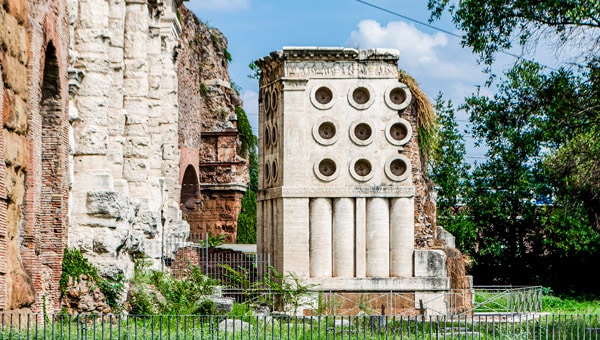
The ownership of the tomb is beyond doubt—an inscription and distinctive decorative elements confirm it.
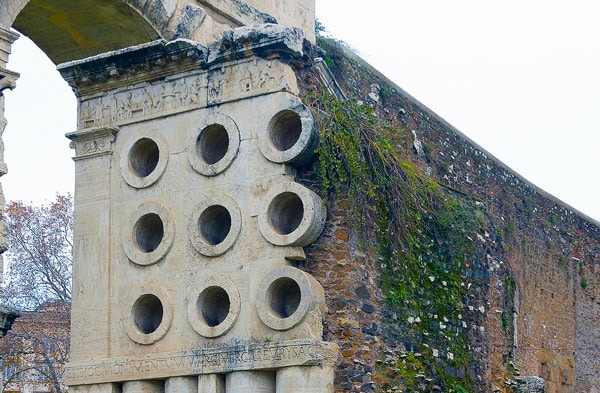
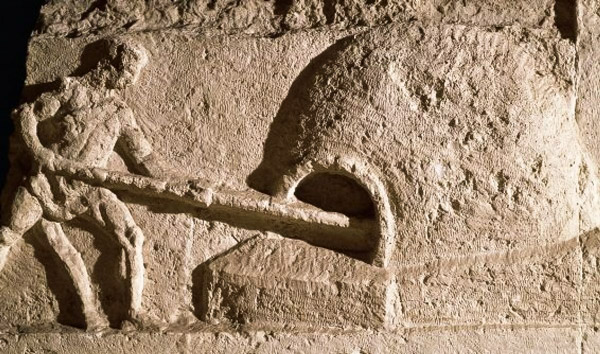
The structure, made of concrete clad in marble, has an unusual shape and design. The frieze of the funerary monument features reliefs illustrating every stage of bread production, Rome’s staple food: weighing and grinding wheat, kneading dough, and baking round loaves resembling pizza.
Cylindrical holes in the tomb’s walls symbolize the kneading vats or grain-measuring containers used in bakeries. Even Atistia’s funerary urn, now housed in the National Roman Museum (Museo Nazionale Romano), was crafted in the shape of a bread basket.
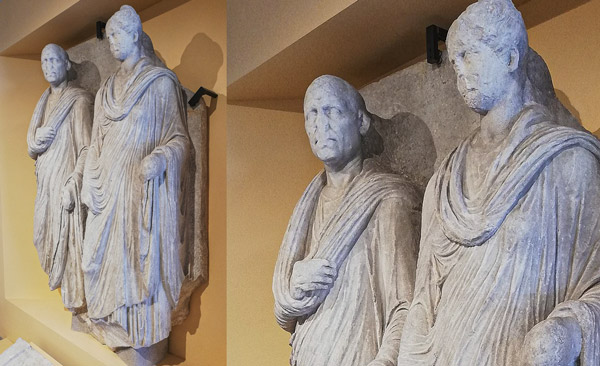
The marble relief with figures of Eurysaces and his wife, which once adorned the eastern side of the tomb (now lost), can be seen at the Capitoline Museums (Musei Capitolini).
The trapezoidal tomb was likely topped by a pyramidal roof, reflecting the Roman fascination with Egyptian culture at the time. The rich decoration of the funerary monument shows that Eurysaces accumulated considerable wealth through his trade, rising from a foreign freedman to a Roman citizen worthy of burial at such a prestigious location.
Other Nearby Archaeological Finds
It’s worth noting that the entire area surrounding Porta Maggiore is rich in ancient discoveries. These include funerary monuments, columbaria, hypogea, and even an underground basilica from the 1st century AD (Basilica sotterranea di Porta Maggiore)—the oldest of its kind in the Western world, which was accidentally discovered near the gates in 1917 during the construction of a tram line.
Next to Eurysaces’ tomb lies another burial site from the 1st century BC, belonging to another baker named Ogulnius. A fragment of a stele with a dedicatory inscription confirms that he specialized in baking bread from the finest quality flour.
Many burials near Porta Maggiore can be explained by the fact that the Aurelian Wall marked the boundary beyond which burials were permitted—that is, outside the city limits. These can be compared to the tombs along the Appian Way (Via Appia) or the street of tombs in Pompei.
Porta Maggiore stands as a priceless monument of antiquity, a reminder of the great achievements of Ancient Rome. But there is another fascinating aspect that lends this place a somewhat mysterious character due to the large number of ancient burials.
According to the ancient Roman concept of commemorating the dead, a person passing by tombs and reading the inscriptions aloud would prolong the lives of the deceased by keeping their memory alive. Thus, all those who, for nearly two millennia, have passed beneath the arches of Porta Maggiore and by the tombs have, in effect, contributed to the immortality of the souls of Romans who had not yet become Christians.
How to Get There
Porta Maggiore is located 2 kilometers (about 1.2 miles) from Termini Station (Roma Termini), about a 25-minute walk. You can also reach it by taking tram number 5 or 14.
Nearby Porta Maggiore is the Basilica of Santa Croce in Gerusalemme (Church of the Holy Cross), built at the command of Saint Helena to house relics brought from Jerusalem. The church contains three pieces of the True Cross, part of the inscription (titulus) once mounted on Christ’s cross, a nail used in the crucifixion, two thorns from the Crown of Thorns, the finger of Saint Thomas the Apostle, and a replica of the Shroud of Turin.