 Italy for me From Italy with love


The Basilica of Saint Paul Outside the Walls (Basilica di San Paolo fuori le Mura) has stood in Rome for seventeen centuries. It is one of the four major papal basilicas. Countless worshippers and pilgrims visit the church to pass through the “Holy Door” and receive absolution. Since 1980, the basilica has been listed as a UNESCO World Heritage Site.
Page Contents
The Martyrdom of Saint Paul
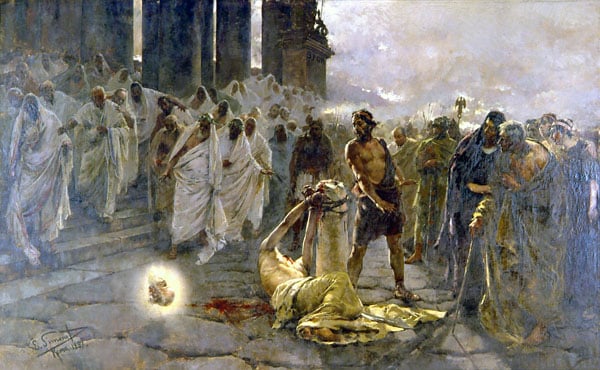
The Apostle Paul (Latin: Paulus and Paullus) was tortured and executed in 67 AD by order of Emperor Nero, accused of spreading the new Christian faith. The apostle was buried about three kilometers from the site of his execution, and his grave was marked with a memorial stone. Later, this part of Rome became known as “Tre Fontane” (Three Fountains), based on the legend that Saint Paul’s severed head struck the ground three times, springing forth three underground springs.
History
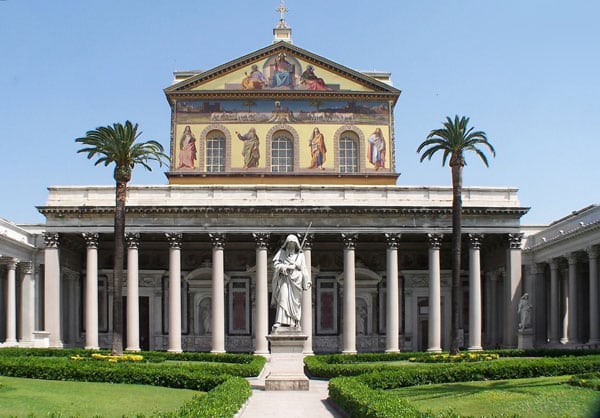
The Basilica of Saint Paul Outside the Walls impresses with its grandeur and solemn architecture. Poet Prudentius praised the beauty of the sacred site in his poem honoring Emperor Honorius. The basilica stands outside the Aurelian Walls, placing it, by early Christian standards, beyond the boundaries of Rome.
The San Paolo Gate (Porta San Paolo), part of the wall marking Rome’s limits, is also a historic site. Tradition holds that it was from this gate that the apostle Paul began his walk to martyrdom. The road south leads directly to the church of Saint Paul (San Paolo).
The basilica was erected over the burial site of Saint Paul, who was executed at the dawn of the Christian era. As many believers came to venerate the grave, it was marked with a commemorative slab. To honor the memory of the beheaded apostle, Emperor Constantine I commissioned the construction of a church in the 4th century AD.
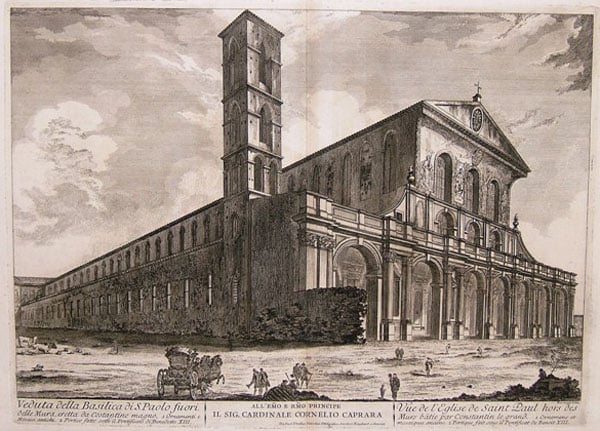
The structure was expanded by order of Emperor Valentinian I, and richly embellished by Theodosius I. Between 590–604 AD, under Pope Gregory the Great, the church underwent major renovations: a new altar was built, and the courtyard was adorned with over a hundred columns. At the center of the courtyard stands a statue of Saint Paul, holding a large book and a sword—so lifelike that it clearly reflects his readiness to die for the Christian faith.
The basilica was first damaged by Saracens in the 9th century, and later destroyed by a great fire in 1823. It was rebuilt and consecrated 31 years later by Pope Pius IX, with help from the global Christian community, including Russia. The church was given a new façade, and decorated with frescoes and mosaics depicting Saint Paul, Christ, and four prophets. In the 13th century, a monastery was established at the basilica.
Note: There are several churches in Rome dedicated to Saint Paul:
- The Papal Basilica of Saint Paul Outside the Walls (Basilica Papale San Paolo fuori le Mura), located at Piazzale San Paolo, 1 – this is the one described in this article.
- The Church of Saint Paul Within the Walls (Chiesa di San Paolo entro le Mura), near Piazza della Repubblica, at Via Nazionale, 16a – it hosts symphonic concerts.
- The Basilica of Saints John and Paul (Basilica Santi Giovanni e Paolo), near the Colosseum, at Piazza Dei SS. Giovanni e Paolo.
- The Basilica of Saints Peter and Paul (Basilica dei Santi Pietro e Paolo), located in the EUR district, at Piazzale dei Santi Pietro e Paolo, 8.
- The Church of San Paolo al Martirio (Chiesa di San Paolo al Martirio), at Via di Acque Salvie, 1.
La Traviata Opera at the Church of Saint Paul Within the Walls
Every Thursday and Saturday, visitors can enjoy Giuseppe Verdi’s masterpiece, La Traviata, performed at the Church of Saint Paul Within the Walls (Chiesa di San Paolo entro le Mura), located at Via Nazionale, 16a, 00184 Rome. The performance begins at 8:30 PM, and tickets range from €25 to €50. They can be purchased through the official ticket office at tiqets.com — highly recommended!
You may also find our Rome Theater Guide helpful.
How to Get There
Address: Piazzale San Paolo, 1
San Paolo Fuori le Mura is located in the southern part of Rome, about two kilometers beyond the Aurelian Walls. You can visit the basilica on a guided tour or explore it on your own. The site is visitor-friendly, offering wheelchairs and allowing guide dogs for the visually impaired. There are souvenir shops at the entrance.
You can reach the church by:
- Metro Line B — exit at Garbatella or Marconi stations;
- Bus No. 23 or 769 — get off at the Via Ostiense-San Paolo stop;
- Tram No. 2 — exit at the Basilica S. Paolo stop.
Opening Hours
- Opening hours: daily from 7:00 AM to 6:30 PM; the monastery and cloister are open from 8:00 AM to 6:15 PM. Confessions are heard from 7:00 AM to 12:30 PM and from 4:00 PM to 6:30 PM.
- Official website of the basilica: www.basilicasanpaolo.org