 Italy for me From Italy with love


The Basilica of Santa Maria del Popolo (Basilica di Santa Maria del Popolo) in Rome is a striking testament to the idea that true beauty often hides beneath a modest exterior. Its façade does not attract attention with elaborate decoration or unusual forms, but behind the walls of this seemingly plain building lie unique treasures.
Page Contents
Legends and Facts
The church building was constructed in the 1470s. Previously, a Roman chapel from the late 11th century stood on the site. The basilica owes its name to an ancient legend: it was believed that the tomb of Emperor Nero, the notorious persecutor of Christians, once stood here. Centuries later, a poplar tree (populus in Latin) grew over the crypt, and flocks of crows gathered in its branches. The site gained a reputation as cursed, and townspeople avoided it until, in 1099, Pope Paschal II was visited by the Virgin Mary in a vision, commanding him to cut down the tree. The pope promptly obeyed and ordered the construction of a chapel on the site, dedicated to her.
Another, less romantic, version suggests that the name originated from the phrase popolo romano (“Roman people”), as the funds for the chapel’s construction were collected through public contributions.
In 1277, by order of Pope Gregory IX, a small church replaced the chapel. At that time, an icon of the Virgin Mary—believed to have been created by the Evangelist Luke—was moved to the new church from the Basilica of Saint John Lateran (Basilica di San Giovanni in Laterano), located on the Lateran Hill in Rome. In reality, the Madonna image was painted in the 13th century in Siena.
In 1250, the church came under the jurisdiction of the Order of Saint Augustine. The building underwent several reconstructions, with a major renovation taking place in the mid-15th century by order of Pope Sixtus IV. The redesign was overseen by Andrea Bregno and Baccio Pontelli. Santa Maria del Popolo became one of the first churches in Rome where Renaissance architecture predominated. It was then that the basilica acquired the appearance it retains today.
Interior
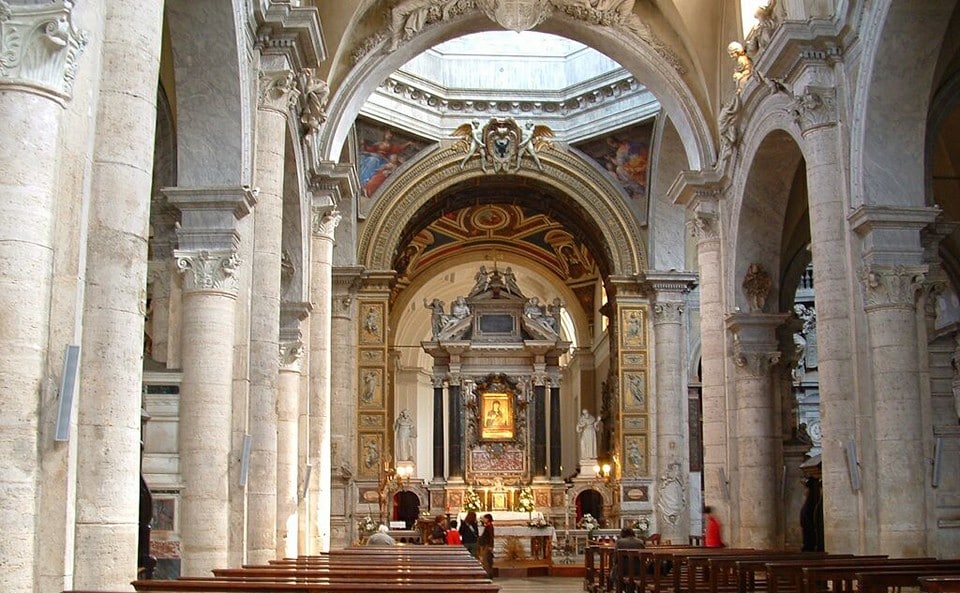
Step through the doorway and magnificent interiors unfold before your eyes—rivaling even those of major city cathedrals.
Humble on the outside, this church dedicated to the Holy Virgin reveals itself in the most surprising way. And when you discover the great masterpieces adorning its walls and the renowned names behind them, you realize that passing it by would be an inexcusable mistake.
Over the years, the design and decoration of the church’s interior involved Donato Bramante, Raphael (Raffaello Santi), and Andrea Bregno. In the mid-17th century, Gian Lorenzo Bernini undertook another major renovation of the basilica; since then, the décor has been dominated by the Baroque style.
Chigi Chapel
Even those who have never visited the Eternal City may recognize this chapel from the film adaptation of Dan Brown’s novel Angels and Demons. Part of the movie’s action takes place in the Chigi Chapel (Cappella Chigi). It was named after its patron, the banker Agostino Chigi. The future family mausoleum was designed by Raphael, who also decorated the chapel’s dome with the mosaic The Creation of the World. Until the end of the 16th century, the church also housed two of Raphael’s paintings. A century later, Bernini renovated the chapel at the request of another Chigi family member, Cardinal Fabio Chigi, who later became Pope Alexander VII.
Caravaggio’s Works in the Cerasi Chapel
The Cerasi Chapel (Cappella Cerasi) is associated with another illustrious Italian master, Caravaggio. Here, two of his original works are preserved: The Conversion on the Way to Damascus (also known as The Conversion of Saul) and The Crucifixion of Saint Peter.
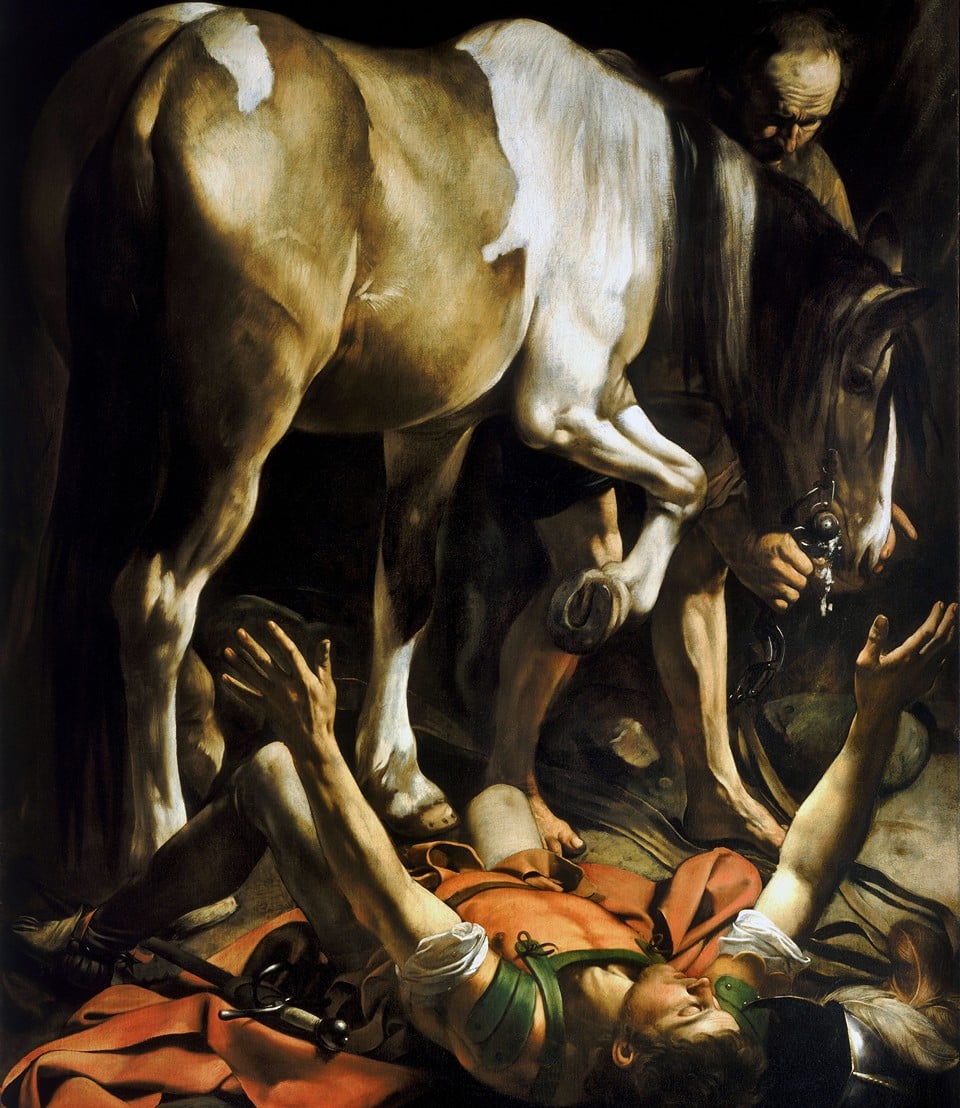
The Conversion of Saul, painted in a realist style, is one of Caravaggio’s most brilliant achievements. Above the altar hangs the canvas The Assumption of the Virgin Mary by Annibale Carracci.
Pinturicchio in the Della Rovere Chapel
Special mention should be made of the Della Rovere family chapel. Built at the end of the 15th century, it was painted by Pinturicchio and his pupils. Pinturicchio also decorated the Cybo Chapel, but his work there can no longer be seen: at the end of the 17th century, the chapel was renovated by Carlo Fontana, an architect who followed Bernini’s style.
Other Chapels
The Cybo-Soderini Chapel (also known as the Chapel of the Crucifixion) and the Theodoli Chapel are less “popular” with tourists but are no less fascinating. The former was decorated by the Flemish painter Pieter van Lint and houses a 15th-century wooden crucifix. The latter is designed in the Roman Mannerist style and features stucco decorations by sculptor Giulio Mazzoni.
The basilica’s altar is adorned with two stained glass windows crafted by the French artist Guillaume de Marcillat. Dating to 1509, they are considered the oldest stained glass windows in Rome. The altar itself was created by Andrea Bregno between 1472 and 1477.
Opening Hours and Directions
The basilica is located at Piazza del Popolo, 12.
The church is open daily from 7:00 to 12:00 and from 16:00 to 19:00, and on Sundays from 8:00 to 19:30. Admission is free.
Public transport: Take the metro Line A (red) to the Flaminio or Spagna station, then continue on foot.