 Italy for me From Italy with love


The Fountain of the Tritons (Fontana dei Tritoni) is one of Rome’s remarkable monuments from the Late Baroque period. While it may not rival the grandeur of the iconic Trevi Fountain (Fontana di Trevi), it undoubtedly possesses a unique charm and allure.
The location of the fountain is steeped in centuries of history—home to ancient Roman ruins, medieval churches, and the famed Mouth of Truth (Bocca della Verità). The depiction of the sea god Triton on an ancient stone relief inspired the fountain’s theme and gave it its name.
Don’t confuse this monument with another landmark—the Triton Fountain (Fontana del Tritone) located in Piazza Barberini, a work by Gian Lorenzo Bernini.
Page Contents
Where is it located?
The Fountain of the Tritons is situated in the Rione Ripa district, on Piazza della Bocca della Verità, directly opposite the Basilica of Santa Maria in Cosmedin.
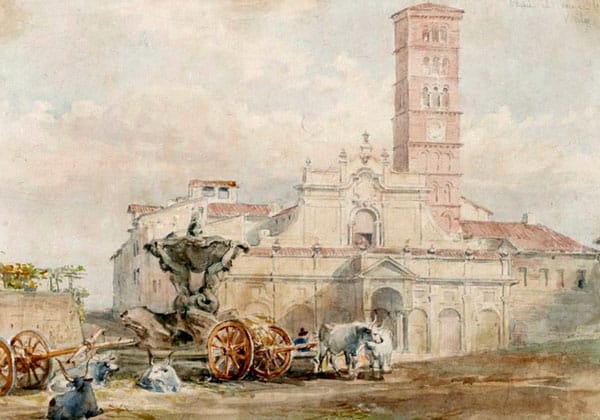
Until the 2nd century BCE, this area was known as the Forum Boarium (Foro Boario)—Rome’s oldest commercial square. After the construction of the new Emporium port further downstream on the Tiber River, the Forum Boarium became filled with residences, warehouses, and temples.
Today, several ancient structures are still visible near the Fountain of the Tritons on modern-day Piazza della Bocca della Verità:
- Temple of Portunus (Tempio di Portuno) – circa 80 BCE;
- Temple of Hercules Victor (Tempio di Ercole Vincitore), also known as the Temple of Hercules the Olive-Bearer (Tempio di Ercole Oleario) – circa 120 BCE;
- Arch of the Moneychangers (Arco degli Argentari) – 204 CE;
- Arch of Janus (Arco di Giano) – 4th century CE.
On the site of the now-lost Temple of Hercules Pompeianus, built in the 1st century BCE, the Basilica of Santa Maria in Cosmedin was constructed in the 6th century. Today, the church is famous for housing the legendary Mouth of Truth in its portico.
Construction History
The construction of the new fountain on Piazza della Bocca della Verità was commissioned by Pope Clement XI as part of a broader renovation of the square and a way to immortalize his name near the monuments of Ancient Rome.
Site Selection
The Acqua Felice aqueduct and its water distribution network, built in 1587, made it possible to bring water to some of Rome’s most distant districts, and the Pope took full advantage. At the time, many of the pontiff’s contemporaries considered the site poorly chosen, since the area was sparsely populated and often flooded when the Tiber River rose.
The Basilica of Santa Maria in Cosmedin sat about 6.5 feet (2 meters) below the level of the square, leading to chronic dampness on the ground floor caused by flooding.
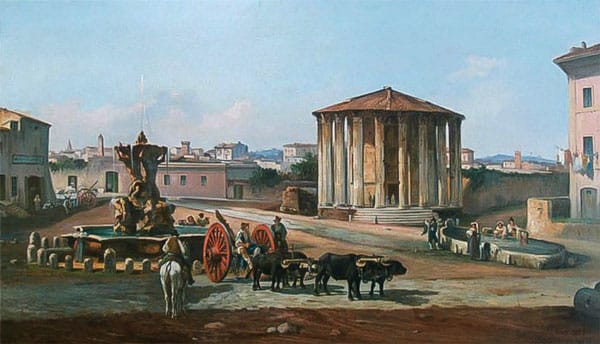
In 1715, renovations to level and restore the square coincided with the construction of the Fountain of the Tritons, which became a symbolic stone emblem of Clement XI.
Architect and Sculptor
The fountain’s design is attributed to Perugian architect Carlo Francesco Bizzaccheri, a student of Carlo Fontana, though Bizzaccheri had a distinct personal style. He was clearly inspired by the Triton Fountain in Piazza Barberini and the heraldry of the Albani family, to which Pope Clement XI belonged.
The fountain’s sculptural group was created by Francesco Moratti of Padua. During Clement XI’s pontificate, Moratti’s talent flourished, and he even gained renown as the pope’s personal portraitist. His most acclaimed work was the statue of Saint Simon for the gallery of the twelve apostles in the central nave of the Basilica of Saint John Lateran.
Description
The Triton Fountain, built entirely from travertine, has a relatively simple design. Its base, a single step, takes the shape of a concave octagonal basin, reminiscent of the star on Clement XI’s coat of arms.
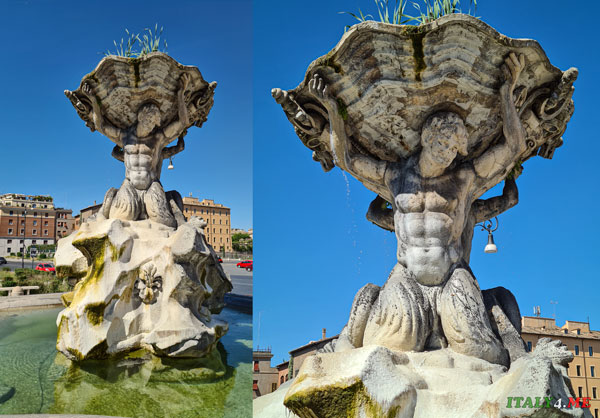
At the center is a rugged group of rocks sculpted by stonemason Filippo Bai. This feature appealed to the pope, having already been used in the famous Fountain of the Four Rivers and the Fountain of Porto di Ripetta.
Atop the rough stone pedestal sit two powerful Tritons, kneeling back to back with intertwined tails. They hold aloft a stylized shell basin, which serves as the fountain’s upper reservoir. On the outer rim of the shell, the recognizable coat of arms of Pope Clement XI is engraved, and at its center, a trio of hills releases a small stream of water.
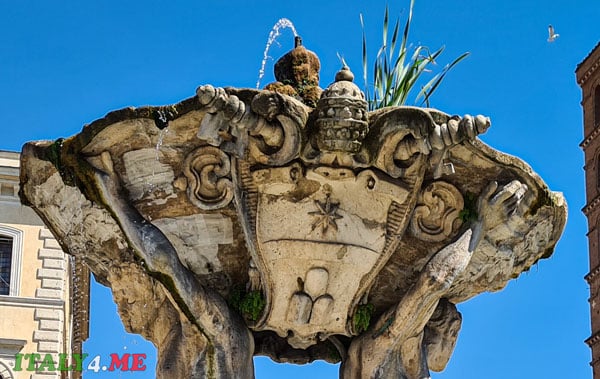
Interestingly, the depiction of hills in papal coats of arms is not only a nod to the hills of Rome but also a spiritual metaphor for mountains as a symbol of closeness to God.
Originally, the fountain featured four masks through which water would flow, but these were removed in the 19th century due to inadequate water pressure.
For more, check out our article on Rome’s most beautiful fountains and squares.
Interesting Facts
At the same time as the Triton Fountain, Bizzaccheri constructed a simple oval-shaped basin nearby—a watering trough for livestock. Since this area was once the southern edge of Rome within the city walls, herds of domestic animals heading toward the abandoned Roman Forum for grazing were a common sight. Later, following the construction of a retaining wall along the Tiber River, the trough was relocated elsewhere.
For many years, the Triton Fountain remained dry and largely overlooked. Thanks to restoration efforts initiated by the Rome municipality in the 1990s and again in 2010, this Baroque gem has been beautifully restored and once again delights visitors with its charm.