 Italy for me From Italy with love


Piazza Barberini is a notable landmark in the central part of Rome. It takes its name from the noble Roman family, the Barberini.
Page Contents
History of the Square
In ancient times, the area where Piazza Barberini now stands was home to a temple dedicated to the goddess Flora. Grand public celebrations marking the arrival of spring were held nearby.
In the early 16th century, a formal square was laid out here and originally named after Cardinal Grimani. In 1625, it was renamed to honor the prominent Sforza family of Milan. Their estate was later purchased by Maffeo Barberini, the future Pope Urban VIII, who in 1627 commissioned the construction of a grand palazzo on the site.
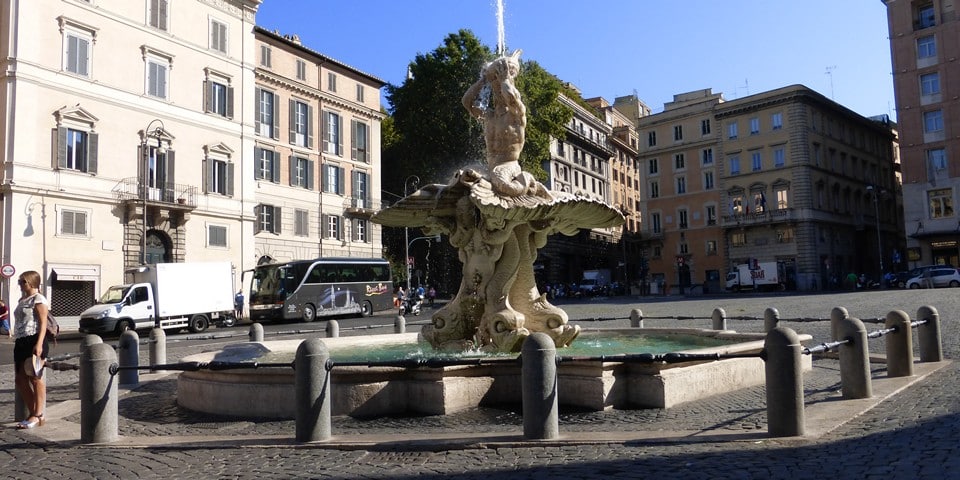
Pope Urban VIII was a celebrated and scholarly figure of his time. He possessed an impressive library, maintained a friendship with Galileo Galilei, and was a strong patron of the arts. He initiated numerous architectural projects in Rome and intended the square and palace to stand as lasting monuments to the Barberini legacy.
The square was officially named in 1633, when the grand Palazzo Barberini rose on its southern side and formal gardens were laid out around the perimeter.
In the mid-17th century, under the direction of architect and sculptor Gian Lorenzo Bernini, a theater bearing the square’s name was constructed. This venue became a cultural hub of the city: it hosted scholars, artists, theatrical performances, musical evenings, balls, and poetry readings. The theater stood until 1873, when it was demolished to make way for Via Barberini.
Later in Rome’s history, after the palazzo’s completion, the square took on a somber role: it became associated with the ritual identification of unknown deceased residents. From the time of its construction until the 18th century, a cart carrying unclaimed bodies would depart from the square and travel the streets of Rome, allowing citizens to identify missing loved ones.
Following Pope Urban VIII’s vision, Piazza Barberini was meant to form a harmonious ensemble with the adjacent palazzo. As part of this plan, two iconic fountains were built here—the Triton Fountain and the Fountain of the Bees—both featuring symbols of the ancient and illustrious Barberini family.
Also read: Rome’s most beautiful squares and fountains
Triton Fountain
The Triton Fountain (Fontana del Tritone) was built by architect Bernini in 1642 at the request of Pope Urban VIII. It was designed to complement the recently completed Palazzo Barberini.
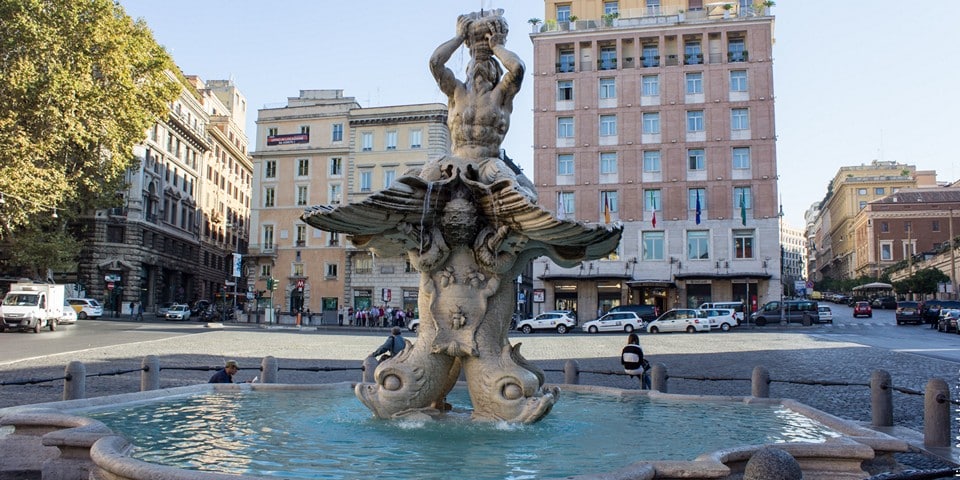
The fountain was carved from travertine, a local stone favored since ancient times for its malleability and ability to capture intricate detail. Water was supplied via the restored ancient Roman aqueduct, the Acqua Felice.
The design of the fountain was unlike anything previously built in Rome—or even by Bernini himself. The sculptural group illustrates a scene from Ovid’s Metamorphoses, in which Triton, the mighty son of Neptune and the sea goddess Amphitrite, blows a conch shell that commands the seas.
Instead of using stacked basins typical of earlier fountains, Bernini introduced a radically new concept.
The fountain embodies the new artistic style of the Baroque period. Every element in the composition features dynamic, flowing lines that suggest movement and drama.
The base of the sculpture consists of four dolphins, heads down and mouths open, with their curved tails lifting a massive open shell. From this shell rises the powerful figure of Triton—half-man, half-fish—who leans back with a twisting tail, lifting a conch shell to his lips as he blasts a strong jet of water into the air.
When it was first built, the fountain’s jet was high and thunderous, earning it the nickname “Roaring Triton.”
Locals adored the fountain, believing its water to be a divine gift from the sea god—imbued with magical properties said to bring peace and harmony.
Read more about ancient Roman aqueducts and baths, as well as the nearby Fountain of the Tritons (Fontana dei Tritoni), located close to the Mouth of Truth (Bocca della Verità).
The Barberini Bees
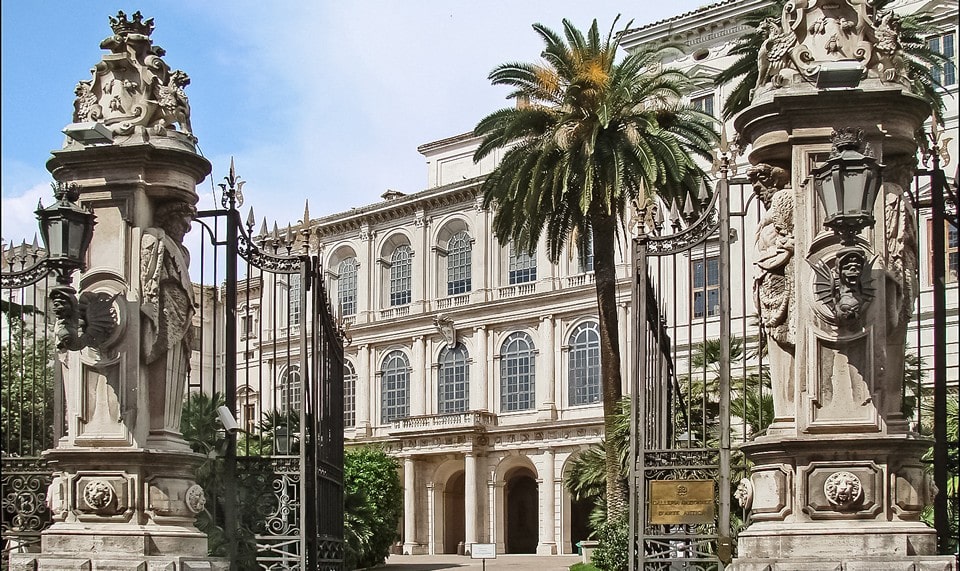
One of the most distinctive features of the sculptural ensemble is the papal tiara and the Barberini family crest adorned with three bees. The bees symbolize the family’s devotion to hard work and domestic values, as well as a celebration of talent and selfless craftsmanship.
The bees’ appearance on the family coat of arms is tied to an old legend. The Barberini lineage, prominent in Florence since the 11th century, once faced a crisis when a young heir fell gravely ill. Despite the efforts of renowned physicians, no cure could be found. By chance, a humble man who gathered wild honey learned of the family’s misfortune. Using bee venom and herbal honey-based remedies, he cured the child. As the boy recovered, the healer vanished, never revealing his name or requesting payment. In gratitude, the family adopted the bee as a symbol of healing and labor, placing it on their heraldic shield.
Pope Urban VIII, seeking to complete the architectural harmony of the square, decided one fountain wasn’t enough. He commissioned Bernini to create another. Thus, the Fountain of the Bees was born.
Fountain of the Bees
The Fountain of the Bees (Fontana delle Api) was created in 1644, two years after the Triton Fountain, but it was not placed in the center of the square. Originally installed at the beginning of Via Felice, it was relocated in the 1800s to the corner of Via Vittorio Veneto and Via di San Basilio. Naturally, the fountain’s designer was Bernini—Urban VIII’s favorite artist. 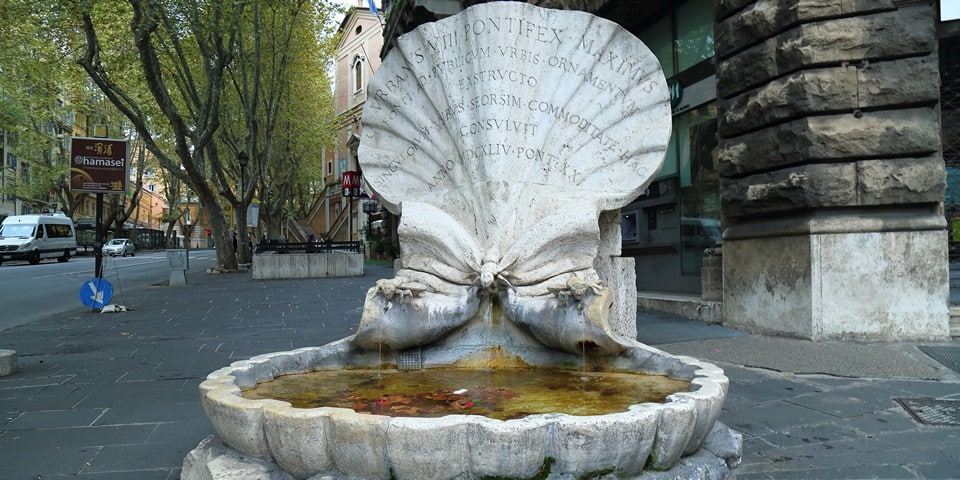
This delicate and elegant fountain is shaped like an open shell, at the base of which three bees rest, releasing fresh water into the basin.
Water flows gently into the lower shell. On the upper shell, an inscription bears the name of Pope Urban VIII. The base is formed from raw, unpolished stones, which contrast strikingly with the refined details of the shell and bee figures.
The inscription includes a couplet composed by Urban VIII himself, marking the 22nd year of his papacy.
- Fun fact: The date had to be altered—he died eight days short of his 22nd year as pope. The original Roman numeral XXII was reduced to XXI. Learn more on Instagram: @joldersman.
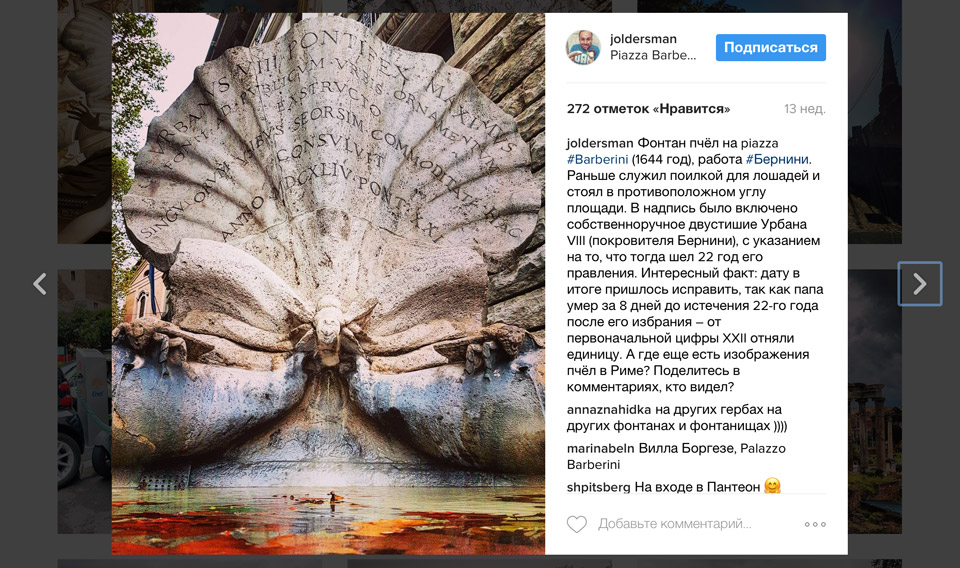
This small but beautifully crafted fountain celebrates the bee’s industrious nature and its service to humanity. It’s also a meaningful visual element of the square. Shaded by plane trees, the area invites visitors to rest and sip its fresh water—while the legendary stories of the Barberini family offer food for thought on life and legacy.
How to Get There
Piazza Barberini is easily reached via the Rome Metro (Line A). The Barberini station is located directly beneath the square. Within a five-minute walk, you’ll also find famous landmarks like the Trevi Fountain and the Spanish Steps.