 Italy for me From Italy with love


The Temple of Portunus (Tempio di Portuno) in Rome is located at the Forum Boarium (Il Foro Boario), along the banks of the Tiber River. In ancient Roman times, a port and livestock market operated near the temple. The Temple of Portunus is one of the few surviving structures from antiquity.
Page Contents
History
The Temple of Portunus is dedicated to Portunus (Portuno or Portumnus), originally the ancient god of keys, gates, granaries, and livestock. Later, the Latin words “porta” (gate) and “portus” (harbor) became associated, and Portunus also came to be regarded as the god of rivers, believed to grant sailors safe passage. The festival of Portunalia was celebrated in his honor, during which, according to tradition, old keys were burned in fire or brought to the forum.
The monument we see today dates to the 1st century BC, during the Roman Republic. In 1947, beneath the sanctuary, archaeologists uncovered the ruins of a large structure from the 4th–3rd centuries BC, likely the foundation of an earlier Temple of Portunus. From the Renaissance through the 20th century, this ancient pseudoperipteros was mistakenly identified as the Temple of Fortuna Virilis (Fortuna Virile).
In 872 AD, the temple was converted into the Christian church of Santa Maria in Gradellis (Chiesa Santa Maria Secundicerii), later rededicated as the Church of Saint Mary of Egypt (Santa Maria Egiziaca), the patron saint of repentant women. This conversion ensured the temple’s survival, and frescoes depicting scenes from the life of the Virgin Mary (madre di Gesù) can still be seen on its walls. Together with the nearby Temple of Hercules (Tempio di Ercole Vincitore), the Temple of Portunus offers a glimpse into the appearance of Rome at the dawn of the common era.
Since the early 20th century, the temple has undergone extensive restoration — later decorative elements were removed, walls and columns restored, frescoes conserved, and the door replaced. A new wooden roof was constructed, ancient tiles were reinstated, and a modern drainage system was installed. Restoration of the façade’s columns included biocide treatment, cleaning, replacing old beams with stainless steel reinforcements.
The Temple of Portunus is frequently studied in university programs as an outstanding example of classical Ancient Roman architecture.
Structure Specifications
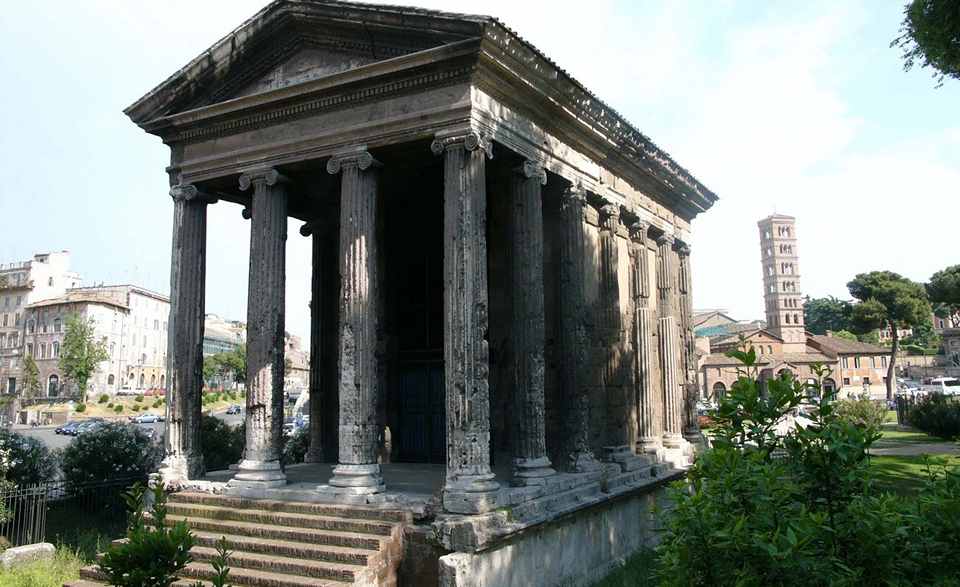
The floor plan of the Temple of Portunus is a rectangle measuring approximately 10.5 by 19 meters (34 by 62 feet). The enclosed inner sanctuary, or cella, extends into a portico surrounded by six columns with bases, shafts, and capitals. The portico is known as tetrastyle, featuring four columns at the front.
The facades are adorned with engaged columns or pilasters — five on each side and four on the southern wall. The corner columns’ capitals differ from the others by having double volutes forming right angles. The frieze above the pilasters was originally decorated with garlands, cupids, and ornamental bull heads.
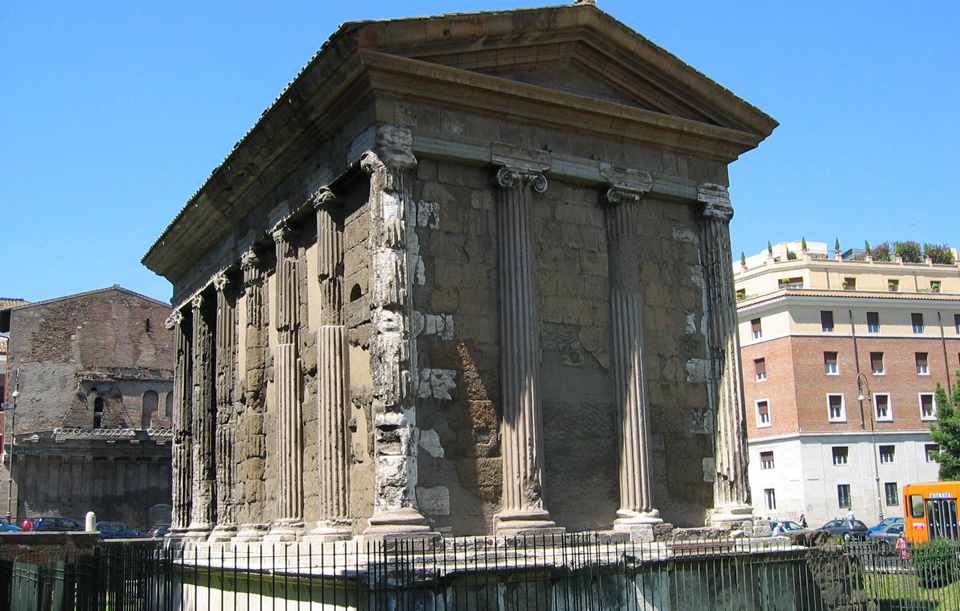
The temple stands on a high concrete podium, with supporting structures made of travertine and other parts constructed from volcanic tuff.
The raised podium was designed to protect the structure from flooding. None of the original decorative stucco, which imitated marble and concealed the dark color of the tuff, has survived. The use of more durable materials, rather than the traditional Italian construction of clay-bound brick blocks and wood, reflects a shift in architectural values across the Mediterranean at the end of the first century BC.
Read also about the Roman Forum.
How to Get There
- Bus routes: 44, 83, 160, 170, 716, 781, C3, N3, or N19 to the “Bocca Della Verita” stop; 51, 81, 85, 87, 118, 160, 628, 715, C3 to the “Greca” stop.
- By metro: take Line B to the Circo Massimo station and enjoy a walk across the Circus Maximus.
The temple is located on Piazza Bocca della Verità, next to the Temple of Hercules. It is closed to visitors, but the façade can be viewed from outside.