 Italy for me From Italy with love


Urbino is an Italian city located in the Marche region, not far from the Adriatic coast, near the resort towns of Rimini and Pesaro, as well as the Republic of San Marino. It is best known as the birthplace of Raphael Santi.
Urbino held a prominent role in the development of culture, education, and politics during the Renaissance. Its historic city center is recognized as a UNESCO World Heritage Site for its outstanding preservation and cultural importance.
Page Contents
Things to Know before Visit Urbino
What is Urbino known for?
Urbino what to do?
Urbino what to see?
Interesting Facts about Urbino
- Urbino, nestled in Italy’s Marche region, has a history stretching back over 2,400 years, with evidence of settlement around 220 BCE.
- Renowned Renaissance architect and artist Donato Bramante—designer of St. Peter’s Basilica in Vatican City—was born here in 1444.
- The Ducal Palace, a UNESCO World Heritage Site, houses the National Gallery of the Marche, featuring masterpieces by Piero della Francesca, Raphael, and Titian.
- In the 15th century, under Duke Federico da Montefeltro, Urbino became a thriving hub of Renaissance culture and education, with one of Europe’s most prestigious universities.
- Urbino’s remarkably well-preserved historic center, with its winding streets and Renaissance architecture, continues to attract history and art lovers from around the world.
History
Founded in the 3rd century BCE during the Roman Republic and originally named Urvinum Mataurense, Urbino has seen many rulers over the centuries. During the Gothic Wars of the 6th century, it changed hands between the Germanic tribes, the Lombards, and the Franks. In the 8th century, it was ceded to the Papal States by Pepin the Short, king of the Franks. From 1213 onward, the powerful Montefeltro family ruled the Duchy of Urbino.
The most significant period in Urbino’s history came under the rule of Federico da Montefeltro (1444–1482). He was a visionary leader, diplomat, and patron of the arts who transformed Urbino into the ideal Renaissance city—designed to reflect beauty, harmony, and humanist ideals.
Another pivotal moment came in 1502 when Urbino was absorbed into the Papal States under Cesare Borgia. This marked the beginning of a slow decline that lasted into the 17th century.
In the late 18th century, Napoleon’s army conquered Urbino and looted many of its treasured artworks. The 19th century brought architectural change, including the construction of the city’s current cathedral. In 1860, Urbino joined the newly unified Kingdom of Italy, alongside Lombardy, Tuscany, and other regions, during the war of independence against Austrian rule.
Landmarks in Urbino
Known during the Renaissance as the “Ideal City,” Urbino perfectly embodied the era’s vision of urban beauty and order.
Set dramatically across two hills, the city is characterized by steep cobbled streets lined with stately palaces and historic buildings.
Via Aurelio Saffi, the ancient Roman cardo, runs north to south through the city, leading to the heart of Urbino: Piazza Duca Federico and nearby Piazza Rinascimento.
Ducal Palace
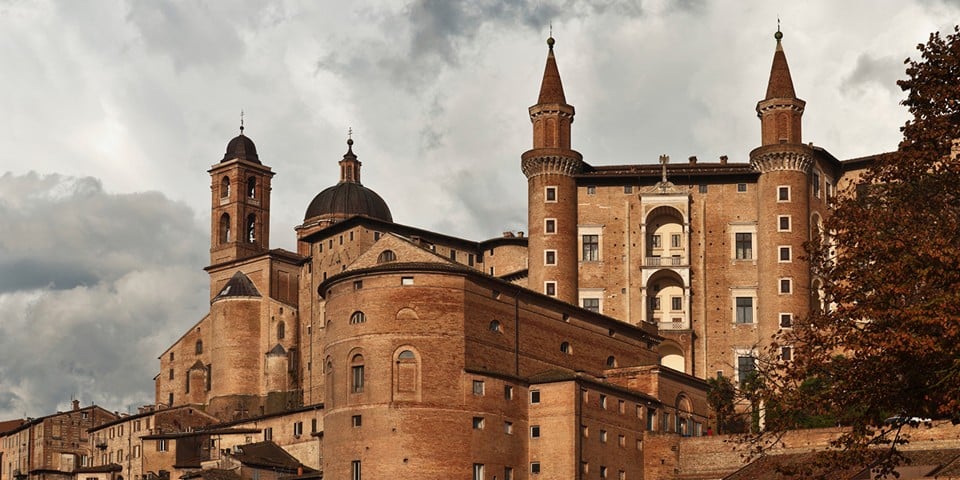
Located in Piazza Duca Federico, the Ducal Palace (Palazzo Ducale) is one of Italy’s finest Renaissance buildings. Today, it houses the National Gallery of the Marche.
Commissioned by Duke Federico da Montefeltro and built on the foundation of an earlier fortress, the palace brought together some of the era’s greatest minds—Piero della Francesca, Fra Luca Pacioli, Francesco di Giorgio Martini, Luciano Laurana, and Paolo Uccello.
Though never fully completed, the palace includes highlights like the stables designed for 300 horses and the famous Spiral Staircase (Scala a Chiocciola) by Francesco di Giorgio Martini.
The architectural ensemble inspired many later artists. In the 19th century, the Sanzio Theater (Teatro Sanzio) was added. The palace later served as the city’s administrative seat before becoming a museum in 1985.
The University in Urbino
The University of Urbino Carlo Bo, founded in 1506, was among the first in Europe. It originally focused on medicine but quickly expanded to include law, rhetoric, logic, and philosophy. Today, it boasts 10 faculties and is a major cultural institution in the city.
Church of Saint Dominic
The Church of Saint Dominic (Chiesa di San Domenico), situated opposite the Ducal Palace, blends Renaissance architecture with Gothic elements added during its 1729 reconstruction.
Republic Square
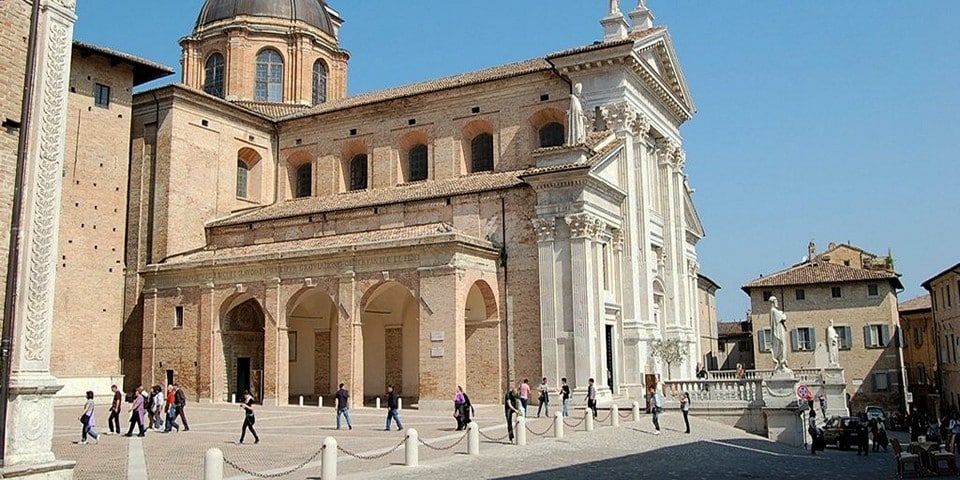
Formerly a bustling market, Piazza della Repubblica is connected to Piazza Duca Federico via Via Vittorio Veneto. At its center stands a fountain built in 1927, adding charm to this popular gathering place.
Cathedral
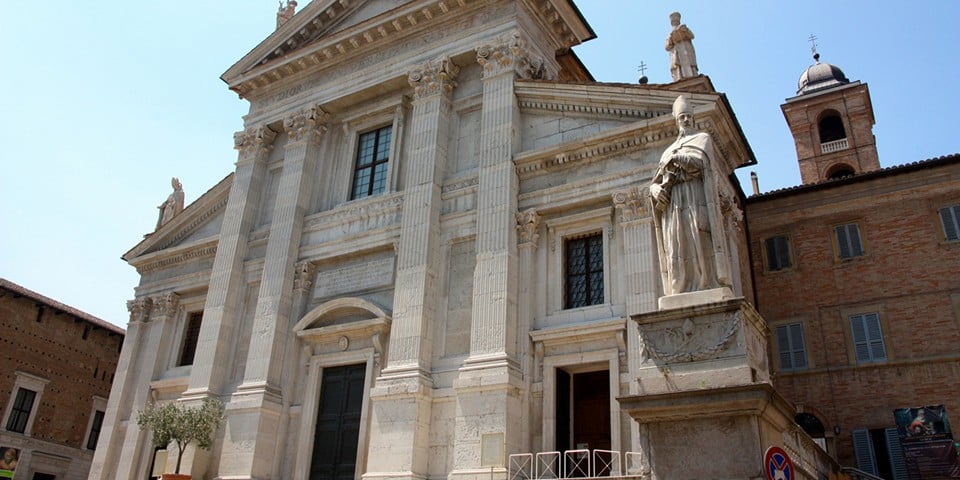
Located on Piazza Duca Federico, Urbino’s Cathedral is dedicated to the Assumption of the Virgin Mary. Originally built in 1062, it has undergone several reconstructions:
- The first major renovation took place in the 15th century under Federico da Montefeltro, led by architect Francesco di Giorgio Martini.
- After a devastating earthquake in 1789 caused the collapse of the earlier structure, the current cathedral was rebuilt in neoclassical style by Giuseppe Valadier.
The cathedral’s interior features notable artworks and architectural elements:
- “The Assumption of the Virgin Mary” by Franz Richard Unterberger
- “The Martyrdom of Saint Sebastian” by Federico Barocci
- “The Annunciation” by Raffaello Motta
The cathedral also features a neoclassical façade by Camillo Morigia, a bell tower, and sculptures honoring Urbino’s patron saints. The city’s most venerated saint is Saint Crescentino (San Crescentino), and his feast is celebrated each year on June 1st.
The Birthplace of Raphael
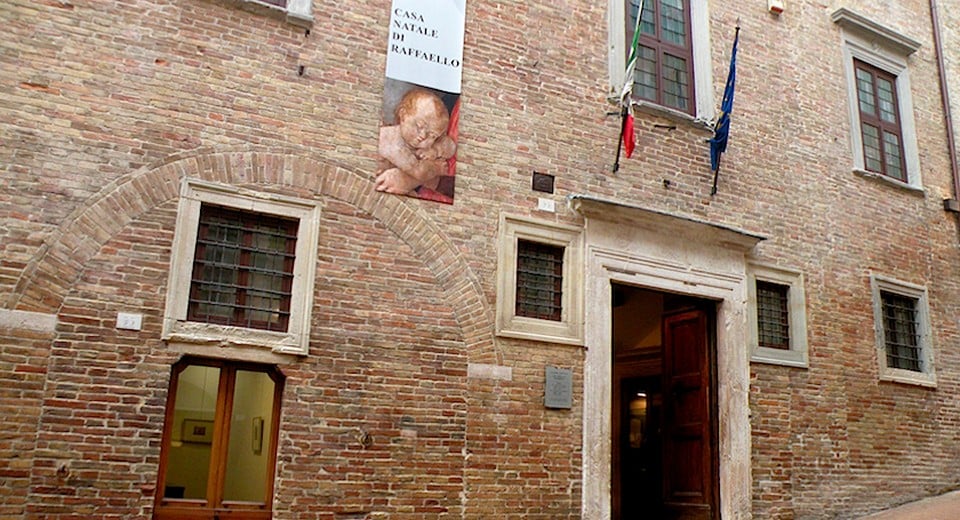
The three-story house at number 57 Via Raffaello, where Raphael Santi was born in 1483, preserves works by his father, Giovanni Santi—a respected court painter and decorator. The home also contains frescoes created by Raphael in his youth.
Raphael lived in this house until the age of 17. Since the 19th century, it has been a museum dedicated to his life and work, marked by a commemorative marble plaque on the facade.
Inside, visitors can explore original Renaissance-era furnishings, collections of ceramic art, medieval manuscripts, rare books, and a numismatic display.
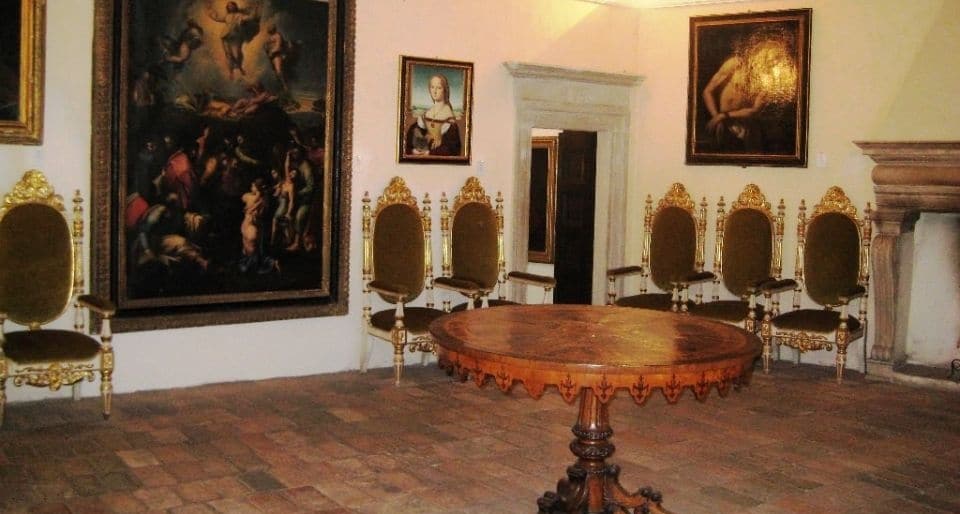
Guests can view the original basin used for mixing paints in Raphael’s time, as well as authentic works by Giovanni Santi and reproductions of Raphael’s most celebrated paintings.
Official website of the Raphael House-Museum: www.accademiaraffaello.it
How to Get to Urbino
The nearest airport to Urbino is in Rimini. To reach Urbino, travelers can take a connecting route via Pesaro.
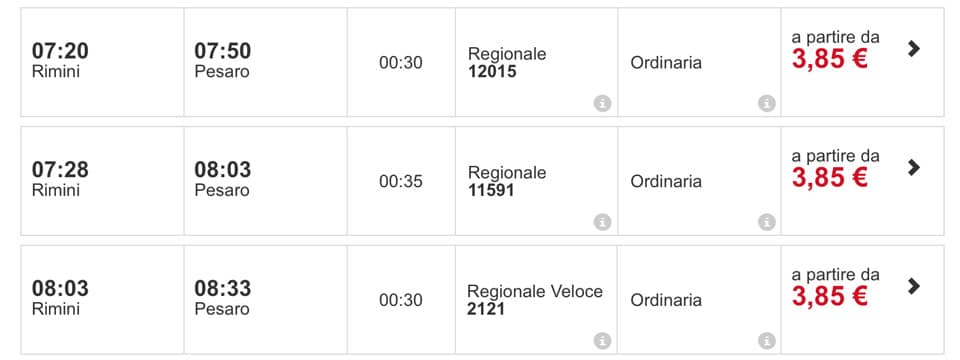
There are no direct trains to Urbino, so you’ll need to buy a ticket to Pesaro. Regional trains run approximately every 30 minutes, with tickets priced at €3.85. The journey takes about 30 minutes.
- For detailed information, consult the Italian train travel guide.
Alternatively, buses operated by FlixBus.com connect Rimini and Pesaro, offering an economical travel option within Italy and across Europe.
From Pesaro, bus N46 takes you directly to Urbino in approximately 45–50 minutes. Tickets cost around €3, and schedules can be found on the adriabus.eu website.
Although public transport is affordable, the journey may be time-consuming. For greater convenience and flexibility, consider renting a car. Rental rates at Rimini Airport start at around €250 for 5 days, allowing you to explore Urbino and nearby destinations at your own pace.
Hotels in Urbino
Urbino offers over 49 comfortable accommodation options ranging from budget stays to elegant historical hotels, catering to a variety of travelers.
The most popular choices are 3- and 4-star hotels, often located in charming historic buildings.
3 Stars
These hotels provide affordable comfort, often within walking distance of major landmarks, and offer views of Urbino’s enchanting Renaissance streets.
Albergo Italia
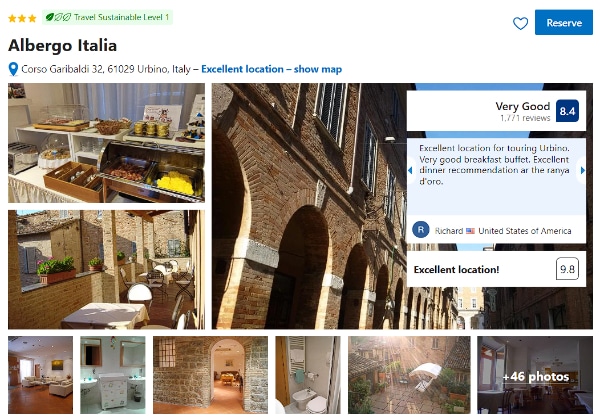
Located just a 5-minute walk from the Ducal Palace and Raphael’s House Museum, Albergo Italia is one of the city’s oldest hotels. The rooms are tastefully decorated and equipped with modern amenities. An open-air terrace invites guests to enjoy breakfast with a view. The hotel is also pet-friendly.
Hotel Piero Della Francesca
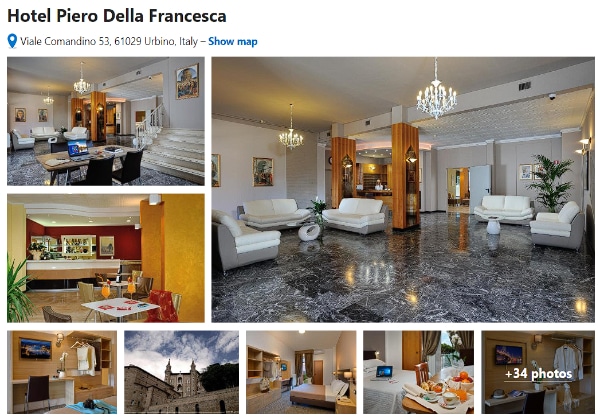
Hotel Piero Della Francesca is located just 15 minutes from Urbino’s historic squares. Spacious rooms offer scenic views of the city’s rooftops and natural surroundings. The hotel features refined interiors, meeting halls for seminars and forums, and an in-house restaurant.
Facilities are available for seniors and guests with limited mobility.
4 Stars
Urbino’s 4-star hotels are located near key landmarks and provide upscale amenities for international travelers seeking elegance and comfort.
Hotel Mamiani & Kì-Spa Urbino
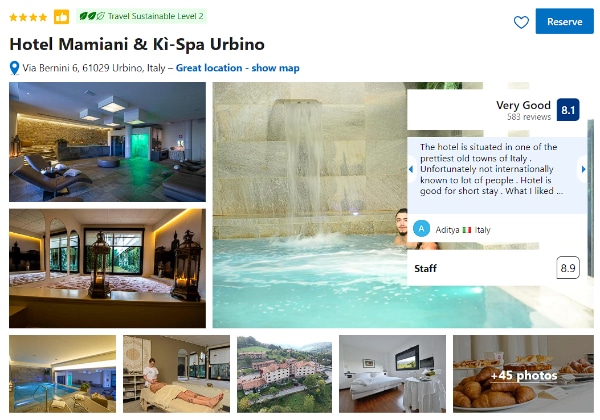
Mamiani & Kì-Spa offers a luxurious stay with a wellness center, fitness area, indoor and outdoor pools, and a panoramic rooftop terrace. Rooms are tastefully decorated with classical artwork reproductions and include modern amenities. The hotel is pet-friendly.
Hotel Bonconte
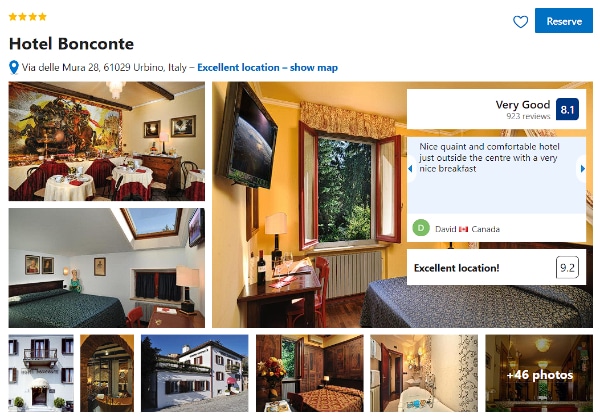
Bonconte is a refined hotel set in a historic villa, just a 5-minute walk from the Ducal Palace. Rooms feature antique furnishings, and some have balconies overlooking gardens, vineyards, and hillside views. Guests can enjoy breakfast in a serene private garden. The hotel includes reading and conference rooms and welcomes pets.
Apartments and B&Bs
For a more personalized experience, Urbino offers charming B&Bs and apartment stays with cozy courtyards, relaxing areas, and spa-like features such as Jacuzzis.
B&B Villa Paradiso
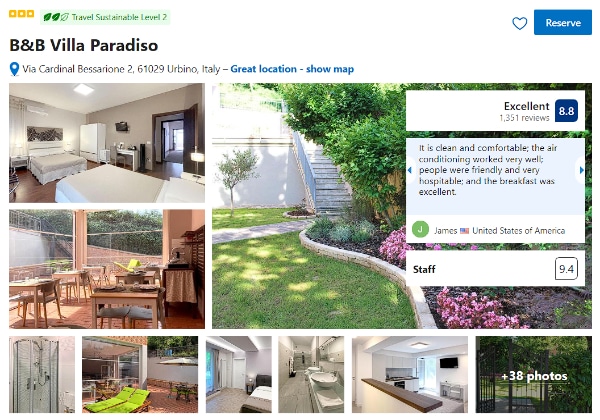
Villa Paradiso is a serene bed and breakfast with beautiful views of tree-lined gardens and historic rooftops. Located just 600 meters from the Cathedral and 10 minutes from major attractions, it features hydro-massage tubs, a sun terrace, and a courtyard with barbecue facilities. Scenic running and cycling paths surround the property, and the Adriatic coast is about 50 minutes away by bus.
Sanpolo 1544 Antique Room
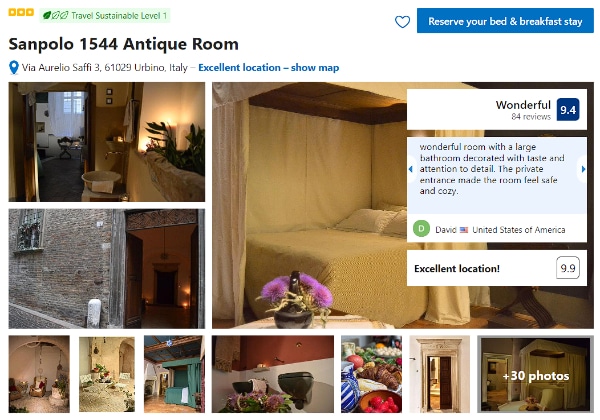
Sanpolo 1544 offers boutique-style apartments in a 16th-century building, just 100 meters from the Ducal Palace. Each double room includes elegant furniture, an electric kettle, a coffee maker, and a private bathroom. Guests enjoy a buffet breakfast, and the coast can be reached by public transport in 40 minutes.
Advice about Travel to Urbino
Urbino is a city that has preserved the appearance and atmosphere of the Renaissance era. Its distinctive architecture, seamlessly integrated with the rolling hills of the Marche region, offers a stunning backdrop of cobblestone streets, terracotta rooftops, and majestic palaces. A rich tapestry of artistic styles and the legacy of great masters make Urbino a must-see destination. Your visit here will leave you with unforgettable memories and add one of the most vivid chapters to your Italian journey.